 Brands
Toyota Sequoia — Now Toyota's Flagship US SUV
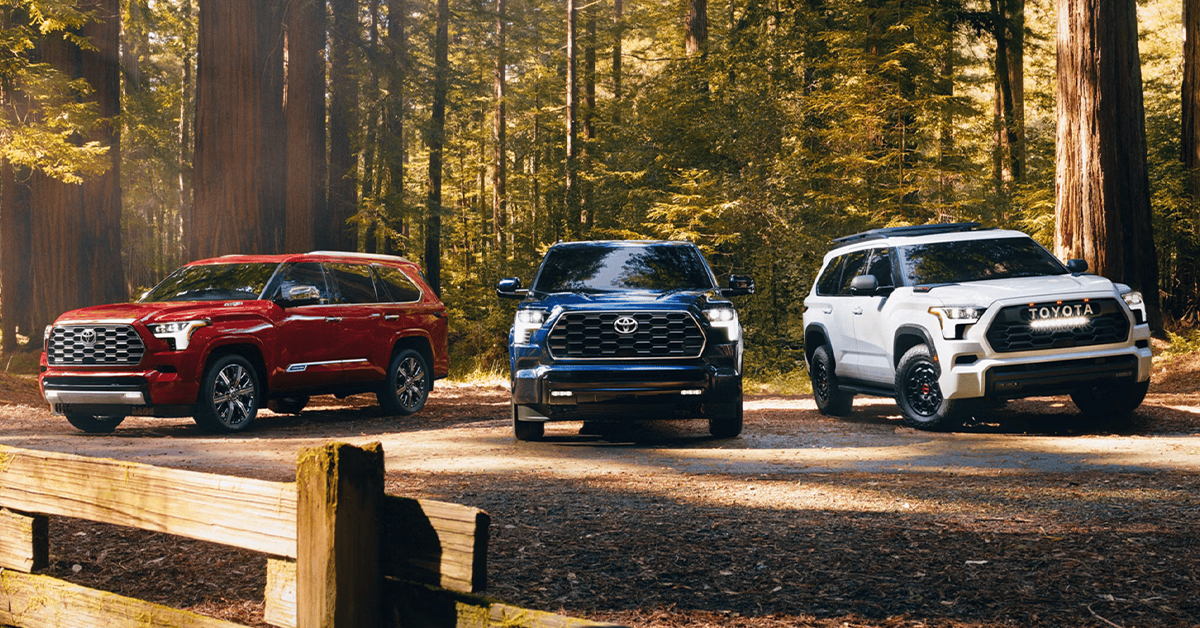
Official press image of the Toyota Sequoia. | © Toyota Motor Corporation
For most of its life, the Toyota Sequoia sat comfortably in the shadow of the company’s genuine flagship SUV, the full-size Land Cruiser — large, capable, but never quite the top of Toyota’s American hierarchy. That changed in 2021, when Toyota discontinued the Land Cruiser in the US market entirely. Without a direct announcement or fanfare, the Sequoia inherited the flagship title by default, and has spent the years since proving it can genuinely carry that responsibility, including surviving one of the more turbulent powertrain transitions in Toyota’s recent history.
The Sequoia name comes from the Giant Sequoia, one of the tallest and most massive tree species native to California — a fitting name for what became, at launch, one of Toyota’s largest SUVs ever built. Unveiled in 2000 as a 2001 model, the first-generation Sequoia was engineered under Toyota Engineering Chief Kaoru Hasegawa specifically to compete head-to-head with the Ford Expedition and Chevrolet Tahoe — two of the most dominant full-size SUVs in America at the time. It shared its underlying Tundra pickup truck platform, exterior panels, dashboard and engine with the first-generation Tundra, though Toyota developed a genuinely new rear suspension system specifically to accommodate the Sequoia’s third row of seating.
This first generation marked a genuine milestone: it was the first full-size SUV Toyota ever built in North America, assembled at Toyota Motor Manufacturing Indiana in Princeton. It launched with just two trims, SR5 and Limited, offered in both rear-wheel and all-wheel drive — a genuinely unusual choice for the segment at the time. Power came exclusively from the Tundra’s 4.7-litre V8, initially producing 240 horsepower, later rising to 282 horsepower by 2005.
The second-generation Sequoia arrived in 2007, growing meaningfully in size and adding a genuinely useful practical upgrade: a third row that now folded completely flat, alongside a considerably larger interior and a more powerful engine option. This generation proved genuinely important to Toyota’s broader business through a difficult period — the Sequoia’s continued strong sales performance helped the company weather the global financial crisis of 2008 to 2010, a period that hit full-size SUV sales across the entire industry hard. Toyota kept this second generation on sale for an unusually long 14 years, with the TRD Pro off-road variant finally arriving at the 2019 Chicago Auto Show for the 2020 model year to keep the ageing platform competitive against newer rivals.
The current, third-generation Sequoia launched for the 2023 model year, built on Toyota’s modern TNGA-F global truck platform — the same architecture underpinning the current Tundra, Land Cruiser and 4Runner. The single biggest change was mechanical: Toyota retired the beloved 5.7-litre V8 entirely, replacing it across the entire lineup with a turbocharged 3.4-litre V6 hybrid i-FORCE MAX powertrain producing 437 horsepower and 583 lb-ft of torque, paired with a 10-speed automatic transmission. The switch delivered genuine towing improvements, up to 9,520 pounds in the right configuration, alongside meaningfully better fuel economy — approximately 21mpg city and 24mpg highway, up considerably from the outgoing V8’s figures.
The transition was not entirely smooth. Early owner reports flagged genuine reliability concerns with the new powertrain’s added complexity, and Toyota issued recalls affecting certain 2023 and 2024 model year Sequoias related to issues with the new 3.4-litre V6. Toyota has continued refining the platform since, and by the 2026 model year the powertrain issues from launch appear to have been substantially addressed through ongoing production updates.
The 2026 Sequoia spans six trims: SR5, Limited, Platinum, 1794 Edition, TRD Pro and Capstone. Pricing starts at approximately $66,920 for the base SR5, rising to approximately $87,330 for the range-topping Capstone. The 1794 Edition — named after the year the King Ranch, Texas, land grant that became Toyota’s San Antonio manufacturing site was originally established — brings genuine Texas-inspired luxury, with real American walnut wood-grain interior trim and massaging front seats. The TRD Pro, standard four-wheel drive only, adds Fox internal bypass shocks, TRD skid plates, 33-inch all-terrain tyres, Multi-Terrain Select, Crawl Control, and a genuinely striking exclusive Wave Maker turquoise-blue exterior colour.
For 2026, Toyota made power-folding third-row seats standard across every trim, added massaging front seats to the Platinum trim, and refreshed the Capstone’s interior with more premium leather-trimmed materials. Every 2026 Sequoia comes standard with the same 437-horsepower i-FORCE MAX hybrid powertrain and Toyota Safety Sense 2.5 — rear-wheel drive is standard on most trims, with four-wheel drive available as an option, except on the TRD Pro, where it comes standard.