 Brands
Toyota Crown — The Sedan That Refused to Look Like One
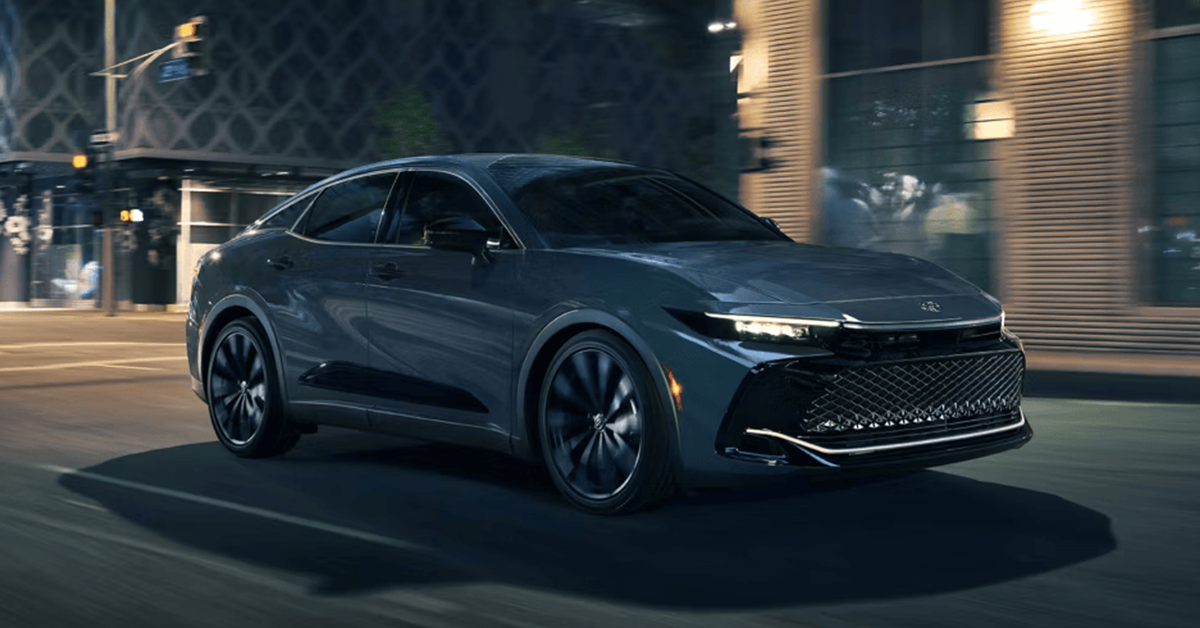
Official press image of the Toyota Crown. | © Toyota Motor Corporation
Toyota has a long, largely successful habit of retiring nameplates when their market has genuinely moved on, and inventing new ones to fill the gap without pretending nothing has changed. The Crown’s return to the American market is the clearest recent example. Rather than build a conventional replacement for the discontinued Avalon, Toyota built something that barely resembles a traditional sedan at all — tall, crossover-influenced, unapologetically distinctive, and standard hybrid every single time. It is a genuinely strange-looking car by segment standards. It is also, by most honest accounts, a genuinely good one.
The Crown nameplate itself is far from new — Toyota has sold Crown sedans in Japan and other international markets continuously since the 1950s, making it one of the longest-running nameplates in the company’s entire history. What makes the current generation notable is its return to the United States after a long absence, arriving specifically to occupy the space left behind when Toyota discontinued the Avalon after the 2022 model year. Rather than simply relabel a conventional Avalon successor, Toyota imported the Crown name and built something deliberately different: a tall, fastback-roofed sedan with a genuinely elevated seating position, crossover-inspired proportions, and standard all-wheel drive across every single trim — a specification list that reads more like an SUV brief than a traditional sedan one.
The Crown’s exterior is built around a genuinely tall profile, a high beltline and a distinctive fastback-style roofline — a combination that has drawn as much criticism as praise since launch, and Toyota appears entirely comfortable with that split reaction. Bold character lines run the length of the body, and a full-width rear light signature reinforces the car’s premium intent alongside standard LED lighting throughout. The base XLE and Limited trims ride on 19-inch wheels, while the Nightshade and Platinum step up to 21-inch alloys. The Nightshade trim leans into darkened exterior accents for a more aggressive look, while the Platinum instead emphasises a genuinely upscale visual treatment — interior copper trim across the dashboard and Bronze Age paint among its more distinctive touches.
The trade-off for that elevated, crossover-like stance is real: the Crown’s sloping roofline and taller seating position genuinely cut into rear-seat headroom and trunk volume compared to boxier, more traditionally proportioned rivals, and passengers of above-average height have noted a tighter fit in the back seat than the car’s exterior size suggests. It is a deliberate compromise in service of the car’s distinctive silhouette, and whether that trade is worth it depends entirely on how much a buyer values standing out from every other sedan in a given parking lot.
Every 2026 Toyota Crown sold in the United States comes with a hybrid powertrain and all-wheel drive as standard equipment — there is no non-hybrid option available at any trim level. Buyers choose between two genuinely distinct hybrid systems. The XLE, Limited and Nightshade trims use a 2.5-litre Atkinson-cycle four-cylinder paired with two electric motors, producing a combined 236 horsepower through an electronically controlled continuously variable transmission, delivering an EPA-estimated 41 mpg combined — genuinely strong efficiency for a sedan this size, though the output itself is unremarkable for the segment, and the CVT can sound notably loud and uncouth under hard acceleration.
The Platinum trim swaps to Toyota’s Hybrid Max system exclusively — a turbocharged 2.4-litre four-cylinder paired with two electric motors producing 340 horsepower and 400 lb-ft of torque, routed through a genuine six-speed automatic transmission rather than a CVT. The performance difference is substantial and immediately noticeable; the efficiency cost is real too, with combined fuel economy dropping to approximately 30 mpg. All-wheel drive remains standard regardless of which powertrain is chosen — an on-demand system on the base hybrid trims, and a full-time system paired specifically with the Hybrid Max Platinum.
The 2026 Crown lineup spans four trims: XLE from approximately $41,440, Limited from $45,950, Nightshade from $48,765, and Platinum from $54,990 — figures that climb close to $56,000–$60,000 once destination charges and options are added. Even the base XLE arrives well-equipped by segment standards: heated and ventilated front seats, wireless phone charging, black leather upholstery, heated rear seats, a heated steering wheel, eight-way power-adjustable front seats and the same 12.3-inch touchscreen found on every trim above it.
Expert reviewers consistently identify the Limited as the strongest overall value in the range — the meaningful feature jump over the XLE without paying for the Nightshade’s largely cosmetic upgrades or the Platinum’s considerable price premium. The honest criticism levelled at the lineup is that the Hybrid Max powertrain — genuinely the most compelling reason to consider a Crown over its rivals — is locked exclusively to the Platinum trim, pushing the price of admission for real performance close to $60,000, a figure that puts the Crown in direct competition with genuine entry-luxury sedans like the Lexus ES rather than mainstream competitors like the Camry or Honda Accord.
The Crown Signia is basically a Crown with a hatchback cargo area — and Toyota's twin-Crown strategy is genuinely one of the more interesting product decisions in its current lineup.
Sitting alongside the sedan is the Crown Signia — sharing the Crown name and much of its underlying platform, but positioned as a wagon-like crossover SUV rather than a sedan. Where the standard Crown offers four trims and a choice of two hybrid powertrains, the Crown Signia is considerably simplified: just two trims, XLE and Limited, both using a single 2.5-litre hybrid system producing 240 horsepower with standard all-wheel drive. Pricing for 2026 starts at approximately $44,690 to $45,840 depending on destination charges, rising to around $49,090 for the Limited.
The Crown Signia’s pitch is straightforward: a genuinely premium-feeling hybrid crossover for buyers who want to step outside the conventional SUV mould without committing to a full luxury badge. Its elongated, wagon-like proportions and touring-car stance give it a more distinctive road presence than the typical upright crossover, while still delivering the practicality — up to 68.8 cubic feet of cargo capacity with the second row folded — that buyers expect from the segment. Every 2026 Crown Signia comes with Toyota Safety Sense 3.0 as standard, alongside a 12.3-inch digital instrument cluster, a matching 12.3-inch touchscreen and JBL premium audio across both trims. For 2026, the only meaningful change is that a contrasting black roof is now available with every exterior colour on the Limited trim — otherwise the Signia carries over unchanged into its second model year.