 Brands
Toyota Mirai — The World's Best-Selling Hydrogen Car (147 Units)
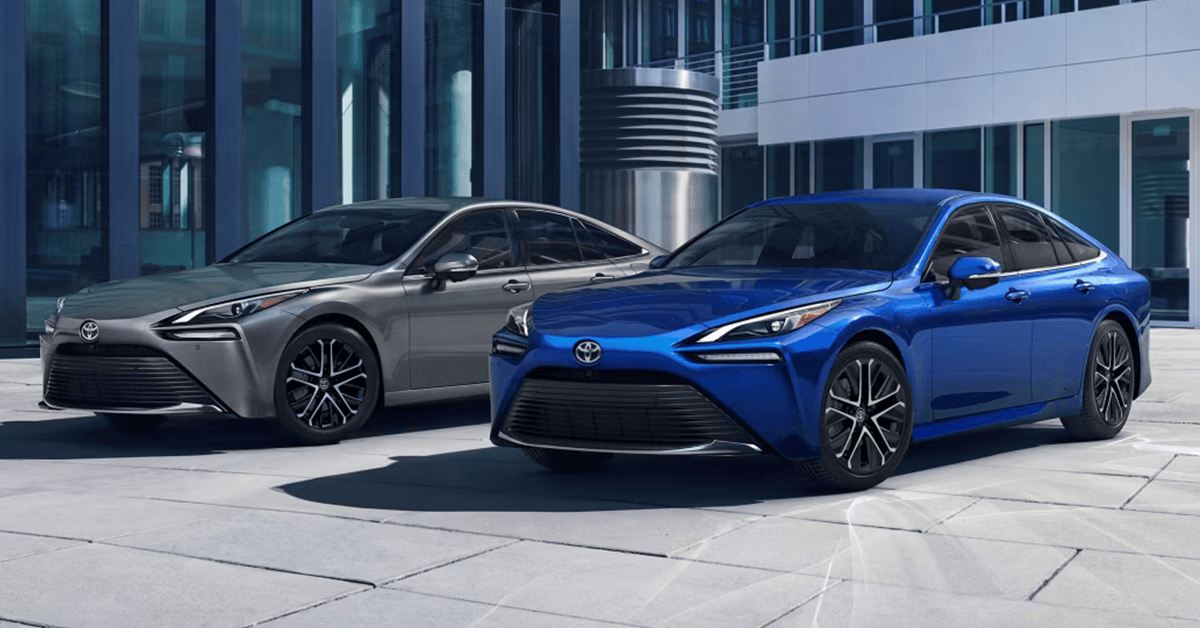
Official press image of the Toyota Mirai. | © Toyota Motor Corporation
Here is a genuinely strange fact about the Toyota Mirai: it is marketed, accurately, as the world’s best-selling hydrogen-powered car. It is also, by any conventional measure, one of the worst-selling vehicles Toyota builds. Both statements are true simultaneously, because the entire category of hydrogen fuel cell passenger cars remains so small that a handful of hundred annual sales is enough to lead the field. Toyota has kept the Mirai alive for over a decade anyway — not because it makes commercial sense today, but because the company is betting, genuinely and expensively, that hydrogen eventually will.
The Mirai launched in 2014, and its name — Japanese for “future” — reflected Toyota’s genuine long-term conviction that hydrogen, not batteries alone, would prove essential to zero-emission transportation. The underlying technology is straightforward to describe and genuinely sophisticated to engineer: hydrogen stored in carbon-fibre-reinforced tanks combines with oxygen drawn from the surrounding air inside a fuel cell stack, producing electricity through a chemical reaction that powers an electric motor — with water vapour as the only tailpipe emission. Functionally, the Mirai behaves like a genuine electric vehicle from the driver’s seat; the difference lies entirely in how the electricity gets made and how the car refuels.
The second generation, launched in 2020, brought a considerably more conventional, less awkward design than the original, moving the Mirai onto the same rear-wheel-drive architecture used by the Lexus LS flagship sedan — a genuine upgrade in both proportions and driving character. This generation is the one still sold today, largely unchanged mechanically, refined incrementally through minor equipment updates rather than fundamental redesigns.
The Mirai’s core advantage over battery-electric vehicles is real and specific: refuelling speed. Where a battery-electric car can require 30 minutes or considerably longer to recharge even on a fast charger, filling the Mirai’s hydrogen tanks takes roughly the same few minutes as filling a conventional petrol car — a genuinely compelling advantage for anyone who has ever waited at a charging station. The current generation’s 182-horsepower electric motor and 221 lb-ft of torque deliver a manufacturer-estimated maximum range of up to 402 miles on a full tank, figures that comfortably match or beat most battery-electric rivals.
The problem is not the car. The problem is that hydrogen refuelling infrastructure in the United States is almost nonexistent outside a single state. Public hydrogen stations number roughly 20 functioning locations nationwide, clustered entirely in Southern and Northern California — which is precisely why Toyota sells the Mirai exclusively in that one state. Owning a Mirai anywhere else in the country would mean owning a car you genuinely cannot refuel.
Toyota’s own sales figures make the Mirai’s commercial reality difficult to dress up. Through the third quarter of 2025, Toyota sold just 147 Mirai units in the entire United States — a 54 percent decline year over year, and a figure smaller than many limited-production performance cars manage in a single quarter. And yet, remarkably, Toyota confirmed the Mirai would continue for the 2026 model year rather than being quietly discontinued, a decision that speaks directly to how seriously the company still takes hydrogen as a long-term technology bet, even as near-term demand remains genuinely minuscule. Toyota is, notably, one of only three automakers still committed to hydrogen passenger vehicles at all, alongside Hyundai and Honda’s more limited efforts.
The 2026 Mirai remains a genuinely simple proposition: a single XLE trim, priced from approximately $51,795 to $52,990 including destination charge, with paint colour as the only real choice on the order sheet. The sole update for 2026 is cosmetic — standard 19-inch wheels now come in a two-tone black machine-finished design. Standard equipment remains genuinely generous for a low-volume model: Toyota Safety Sense 3.0, blind-spot monitoring, a 360-degree camera system, and a premium 14-JBL-speaker audio system paired with a 12.3-inch touchscreen.
To make the Mirai’s genuinely unusual ownership proposition workable, Toyota bundles in extraordinary incentives most car buyers never see elsewhere: $15,000 or six years of complimentary hydrogen fuel for purchasers (whichever comes first), $15,000 or three years for lessees, and 21 days of free car rental spread across the first three years of ownership — a genuine acknowledgement that Mirai owners will occasionally need a different car entirely for any trip outside California’s limited hydrogen network.
What makes the Mirai’s story genuinely unusual is that Toyota has not tried especially hard to dress up its commercial performance. Hiroki Nakajima, Toyota’s technical chief, has publicly acknowledged the car “has not been successful” — a remarkably candid admission from a senior executive about one of the company’s own products. Since its 2014 launch, Toyota has sold approximately 28,000 Mirai units globally across more than 30 countries — a figure that sounds respectable in isolation, until set against the roughly 10.5 million vehicles Toyota sells worldwide in a single year. In the US specifically, the 147 units sold through Q3 2025 represented roughly 0.0008 percent of Toyota’s total American sales volume over that period — a genuinely negligible share by any measure.
So why does Toyota keep building it? The honest answer appears to be optics and long-term positioning rather than near-term profit. In 2024, Toyota renamed its California research and development facility the Hydrogen Headquarters (H2HQ), a deliberate signal of institutional commitment. Earlier in 2025, the company reaffirmed its ambition toward what it calls a “hydrogen society,” and unveiled a genuinely upgraded third-generation fuel cell stack — claimed to be 1.2 times more fuel-efficient than the outgoing unit, delivering a 20 percent improvement in range between refuelling stops, with durability Toyota compares directly to a diesel engine’s. Toyota plans to introduce that new stack in both passenger vehicles and heavy-duty commercial trucks across North America, Europe, China and Japan.
The clearest explanation for why Toyota keeps the Mirai alive despite its tiny sales volume is that the passenger car was never really the end goal — it was the proving ground. Since 2017, Toyota has run Project Portal, a heavy-duty hydrogen trucking programme built directly on Mirai fuel cell technology. The original Project Portal truck, developed for port drayage operations at the Port of Los Angeles, used two Mirai fuel cell stacks paired with a 12kWh battery to generate over 670 horsepower and 1,325 lb-ft of torque — genuine Class 8 semi-truck output, built from the exact same fuel cell hardware sold in the passenger sedan. A second-generation Portal truck followed, larger and lighter, extending range from 200 to 300 miles by adding four extra hydrogen tanks, and has since logged over 10,000 real-world miles shipping cargo between the ports of Long Beach and Los Angeles.
Toyota has continued expanding this commercial hydrogen strategy well beyond a single proof-of-concept truck. The company partnered with PACCAR in 2023 to develop zero-emission hydrogen fuel cell trucks at genuine production scale, and confirmed plans to deploy Toyota fuel cell-powered Class 8 trucks in its own commercial logistics fleets by early 2027. A definitive supply agreement with Air Liquide will fuel that growing fleet at Toyota’s North American Parts Center in California, with a permanent hydrogen station planned to eventually serve every fuel-cell vehicle on-site — from heavy trucks down to the Mirai itself. Toyota’s stated logic for trucking specifically is genuinely compelling on paper: fuel-cell trucks can match diesel payload capacity while refuelling in 15 to 20 minutes, versus roughly 90 minutes for the fastest available battery-electric truck chargers — a meaningful uptime advantage for commercial fleet operators where every idle hour costs money.
Viewed through that lens, the Mirai’s continued existence makes considerably more sense. It is less a standalone commercial product Toyota expects to sell in volume, and more a public-facing showcase and ongoing real-world test bed for fuel cell technology the company genuinely believes will matter far more in heavy trucking, buses, trains and stationary power generation than it ever will in passenger cars. Toyota’s own hydrogen timeline traces back to 1992, when the company built its first fuel cell vehicle prototype, through a 2008 milestone where an earlier FCHV-ADV prototype completed over a million testing miles, culminating in the Mirai’s 2014 debut as the world’s first mass-produced fuel cell electric vehicle. Whether hydrogen ultimately wins a meaningful share of the broader zero-emission transport market remains genuinely uncertain — but Toyota, alongside a small handful of holdouts including Hyundai and Honda, continues betting real engineering resources that it eventually will.