 Brands
Volkswagen Atlas — History, Cross Sport and 2027 Specs

Official press image of the 2027 Volkswagen Atlas. | © Volkswagen AG
The Volkswagen Atlas is the largest SUV Volkswagen builds for America, a seven-seat family vehicle made in Chattanooga, Tennessee. Here is the full Atlas story, from the 2016 premiere and the Cross Sport to the all-new 2027 generation, with the engines, trims, prices and plant figures Volkswagen and the trade press have published.

Official press image of the Volkswagen Atlas. | © Volkswagen AG
The Volkswagen Atlas is the largest SUV Volkswagen has built for the American market, a seven-seat family vehicle assembled in Chattanooga, Tennessee. Volkswagen’s own newsroom lists it with a US launch in 2017 and describes it as the largest model on the modular transverse toolkit, known as MQB, to date. Volkswagen of America later described it as the first modern Volkswagen designed, engineered and produced specifically for American buyers. This guide follows the Atlas from its world premiere to the all-new second generation of 2027.
| World premiere | 28 October 2016, Santa Monica Pier (Volkswagen) |
| Built in | Chattanooga, Tennessee (Volkswagen) |
| US launch | 2017 (Volkswagen) |
| Platform | MQB, largest MQB model at launch (Volkswagen) |
| Cross Sport concept | 28 March 2018, New York (Volkswagen) |
| Cross Sport production unveil | 15 October 2019, Chattanooga (Volkswagen) |
| First big update | Chicago Auto Show, 10 February 2023 (Volkswagen) |
| Second generation shown | Eve of the 2026 New York show (Volkswagen) |
| Second generation platform | MQB Evo (Volkswagen) |
| Teramont, Middle East launch | September 2018 (Volkswagen) |
The world premiere took place on 28 October 2016. Volkswagen’s release was titled “World premiere of the Volkswagen Atlas – all-new seven-seater SUV for America”, and it said the car was shown on Santa Monica Pier in California, at the end of Route 66. The same release stated that the Atlas is built in Chattanooga, Tennessee. Sales began in 2017, and some US sources refer to the first model year as 2018 (reported), which is why you will see both years used for the original car.
The Atlas arrived at a time when Volkswagen had no large SUV left in the United States. A trade report noted that when the Touareg left the American market, Volkswagen replaced it with the first-generation Atlas (reported). The Touareg story is told in our Touareg guide.
The family grew quickly. In March 2018 Volkswagen showed two concept cars at the New York International Auto Show: the five-seat Atlas Cross Sport and the Atlas Tanoak pickup. Volkswagen said the pair showed the potential of a possible family of Atlas vehicles. The Cross Sport went into production and was unveiled in Chattanooga on 15 October 2019 (Volkswagen), while the Tanoak stayed a concept. Volkswagen’s newsroom still lists both studies on the Atlas page.
The first big change to the original car came for the 2024 model year. Volkswagen announced the updated Atlas and Atlas Cross Sport at the Chicago Auto Show on 10 February 2023, with a new front end, a new interior and one engine, a 2.0-litre turbocharged four-cylinder, replacing both the earlier four-cylinder and the VR6. That update is covered in detail further down this guide, together with the trims and the technology that came with it.
The second generation was unveiled on the eve of the 2026 New York International Auto Show. Volkswagen of America said the all-new 2027 Atlas sits on the upgraded MQB Evo architecture, keeps the generous third row and uses a new EA888 evo5 engine of 282 horsepower. Official pricing followed in July 2026 and the car was due at dealers in the autumn. The sections below cover each step, from the 2017 launch to the 2027 prices, and link to the other SUV guides in this series, such as the Tiguan and the full Volkswagen models list. The newsroom Atlas page also links a video and an image album, and it lists the Teramont release of 5 September 2018 beside the premiere release, so the American model and its Middle East counterpart were handled as one family from the start. Volkswagen’s plant fact sheet confirms that the Atlas and the Atlas Cross Sport are the models assembled in Chattanooga today.
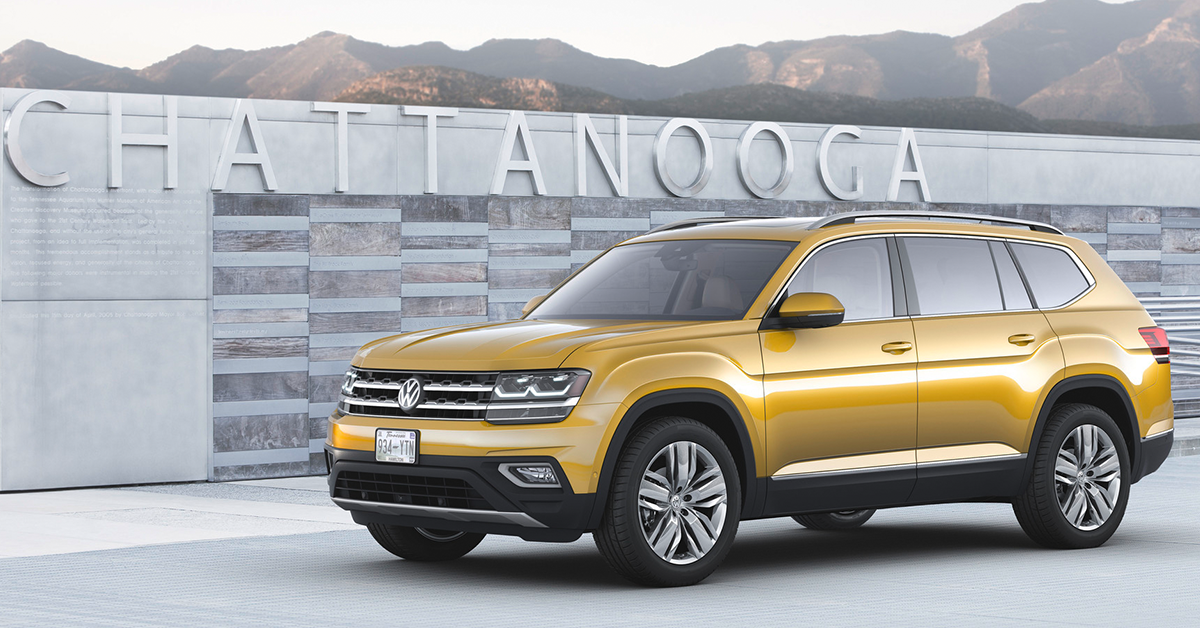
Official press image of the Volkswagen Atlas (USA). | © Volkswagen AG
The first-generation Atlas was big by Volkswagen standards. The newsroom specification page gives the car as 5,037 mm long, 1,979 mm wide and 1,768 mm high, which works out to about 198 inches in length. It is a seven-seat SUV that Volkswagen places in the mid-size segment in the United States. The same page names the platform as the modular transverse toolkit and calls it the largest MQB model to date, which was the point of the project: to prove that the toolkit could carry a three-row vehicle.
| Length | 5,037 mm (Volkswagen) |
| Width | 1,979 mm (Volkswagen) |
| Height | 1,768 mm (Volkswagen) |
| Seats | Seven (Volkswagen) |
| Petrol four-cylinder | 175 kW / 238 PS (Volkswagen) |
| VR6 | 206 kW / 280 PS (Volkswagen) |
| 4Motion | Optional with the VR6 (Volkswagen) |
| Gearbox | Eight-speed automatic (Volkswagen) |
| Standard equipment | LED headlights, App-Connect (Volkswagen) |
| Deliveries by October 2019 | 175,000 since the start of 2017 (Volkswagen) |
At launch the Atlas had two engines. The first was a four-cylinder turbocharged petrol engine rated at 175 kW or 238 PS. The second was the VR6, rated at 206 kW or 280 PS. Volkswagen’s page states that four-wheel drive, which the company calls 4Motion, was optional with the VR6. An eight-speed automatic gearbox, LED headlights and the App-Connect smartphone interface were listed as standard equipment, which was a generous list for the segment at the time.
The specification is given in metric units because the newsroom page comes from Volkswagen in Wolfsburg. 238 PS is about 235 hp and 280 PS is about 276 hp, so American sources that quote horsepower describe the same two engines. We keep the Volkswagen figures in kW and PS here and note that a unit conversion, not a different tune, explains the gap.
The Atlas was also sold outside America under another name. Volkswagen’s release of 5 September 2018 announced the Teramont as a new seven-seater for the Middle East and called it the American counterpart of the Atlas. The same release said the Atlas had drawn interest in China since 2017 and that the Teramont would not go on sale in Germany. In other words, the model was designed for America, but it found customers in other regions where large SUVs are popular.
Volkswagen also used the Atlas as a symbol for its American plant. The Chattanooga factory had been building the Passat since it opened, and the Atlas gave it a new product to build with a different customer. A trade report from 2019 said that Volkswagen had by then built more than 100,000 Atlas SUVs and 700,000 Passats in Chattanooga (reported). A Volkswagen release from October 2019 said 175,000 Atlas SUVs had been delivered to customers since the start of 2017.
One caution on numbers: delivery and production figures are not the same thing, and the two dates above are different. The 100,000 figure is a production count from early 2019 as quoted by local media, while the 175,000 figure is a delivery count from Volkswagen in October 2019. Treat them as two points on one growth curve rather than as a conflict. The newsroom page for the first car lists the United States as the launch market and the Middle East as the market for the Teramont, and it gives no unit sales, so every sales figure in this section comes from a separate release or from reports. If you compare the Atlas with the smaller Tiguan, remember that the Atlas was a US-first design, while the Tiguan is a global model.

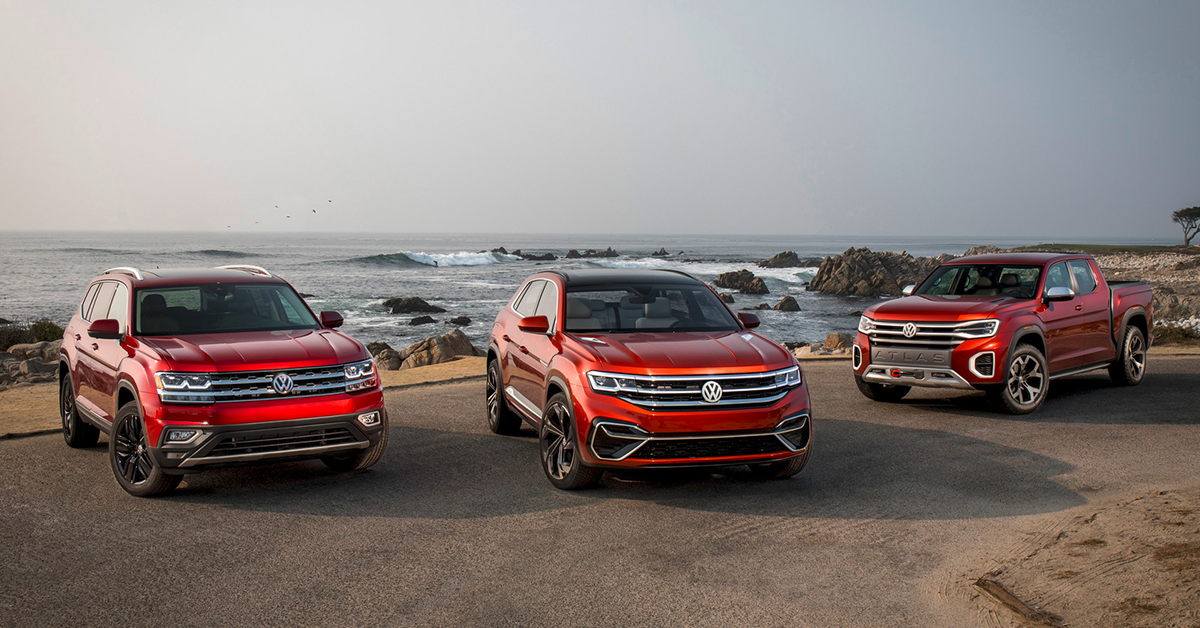
Official press image of the Volkswagen Atlas Cross Sport. | © Volkswagen AG
The Atlas Cross Sport is the five-seat, coupe-style version of the Atlas. It began as a concept car shown at the New York International Auto Show on 28 March 2018 together with the Atlas Tanoak pickup. Volkswagen’s newsroom describes the Cross Sport Concept as a near-production SUV study with a coupe-style rear end and a plug-in hybrid drivetrain, and it adds that the production car would be built at the US plant in Chattanooga. The press release for the show also said the Cross Sport is not for sale in Europe.
| Concept premiere | 28 March 2018, New York (Volkswagen) |
| Monterey showing | August 2018 (Volkswagen) |
| Production unveil | 15 October 2019, Chattanooga (Volkswagen) |
| Seats | Five (Volkswagen) |
| Concept plug-in hybrid | 265 kW / 360 PS, up to 26 miles EPA (Volkswagen) |
| Concept hybrid | 231 kW / 314 PS (Volkswagen) |
| Extra plant investment | US$340 million (Volkswagen) |
| Versus Atlas, first generation | 2.8 in shorter, 2.3 in lower (reported) |
| Second generation reveal | 10 August 2026 (reported) |
| Second generation launch | Early 2027 (reported) |
The concept carried two hybrid options. The plug-in hybrid had a system output of 265 kW or 360 PS and up to 26 miles of electric range on the EPA cycle, according to Volkswagen. The second version was a hybrid without external charging, with a system output of 231 kW or 314 PS. Neither concept powertrain reached the production car in the first generation, which launched with petrol engines only. Volkswagen has said a hybrid will return to the Atlas range with the mid-cycle refresh of the second generation.
Volkswagen showed the concept again at Monterey Car Week in August 2018. The release of 22 August 2018 called the Cross Sport the series-production version of the five-seat Atlas Hybrid concept and said it was intended for the United States as early as 2019. The same release called the Tanoak the first pickup based on the modular transverse matrix. Volkswagen did not confirm the Tanoak for production at that time, and it never reached the market.
The production car was unveiled at the Chattanooga plant on 15 October 2019, according to the newsroom release, although a US reprint of the Volkswagen of America text is dated 11 October 2019. We use the newsroom date in this guide and flag the difference for readers who check. Scott Keogh, then CEO of Volkswagen Group of America, was quoted as saying the Cross Sport combines elegance and sportiness with the proven properties of the Atlas. The car was offered with 4Motion all-wheel drive.
On size, trade reports said the Cross Sport is 2.8 inches shorter and 2.3 inches lower than the Atlas and shares its wheelbase (reported). The Cross Sport is built alongside the Atlas and the Passat in Chattanooga, and Volkswagen said it was the result of an additional investment of US$340 million in the plant. Volkswagen described it as the third SUV derivative for the North American market, and the release said the model was aimed at North America, Russia and the Middle East.
The second-generation Cross Sport was revealed on 10 August 2026 (reported), with a launch planned for early 2027. A trade report said it is 5.4 inches shorter and 2.1 inches lower than the seven-seat Atlas, has five seats, uses the same 282-hp engine and shares the MQB Evo architecture with the Golf and the new Tiguan (reported). Pricing had not been published when we checked, so no figure is given here. For a smaller American-built-style crossover, see our Taos guide.

Official press image of the Volkswagen Atlas. | © Volkswagen AG
The Atlas has used a short list of engines, and each change was a step in a clear direction: fewer engine types, more output per litre. At launch the choice was a turbocharged four-cylinder and a VR6, and the newsroom page lists them at 175 kW or 238 PS and 206 kW or 280 PS. Every engine was paired with an eight-speed automatic gearbox, and four-wheel drive was optional with the VR6 at launch. Front-wheel drive was the standard layout for the car.
| Launch engines | 2.0 four-cylinder turbo and VR6 (Volkswagen) |
| VR6 output | 206 kW / 280 PS (Volkswagen) |
| 2024 engine | 2.0 TSI, 269 hp, 273 lb-ft (Volkswagen) |
| 2024 change | Replaced four-cylinder and VR6 (Volkswagen) |
| 2027 engine | EA888 evo5 2.0 TSI, 282 hp, 258 lb-ft (Volkswagen) |
| Gearbox | Eight-speed automatic (Volkswagen) |
| Drive | Front-wheel drive, 4Motion available (Volkswagen) |
| Towing | 5,000 lb, unchanged (Volkswagen) |
| EPA, 2027 FWD | 22 / 29 / 25 mpg city / highway / combined (Volkswagen) |
| Hybrid | Planned for mid-cycle refresh, no date (Volkswagen) |
For the 2024 model year Volkswagen simplified the range. The release of 10 February 2023 states that a new 2.0-litre turbocharged, direct-injection TSI four-cylinder replaced the previous four-cylinder and the VR6. It produces 269 hp and 273 lb-ft of torque, and Volkswagen said the torque arrives over a broader rev range, which should improve drivability and acceleration. The company expected fuel economy to improve but gave no figures at the time. Towing stayed at 5,000 lb, and 4Motion became available across the whole lineup.
That move ended the VR6 in the Atlas. The VR6 had been the engine that came with optional four-wheel drive at launch, and the 2024 release made 4Motion available across the whole lineup instead. Volkswagen’s own text does not give a reason for dropping the VR6; it only says the new engine replaced it, so we do not guess one.
The 2027 Atlas takes the next step. Volkswagen of America says it is fitted with the new EA888 evo5 turbocharged, direct-injection 2.0-litre four-cylinder TSI, producing 282 horsepower and 258 lb-ft of torque. That is 13 hp more than the 2026 engine and 15 lb-ft less (reported by several trade outlets). One outlet printed 253 lb-ft for the same engine and another quoted 273 lb-ft in a first-drive report, so we use the 258 lb-ft that Volkswagen of America published and flag the difference.
Fuel economy is where the new engine helps. Volkswagen of America published EPA estimates of 22 mpg city, 29 highway and 25 combined for front-wheel-drive models, and trade reports quote 20, 27 and 23 mpg for the all-wheel-drive versions (reported). Volkswagen said that was an improvement of up to two mpg over the 2026 model. A consumer testing report measured 20 mpg overall in its own Atlas test, so real use will vary with load, speed and driving style, and the EPA figure is a label number.
Towing remains 5,000 lb for models with the factory-installed trailer hitch, according to reports of the Volkswagen release, and the company points out that passengers, cargo and accessories reduce the available capacity. A hybrid is the missing piece: Volkswagen has said a hybrid variant is planned for the mid-cycle refresh, without giving a date. Until then the 2027 Atlas has one engine, one gearbox and a choice between front-wheel drive and 4Motion. Compare that with the engine range of the T-Roc, which has several. In short, the car began with two engines and 238 PS in the entry version, moved to one engine of 269 hp in 2024 and now has one engine of 282 hp, so the number of choices fell while output rose by roughly 47 hp.
Official press image of the Volkswagen Atlas. | © Volkswagen AG
Volkswagen revealed the updated Atlas and Atlas Cross Sport at the Chicago Auto Show, and the release is dated 10 February 2023 from Herndon, Virginia. The 2024 Atlas kept the body of the original car but changed the face and the cabin, and it moved to a single 2.0-litre engine. Pablo Di Si, then president and CEO of Volkswagen of America, was quoted as saying that the Atlas was the first modern Volkswagen designed, engineered and produced specifically for American buyers.
| Revealed | Chicago Auto Show, 10 February 2023 (Volkswagen) |
| Grille | Wide chrome four-bar grille (Volkswagen) |
| Headlights | LED, Adaptive Front-lighting System standard (Volkswagen) |
| Wheels | 18 to 20 inches, 21-inch on R-Line (Volkswagen) |
| Infotainment | 12-inch floating display (Volkswagen) |
| Instrument cluster | 10.25-inch Digital Cockpit Pro (Volkswagen) |
| Ambient lighting | 30 colours (Volkswagen) |
| USB-C ports | Six standard, eight available (Volkswagen) |
| Driver assistance | IQ.DRIVE standard (Volkswagen) |
| Quote | Pablo Di Si, Volkswagen of America (Volkswagen) |
The front end was new. Volkswagen’s release lists a wide chrome four-bar grille, LED headlights and a new fascia with integrated air intakes, plus the Adaptive Front-lighting System as standard. Most trims have daytime running lights that wrap around the headlights and connect to an illuminated light bar above an illuminated VW logo. The Cross Sport added gloss-black grille details and a gloss-black X element across the lower fascia, and both models got a larger rear spoiler.
At the rear, most trims have an illuminated light bar and VW logo between the LED taillights, and the Cross Sport gets a more aggressive rear diffuser than before. R-Line trims add a gloss-black grille, 21-inch aluminium-alloy wheels and R-Line badging. All trims received new wheel designs between 18 and 20 inches, with machined-alloy and black finishes available.
Inside, the dash and centre console were covered in soft-touch materials with leatherette trim, and the door trim flows into the dash. Ambient lighting offers 30 colours and is paired with backlit dash décor that shows the model name. Top trims have quilted, diamond-pattern leather seats, and leather seating and heated rear seats became available one trim level lower than before. The centre console has a new storage cubby underneath.
The technology list was long. A 12-inch floating infotainment display is standard, and every trim has a 10.25-inch, fully configurable Digital Cockpit Pro. Wireless App-Connect and wireless charging are standard. Six USB-C ports are standard, with eight available, and they offer 45-watt fast charging. Standard comfort features include a heated steering wheel with shift paddles, ventilated front seats, a height-adjustable passenger seat, three-zone Climatronic automatic climate control and Voice Control.
On safety, IQ.DRIVE became standard, including hands-on semi-automatic capability. Volkswagen lists lane centring and a capacitive steering wheel as highway features, and obstacle alerts ahead and surround monitoring as urban features. A head-up display and predictive Adaptive Cruise Control are available. Details, specifications and pricing were to follow before an early third-quarter launch in 2023. The update gave the Atlas a longer life, and it set the baseline that the 2027 generation had to improve; the same sort of mid-life change is told in our Taos guide for the compact SUV. Compared with the launch car, the interior is the biggest part of this story: the 2024 Atlas added a floating screen, a configurable cluster on every trim and a long list of USB-C ports, and Volkswagen made leather and heated rear seats available lower in the range. The exterior changes are mostly light signatures and new wheels, and the body stayed recognisably the same, which is why the update counts as a mid-life change rather than a new generation.

Official press image of the 2027 Volkswagen Atlas. | © Volkswagen AG
Volkswagen of America announced official pricing for the 2027 Atlas in July 2026. The release says pricing starts with the SE trim at US$41,610 MSRP for front-wheel drive and US$43,610 for 4Motion all-wheel drive, with a destination charge of US$1,525 on all models. Adding the destination charge gives US$43,135 for the base car, a figure quoted by many outlets. The release describes the second-generation Atlas as a seven-seat mid-size SUV that builds on the success of the original with a bolder design, smarter tech and premium features.
| Pricing announced | July 2026 (Volkswagen) |
| SE front-wheel drive | US$41,610 MSRP (Volkswagen) |
| SE 4Motion | US$43,610 MSRP (Volkswagen) |
| Destination | US$1,525 (Volkswagen) |
| Base with destination | US$43,135 (Volkswagen) |
| Trims | SE, SE Technology, SEL R-Line, SEL Premium R-Line (reported) |
| Top trim, with destination | US$58,135 (reported) |
| Airbags | Seven, with new front centre airbag (Volkswagen) |
| Standard driver display | 10.25-inch Digital Cockpit Pro (Volkswagen) |
| On sale | Autumn 2026 (Volkswagen) |
The ladder has four trims and six configurations according to trade reports of the release (reported). The SE comes first, followed by the SE with Technology, then the SEL R-Line, and the SEL Premium R-Line at the top. Prices including destination, as reported, are US$43,135 for the SE front-wheel drive, US$45,135 for the SE 4Motion, US$47,135 for the SE with Technology front-wheel drive and US$49,135 for the same trim with all-wheel drive. The SEL R-Line is all-wheel drive only, at US$53,635 with destination (reported).
At the top, the SEL Premium R-Line 4Motion starts at US$58,135 with destination (reported). That is a long way above the base car, and Volkswagen justifies the gap with equipment. The release says the SEL R-Line adds Varenna leather seating surfaces, a head-up display, Discover Media navigation, driver-side thigh support, and heated and ventilated second-row outboard seats. Trade reports describe the top two trims as R-Line, with a blacked-out grille and the latest Park Assist Plus and Area View camera (reported).
Volkswagen also changed the standard list. Reports of the launch say that power liftgate, rear sunshades, and front and rear park distance sensors are now standard, while second-row captain’s chairs and a panoramic sunroof remain optional (reported). The release states that the car has an additional front airbag between the driver and front passenger, for a total of seven. A 10.25-inch Digital Cockpit Pro is fitted to all models, and the new Driver Experience Dial, which controls volume, drive modes and the Atmospheres feature, is part of the cabin (reported).
The price rise is the story of the year. One outlet said the 2027 car starts US$2,350 above the equivalent 2026 trims (reported), and the previous base price of US$39,310 plus destination was quoted by another (reported). Volkswagen is betting that buyers will accept a higher price for new sheet metal, a richer cabin and more power. In the segment, the Atlas is up against cars such as the Kia Telluride and the Ford Explorer, which a trade report listed at US$40,260 for the 2026 model (reported).
A few figures differ between sources. Cargo room behind the third row is given as 21.2 cubic feet, with 55.9 behind the second row and 95.4 with both rows folded, in one first-drive report (reported), while a price guide shows a total of 96.6 cubic feet (reported). A first-drive review put an SE with the Technology package and all-wheel drive at US$51,030 with delivery (reported), a figure that includes options, so check the dealer sticker before you buy. For a cheaper Volkswagen SUV, look at the Taos.

Official press image of the Volkswagen plant in Chattanooga. | © Volkswagen AG
Every Atlas is built at the Volkswagen Group of America plant in Chattanooga, Tennessee, and the newsroom specification page for the car names no other plant. The factory is about 214 kilometres from Nashville, and Volkswagen’s fact sheet shows 353,403 square metres under roof. As of August 2026 the newsroom lists its models as the Atlas and the Atlas Cross Sport, with production of about 150,000 vehicles in 2025 and more than 4,000 employees.
| Plant | Volkswagen Group of America, Chattanooga (Volkswagen) |
| Location | About 214 km southeast of Nashville (Volkswagen) |
| Area under roof | 353,403 square metres (Volkswagen) |
| Models, August 2026 | Atlas and Atlas Cross Sport (Volkswagen) |
| Production, 2025 | About 150,000 (Volkswagen) |
| Employees, August 2026 | More than 4,000 (Volkswagen) |
| Employees, November 2023 | About 5,500 (Volkswagen) |
| Cross Sport investment | US$340 million (Volkswagen) |
| EV assembly plan, January 2019 | US$800 million (reported) |
| Total investment, 2018 | US$2.3 billion (reported) |
The plant had a different mix earlier. A newsroom page dated November 2023 listed the ID.4, the Atlas and the Atlas Cross Sport, with about 5,500 employees and 175,000 vehicles year to date. The ID.4 was the first electric Volkswagen assembled in North America, and the plant also houses the Battery Engineering Lab. The two fact sheets are from different dates, so the headcount and the model list are not a conflict, but they show how the plant has changed. The ID.4 guide tells that story.
Investment came in steps. A trade report said the Chattanooga plant was expanded to build the Atlas (reported). In March 2018 Volkswagen announced a further US$340 million for the Cross Sport, which the release of October 2019 confirmed as the cost of building it alongside the Atlas and the Passat. Local media reported at the time that the Cross Sport brought Volkswagen’s total investment in the site to US$2.3 billion (reported). In January 2019 Volkswagen announced a further US$800 million for electric-vehicle assembly there (reported).
The plant was also the stage for launches. The 2019 Cross Sport premiere was held inside the factory, and a trade report said it was revealed eight years after the first Passat rolled off the line there (reported). The same report said the Atlas and the Cross Sport spring from the MQB architecture and share a single assembly line with the Passat, which was derived from the older PQ platform. That shared line is a sign of how flexible the plant was designed to be.
Volkswagen has described the Atlas as designed, engineered and produced specifically for American buyers, and Chattanooga is where that production happens. Its sibling in the compact class, the Taos, comes from Puebla, Mexico, as our Taos guide explains, so the Atlas and the Cross Sport are the two models in the company’s August 2026 plant listing. The same fact sheet describes the site as a centre for workforce development, community engagement, and research and development, which shows that it does more than assemble cars.
Plans for the 2027 car did not change the site. A trade report said that production would continue in Chattanooga for the second generation (reported), and Volkswagen’s own pricing release says the Volkswagen Group of America assembly facility in Chattanooga produces the Atlas and the Atlas Cross Sport. We found no official statement on a new investment for the 2027 model or for the planned hybrid, so we make no claim about one. If Volkswagen announces investment figures for the hybrid, we will update this section.
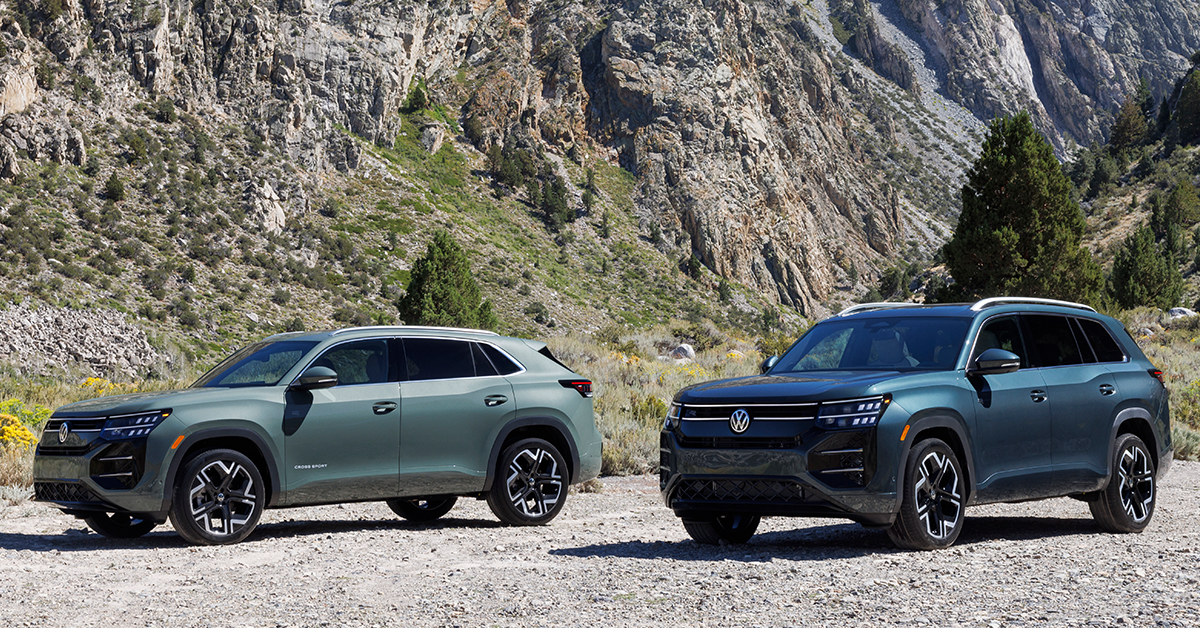
Official press image of the 2027 Volkswagen Atlas. | © Volkswagen AG
The Atlas has become one of Volkswagen’s most important vehicles in the United States. A trade report said it has been the brand’s second-best-selling model for the past three years and that the Atlas and the Cross Sport together made up about 30 percent of Volkswagen of America sales in 2025 (reported). Volkswagen’s plant sheet gives production of about 150,000 vehicles for 2025, which fits that picture, since the plant builds only these two models.
| Second generation revealed | Eve of the 2026 New York show (Volkswagen) |
| Platform | MQB Evo (Volkswagen) |
| Length change | About one inch longer (Volkswagen) |
| Wheelbase | 117.3 in, unchanged (reported) |
| Engine | EA888 evo5 2.0 TSI, 282 hp (Volkswagen) |
| Torque | 258 lb-ft (Volkswagen) |
| Towing | 5,000 lb (Volkswagen) |
| Sales share, 2025 | About 30% of Volkswagen of America with Cross Sport (reported) |
| Cross Sport launch | Early 2027 (reported) |
| Hybrid | Planned for mid-cycle refresh (Volkswagen) |
The second generation was unveiled on the eve of the 2026 New York International Auto Show. Volkswagen of America said the car has all-new body panels, sits on the upgraded MQB Evo architecture and is about an inch longer than the outgoing Atlas, while width, wheelbase and height stay the same. Kjell Gruner, president and CEO of Volkswagen of America, said the all-new Atlas brings more of what matters: a stronger design, smarter technology, increased power and a premium feel where it matters most.
Not all outlets agree on the new length. Volkswagen’s own wording is “about an inch” longer, one trade report said 2.5 centimetres, another said 2.5 inches, and a design-news report put the car at 203.1 inches overall with a 117.3-inch wheelbase (reported), while a third estimated 201.7 inches (reported). We use Volkswagen’s wording and the 117.3-inch wheelbase, which several reports repeat, and we leave the exact overall length open until Volkswagen publishes a specification sheet.
Design and technology move up a step. The new Atlas has a larger freestanding screen, reported as 15 inches, beside a 10.25-inch Digital Cockpit Pro, and the gear selector moved to the steering column to make room for larger cup holders (reported). The ambient lighting has ten colours as standard and thirty on top trims (reported). B-pillar air vents help rear passengers, and the Driver Experience Dial, already seen on other new Volkswagen models, controls volume, drive modes and Atmospheres. Volkswagen describes light as the new chrome.
The Atlas is built for families. A trade report said three child seats fit across the second-row bench and that the second-row seats tilt forward with the seats installed, which gives access to the third row. Another report said an adult can sit in all three rows. Volkswagen’s stated aim with MQB Evo was to keep the spacious interior, especially the generous third row. For buyers who want two rows and a sportier shape, the Cross Sport follows in early 2027.
What comes next is the hybrid. Volkswagen said a hybrid variant is planned to arrive with the mid-cycle refresh, and a trade report suggested that could be two to three years away depending on market conditions (reported). The company has not given a date. The first generation ran from 2017 to the 2026 model year, and the second begins with the 2027 model year at dealers in the autumn of 2026. We will revisit this guide when Volkswagen publishes the final specification sheet and any hybrid details. Meanwhile, the ID.4, also built in Chattanooga, shows the electric side of the plant.