 Brands
Volkswagen Passat — 34 Million Sold Since 1973

Official press image of the Volkswagen Passat TDI 4MOTION (142 kW). | © Volkswagen AG
The Volkswagen Passat has been built since 1973, with more than 34 million sold worldwide. Here is the full Passat story, with every generation from the B1 to the ninth, the R36 and plug-in hybrids, the CC and Alltrack, the US story and the current Variant range.

Official press image of the Volkswagen Passat B1 LS of 1973. | © Volkswagen AG
The Volkswagen Passat is the mid-size car that has carried the brand’s family and business customers since 1973. Series production of the first Passat began on 14 May 1973, and it arrived as a new model family with a water-cooled engine and front-wheel drive at a time when Volkswagen was moving on from the air-cooled Beetle. It was launched as a two-door and four-door hatchback saloon, and an estate followed in January 1974. The larger rear lid that reached up to the roof went into series production in January 1975. Early cars had a smaller boot lid, so the first Passats are easy to tell apart from later ones.
| Series production start | 14 May 1973 |
| Designer | Giorgetto Giugiaro |
| Technical basis | Audi 80 B1 (according to Volkswagen history) |
| First body styles | Two- and four-door hatchback saloon, estate from January 1974 |
| Large rear lid | Series production from January 1975 |
| Oldest Passat shown | B1 LS of 1973, VIN 2 |
| Total sold | More than 34 million worldwide |
| Germany 2023 | Passat Variant, 45,494 registrations, top of the mid-size segment |
| Generations | Nine, B1 to B8 plus the ninth generation |
The Passat was designed by Giorgetto Giugiaro, the Italian stylist who also drew the first Golf. Volkswagen’s own history notes that his original EA 272 design was dropped for cost reasons and that the production car was based on the Audi 80 of the time, the B1. That link explains why the Passat has always sat between the Golf and the larger cars in the range. The oldest Passat Volkswagen shows is a B1 LS of 1973 with the chassis number VIN 2, and its Techno Classica exhibits also included a B1 L estate of 1974 in Atlas White with 40 kW (55 PS).
Volkswagen describes the Passat as its top-selling model after the Golf and ahead of the Beetle, with more than 34 million sold worldwide since 1973. The company had passed the 30 million mark in 2019, when it said the 30 millionth car would come from the eighth generation. The Golf guide and the Beetle guide cover the two models that Volkswagen ranks either side of the Passat. In Germany in 2023 the Passat Variant led the mid-size segment with 45,494 new registrations, which shows how strongly the estate still sells to fleets and families.
The Passat has been through nine generations, with the first eight carrying the factory codes B1 to B8. Each generation changed the car’s role a little. The early cars were practical hatchbacks, the B3 of 1988 moved to a notchback and estate with a transverse engine, and the B5 of 1996 pushed the car into the upper mid-size class with six-cylinder and even eight-cylinder engines. The B6 added the CC coupé and the first Passat dual-clutch gearbox, and the B8 added a fully digital cockpit. The newest car, the ninth generation, is an estate with plug-in hybrid power.
Since 2022 Volkswagen has offered the Passat in Europe only as an estate, the Variant, and in the United States the car went out of production in December 2021. That makes the modern Passat a very different business from the car that sold in millions as a saloon. The sections below cover the generations one by one, the sporting and plug-in versions, the variants and discontinued cars, the US story and the current ninth-generation range. The table gives the key dates and figures for the car’s early years and its overall record.
A few dates help separate the early facts. Series production of the B1 began on 14 May 1973, while one history overview says the car was unveiled that month and that deliveries began in July 1973, so the start of sales and the start of production should not be confused. The estate came about eight months after the saloon, and the larger rear lid followed a year later, so a Passat built in 1973 can look noticeably different from one built in 1975. Volkswagen’s Techno Classica display in 2023 used the 1973 B1 LS and the 1974 estate to show those differences side by side.
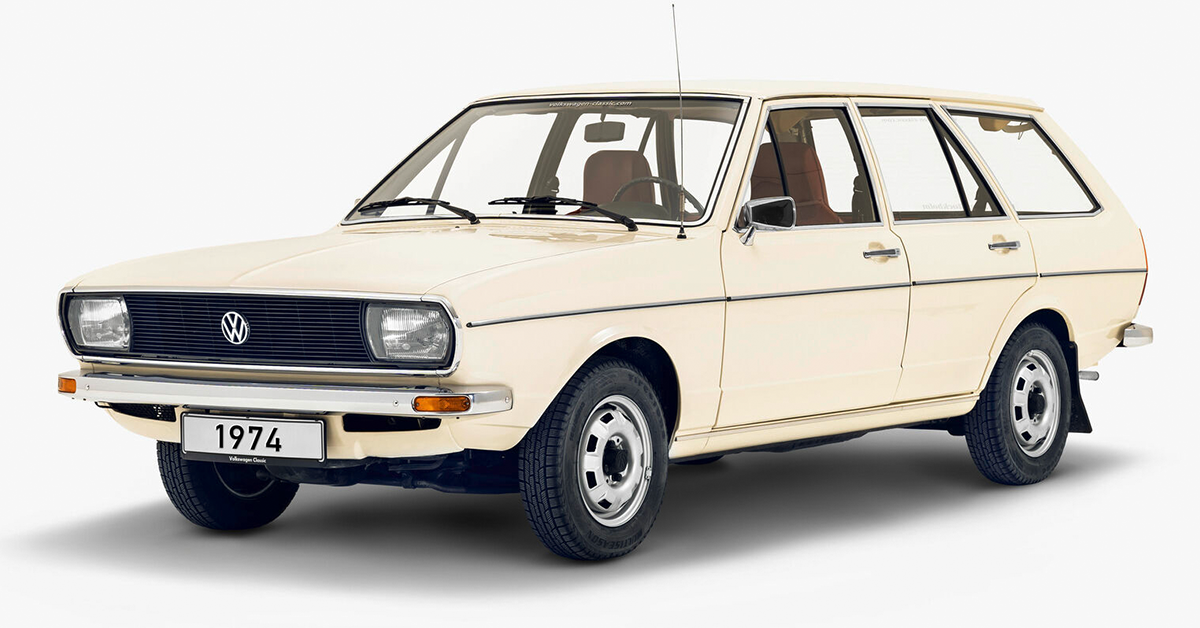
Official press image of the Volkswagen Passat B1 L Estate of 1974. | © Volkswagen AG
The first generation, the B1 or Type 32, ran from 1973 to 1980. It was front-wheel drive with water-cooled four-cylinder engines, and Reported history says it reached the top of the German registration lists a year after launch, and about 2.5 million were built by reported figures. The car was around 4,200 mm long and 1,620 mm wide and weighed about 880 kg. The 1977 update brought new bumpers and materials, a diesel engine was offered, and a hatchback with two doors and a longitudinally mounted engine was also sold. In 1979 the 1.6-litre injection model with 110 PS became the GLI.
| B1 (Type 32) | 1973 to 1980, about 2.5 million, 4,200 mm long |
| B1 GLI (1979) | 1.6-litre injection, 110 PS |
| B2 (Type 32B) | October 1980 to 1988, nearly 5.5 million, 4,435 mm long |
| B2 launch engine | 1.6-litre, 55 kW (75 PS) |
| B2 firsts | All-wheel drive, turbodiesel, five-cylinder petrol, Formula E |
| B3 (Type 35i) | 1988 to 1993, about 1.6 million, notchback and estate only |
| B3 G60 (1989) | 1.8-litre supercharged, 118 kW (160 PS), Syncro |
| Santana | Notchback version of the B2, built in China until 2012 |
The second generation, the B2 or Type 32B, arrived in October 1980 and was markedly larger. It came as a hatchback and a five-door estate, and the notchback version was sold as the Santana. The B2 introduced a series of firsts for the Passat, including all-wheel drive, a turbodiesel and a five-cylinder petrol engine. A 1.6-litre engine of 55 kW (75 PS) was available at launch. The Formula E economy version was an early forerunner of what Volkswagen later called BlueMotion, and it anticipated features such as a start-stop system. A one-off Passat B2 Electronic of 1983 showed four-wheel drive, a turbocharger and advanced electronics.
The B2 was also the most produced Passat generation, with nearly 5.5 million built by reported figures. It was around 4,435 mm long and 1,685 mm wide, and it weighed between 920 and 965 kg. It was built in Emden and in several countries abroad, including Belgium, Spain, Brazil, Mexico, South Africa and Japan. The Santana version was built in China until 2012, and a long-wheelbase Vista version continues there. These numbers explain why many drivers outside Europe know the Passat family under other names, and why the B2 remains the best-selling Passat generation to this day.
The third generation, the B3 or Type 35i, ran from 1988 to 1993 and was a completely new design. It dropped the hatchback and came only as a notchback saloon and an estate, with a transverse engine and gearbox for more interior space and better aerodynamics. The B3 introduced the TDI diesel to the Passat, a turbocharged petrol engine and a compact six-cylinder. It was about 4,575 mm long and 1,705 mm wide and weighed about 1,130 kg, and Volkswagen built about 1.6 million. The sporty GT package was the performance specification, and the G60 became the top model from 1989.
The G60 used a 1.8-litre supercharged engine with 118 kW (160 PS) and Syncro four-wheel drive, which made it a rare fast Passat of the period. Volkswagen showed a Passat B3 estate GT G60 Syncro of 1991 at its classic-car exhibits. The dates for these early generations differ slightly between Volkswagen documents, with some giving the B2 and B3 transitions as 1987 and others as 1988, so this guide gives approximate ranges. Taken together, the first three generations built roughly 9.6 million Passats and established the car as a practical mid-size choice for Europe.
The size figures show how steadily the car grew. The B1 was about 4,200 mm long and weighed about 880 kg, the B2 was about 4,435 mm long and weighed 920 to 965 kg, and the B3 was about 4,575 mm long and weighed about 1,130 kg. The width grew from about 1,620 mm to 1,685 mm and then to 1,705 mm. That is roughly 375 mm more length and about 250 kg more weight in 15 years. The extra size explains why the Passat stopped competing with small hatchbacks and became a proper mid-size family and business car by the end of the 1980s.

Official press image of the Volkswagen Passat B8. | © Volkswagen AG
The fourth generation, the B4 or Type 3A, ran from 1993 to 1997 and was a heavy update of the B3 with a stiffer body, more safety features and more powerful diesels. About 700,000 were built, and it measured roughly 4,595 mm long and 1,720 mm wide and weighed about 1,220 kg. ABS was standard, and the car was also available with the VR6 engine. It is the lowest-volume Passat generation, but it set the stage for the larger step that followed with the B5.
| B4 (Type 3A) | 1993 to 1997, about 700,000, ABS standard, VR6 available |
| B5 (Type 3B) | 1996 to 2000, over 4 million with the GP, W8 offered |
| B5 GP (Type 3BG) | 2000 to 2005, pump-nozzle diesel |
| B6 (Type 3C) | 2005 or 2006 to 2010, about 1.7 million, CC and first DSG |
| B7 | 2010 to 2014, CC became independent, Alltrack added |
| B8 | From July 2014, first fully digital cockpit and head-up display |
| B8 facelift (2019) | Travel Assist 0 to 210 km/h, GTE 160 kW (218 PS), about 55 km WLTP |
| 30 million sold | Passed in spring 2019, a B8 was the 30 millionth |
The fifth generation, the B5 or Type 3B, ran from 1996 to 2000, and a heavily revised B5 GP or Type 3BG continued to 2005. It was a much more upmarket car with a fully galvanised body and four-, five-, six- and eight-cylinder engines, as well as an advanced TDI. The eight-cylinder car was the W8, which paired a W8 engine with all-wheel drive. Reported history describes it as a rarity that enhanced the car’s image but sold poorly. The B5 used longitudinal engines and CAN-bus electronics, and a long-wheelbase version was built in China until 2009.
The B5 was around 4,669 mm long and 1,740 mm wide and weighed 1,345 kg, and the GP version was 4,682 mm by 1,746 mm and 1,356 kg. The GP brought a diesel with pump-nozzle injection. More than 4 million B5 Passats were built by reported figures. It is the generation most associated with the Passat’s move into a more premium position, and its quality reputation helped the car win business buyers who might otherwise have chosen a German executive saloon.
The sixth generation, the B6 or Type 3C, was introduced in 2005 or spring 2006 depending on the source, and ran until 2010. It returned to transverse engines and introduced the CC four-door coupé as well as the first Passat dual-clutch gearbox. BlueMotion versions were offered, and about 1.7 million were built. It was roughly 4,765 mm long and 1,820 mm wide and weighed about 1,343 kg. The seventh generation followed in 2010 and ran to 2014, with the CC becoming an independent model and the Alltrack adding a higher body and optional all-wheel drive. A Chinese new midsize saloon and a US-built Passat also joined the family.
The eighth generation, the B8, made its debut in July 2014 with a premium focus and the latest engine technology. It had less weight and more interior space with nearly unchanged exterior dimensions, and it was the first Passat with a fully digital cockpit and a head-up display. It measured around 4,767 mm long and 1,832 mm wide. In February 2019 Volkswagen announced the facelifted car for the Geneva motor show with Travel Assist, which offered partially automated driving at any speed from 0 to 210 km/h, and a GTE plug-in hybrid with 160 kW (218 PS) of system power and about 55 km of electric range in the WLTP cycle. The saloon and the estate debuted together.
The size growth continued through the later generations. The B4 was about 4,595 mm long, the B5 about 4,669 mm, the B6 about 4,765 mm and the B8 about 4,767 mm, so the car stopped growing in length after the B6. Width rose from about 1,720 mm on the B4 to about 1,820 mm on the B6 and about 1,832 mm on the B8. Weight figures rose from about 1,220 kg on the B4 to about 1,345 kg on the B5. These numbers come from reported history figures and may differ from the specifications in individual market brochures, so use them for comparison rather than as exact data.
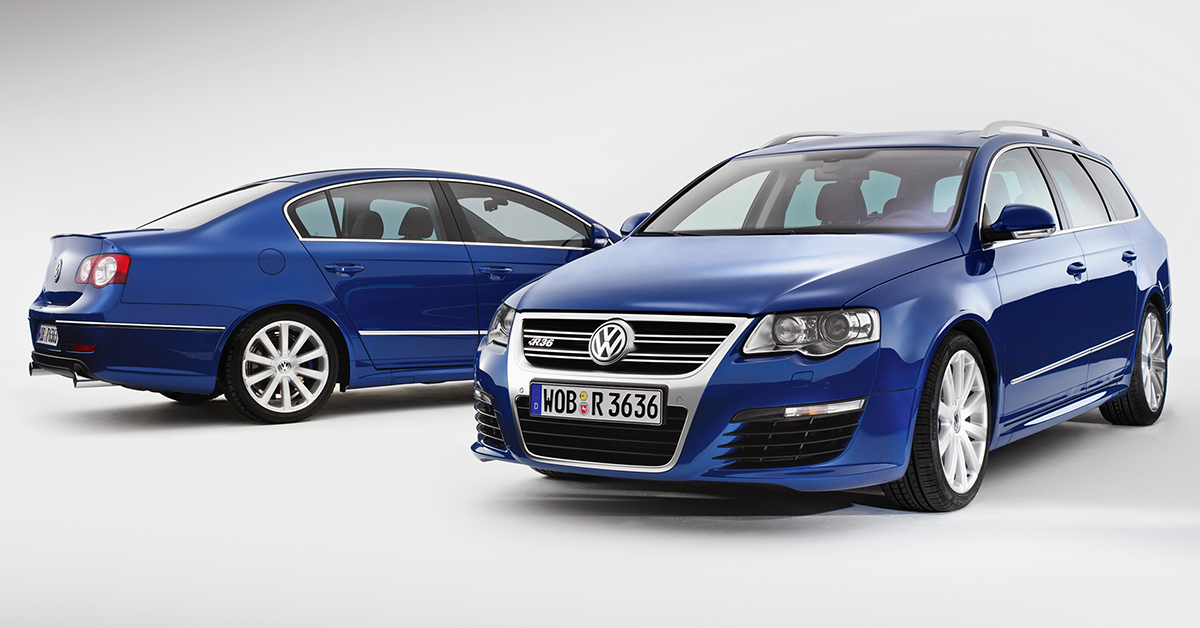
Official press image of the Volkswagen Passat R36. | © Volkswagen AG
The Passat was never a sports car, but Volkswagen has built several fast versions. The first was the GLI of 1979, a 1.6-litre injection car with 110 PS that grew out of a one-off GTI prototype shown in 1977. The B3 G60 of 1989 was the first truly quick Passat, with a supercharged 1.8-litre engine of 118 kW (160 PS) and Syncro four-wheel drive. The sporty GT package gave the B3 a sharper image. These cars are now rare and have a following among Volkswagen enthusiasts.
| GLI (1979) | 1.6-litre injection, 110 PS |
| B3 G60 (1989) | 1.8-litre supercharged, 118 kW (160 PS), Syncro |
| B5 W8 | W8 engine with all-wheel drive, sold poorly |
| R36 (2008) | 3.6 V6, 220 kW (about 300 PS), 5.6 s saloon, 5.8 s Variant, 250 km/h |
| B8 GTE (2019) | 160 kW (218 PS), about 55 km WLTP |
| Ninth eHybrid 150 kW | 204 PS, 350 Nm, from 50,320 euros (Germany, March 2024) |
| Ninth eHybrid 200 kW | 272 PS, 400 Nm, from 62,470 euros (Germany, March 2024) |
| eHybrid battery | 19.7 kWh net, about 100 km WLTP, 11 kW AC, 50 kW DC |
The W8 was the most unusual Passat. Based on the B5, it combined an eight-cylinder W8 engine with all-wheel drive, and Reported history describes it as a rare car that lifted the model’s image but sold poorly. It was a statement about how far the Passat had moved up the market in the 1990s, and it showed that Volkswagen was prepared to put a very complex engine into a mid-size saloon. For collectors it is one of the most interesting Passats because of its rarity and its place in Volkswagen’s history.
The Passat R36 was the sportiest Passat of all. It used a 3.6-litre six-cylinder direct-injection petrol engine with 220 kW, which Volkswagen listed as 300 hp, and came as a saloon and as the Variant estate. It had a standard DSG gearbox and permanent 4MOTION all-wheel drive. Volkswagen gave the saloon a 0 to 100 km/h time of 5.6 seconds and the Variant 5.8 seconds, with an electronically limited top speed of 250 km/h. The Middle East launch took place in Dubai on 6 July 2008.
The Passat GTE brought the plug-in hybrid to the range. In the facelifted B8 of 2019 it had 160 kW (218 PS) of combined system power and about 55 km of electric range in the WLTP cycle, or about 70 km under the older NEDC cycle. The ninth generation took the idea much further. Its eHybrid uses a 1.5 TSI evo2 engine with an electric motor and a 19.7 kWh net battery, which Volkswagen says gives about 100 km of electric range in the WLTP cycle. AC charging is up to 11 kW, up from 3.6 kW before, and DC fast charging is up to 50 kW.
There are two eHybrid power levels in the ninth generation. The 150 kW (204 PS) version has 350 Nm of system torque, and the 200 kW (272 PS) version has 400 Nm. German list prices at the March 2024 launch started at 50,320 euros for the 150 kW car and 62,470 euros for the 200 kW car. One German trade report cites up to 120 km, while Volkswagen’s releases say about 100 km, so treat the range as approximate. The Passat TDI 4MOTION with 142 kW (193 PS) and a towing capacity of up to 2,200 kg is the other high-end option.
The step from the GTE to the ninth-generation eHybrid is easy to see in the numbers. The B8 GTE had about 55 km of electric range in the WLTP cycle, while the ninth-generation car quotes about 100 km. AC charging has risen from 3.6 kW to 11 kW, and DC fast charging is available for the first time at up to 50 kW. For the 200 kW version Volkswagen quotes electric consumption of 17.5 to 16.6 kWh per 100 km, weighted fuel consumption of 0.5 to 0.4 litres per 100 km and CO2 emissions of 12 to 10 g/km, with 6.0 to 5.6 litres per 100 km when the battery is empty.

Official press image of the Volkswagen Passat CC. | © Volkswagen AG
The Passat family has always been wider than a single car. The B1 was sold as a two-door and four-door hatchback and as the Variant estate from 1974. The B2 added a notchback saloon that was sold as the Santana, and the B3 dropped the hatchback and came only as a notchback and an estate. From the B3 onward the Passat was a saloon and a Variant. The Variant name has stayed with the estate ever since, and it is now the only version sold in Europe, which makes it the Passat that most buyers know.
| Variant | Estate from 1974, now the only Passat in Europe |
| Santana | Notchback version of the B2, built in China until 2012 |
| Vista | Long-wheelbase version, continues in China |
| CC | Four-door coupé, introduced with the B6, independent in the B7 |
| Alltrack | Higher body, optional all-wheel drive, added with the B7 |
| BlueMotion | Economy versions from the B6, descended from the B2 Formula E |
| Long-wheelbase B5 | Built in China until 2009 |
| Hatchback | Offered on the B1 and B2, dropped from the B3 |
The CC was the most important derivative. It was introduced with the B6 as a four-door coupé with a sloping roof, and in the B7 generation it became an independent model. The CC is not part of the current Passat range, and Volkswagen’s newsroom keeps a CC archive of images.
The Alltrack was the Passat’s answer to the crossover trend. It appeared with the B7 and offered a higher body and optional all-wheel drive. It is not part of the ninth-generation line-up in Volkswagen’s current releases. Alongside it were the BlueMotion models, which first appeared on the B6 and focused on lower fuel consumption, in a lineage that goes back to the Formula E version of the B2.
The Passat also lives on under different names in other markets. The Santana was built in China until 2012, and the long-wheelbase Vista version continues there. Long-wheelbase B5 cars were built in China until 2009, and a Chinese new midsize saloon joined the family during the B7 generation. These cars show how important the China market was for the Passat family. The B2 was built in Emden and abroad in Belgium, Spain, Brazil, Mexico, South Africa and Japan, and the B7 gave the family a US-built car as well, which is the subject of the next section.
The discontinued Passat list is therefore long. The hatchback of the B1 and B2 is gone, the notchback has been dropped in Europe, and the CC and the Alltrack are not part of the current Passat range. The W8, the R36 and the G60 were limited runs. The Passat Variant is now the single body style in Europe. When buying a used Passat, check the generation, the body style and the engine, because the badge covers some very different cars across five decades.
The body styles by generation can be summed up simply. The B1 offered two-door and four-door hatchback saloons and an estate. The B2 offered a hatchback, a five-door estate and the Santana notchback. The B3 had a notchback and an estate only. The B8 facelift of 2019 brought the saloon and the estate together, and from 2022 Volkswagen has offered Europe only the estate. Anyone looking for a hatchback Passat therefore needs a B1 or B2, anyone looking for a coupé needs a CC, and anyone looking for a modern saloon in Europe needs a used B8 or earlier car.
The production map is wider than most buyers expect. The B2 was built in Emden in Germany and also in Belgium, Spain, Brazil, Mexico, South Africa and Japan. The Santana was built in China until 2012, and the long-wheelbase Vista version continues there. A long-wheelbase B5 was built in China until 2009, and the B7 generation added both a Chinese new midsize saloon and a US-built Passat. These cars often carried different names and different equipment, so a Passat from one country can be very different from the Passat sold in another.

Official press image of the Volkswagen Passat (US version). | © Volkswagen AG
The Passat first entered the US market in 1974, initially under the name Dasher. Over the years it was sold in various forms, and Volkswagen says more than 1.8 million Passats were sold in the United States in total.
| US debut | 1974, initially as the Dasher |
| US sales | More than 1.8 million Passats |
| US-built Passat | Joined the family with the B7, built at Chattanooga |
| End of US production | December 2021, last car built at Chattanooga |
| Reason | Slow sales, brought forward from the 2023 model year |
| Farewell car | 2022 Passat Limited Edition in Platinum Grey |
| Plant after Passat | Switched to electric vehicles, starting with the ID.4 |
A major change came with the B7 generation. Volkswagen’s history notes that a US-built Passat joined the family at that time, produced at the Chattanooga plant in Tennessee. The car stayed in production there until December 2021, while Europe kept the Variant estate. That split explains why the Passat has been two different cars in the two markets.
Sales declined as American buyers moved to SUVs, and Volkswagen decided to end the car early. The last US-market Passat rolled off the line at Chattanooga in December 2021, a year earlier than the plan of ending it with the 2023 model year, because of slow sales. As a farewell, Volkswagen built the 2022 Passat Limited Edition in Platinum Grey. The plant was then switched to electric vehicles, starting with the ID.4. Volkswagen did not give a production count for the Limited Edition in the sources used for this guide.
The Passat name is no longer on sale in the United States. The ninth-generation Passat Variant is a European car, and Volkswagen’s release for it does not mention a US launch. Any plan to bring a modern Passat to America should therefore be treated as unconfirmed, and this guide does not list one.
The US story is also a reminder of how the Passat has changed. It began in the 1970s as a hatchback, later gained a US-built saloon, and in the 2020s it is a European estate with plug-in hybrid power. The name has stayed, but the car behind it has been reinvented several times to fit local demand. If you are reading a used-car listing, check whether the Passat is a US-market car or a European one, because the dimensions, engines and equipment differ greatly.
The timeline is short and clear. The Passat entered the US market in 1974 as the Dasher, a US-built Passat joined the family with the B7 generation, the car was planned to run to the 2023 model year, and production stopped at Chattanooga in December 2021 after sales were too slow. The 2022 Limited Edition in Platinum Grey was the farewell model, and the plant then moved to electric vehicles, starting with the ID.4. Of the more than 34 million Passats sold worldwide, the roughly 1.8 million sold in the United States are about 5 percent of the total.
This history matters for used buyers and for readers comparing markets. A Passat in the United States and a Passat in Europe have shared a name for decades, but the two cars have not always shared a platform, body style or engine range. In Europe the Variant has been the focus since 2022, with 45,494 registrations in Germany in 2023 from the previous generation alone. In the United States the plant that built the Passat now builds electric Volkswagens. When researching a used car, always confirm the market, the model year and the engine rather than relying on the badge alone.
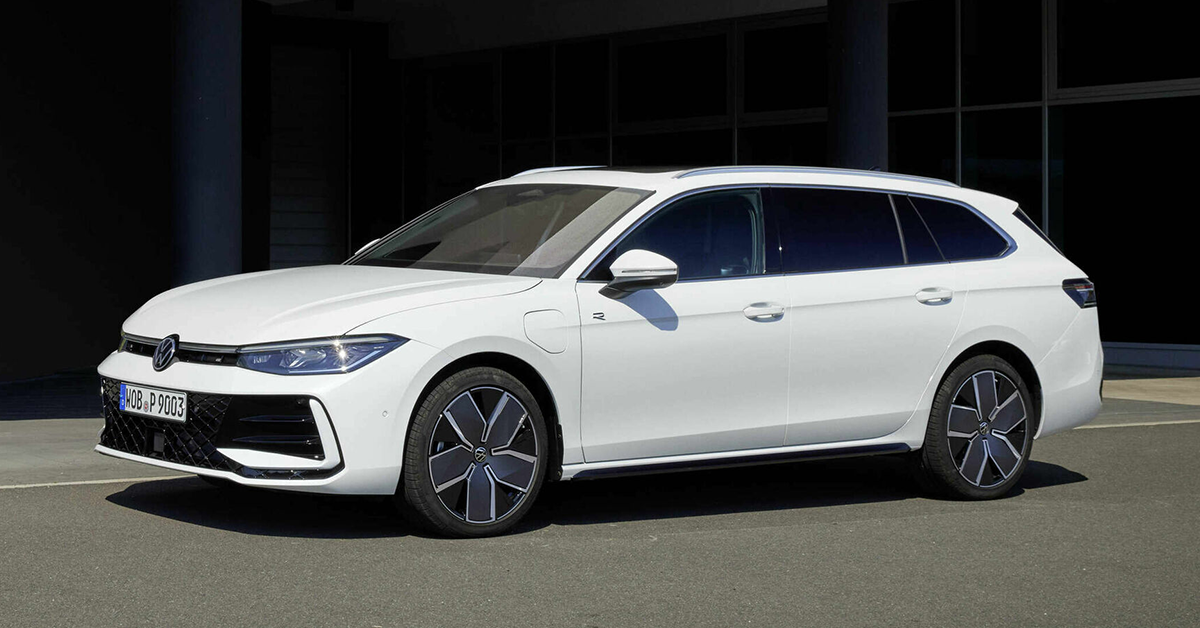
Official press image of the Volkswagen Passat TDI 4MOTION (142 kW). | © Volkswagen AG
The ninth-generation Passat was revealed as a near-production concept ahead of the IAA Mobility show in Munich in September 2023, with a market launch from the first quarter of 2024. It is built on the MQB evo platform, the new development stage of Volkswagen’s modular transverse matrix. The car is an estate only, and Volkswagen’s releases do not mention a saloon. It is 14 cm longer than its predecessor, with a rear legroom increase of 5 cm and a longer wheelbase. Volkswagen gives the length as 4,917 mm, the height as 1,497 mm and the wheelbase as 2,841 mm. The width is given as 1,849 mm in one place and 1,852 mm in another.
| Platform | MQB evo |
| Length / height / wheelbase | 4,917 mm / 1,497 mm / 2,841 mm |
| Width | 1,849 or 1,852 mm (sources differ) |
| Boot | 690 litres, 1,920 litres seats folded |
| Display | 12.9-inch standard, 15-inch optional |
| Mild hybrid | 1.5 eTSI, 110 kW (150 PS), 48 V |
| TDI 4MOTION | 142 kW (193 PS), 2,200 kg towing |
| Euro NCAP | Five stars, 10 July 2024 |
| Market launch | First quarter of 2024 |
The boot is where the new Passat Variant has made the biggest gains. It holds 690 litres with the rear seats up, which is 40 litres more than before, and up to 1,920 litres with the rear bench folded, which is 140 litres more. It has five seats. The chassis includes new electromechanical steering with a more direct ratio, revised anti-roll bars and shock absorbers, and increased rear-axle camber stiffness. A Vehicle Dynamics Manager controls the electronic differential locks and shock absorber firmness as standard, and the optional DCC Pro adaptive chassis control uses two-valve dampers.
Inside, the Passat has a redesigned interior with higher-grade materials and better noise insulation. The standard infotainment display is 32 cm (12.9 inches) and runs on the MIB4 platform, with an optional 38 cm (15-inch) screen. Backlit touch sliders below the screen control temperature and volume, and physical buttons have returned to the multifunction steering wheel. The gear selector is a steering-column switch. Optional equipment includes ergoActive front seats with up to 14-way electric adjustment, massage and climate functions, a head-up display, IQ.LIGHT LED matrix headlights with a main beam range of about 500 metres and a continuous LED strip at the rear.
The standard Passat trim has App Connect with wireless Apple and Android connection, automatic air conditioning, front USB-C ports with 45 W charging, LED headlights and tail lights and a Car2X warning system. Standard assist systems include Adaptive Cruise Control, Side Assist, Front Assist with autonomous emergency braking, Lane Assist, Park Distance Control, a rear-view camera and Dynamic Road Sign Display. Park Assist Plus and Park Assist Pro, which allows remote parking from a smartphone, are optional. Euro NCAP gave the new Passat its top five-star rating on 10 July 2024.
The engines at launch were a 1.5 eTSI mild hybrid, TDI diesels, TSI petrol engines and the eHybrid plug-in. The 1.5 eTSI has 110 kW (150 PS) and a 48-volt system, and it was the first time the Passat had used mild-hybrid technology. All drives use a DSG gearbox as standard, and the most powerful TSI and TDI versions come with 4MOTION all-wheel drive. In February 2025 Volkswagen announced a Passat 2.0 TSI 4MOTION with a towing capacity of up to 2,200 kg, with sales starting in some European markets. Volkswagen’s releases for the ninth generation do not name a production plant.
The ninth-generation timeline is also worth setting out. Volkswagen showed the car as a near-production concept ahead of the IAA Mobility show in Munich, which ran from 5 to 9 September 2023. Pre-orders opened on 16 November 2023 in the first European countries, and the 1.5 eTSI was orderable from calendar week 50. Deliveries began in the first quarter of 2024, the international media drive took place on 5 March 2024, and the full range with the plug-in hybrids and the base diesel followed that spring. Euro NCAP awarded five stars in July 2024, and the 2.0 TSI 4MOTION was announced in February 2025.

Official press image of the Volkswagen Passat eHybrid 200 kW. | © Volkswagen AG
The Passat is sold in Germany as a Variant only, and the range is built around four trims: Passat, Business, Elegance and R-Line, with R-Line Signature as an optional package on top. Prices at the launch were from 39,995 euros including 19 percent VAT, for the 1.5 eTSI in the entry-level Passat trim. Pre-orders opened on 16 November 2023 in the first European countries, with deliveries from the first quarter of 2024. The prices below are German list prices at the March 2024 stage of the roll-out and will have changed since, so check the current price list before buying.
| Trims (Germany) | Passat, Business, Elegance, R-Line, R-Line Signature package |
| 1.5 eTSI 110 kW (150 PS) | From 39,995 euros |
| TDI 90 kW (122 PS) | From 41,745 euros |
| TDI 110 kW (150 PS) | From 48,495 euros |
| TDI 4MOTION 142 kW (193 PS) | From about 57,475 euros |
| eHybrid 150 kW (204 PS) | From 50,320 euros |
| eHybrid 200 kW (272 PS) | From 62,470 euros |
| Pre-orders opened | 16 November 2023, deliveries from Q1 2024 |
The mild hybrid 1.5 eTSI with 110 kW (150 PS) starts at 39,995 euros in the Passat and Business trims. The base TDI with 90 kW (122 PS) and 320 Nm starts at 41,745 euros in the same trims. The 110 kW TDI starts at 48,495 euros in the Business, Elegance and R-Line trims, and it has 360 Nm of torque. The TDI 4MOTION with 142 kW (193 PS) and standard all-wheel drive started at about 57,475 euros and is available in the Elegance and R-Line trims. The consumption of the TDI 4MOTION is 6.2 to 5.7 litres per 100 km combined, and the CO2 emissions are 162 to 149 g/km.
The plug-in eHybrid has two power levels. The 150 kW (204 PS) version starts at 50,320 euros in the Passat, Business and Elegance trims, and the 200 kW (272 PS) version starts at 62,470 euros in the Elegance and R-Line trims. Volkswagen quotes electric consumption of 17.5 to 16.6 kWh per 100 km for the 200 kW car, and a CO2 figure of 12 to 10 g/km, with an overall range of around 1,000 km in one release and more than 900 km in another. A trade publication observed that the trim and drive combinations reduce variant choice, since weaker engines come only in simpler trims and stronger ones only in pricier trims.
The Passat competes with other mid-size estates, and the trade publication noted that the Skoda Superb Combi is otherwise very similar apart from its interior, front and rear. That is a useful reminder that the Passat is part of a shared platform family. Volkswagen’s fleet and family focus is clear in the range, with the TDIs still important for long-distance business users. In Germany in 2023 the previous Passat Variant was the top-selling mid-size car, and the new car is aimed squarely at keeping that position.
For buyers outside Germany, prices, trims and engine availability differ by country, so the Volkswagen models guide is the best place to compare the Passat with the rest of the range. The Passat remains the largest conventional Volkswagen car in Europe. Used Passats of the B6, B7 and B8 generations offer good value. If you want the newest technology, the ninth-generation Variant eHybrid is the one to look at.
Volkswagen’s consumption figures give a useful picture of what the diesels can do. The 110 kW TDI is rated at 5.3 to 4.9 litres per 100 km combined with CO2 emissions of 138 to 129 g/km, while the TDI 4MOTION with 142 kW (193 PS) uses 6.2 to 5.7 litres per 100 km and emits 162 to 149 g/km. The eHybrid is rated at 0.5 to 0.4 litres of fuel per 100 km on the weighted test, with CO2 emissions of 12 to 10 g/km. These figures are from Volkswagen’s 2023 and 2024 releases and vary with equipment and wheel size, so check the current figures for your country.