 Brands
Toyota Camry — America’s Favourite Sedan, Now All-Hybrid
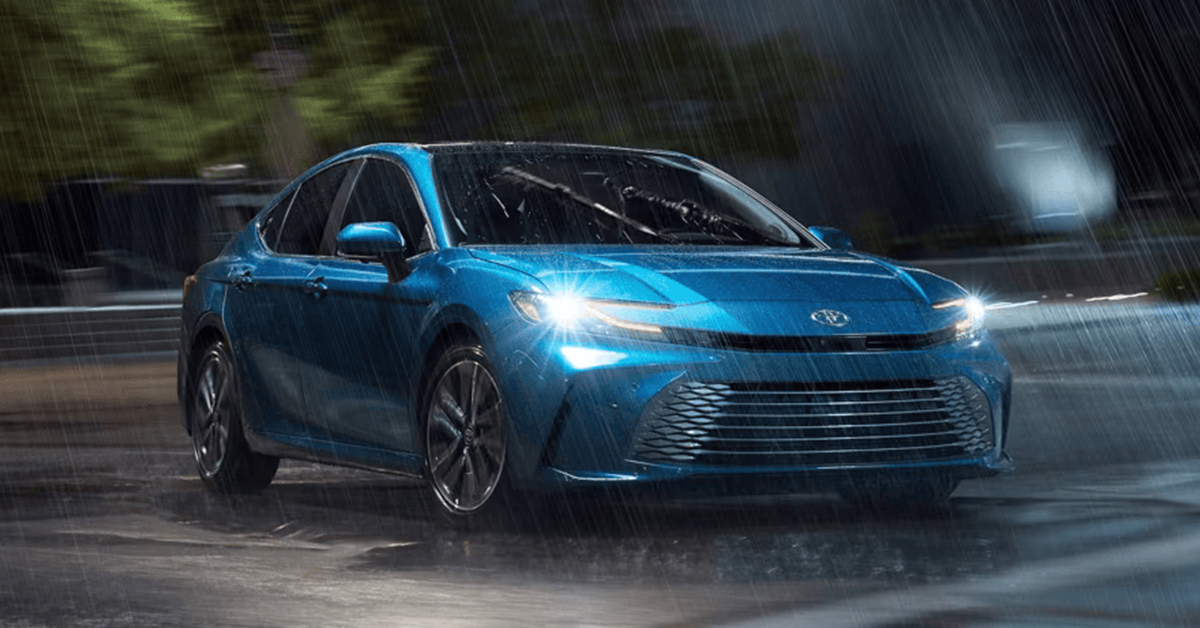
Official press image of the Toyota Camry. | © Toyota Motor Corporation
For decades, the Toyota Camry has occupied a strange and enviable position in the automotive world: it is simultaneously one of the least exciting cars discussed in enthusiast circles and one of the most consistently successful vehicles ever sold in the United States. In 2026, the Camry commits fully to a new identity — the ninth generation is offered exclusively as a hybrid, with no gasoline-only option available for the first time in the nameplate’s history. It is exactly the kind of change that sounds dramatic on paper and, in practice, simply makes an already excellent formula better.
The Camry launched in 1982 as a relatively modest compact sedan, part of Toyota’s broader push into the American market during a period when Japanese manufacturers were rapidly gaining ground on fuel efficiency and reliability. What began as a competent, unremarkable family car steadily grew in size, refinement and market share across successive generations, eventually becoming America’s best-selling passenger car for multiple consecutive decades — a run interrupted only recently as SUVs and crossovers have reshaped what American buyers choose to drive. Even as overall sedan sales have declined industry-wide, the Camry has consistently outperformed its segment, a testament to how deeply the nameplate’s reputation for reliability and resale value is embedded in American car-buying culture.
The current, ninth-generation Camry debuted for the 2025 model year with a decision that would have seemed unthinkable a decade earlier: no gasoline-only engine option at all. Every 2026 Camry runs on Toyota’s fifth-generation hybrid system, pairing a 2.5-litre four-cylinder engine with electric motors through an electronically controlled continuously variable transmission. Front-wheel-drive models produce 225 combined horsepower; opting for Toyota’s Electronic On-Demand All-Wheel Drive — available across the entire lineup for approximately $1,525 — adds a dedicated rear-mounted electric motor for 232 horsepower and genuinely useful wet-weather traction, without the continuous fuel economy penalty of a traditional mechanical AWD system.
The efficiency numbers are the real headline. The base LE with front-wheel drive and lighter 16-inch wheels achieves an EPA-estimated 53 mpg city, 50 mpg highway and 51 mpg combined — genuinely exceptional figures for a midsize sedan with real interior space, not a small hatchback. The SE, Nightshade and XLE trims, riding on larger wheels, return approximately 46–47 mpg combined, while the sport-focused XSE settles around 44 mpg combined. Every configuration still comfortably beats what most non-hybrid midsize sedans could achieve even a decade ago.
The 2026 model year is largely a carryover from the ninth-generation redesign, with the single notable addition being the new Nightshade Edition trim. Built on the SE’s foundation, the Nightshade is a pure appearance package rather than a mechanical upgrade — 19-inch satin black-finished alloy wheels, gloss-black exterior accents across the grille, door handles, mirror caps, rear spoiler, rear lower diffuser, antenna and side canards, offered in just three exterior colours: Ice Cap, Supersonic Red, and Midnight Black Metallic for the full blackout effect. Inside, black faux-leather seats with white accent stitching, a leather-wrapped steering wheel with paddle shifters, and aluminium pedals complete the look. It uses the same sport-tuned suspension as the SE and XSE — independent multi-link rear and MacPherson strut front — but the powertrain and performance remain identical to the standard SE.
Every 2026 Camry comes with a substantial list of standard driver-assistance features: blind spot monitoring, rear cross-traffic alert, adaptive cruise control, lane departure warning with steering assist, automatic high beams, and forward collision avoidance with pedestrian detection. The Camry has earned the IIHS Top Safety Pick+ award for this generation. Toyota’s standard ownership package includes a 3-year/36,000-mile basic warranty, a 5-year/60,000-mile powertrain warranty, an 8-year/100,000-mile warranty on hybrid components, and a 10-year/150,000-mile hybrid battery warranty — alongside two years of complimentary scheduled maintenance and roadside assistance. Combined with the Camry’s consistently class-leading resale value, the total cost of ownership case remains one of the strongest arguments in the entire midsize sedan segment.