 Brands
Toyota Motorsport: WRC, Le Mans, Dakar & NASCAR
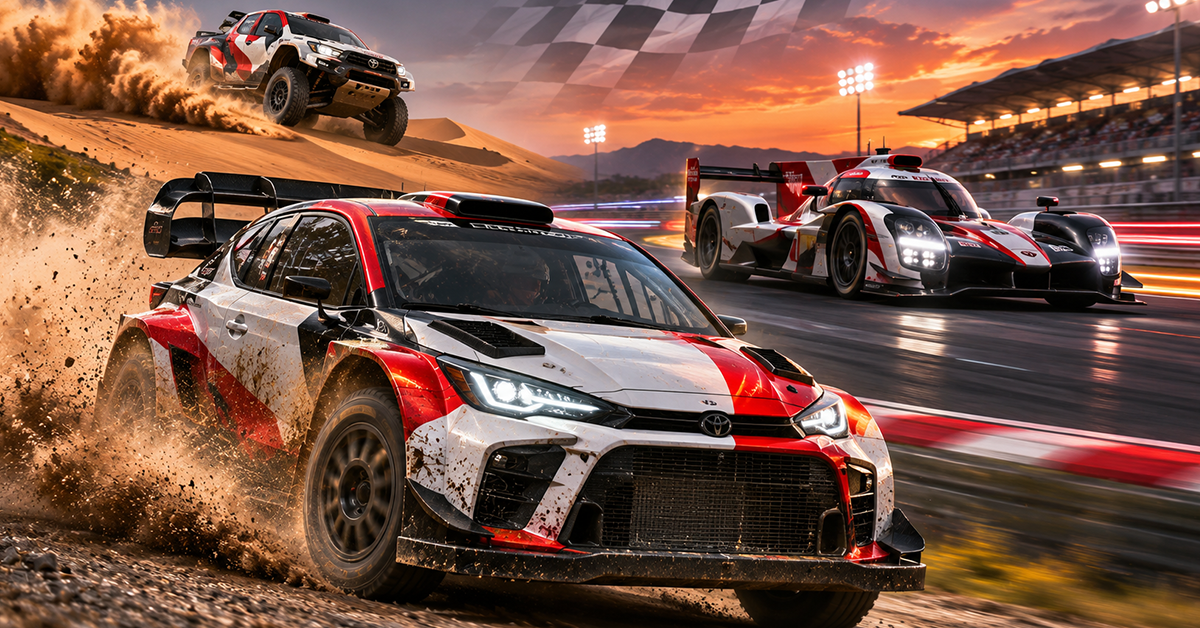
AI-generated concept illustration — Toyota motorsport. | Rev N Rise
Toyota races in more disciplines than almost any other manufacturer, and 2026 has been one of its strongest years: a World Rally Championship double, a first Le Mans win since 2022, a Daytona 500 victory and a new partnership with a Formula 1 team. Here is a clear guide to every major Toyota racing programme, the results that matter and why the company races at all.
Toyota treats racing as a laboratory rather than a marketing exercise. The company's long-standing belief, championed by its president Akio Toyoda, who has raced under the pseudonym “Morizo,” is that competition makes better cars: the extreme demands of rallying, endurance racing and off-road events reveal weaknesses in engineering that ordinary road testing never will, and the lessons flow back into the models that customers buy. That philosophy sits behind Toyota Gazoo Racing, the umbrella that organises most of Toyota's factory competition programmes and gives its performance road cars their GR badge.
Gazoo Racing began as an internal Toyota effort in the mid-2000s, with early appearances at the Nürburgring 24 Hours, and it grew into the company's global motorsport arm. Its modern form includes a factory team in the World Rally Championship, a Hypercar programme in the FIA World Endurance Championship, a factory-backed entry in the Dakar Rally and the wider world of rally-raid, and, through Toyota Racing Development, a presence in American stock-car racing. More recently it has expanded into Formula 1 through a title partnership with the Haas team, which we cover later in this guide.
Each programme serves a distinct purpose. Rallying tests durability, traction and speed on loose and unpredictable surfaces, and it has directly shaped road cars such as the GR Yaris, a homologation special built to make Toyota competitive in the sport. Endurance racing at Le Mans is an engineering exercise in efficiency, reliability and hybrid technology, because a 24-hour race rewards the car that uses less fuel and breaks down less than its rivals. The Dakar Rally pushes trucks across thousands of kilometres of desert, validating the toughness of chassis and drivetrain components. NASCAR, meanwhile, is both a marketing platform and a showcase for Toyota's American manufacturing presence.
The racing programme also feeds the company's technology strategy. Toyota has used the Super Taikyu endurance series in Japan to develop hydrogen combustion engines, which we cover in our Toyota engines guide, and its motorsport engineers contribute to the performance and driving feel of the GR range, from the GR Yaris and GR Corolla to the GR86 and GR Supra. When Toyota says that it builds cars through racing, it is describing a real engineering loop: develop a technology on track, learn from failures under extreme stress, and carry the refined version onto the road.
That approach has produced extraordinary results in the past few years. In 2026 Toyota won the World Rally Championship manufacturers' title for a sixth consecutive year and saw Elfyn Evans take the drivers' crown, returned to the top step at the 24 Hours of Le Mans, and added a Daytona 500 victory in NASCAR, as the sections below explain. Few manufacturers compete at the top level in as many different disciplines at once, and fewer still win in several of them within the same season.
For fans, the best way to understand Toyota's motorsport identity is to recognise its two sides. There is the factory effort, built around purpose-designed machines such as the GR Yaris Rally1 and the TR010 Hybrid Hypercar, and there is the customer and grassroots side, which supports privateers and drivers from club level up. Both are designed to build the same thing: a stronger, more engaging range of cars. The sections that follow take each major series in turn, with the results that matter and the context behind them.
The World Rally Championship is where Toyota's motorsport reputation is strongest, and 2026 was one of its most dominant seasons. Toyota returned to the WRC as a factory team in 2017 with the Yaris WRC and has been a front-runner ever since, with the current-generation GR Yaris Rally1 bringing hybrid power to the sport. In 2026, the Toyota Gazoo Racing World Rally Team won the manufacturers' championship, clinching it at Rally Chile, which reports describe as its sixth consecutive title and the tenth in the manufacturer's history.
The numbers behind that title are remarkable. After 12 of the season's 14 rounds, Toyota had won 11 of them, eight with its main factory team and three with its second team, Toyota Gazoo Racing WRT2. The factory crews won at Rallye Monte-Carlo, Rally Sweden, the Safari Rally, Croatia, the Canary Islands, Japan, the Acropolis Rally and Chile, while the WRT2 crews took victories in Estonia, Finland and Paraguay. The factory line-up featured Elfyn Evans, Oliver Solberg, Takamoto Katsuta and, on a part-time programme, the eight-time world champion Sébastien Ogier, with Sami Pajari competing for the second team.
The drivers' championship came down to a dramatic final-day decider at Rally Italia Sardegna on 4 October 2026. Evans entered the rally with a narrow lead over two Toyota rivals, Sami Pajari and the young Swede Oliver Solberg, who had been the surprise of the season. Evans suffered a puncture on the final day and lost almost two minutes, which should have cost him the title. But Solberg, who was leading the rally by a large margin and needed only a solid Power Stage to take the championship, ran wide two corners from the end of the final stage, clipped a bank and went off the road, giving the title to Evans even though Solberg still won the rally.
It was an emotional result. Evans, from Wales, had finished as runner-up in the championship five times before, and the title was his first. He became the first Welsh world champion in the sport and the first British driver to win the drivers' crown since Richard Burns in 2001, while his co-driver Scott Martin became the first English co-driver to win the co-drivers' title. After years of near misses, the result confirmed Evans as one of the most consistent and respected competitors of his generation, and it capped a season in which he won the rallies in Sweden and Japan.
The title also marks the end of an era. The current Rally1 rules, introduced in 2022 with hybrid power units and a focus on safer, more cost-conscious cars, reportedly reach the end of their run in 2026, with new regulations due from 2027. Reports also point to Ford returning to the championship from 2028 with its M-Sport partner, which suggests a more competitive field in the years ahead. For Toyota, the GR Yaris Rally1 will go down as one of the most successful rally cars of the modern era, a machine that carried the team to a string of consecutive manufacturers' titles.
The connection to the showroom is direct. The GR Yaris road car exists because Toyota wanted a homologation special to compete in rallying, and the GR Corolla shares its turbocharged three-cylinder engine and all-wheel-drive philosophy. When you drive either of those cars, you are experiencing the road-going descendants of Toyota's rally programme. For a deeper look at those cars and the rest of the performance range, see our dedicated GR models guide, and for the hatchback that started it all, see our Toyota hatchbacks guide.
If the World Rally Championship shows Toyota's consistency, the 24 Hours of Le Mans shows its resilience. Toyota first won the famous French endurance race in 2018, after years of heartbreak that included losing the 2016 race in the final minutes, and it went on to win five consecutive times from 2018 to 2022. The 2018 victory was shared by Sébastien Buemi, Kazuki Nakajima and the former Formula 1 world champion Fernando Alonso, and it began a run of success with the TS050 Hybrid and then the GR010 Hybrid that established Toyota as the benchmark in the top Hypercar category.
After 2022, the picture changed. Ferrari returned to the top class and won the race in three consecutive years, while rule changes to balance performance between competitors made winning harder for any manufacturer. Toyota remained competitive but could not convert its speed into victories, and the long wait between wins made its return to the top step at the 2026 race in June all the more significant. The result is covered below, but the broader point is that endurance racing is brutally difficult to win, and even the best-prepared team can be undone by balance-of-performance adjustments, a small mechanical failure or a safety-car period at the wrong moment.
At the 2026 24 Hours of Le Mans, the number 7 Toyota TR010 Hybrid, driven by Kamui Kobayashi, Mike Conway and Nyck de Vries, won the race by 10.9 seconds, ending Ferrari's run of three consecutive victories. It was Toyota's sixth Le Mans win overall, its first with the TR010 Hypercar and its first since 2022. The sister number 8 car of Brendon Hartley, Sébastien Buemi and Ryo Hirakawa finished third, giving the team a double podium and underlining the strength of the car across both entries. Kobayashi's victory was particularly meaningful, as he is also team principal of Toyota's Le Mans squad.
A 24-hour race is the ultimate test of a hybrid powertrain. The cars run a turbocharged V6 petrol engine combined with an electric motor, and Toyota's expertise in hybrid systems, built over decades since the first Prius in 1997, is a core part of its advantage. Efficiency matters because every unnecessary fuel stop costs time, and reliability matters because a car that retires after 20 hours has wasted its entire effort. The lessons Toyota learns from this environment, about thermal management, energy recovery and component durability, flow into the hybrid technology covered in our Toyota hybrid cars guide.
The World Endurance Championship itself is a global series that visits circuits across Europe, the Americas, the Middle East and Asia, with Le Mans as its centrepiece. Toyota competes there against a growing list of manufacturers in the Hypercar class, including Ferrari, Porsche, Cadillac and others, and the competition has never been closer. That depth makes each victory more valuable, and it explains why the 2026 win was celebrated so strongly within the company after a four-year wait.
For fans following Toyota's endurance story, the key themes to watch are the continuing development of the TR010 Hybrid, the strength of the driver line-up, and how the rules governing performance balance evolve. Toyota has also been exploring hydrogen technology for racing through the Japanese Super Taikyu series, and the organisers of Le Mans have long-term plans for hydrogen-powered cars, so the endurance programme may influence Toyota's future technology as well as its trophy cabinet.
The Dakar Rally is widely regarded as the toughest motorsport event in the world, a two-week marathon across deserts, dunes and mountains in which cars and trucks cover thousands of kilometres of unmarked terrain. It suits Toyota's engineering philosophy perfectly, because the event rewards durability above everything else, and the Hilux pickup, one of the most robust vehicles ever built, has been a leading contender since it took a first overall win in 2019 with Nasser Al-Attiyah. Toyota's Dakar effort is run by Toyota Gazoo Racing with partners including Toyota Gazoo Racing South Africa, and it competes within the wider World Rally-Raid Championship.
For the 2026 edition, Toyota introduced an all-new race truck called the DKR GR Hilux, which features a new tubular chassis and a strengthened transmission, designed to address the weaknesses that had held the previous machine back. The team entered three trucks driven by Toby Price and Armand Monleón, Seth Quintero and Andrew Short, and Henk Lategan and Brett Cummings, a line-up combining experienced rally-raid specialists with promising younger talent. Toyota cars earned two stage wins during the rally, and Toyota trucks filled the top five places on the second day, showing the pace was there early in the event.
The final result, however, did not match that early promise. Nasser Al-Attiyah, the veteran Qatari driver who has won the Dakar multiple times including with Toyota, took his sixth overall victory in a Dacia, finishing in just under 49 hours with co-driver Fabian Lurquin, ahead of Ford's challenge. Toyota's best-placed crew, Price and Monleón, finished eighth overall, 52 minutes behind the winners, with Quintero and Short ninth. The most painful moment came for Lategan and Cummings, who were running second overall until a wheel bearing failure on the eleventh stage dropped them to 21st by the finish.
That kind of setback is a defining feature of the Dakar. The rally is so punishing that a single mechanical failure or navigational mistake can undo days of consistent driving, and even dominant teams rarely control the outcome until the final stages. The team did complete the event with all of its entries, which in itself reflects the strength of the new truck. The new DKR GR Hilux will undoubtedly be refined with the lessons learned in 2026, and Toyota's long record in the event means it remains one of the favourites for each edition.
The Dakar programme matters to Toyota customers because the technology and the toughness it develops are shared with road-going vehicles. The Hilux is among the world's best-selling pickups outside North America, and its reputation for indestructibility was built partly on events like this one, which is why Toyota is so willing to invest in the sport. Features such as improved suspension durability, drivetrain strength and cooling performance in extreme conditions are tested in competition, long before they appear in a vehicle that you can buy.
For readers who want to know more about the machines that inspire these racers, our guides to the Hilux and the wider pickup truck range cover their history and engineering in detail. And while the Dakar results in 2026 were disappointing relative to Toyota's ambitions, the combination of a new truck, a deep driver line-up and a reputation for reliability suggests that the team will be a serious contender again in the editions to come.
In the United States, Toyota's most visible racing programme is NASCAR, the stock-car series in which the Toyota Camry, developed with Toyota Racing Development, competes against Chevrolet and Ford in the Cup Series. Toyota joined the top level of NASCAR in 2007, which at the time was a bold and controversial move for a Japanese manufacturer, and it has since become one of the series' most successful brands. Its cars are run by leading teams including Joe Gibbs Racing, 23XI Racing and Legacy Motor Club, with a driver roster that has included some of the sport's biggest names.
A major milestone came in September 2025, when Denny Hamlin delivered Toyota's 200th win in the Cup Series, a landmark that shows how consistently the manufacturer has competed at the front of the field since its arrival. Hamlin, who drives for Joe Gibbs Racing and also co-owns 23XI Racing, went on to reach the championship finale at Phoenix that season, finishing as runner-up in the title race, which Kyle Larson won. For a driver of Hamlin's quality, the near miss was another chapter in a long-running pursuit of a first Cup Series title.
The 2026 season brought a different kind of triumph. On 15 February 2026, Tyler Reddick won the Daytona 500, the sport's most prestigious race, driving the number 45 Toyota for 23XI Racing. It was the first Daytona 500 victory for the 23XI team, the fourth in Toyota's history and its first since 2020. Toyota cars led more than half of the race, with 103 laps led in total, and Bubba Wallace led the most laps of any driver with 40, showing that the entire Toyota effort was strong rather than relying on one standout performance.
The win also continued a remarkable run in the sport's biggest events. Toyota has now won the last three NASCAR crown-jewel races, with Wallace winning the Brickyard 400, Chase Briscoe taking the Southern 500 and Reddick winning the Daytona 500. That kind of success across different tracks and race types is a sign of strong engineering depth, as well as strong team execution, and it demonstrates that Toyota's NASCAR programme remains among the leaders in the sport.
Why does NASCAR matter to Toyota? The answer is largely about the American market, where Toyota builds many of its best-selling vehicles, including the Camry, at plants in Kentucky and elsewhere. Racing a car called the Camry in the country's most popular motorsport helps reinforce the connection between Toyota and American customers, and it supports the brand's image as a competitor rather than only a maker of sensible, reliable cars. It is also a place where Toyota's engineers and its team partners continue to build expertise in engines, aerodynamics and race strategy.
Beyond NASCAR's top series, Toyota is active across American motorsport, with programmes in the second-tier and truck series, in drag racing and in sports-car competition. Readers interested in the performance cars that Toyota offers for road use can find more detail in our Toyota sports cars guide, which covers the Supra, the GR86 and the history that led to them. Together, they show a brand that competes in nearly every discipline it can, from American ovals to European circuits and the deserts of Saudi Arabia.
Formula 1 is the one top-level series in which Toyota is not a full competitor, but 2026 marked its biggest step back toward the sport in years. From the 2026 season, Toyota Gazoo Racing became the title sponsor of the Haas team, which now races as the TGR Haas F1 Team, replacing MoneyGram. The arrangement expands a multi-year technical partnership between the two organisations that began in October 2024, and it gives Toyota a much more visible presence on the grid without the cost of building its own engine or chassis.
Toyota has a history in the sport that makes the partnership meaningful. The company competed as a full constructor between 2002 and 2009, taking several podium finishes but never a win, and it withdrew after the 2009 season with its TF109 car. Since then it has stayed away from the championship, focusing on rallying, endurance racing and other programmes. The Haas link therefore represents a cautious return, and it is important to be clear that Toyota has not announced an engine supply or a full factory entry, and that reports of a possible full return remain speculation rather than confirmed plans.
The practical content of the partnership is broader than a sponsorship logo. In 2025, Toyota ran Haas's first full Testing of Previous Car programme, using the team's 2023 car with Japanese drivers Ryo Hirakawa, Ritomo Miyata, Sho Tsuboi and Kamui Kobayashi at circuits including Silverstone, Paul Ricard, Fuji, Imola and Mugello. From 2026 that programme has become the TGR Haas Driver Development Programme, and a simulator is being developed at Haas's base in Banbury in England. These elements help Toyota train and assess young drivers, particularly from Japan, and gain experience of how a Formula 1 team operates.
The 2026 race drivers for the team are Esteban Ocon and Oliver Bearman, both of whom were confirmed before the season. For Toyota, the aim is to build knowledge and relationships, and to give its Japanese drivers a route toward the sport's top level. For Haas, the deal brings financial support and technical resources from one of the world's largest manufacturers, which can help a mid-sized team compete more effectively against its larger rivals. Whether it eventually leads to a deeper Toyota commitment will depend on the sport's regulations, on Toyota's own priorities and on the company's results elsewhere.
Beyond Formula 1, several threads point toward the future of Toyota's racing. The company has been racing a hydrogen-combustion GR Yaris in Japan's Super Taikyu series since 2021, treating it as real-world development of a technology that could provide combustion-engine driving thrills with far lower carbon emissions, which we cover in our Toyota engines guide. It has also launched the GR GT3 customer racing car alongside the new GR GT road car, a package covered in our GR models guide, which gives Toyota a route into GT3 racing around the world.
Taken together, Toyota's motorsport strategy is unusually broad. It wins rallies and endurance races with hybrid machines, competes in the world's toughest off-road event, challenges for stock-car racing's biggest prizes and is building ties with Formula 1, while using racing as a proving ground for hydrogen and hybrid technology. For fans, the message of 2026 is that Toyota is in one of the strongest competitive positions in its history, with the rest of the decade promising new rules, new rivals and new chances to win.