 Brands
Ford Bronco — From the 1966 Original to Raptor and Filson
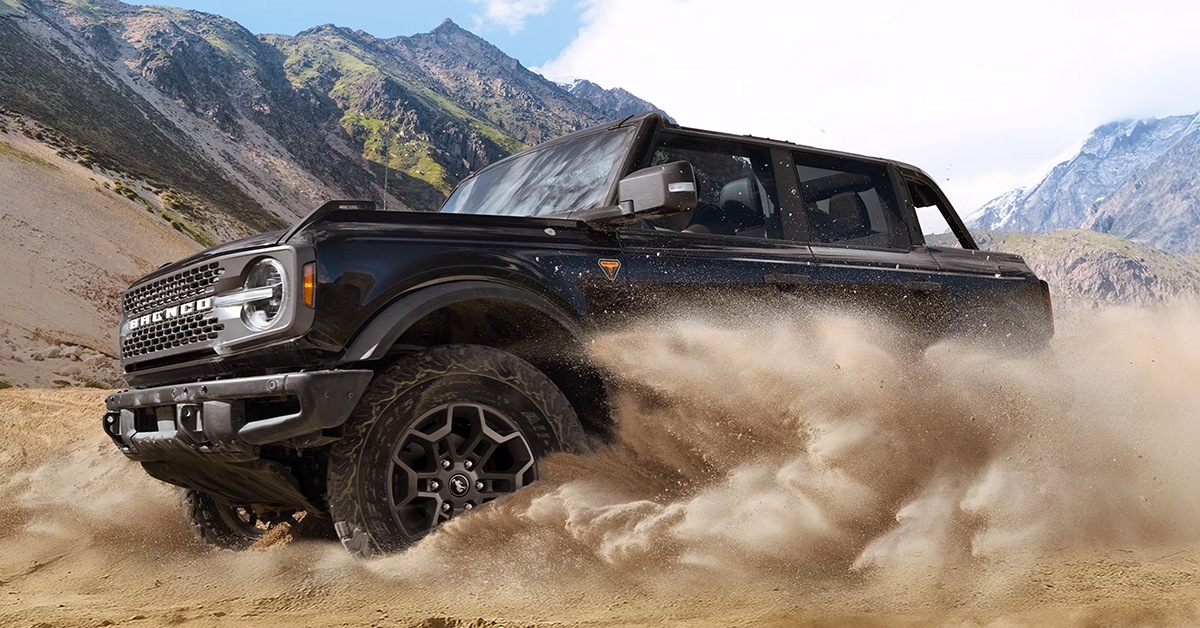
Official press image of the Ford Bronco. | © Ford Motor Company
The Ford Bronco from the 1965 launch and Baja wins to the 2021 return: generations, engines, the Raptor, the 2027 Filson and RTR, specs and prices where sources give them.
The Ford Bronco is Ford’s off-road SUV. Ford introduced it on August 11, 1965 as a 1966 model, and the original run lasted 31 years, until the last Bronco left the Michigan Truck Plant on June 12, 1996 (Ford). Ford says 1,148,926 were built in that run (Ford). The name returned for the 2021 model year after a reveal on July 13, 2020, and the sixth generation is built at Ford’s Michigan Assembly Plant in Wayne, Michigan (Ford). This article covers the original generations, the Baja racing record, the 2021 return, the 2026 lineup, the Raptor and the 2027 Filson and RTR. Every claim is tagged (Ford) or (reported), and we have not driven any of these vehicles.
| Introduced | August 11, 1965 (Ford) |
| First model year | 1966 (Ford) |
| Original run | 1966 to 1996, five generations (reported) |
| Last original built | June 12, 1996 (Ford) |
| Total built, 1966 to 1996 | 1,148,926 (Ford) |
| Return announced | January 2017 (Ford) |
| Return revealed | July 13, 2020 (Ford) |
| Assembly, sixth generation | Michigan Assembly Plant, Wayne (Ford) |
| US sales, 2025 | 146,007, a record (Ford) |
| Drive | Standard 4x4 on the sixth generation (Ford) |
Ford’s own heritage account says Don Frey, then a Ford Vice President and Ford Division General Manager, introduced the Bronco by noting that the company had added “another pony to the stable” to join the Mustang (Ford). The same account calls the Bronco the first automobile called out specifically as a “Sports-Utility Vehicle” (Ford). A July 2020 Ford release quotes Jim Farley as saying “Bronco gave rise to the fun and versatile off-road SUV in 1966” (Ford). Those are Ford’s own statements about its place in SUV history, and we report them as Ford’s, not as settled fact. Our Ford Mustang article covers the other pony.
Generation counts depend on who is counting. Ford’s heritage account and the reported histories group the original run as five generations: 1966 to 1977, 1978 to 1979, 1980 to 1986, 1987 to 1991 and 1992 to 1996 (Ford, reported). The sixth generation began with the 2021 model year (reported). The smaller Bronco II, introduced in March 1983 as a 1984 model and built through 1990, and the Bronco Sport crossover, revealed alongside the 2021 Bronco, are separate models that share the name (Ford). We keep them apart in the tables, so a figure for one is never read as a figure for the other.
The current lineup is built around three EcoBoost engines. For 2026, Ford’s pages list a 2.3L four-cylinder, a 2.7L V6 and a 3.0L V6, with the 3.0L standard only on the Raptor (Ford). For 2027, Ford has announced a 380 horsepower 3.0L V6 for more trims and two new series, the Filson and the RTR (Ford). Prices are the weakest part of the picture. The Ford pages we read show no price amounts, so every price in this article is reported, and we say each time whether the destination charge is included.
Demand has grown since the return. Ford says Bronco sales reached a record 146,007 in the United States in 2025, up 33.7% on the year before (Ford). A reported table of Ford’s sales gives 134,493 for the Bronco Sport in 2025 (reported). We could not confirm from that table whether both figures use exactly the same basis, so we show them side by side and do not add them. We also did not find Ford sales figures for the earlier years of the sixth generation, so we make no claim about the trend before 2025.
Two other Ford vehicles are easy to confuse with the Bronco in search results. The Bronco II was a compact model from the 1980s, and the Bronco Sport is a smaller crossover sold today. Neither is covered in depth here beyond the short sections where they matter to the story. Our Ford models article covers the whole current lineup, and our Ford history article covers the company. Where sources disagree we show both values, and where Ford gives a figure we use it as the reference, with reported figures tagged beside it.
Ford’s heritage account dates the Bronco’s origin to 1962, when Ford began surveying owners of the Jeep and the International Harvester Scout (Ford). An internal memo dated July 11, 1963 summarised the findings and noted poor comfort, ride, noise and vibration in both rivals (Ford). The earliest Bronco sketches, by the designer McKinley Thompson, are dated July 24, 1963 (Ford). The account describes Thompson as the first African American automobile designer at Ford (Ford). On October 23, 1963 the Product Planning Committee received a recommendation to fund development (Ford).
| Years | 1966 to 1977 (Ford) |
| Survey of rivals began | 1962, Jeep and Scout owners (Ford) |
| Earliest sketches | July 24, 1963, McKinley Thompson (Ford) |
| Funding recommendation | October 23, 1963 (Ford) |
| Standard engine, 1966 | 170 cu in six, 105 hp (Ford) |
| Optional engine | 289 V-8, from March 2, 1966 (Ford) |
| Body styles | Roadster, Sports Utility, Wagon (Ford) |
| Most popular body | Two-door Wagon (Ford) |
| 1973 changes | Power steering, automatic, 200 six (Ford) |
| Sales, 1966 to 1977 | Over 225,000 (reported) |
Ford introduced the Bronco on August 11, 1965 (Ford). For 1966 the standard engine was a 170 cubic inch inline six with 105 horsepower, standard four-wheel drive and a three-speed manual (Ford). A 289 V-8 became available as an upgrade on March 2, 1966, and Ford says it raised horsepower and torque to the top of the sports-utility segment (Ford). A reported history says the first generation used a chassis developed only for the Bronco and shared with no other Ford or Lincoln-Mercury vehicle (reported). Ford says the 1978 generation moved to the F-Series platform (Ford).
Three body styles made up the original lineup. The Roadster was open-air, the most basic and least expensive, with doors and roof as options (Ford). The Sports Utility had a short top, a pickup bed and seating for two or three, and was later called the half-cab (Ford). The Wagon had two doors, a tailgate, a full hardtop and seating for up to five, and Ford calls it the most popular (Ford). A reported history says the roadster and the single-cab pickup were gone by 1972, as Ford focused on the two-door wagon (reported). We did not find a Ford production split by body style, so we give none.
For 1973 Ford added power steering and an automatic transmission, and a 200 cubic inch six replaced the 170 (Ford). The 302 V-8 was offered with the SelectShift Cruise-O-Matic three-speed automatic (Ford). A separate reported source says a 4.9-litre V8 replaced the earlier V8 in 1968 and that a three-speed automatic arrived in 1973 (reported). A 302 cubic inch engine is about 4.9 litres, so that report and Ford’s text may describe the same engine, but we cannot tell from the text when the 302 first arrived. We therefore do not date it, and we show Ford’s 1973 line as written.
A reported history says more than 225,000 Broncos were sold between 1966 and the end of the first generation in 1977 (reported). Ford’s heritage account notes that many first-generation Broncos were sold in Iceland (Ford). In 1976 Ford introduced a Special Décor Package to send out the first-generation Bronco in style (Ford). We did not find a Ford figure for first-generation production by year, and the 225,000 figure is a sales total from one report, so we treat it as an approximation and do not compare it with the production total for the whole 1966 to 1996 run.
First-generation values are the one place where Ford itself quotes outside data. Its July 2020 announcement says the average sale price of a first-generation Bronco rose from $39,763 to $74,820 in just over three years, citing Barrett-Jackson data, and that 1966 to 1977 Broncos showed a 75.8% gain in the Hagerty valuation guide over three years (Ford). Those figures date from 2020. We did not find current values and do not give any, and we cannot say whether the gains continued. Anyone buying a first-generation Bronco should check a current valuation guide and the vehicle’s documentation.
Ford’s heritage account says Bill Stroppe prepared a pre-release Bronco for competition (Ford). In 1967 a Stroppe-prepared six-cylinder Bronco won overall at the Riverside Four-Wheel Drive Grand Prix (Ford). In 1968 Stroppe Broncos won at Riverside, at the Mint 400 and at the Baja 1000, where Larry Minor and Jack Bayer took a class win in a stock Bronco (Ford). These early results are the base of the Bronco’s off-road reputation, and every one of them comes from a single Ford heritage account, so we have not cross-checked the race records.
| 1967 result | Stroppe six won overall, Riverside 4WD GP (Ford) |
| 1968 results | Stroppe Broncos won Riverside, Mint 400, Baja 1000 (Ford) |
| 1968 Baja 1000 class | Minor and Bayer, stock Bronco (Ford) |
| 1969 Baja 1000 | Minor and Hall, class and overall (Ford) |
| 1969 claim, as of 2020 | No production 4x4 has repeated it (Ford) |
| 1970 | “Big Oly” modified Bronco (Ford) |
| 1971 and 1972 | Jones and Stroppe won the Mexican 1000 (Ford) |
| 2019 Bronco R | Entered Baja 1000, did not finish (reported) |
| 2025 Stroppe Edition | Honors the original Baja Bronco (Ford) |
| 2027 Stroppe | Reported dropped, not in Ford’s 2027 page (reported) |
The record that Ford leans on most is 1969. Ford’s accounts say Larry Minor and Rod Hall won both class and overall at the Baja 1000, setting a new record (Ford). Ford’s July 2020 announcement adds that no other production 4x4 had repeated the overall win in 50 years (Ford). That claim dates from 2020. We did not check it against races since then, so read it as Ford’s statement as of that date. Ford’s announcement names Hall only for this win and gives no further detail about him.
The account mentions other names and events. It says the modified “Big Oly” Bronco became well known in 1970 and that Parnelli Jones and Stroppe won the Mexican 1000 in 1971 and 1972 (Ford). It describes Jones as an Indianapolis 500 winner who drove for the Stroppe team, and says James Garner and Ray Conniff joined the Ford racing team (Ford). We could not find Ford numbers for how many races these Broncos entered or how often they finished, so we do not rank them or call any result typical.
The racing story returned with the new Bronco. A report says Ford introduced the Bronco R race prototype in November 2019, just ahead of the Baja 1000, in a livery inspired by Hall’s 1969 winner (reported). Another report says it did not finish that race because of reliability issues (reported). A further report says the Bronco R was set to return to the SCORE Baja 1000 in 2020, built on the four-door’s chassis with the 2.7L EcoBoost V6 and the 10-speed automatic (reported). We did not find a result for that later race and do not state one.
Racing names now appear in the road-car lineup. Ford’s What’s New page for 2025 says the Stroppe Edition was added that year, and its title says it honors the original Baja Bronco (Ford). For 2026, Ford’s pages list the Stroppe Edition as four-door only, with the 2.7L V6 and the Sasquatch package standard (Ford). A report says the 2027 lineup drops the Stroppe (reported). Ford’s 2027 page that we read does not mention it either way, so we treat the removal as unconfirmed by Ford.
The 2027 RTR is described by Ford as the second chapter of a motorsport-inspired collaboration between Ford and RTR Vehicles, following the RTR Mustang of the 2026 model year (Ford). The Baja mode in the G.O.A.T. terrain system is another nod to the racing past, and Ford lists it on the 2026 Badlands, Stroppe and Raptor (Ford). Racing results are the thinnest part of our research. Wherever a detail goes beyond Ford’s heritage account we have marked it as reported, and we have left out claims we could not source.
The second generation debuted in 1978 on the F-Series platform (Ford). Ford says it offered two V-8 engines and, for the first time, no V-6 option, with more interior space and optional air conditioning and an AM/FM radio (Ford). Ford also says more than 180,000 were sold in its first two years (Ford). A reported history says it was the last Bronco with a solid front axle and that round headlights gave way to rectangular ones in 1979 (reported). It was a short generation, 1978 to 1979, and we found no Ford explanation of why it ended after two years.
| Second generation | 1978 to 1979, F-Series platform (Ford) |
| Second generation sales | Over 180,000 in two years (Ford) |
| Pope Mobiles | Three Broncos, Oct 1 to 7, 1979 (Ford) |
| Third generation | 1980 to 1986, F-150 platform (Ford) |
| Third generation sales | Over 320,000, peak 62,127 in 1986 (reported) |
| Bronco II | 1984 to 1990, four V-6 options (Ford) |
| Fourth generation | 1987 to 1991, fuel injection, rear ABS (Ford) |
| Fifth generation | 1992 to 1996, driver airbag (Ford) |
| Fifth generation sales | About 162,000 (reported) |
| Last built | June 12, 1996, Michigan Truck Plant (Ford) |
One of the best-known uses of this generation came in 1979. Ford’s heritage account says three second-generation Broncos were modified as “Pope Mobiles” for Pope John Paul II’s US visit, between October 1 and 7, 1979 (Ford). We did not find details of the modifications or where the vehicles are now, so we say nothing further. The Pope Mobile story is a good example of the kind of detail that appears in Ford’s heritage material but is hard to verify elsewhere.
The third generation ran from 1980 to 1986 and was based on the F-150 platform (Ford). Ford says it was smaller, lighter and more fuel-efficient than the second generation, with independent front suspension and a choice of V-6 and V-8 engines (Ford). Ford’s performance history says the timing was providential, as the second oil crisis had pushed fuel prices up (Ford). A report says this generation sold over 320,000 in seven years, peaking at 62,127 in 1986 (reported). Another report says every later full-size Bronco used the same basic platform that debuted in 1980 (reported).
The Bronco II was a separate, smaller model. Ford says it was introduced in March 1983 as a 1984 model, was built through 1990 and offered four V-6 engine options (Ford). A reported history says it quickly became notorious for rollovers, that lawsuits took their toll and that Ford discontinued it after a six-year run (reported). We found no Ford statement on that point, so we report it only as the claim of one source. It is not a first-, second- or third-generation Bronco in Ford’s own grouping.
The fourth generation, 1987 to 1991, brought a redesigned front end, electronic fuel injection and rear anti-lock brakes (Ford). The fifth, 1992 to 1996, added a driver’s-side airbag and three-point seat belts (Ford). A report says about 162,000 fifth-generation Broncos were sold (reported). The last Bronco was built on June 12, 1996, and Ford says the four-door Ford Expedition took its place in the lineup (Ford). A report says Ford cited declining sales as larger four-door SUVs became more popular (reported).
Ford puts total Bronco production from 1966 to 1996 at 1,148,926 (Ford). The generation figures above come from different sources and different bases, some of them sales and some production, so we do not add them up or claim they match Ford’s total. The gap between the last original Bronco and its return was a little over 24 years, and Ford says it announced the return in January 2017 (Ford). Our Ford history article places the Bronco in the wider company story, and the next section covers the return itself.
Ford says it announced the Bronco’s return in January 2017 (Ford). On July 6, 2020 it announced the Bronco brand as a family of Built Wild SUVs with U.S. off-road driving schools and a community for owners and enthusiasts (Ford). The reveal came on July 13, 2020 at 8:00 p.m. EDT across Disney’s television networks, as reservations opened with a $100 refundable deposit (Ford). A report says deliveries of the two- and four-door models were pushed back, with some customers told they might not get a 2021 model year vehicle until 2022 (reported).
| Return announced | January 2017 (Ford) |
| Brand announced | July 6, 2020 (Ford) |
| Reveal | July 13, 2020, 8:00 p.m. EDT (Ford) |
| Reservation | $100 refundable deposit (Ford) |
| Base two-door price | $29,995 including $1,495 destination (Ford) |
| Launch series | Seven, Base to First Edition (Ford) |
| Launch 2.7L V6 | 310 hp, 400 lb-ft projected (Ford) |
| Launch 2.3L | 270 hp expected, 310 lb-ft targeted (Ford) |
| Manual gearbox | Seven-speed, 94.75:1 crawl ratio (Ford) |
| Front suspension | Independent on every Bronco (Ford) |
The family had three members: the Bronco two-door, the first-ever Bronco four-door and the smaller Bronco Sport (Ford). Ford said every one came with 4x4 and that Bronco would be the only domestic SUV brand with standard 4x4 (Ford). It said it drew on off-road experience from the F-150 Raptor to develop the durability of the new Bronco (Ford). The Bronco was to be built at the Michigan Assembly Plant in Wayne, Michigan, and Ford planned four Off-Roadeo adventure locations in U.S. sites, opening from 2021 (Ford).
The launch engines were projections. Ford’s release gave the 2.7L EcoBoost V6 a projected 310 horsepower and 400 lb-ft, and the 2.3L EcoBoost four-cylinder an expected 270 horsepower and a targeted 310 lb-ft (Ford). It also announced a seven-speed manual, a segment first, with a 94.75:1 crawl ratio when paired with the advanced 4x4, and a 10-speed automatic with a 67.8:1 crawl ratio (Ford). Ford’s current figures, covered later, are higher: 300 and 330 horsepower on premium fuel (Ford). We did not find an explanation for the difference, so we show both sets of numbers.
Ford listed the hardware in detail. Every Bronco had independent front suspension and a solid rear axle with coil springs and five locating links (Ford). A base two-speed 4x4 system was standard, and an advanced system with an automatic mode was optional (Ford). The release gave ground clearance of 11.6 inches, water fording up to 33.5 inches, and breakover and departure angles of 29 and 37.2 degrees, and said 35-inch tires were available from the factory on every trim (Ford). Roof panels and frameless doors are removable, and the four-door can store all four doors on board (Ford).
The launch lineup had seven series: Base, Big Bend, Black Diamond, Outer Banks, Wildtrak, Badlands and a limited-production First Edition (Ford). The base two-door started at $29,995, including a $1,495 destination charge (Ford). There is one inconsistency in Ford’s own release. It says “up to seven” G.O.A.T. modes but lists eight: Normal, Eco, Sport, Slippery, Sand, Baja, Mud/Ruts and Rock Crawl (Ford). Today Ford lists five or seven modes depending on the trim (Ford), so we show both counts and make no claim about the launch number.
The Bronco Sport is a separate vehicle and not a smaller Bronco in Ford’s grouping. Reported 2026 prices including the $1,995 destination charge are $33,840 for the Big Bend, $36,140 for the Heritage, $38,940 for the Outer Banks and $42,260 for the Badlands (reported). Ford’s Canadian page lists the Heritage with a 1.5L EcoBoost making 180 horsepower and 200 lb-ft, with standard 4x4 (Ford). A report says the Free Wheeling trim was dropped for 2026 (reported). The Raptor was added later, for the 2022 model year (reported).
A reported guide lists seven 2026 series: Base, Big Bend, Outer Banks, Badlands, Heritage Edition, Stroppe Edition and Raptor (reported). The two-door body is offered only on the Base and Badlands (reported). Ford’s What’s New page for 2025 says the Big Bend and Heritage Edition became four-door only that year, that the Black Diamond changed from a series to a package, and that the Stroppe Edition was added (Ford). For 2026 it says the two-door Stroppe was deleted, so the Stroppe is four-door only (Ford).
| Series, reported | Base, Big Bend, Outer Banks, Badlands, Heritage, Stroppe, Raptor (reported) |
| 2.3L EcoBoost | 300 hp, 325 lb-ft premium; 275 hp, 315 lb-ft regular (Ford) |
| 2.7L EcoBoost V6 | 330 hp, 415 lb-ft premium; 315 hp, 330 lb-ft regular (Ford) |
| 3.0L EcoBoost V6 | 418 hp, 440 lb-ft, Raptor (Ford) |
| Towing | Up to 3,500 lb; Raptor 4,500 lb (Ford) |
| Two-door wheelbase | 100.4 in (Ford) |
| Four-door wheelbase | 116.1 in (Ford) |
| Base price | $40,495 before destination (reported) |
| Base price, other listing | $42,790 (reported) |
| Raptor price | $79,995 before, $81,990 with destination (reported) |
Ford’s capability page gives the engines. The 2.3L EcoBoost four-cylinder makes 300 horsepower and 325 lb-ft on premium fuel and 275 horsepower and 315 lb-ft on regular, with a seven-speed manual or a 10-speed automatic, and it is standard on the Base, Big Bend, Outer Banks, Badlands and Heritage (Ford). The 2.7L EcoBoost V6 makes 330 horsepower and 415 lb-ft on premium and 315 horsepower and 330 lb-ft on regular, and is standard on the Stroppe and available on the Outer Banks, Badlands and Heritage (Ford). The 3.0L EcoBoost V6 makes 418 horsepower and 440 lb-ft and is standard on the Raptor (Ford).
Reports quote different horsepower ranges for the same year, some from 275 to 418 and others from 300 to 418 (reported). Ford’s page explains the difference: the lower figure is the regular-fuel rating of the 2.3L and the higher is the premium-fuel rating, so both are correct on their own basis (Ford). Ford lists towing at up to 3,500 lb for most trims and 4,500 lb for the Raptor, with a trailer tow package required on several trims (Ford). A reported range for combined fuel economy across trims is 15 to 20 mpg (reported).
The 2026 model year brought modest changes. Ford says the 10-speed automatic became available with the 2.3L on the Heritage Edition (Ford). A 60th Anniversary Package, code 51V, was added as an option on the Outer Banks only, with painted door handles, a warm alloy grille with two-color BRONCO lettering, black mirror caps and leather seats (Ford). New colors were Avalanche, Orange Fury and, on the 60th Anniversary Package, Wimbledon White (Ford). Several Dual Tops combinations and some accessories were deleted (Ford). A report says the 2026 Bronco still uses the Sync 4 system and does not get Ford’s newer Google-based system (reported).
Ford’s capability page gives the sizes. The two-door Base has a 100.4 inch wheelbase, a 173.7 inch length and a 71.9 inch height, and the four-door has a 116.1 inch wheelbase and a 189.4 inch length (Ford). Ford says the available cargo volume behind the first row, with the second row folded, is 83.0 cubic feet (Ford). Ground clearance rises from 8.3 inches on the Base two-door to 10.5 inches on the Badlands, and to 11.5 or 11.6 inches with the Sasquatch package (Ford). The Raptor and the other off-road trims are covered in the next section.
Prices are reported, and the basis matters. One guide lists the Base at $40,495, the Big Bend at $40,995, the Outer Banks at $48,090 and the Badlands at $48,890 before destination (reported). Another puts the starting price at $42,490, which matches $40,495 plus the $1,995 destination charge (reported). A third lists the Base at $42,790 and the Big Bend at $43,290 (reported), which does not match, and we show it as a differing value. The Heritage is reported at $53,620 and the Stroppe at $71,990 with no basis stated (reported). The Raptor is reported at $81,990, or $79,995 in another listing, which would match with and without destination (reported). Our Ford models article gives the wider lineup.
The Raptor is the top Bronco. Ford’s page for the 2026 Raptor lists a standard 3.0L EcoBoost V6 with 418 horsepower and 440 lb-ft, and a 10-speed automatic on four-door models (Ford). A Ford Middle East page gives the 418 horsepower at 5,750 rpm and 597 Nm, which is the same torque in metric units (Ford). A report says the Raptor joined the lineup for the 2022 model year (reported). Ford rates its towing at up to 4,500 lb, with an upgraded tow package standard (Ford).
| Raptor engine | 3.0L EcoBoost V6, 418 hp, 440 lb-ft (Ford) |
| Raptor suspension | HOSS 4.0, FOX Live Valve 3.1 (Ford) |
| Raptor wheel travel | 13 in front, 14 in rear (Ford) |
| Raptor tires | 37 x 12.5R17 all-terrain (Ford) |
| Raptor ground clearance | 13.1 in (Ford) |
| Raptor angles | 47.2 approach, 30.8 breakover, 40.5 departure (Ford) |
| Raptor water fording | 37 in (Ford) |
| Raptor weight | About 5,814 lb (Ford) |
| Badlands ground clearance | 10.5 in; 11.6 in with Sasquatch (Ford) |
| Sasquatch package | 35-inch tires, locking axles, 4.7 final drive (Ford) |
Ford says the Raptor uses the HOSS 4.0 suspension with FOX Live Valve 3.1 semi-active dampers, tuned separately front and rear, with 13 inches of wheel travel at the front and 14 at the rear (Ford). It rides on 37 x 12.5R17 all-terrain tires on 17-inch alloy wheels and has an advanced 4x4 system with automatic on-demand engagement and electronic-locking front and rear axles (Ford). A report says one instrumented test of a Raptor reached 60 mph in 6.3 seconds (reported). We did not run any test ourselves.
Ford gives the Raptor ground clearance of 13.1 inches and water fording of 37 inches (Ford). Its approach, breakover and departure angles are 47.2, 30.8 and 40.5 degrees (Ford). It is 191.0 inches long on a 116.5 inch wheelbase, 86.9 inches wide and 77.8 inches high, and weighs about 5,814 lb depending on configuration (Ford). Ford lists maximum cargo with the rear seats folded at 72.8 cubic feet for the Raptor, against 83.0 cubic feet quoted for the Bronco generally (Ford). We show both and do not claim they use the same measurement.
The Badlands is the rock-crawling trim. Ford gives it 10.5 inches of ground clearance, rising to 11.6 inches with the 35-inch Sasquatch tires, and approach, breakover and departure angles of 41.3, 26.4 and 34.6 degrees for the two-door (Ford). The Sasquatch package is standard on the Heritage and the Stroppe and available on the Base, Big Bend, Outer Banks and Badlands (Ford). It includes 17-inch Carbonized Gray alloy wheels, 35-inch rugged-terrain tires, electronic-locking front and rear axles, a 4.7 final drive ratio and high-clearance fender flares, with the HOSS 3.0 suspension available (Ford).
The terrain system has two sets of modes. On the Base, Big Bend, Outer Banks and Heritage, Ford lists five G.O.A.T. modes: Normal, Eco, Sport, Slippery and Sand (Ford). On the Badlands, Stroppe and Raptor it lists seven: Normal, Eco, Slippery, Off-Road, Sport, Rock Crawl and Baja (Ford). Ford also offers Raptor appearance packages, including a Black Appearance Package, a Shadow Black Appearance Package and a Code Orange Appearance Package on its Canadian page (Ford). Appearance packages change the look and not the hardware, so we do not rank them.
Ford’s own capability tables contain a few inconsistencies, and we show both values. The table lists a dash for water fording on some base trims, while the trim descriptions and the Sasquatch rows show 33.5 inches, and we use 33.5 inches for most trims (Ford). The Stroppe Edition is labeled two-door in one table header and four-door elsewhere, although Ford’s What’s New page says it is four-door only (Ford). The Badlands two-door length is 173.2 inches in the table and 173.9 inches in the FAQ (Ford). We could not resolve these from Ford’s pages.
Ford’s page on the 2027 Bronco, dated October 12, 2026, says the 3.0L EcoBoost V6 is now available on more models, at 380 horsepower and 440 lb-ft (Ford). It is available on the Outer Banks, Badlands and Heritage and standard on the new Filson (Ford). The page also adds a premium vinyl seat to the Outer Banks with the Lux Package in place of the previously standard leather, a power-adjustable Marine Grade Vinyl option on the Badlands, and a heated steering wheel on the Big Bend with the Mid Package (Ford). Neptune Blue joins the palette and replaces Velocity Blue (Ford). The page gives no pricing and no on-sale date.
| 3.0L V6 output, 2027 | 380 hp, 440 lb-ft (Ford) |
| Available on | Outer Banks, Badlands, Heritage (Ford) |
| Standard on | Filson (Ford) |
| Filson output | Not stated by Ford (Ford) |
| Filson price target | Mid-$70,000s (Ford) |
| Filson timing | Orders fall 2026, showrooms early 2027 (Ford) |
| RTR engine | 2.3L, unique calibration, anti-lag (Ford) |
| RTR price | Just over $50,000 before destination (Ford) |
| RTR tires | 33-inch; 35-inch with Sasquatch (Ford) |
| New paint | Neptune Blue replaces Velocity Blue (Ford) |
Ford’s June 2026 release introduces the Bronco Filson as the newest Bronco, a premium 4x4 SUV (Ford). It has a 3.0L EcoBoost V6 shared with the Raptor and tuned for this model, and Ford does not state its horsepower or torque (Ford). Standard equipment includes the Sasquatch package, with front and rear electronic-locking differentials, Fox shocks with internal bypass and 35-inch tires, which Ford calls the largest on any premium 4x4 SUV (Ford). Ford targets a starting price in the mid-$70,000s, with orders in fall 2026 and showrooms in early 2027 (Ford).
Ford says the Filson has a high-strength steel ladder frame, a 12-inch SYNC 4 screen, a 360-degree camera and 5G connectivity (Ford). The cabin uses perforated, quilted leather, a leather-wrapped instrument panel and brass accents, and Ford calls it the quietest Bronco cabin ever built, claiming nearly 20% less perceived wind noise than the 2021 Bronco (Ford). The colors are Field Green Metallic, which is exclusive, plus Marsh Gray, Avalanche Gray, Desert Sand, Shadow Black and Oxford White (Ford). A First Edition adds Iron Sands Copper Metallic paint and a serialized console badge, and Ford does not state how many will be built (Ford).
The 2027 RTR is a different kind of Bronco. Ford says it has a unique 2.3L calibration with anti-lag, cooling upgrades, the HOSS 1.0 wide-track suspension with a lift, 33-inch tires, rock rails and beadlock-capable 17-inch wheels, and that the 33-inch combination is one Bronco has never offered before (Ford). Optional packages include Hyper Lime, RTR Appearance Graphics, and a Sasquatch package with RTR suspension that adds 35-inch tires, a Ford Racing heavy-duty modular front bumper and HOSS 3.0 Fox dampers (Ford). Ford does not list power or torque for the RTR.
Ford says the RTR starts at just over $50,000 and that a fully equipped car with all three packages is just under $60,000, both before destination (Ford). Reports put the starting price at $50,790 and at $50,495, so the exact figure differs by source (reported). A report says the 2.7L V6 has been dropped for 2027, which would make the 3.0L the only V6 (reported). Ford’s page does not say that, so we treat it as unconfirmed. A listing that gave the Filson 418 horsepower does not match Ford’s statement that the output is not stated, so we left it out.
There are limits to what we can say. We did not find Ford prices for the full 2027 lineup, an on-sale date for the RTR, or output figures for the Filson and the RTR. A report mentions a limited Desert Rising appearance package with magenta and pink tones, but Ford’s page we read gives only a photo link, so we say no more (reported). Our Ford Europe article covers a Bronco planned for Europe, which we have not verified here. We will update this article when Ford publishes 2027 pricing, and we make no claim about future Bronco plans.