 Brands
Ford Crown Victoria — History, Specs and Why It Ended
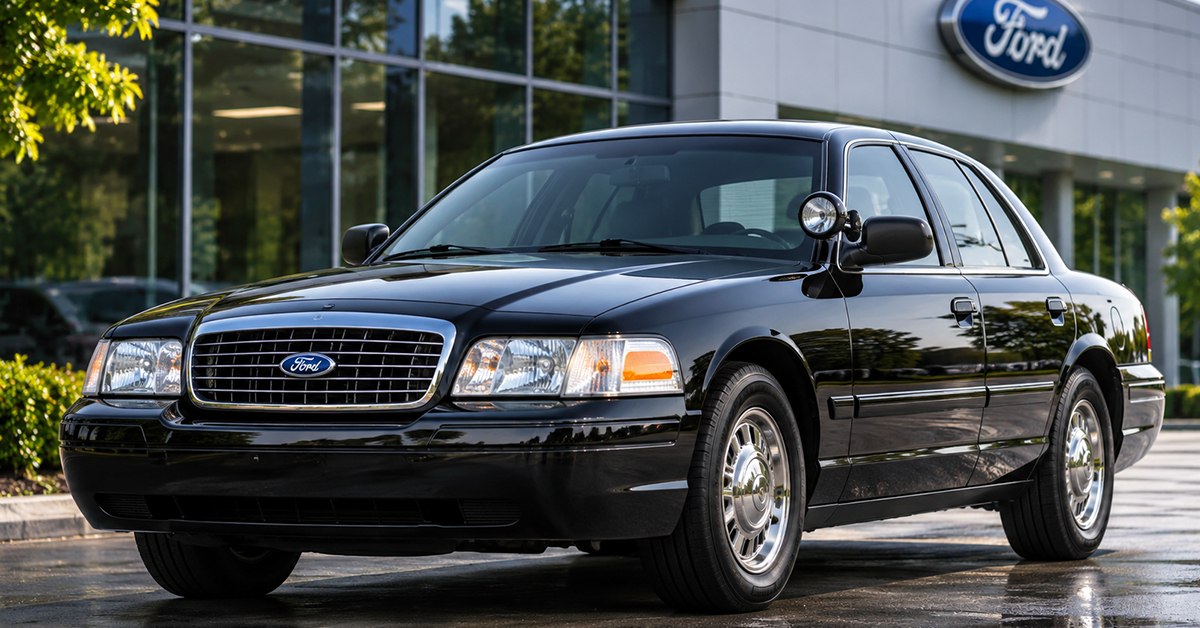
AI-generated concept illustration — Ford Crown Victoria. | Rev N Rise
The Ford Crown Victoria from the 1992 redesign on the Panther platform through the 4.6-litre V8 Police Interceptor and taxi years to the last car built in Ontario in 2011: engines, sales and what is known.
The Ford Crown Victoria was a full-size, rear-wheel-drive sedan that Ford built in Canada for the 1992 to 2012 model years. A reference history gives production as January 1991 to September 15, 2011, at the St. Thomas Assembly plant in Southwold, Ontario (reported). Ford’s own heritage post says Crown Victoria production at St. Thomas ended in late 2011, as Chicago Assembly moved to the new Police Interceptor and Interceptor Utility (Ford). We use the 2011 date for the end of production and 1992 for the start of the model years.
| Model years | 1992 to 2012 (reported) |
| Production, one source | January 1991 to September 15, 2011 (reported) |
| Plant | St. Thomas Assembly, Ontario (reported) |
| Platform | Panther, body-on-frame (reported) |
| Layout | Rear-wheel drive (reported) |
| Siblings | Grand Marquis, Town Car (reported) |
| Police version | Dedicated from 1992 (Ford) |
| Taxi version | Long wheelbase, 2002 to 2011 (reported) |
| Panther total | 9.6 million, or almost 10 million (reported) |
| St. Thomas total | Over 1.5 million cars (reported) |
The car sat on the Panther platform. A reference history says the Crown Victoria was built on the rear-wheel-drive, body-on-frame Panther platform, sharing its chassis with the Mercury Grand Marquis and the Lincoln Town Car, and that it was the last car made on that platform (reported). A news feature says the platform ended with the Crown Victoria after the longest run of any American platform, with more than 9.6 million units sold (reported). Another report says almost 10 million sales, so we carry both figures.
The Crown Victoria was best known as a police car and a taxi. A reference history says a Police Interceptor version was sold from 1992 to 2011, and that a long-wheelbase sedan built from 2002 to 2011 was marketed mainly to taxi fleets (reported). Ford’s own heritage post says that in 1992 Ford debuted a dedicated Crown Victoria Police Interceptor with a 4.6-litre V8 and beefed-up electrical, cooling and braking systems (Ford). Later sections cover both uses.
Ford’s own pages that we could read are strongest on the police car. They include a Ford police-vehicle page, a 2011 Police Interceptor brochure, a 2011 fleet release and a 2025 heritage post. They say less about the civilian car, so most of the 1990s and 2000s retail story, including engines, trims and sales, comes from reference histories and magazines and is tagged (reported). We state where a figure comes from so the source type is always clear.
The numbers of cars built are also reported, not Ford-confirmed. A reference history says St. Thomas Assembly produced over 1.5 million cars, including Police Interceptors, from 1991 to 2011 (reported). An Australian news report says that at its peak the plant made 250,000 Crown Victorias and Lincoln Town Cars a year, but only 80,000 in 2010 (reported). Ford’s own pages we read give no total for the Crown Victoria alone, so we give none of our own. Readers who need production counts by year should consult an industry database, since the figures in magazines rarely agree.
The car has a long family tree. A reference history says the Crown Victoria name was used on a premium two-door Ford Fairlane in 1955 and 1956 and later on the LTD Crown Victoria (reported). We keep distinct models separate, so the 1950s car is covered only briefly here and the Mercury Grand Marquis and Lincoln Town Car get no figures of their own. Our wider Ford history article gives the company context for the full-size sedan era.
The Crown Victoria name is older than the car most people remember. A reference history says the name was used on a premium two-door Ford Fairlane from 1955 to 1956 (reported). A used-car guide says 24 years passed before the Crown Victoria rejoined the Ford lineup (reported). A reference history says the LTD Crown Victoria then became a stand-alone model line in 1983, alongside its Mercury Grand Marquis counterpart (reported). Another source dates the LTD Crown Victoria to the 1979 model year, so we carry both dates (reported).
| Name first used | 1955 Fairlane Crown Victoria (reported) |
| Two-door years | 1955 and 1956 (reported) |
| LTD Crown Victoria | 1979 or 1983, by source (reported) |
| Redesign code | EN53 (reported) |
| Unveiled | November 28, 1990 (reported) |
| Launched | March 21, 1991 (reported) |
| Fleet delay | 14 months (reported) |
| New engine, 1992 | 4.6L Modular V8 (reported) |
| Earlier engines | 5.0L and 5.8L Windsor V8 (reported) |
| Chrome grille added | 1993 (reported) |
The 1992 car was a major redesign. A reference history says development began in the first quarter of 1987 under the code name EN53, and that the car was unveiled on November 28, 1990, with production starting in January 1991 as a 1992 model and a launch on March 21, 1991 (reported). It adds that fleet sales were postponed for 14 months to maximise availability for retail buyers (reported). We found no Ford release for the launch, so these dates are tagged as reported.
The Crown Victoria was not meant to last. A used-car guide says the Taurus was intended to replace the full-size, rear-wheel-drive Crown Victoria, but the car’s popularity as a fleet vehicle motivated a complete redesign for 1992 (reported). That account fits the later history, in which the Crown Victoria outlived the plan for its replacement by many years. Ford’s own pages we read do not describe that decision, so we present it only as a reported explanation.
The 1992 design drew some complaints. A heritage magazine says Ford received complaints about the Taurus-like grille-less nose, so a proper chrome grille was added for 1993, and that a mild restyle for 1995 brought a new grille, taillights and alloy wheels (reported). A reference history says the 1992 to 1997 car had an aerodynamic look that was dropped in the 1998 restyle (reported). Ford’s own pages we read do not mention those changes, so we leave them as reported commentary, and we found no Ford statement on how buyers reacted to the 1992 design.
The engine changed too. A reference history says the 5.0-litre and 5.8-litre Windsor V8 engines gave way to the overhead-cam 4.6-litre Modular V8 for 1992, and that no other American car at the time used a comparable engine apart from the similar Grand Marquis and Town Car (reported). Ford’s own heritage post says an optional 5.8-litre high-output V8 was available on the earlier car, and that the dedicated police car of 1992 used the 4.6-litre V8 (Ford).
Early sales are not documented by Ford in the pages we read. An Australian heritage feature says the Panther family’s first-year sales exceeded 340,000 buyers in 1979, and that Ford, Mercury and Lincoln together sold 250,000 units even in 2000 (reported). That figure covers three brands and many years, so it is not a Crown Victoria figure. We found no source for annual 1992 to 1997 Crown Victoria sales, and we give none. That is a gap in this article, and we prefer to say so than to estimate.
The Panther platform explains a lot about the Crown Victoria. A reference history says the Panther family ran from 1978 to 2011, and that Ford and Mercury versions were assembled at Hazelwood, Missouri until 1985, before production moved to St. Thomas, Ontario for the 1986 model year (reported). It says Lincoln versions came from Wixom, Michigan until 2007, and that the Town Car was built at St. Thomas from 2008 to 2011 (reported). Ford’s own pages we read do not describe the platform history.
| Panther years | 1978 to 2011 (reported) |
| Frame | Body-on-frame (reported) |
| Hydroformed frame | Police brochure: yes (Ford) |
| Engine | 4.6L SOHC Modular V8 (reported) |
| 2011 base power | 239 hp, 281 lb-ft (reported) |
| 2004 base power | 224 hp (reported) |
| Police power | 250 hp (Ford) |
| Police torque | 297 lb-ft (Ford); 287 in 2004 (reported) |
| First police V8 | 190 hp, 260 lb-ft (reported) |
| Gearbox | Four-speed automatic (reported) |
A rear-wheel-drive, body-on-frame layout was unusual by the end. A reference history says the Crown Victoria was one of Ford’s products that were not of unibody construction for the entire generation (reported). An enthusiast site says a hydroformed steel chassis arrived in 2003 (reported). Ford’s own 2011 brochure describes a heavy-duty hydroformed body-on-frame construction for the police car (Ford). Those statements agree on the frame type, though not on when each change happened, so we give the 2003 date only as reported. A buyer who needs to know which frame a particular car has should check its VIN and build sheet, because the sources we found do not give a changeover date by model.
The standard civilian engine was a 4.6-litre V8. A parts and spec site lists the 2011 Crown Victoria at 239 horsepower and 281 lb-ft (reported), and a used-car listing lists 239 horsepower for 2006 (reported). A listing for 2004 gives 224 horsepower (reported), and a motoring site says the base car made between 200 and 224 horsepower depending on how new it was (reported). The outputs therefore changed over the years, and we found no Ford table to give exact years.
The police engine had its own figures. Ford’s police-vehicle page says the 4.6-litre V8 delivers 250 horsepower (Ford). Ford’s 2011 brochure gives the engine as a 4.6-litre OHC SEFI V8 flex-fuel unit with 250 horsepower and 297 lb-ft of torque, calling it the only squad car in its class with a standard V8 (Ford). A motoring-data site lists 287 lb-ft for a 2004 police car (reported). We carry both torque values, because the model years differ.
Earlier police outputs are lower in the sources we found. A history page says the first-generation police car had a 4.6-litre V8 with 190 horsepower and 260 lb-ft, and that the 1998 car offered up to 200 or 215 horsepower (reported). A model-year guide says the police engine was increased to 250 horsepower in 2004 and could run E85 blended fuel from the 2008 model year (reported). Ford’s own pages we read do not list those earlier outputs, so we tag them all as reported.
The transmission was an automatic with four speeds. A reference history lists 4-speed automatics throughout, including the AOD for the earliest cars and the 4R70W and 4R75W later (reported). Ford’s own pages we read do not describe the gearbox. A vehicle-data site gives fuel economy of 15 to 18 mpg combined for a police car (reported), and we found no Ford figure for the civilian car.
The 1998 Crown Victoria was the shape most people recall. A news feature says 1998 brought a major redesign that created the signature look the car would wear to the end of its life (reported). A heritage magazine says the 1998 LX shared its roofline with the Grand Marquis, giving a formal C-pillar in place of the rear quarter window of the 1992 to 1997 cars (reported). A reference history says Ford eliminated the aero look and adopted the more conservative Grand Marquis styling (reported).
| Restyle | 1998 model year (reported) |
| 1998 roofline | Shared with Grand Marquis (reported) |
| 1998 changes | Rear suspension, larger rotors (reported) |
| Ignition | Coil-on-plug from 1998 (reported) |
| ABS standard | 1999 (reported) |
| Trunk release | Emergency release, 2000 (reported) |
| Extended length | First sold 2002 (reported) |
| Starting price, 2003 | $23,705 (reported) |
| LX Sport MSRP, 2006 | $31,605 (reported) |
| Retail sales, 2006 | About 3,000 (reported) |
Mechanical changes came with it. A used-car guide says the 1998 redesign included changes to the rear suspension and larger brake rotors, and that a coil-on-plug ignition replaced a distributorless system (reported). A model-year guide says anti-lock brakes became standard in 1999 and an emergency trunk release was added in 2000 (reported). Ford’s own pages we read do not list those changes, so they remain reported, and we give no pricing or equipment tables for particular trims. A reader who needs equipment by year should use the original brochure for that model year, since lists changed often and we found none from Ford.
A longer car was added in 2002. A model-year guide says an extended-length sedan was first sold in 2002 (reported), and a reference history says the long-wheelbase Crown Victoria from 2002 to 2011 was marketed mainly to taxi fleets (reported). Ford’s own pages we read do not give the extra length, so we give none. The long-wheelbase car matters mainly for the fleet story told in a later section, where we cover taxi and livery use.
Prices are reported only. A motoring site says the Crown Victoria started at $23,705 in 2003, making it the cheapest of the Panther cars (reported). A listing for the 2006 LX Sport trim gives an MSRP of $31,605 (reported). A third listing gives $27,945 for a 2004 trim (reported). Those prices are for different trims and years, so they do not conflict, but they are not Ford price lists, and we give no other prices.
Retail sales faded in the 2000s. A green-car news site reported that, compared with total sales of over 50,000 Crown Victorias in 2006, retail sales were only 3,000, showing the car was already primarily a fleet car (reported). A heritage feature says output slipped to 61,000, of which only 3,000 were retail, without naming the year (reported). Because the totals differ and one has no year, we do not pick a single number for annual output, and we found no Ford figure to settle it.
A performance sibling existed. A reference history lists the Mercury Marauder as related to the Crown Victoria and Police Interceptor (reported). Ford’s own pages we read do not describe it, and we keep distinct models separate, so we give no Marauder specifications. We also give no top speed or acceleration figures for the Crown Victoria, because we found no Ford figures for them. The car was built for durability and simplicity more than speed, which is how motoring writers describe it (reported).
The Crown Victoria Police Interceptor became the standard American patrol car. A police-industry feature says the police version was designated the P71 and was built on the body-on-frame Panther platform (reported). Ford’s heritage post says that in 1992 Ford debuted a dedicated Crown Victoria Police Interceptor with a 4.6-litre V8 engine and other police-friendly attributes, such as beefed-up electrical, cooling and braking systems (Ford). A reference history says it was the first vehicle to use the Police Interceptor name (reported).
| First dedicated police car | 1992 (Ford) |
| Police code, 1998 to 2009 | P71 (reported) |
| Police code, 2010 and 2011 | P7B (reported) |
| Police engine | 4.6L V8, 250 hp (Ford) |
| Police torque, 2011 | 297 lb-ft (Ford) |
| Steering | Rack-and-pinion (Ford) |
| Options | Fire suppression, ballistic door panels (Ford) |
| Ford police-market share | About 80 per cent (Ford) |
| Ford share of pursuit sales | 85 per cent in the US (Ford) |
| Police leadership | 15 years by 2011 (Ford) |
Ford’s police-vehicle page describes the equipment. It says all Police Interceptors feature rack-and-pinion steering for improved handling, with an available fire suppression system and ballistic door panels, and that the 4.6-litre V8 delivers 250 horsepower (Ford). Its 2011 brochure says the car had a standard V8 and a flexible-fuel capability that could earn fleet credits under US energy law (Ford). Those are Ford’s own marketing statements, and we did not test the equipment.
Ford said it dominated the police market. Its police-vehicle page says Ford owned about 80 per cent of total annual sales in the police vehicle market (Ford). Its 2011 fleet release says Ford had held 15 years of leadership in police fleet sales (Ford), and that in 2009 it had 32 per cent of commercial and 44 per cent of government fleet sales (Ford). Ford’s heritage post says the Crown Victoria accounted for 85 per cent of police pursuit vehicle sales in the United States (Ford).
The police share of production grew over time. A heritage feature says fleet sales increasingly made up the majority of Crown Victoria production over time (reported). A trade report says that from 2008 the car was sold only to fleets, mainly police and taxi buyers (reported). Ford’s own pages we read do not give a police-only production number, so we give none. We also found no Ford figure for how many Police Interceptors were built in total.
The model code changed over the years. A reference history says the police car was also called the P71 from 1998 to 2009 and the P7B for 2010 and 2011 (reported). It says Ford introduced the Crown Victoria Police Interceptor badge in 1999, replacing the 1998 Crown Victoria badge on the trunk lid (reported). Ford’s own pages we read do not cover the badge history, so we treat those details as reported and do not use them to date any particular car. Collectors should check a car’s trunk badge, VIN and build sheet together instead of relying on any one of them.
Police departments stocked up at the end. A radio report says some departments did not want to take a risk on the replacement and were buying Crown Victorias in advance (reported). A news report says many agencies stocked up in the final months, and a news feature says sales of the Crown Victoria and Town Car rose in 2011 as police, taxi and limousine companies stockpiled them (reported). A trade report, covered in an earlier section, says 2011 output was roughly double the year before (reported).
Ford ended retail sales of the Crown Victoria after the 2008 model year. A trade report said that after 2008 the Crown Victoria would be sold as a fleet car only, still available to police departments and taxi operators, with the Grand Marquis staying in the retail lineup (reported). A news feature says Ford moved the Crown Victoria to its fleet sales division in 2008, effectively turning it into a full-time taxi and police car (reported). Ford’s own pages we read do not describe the decision.
| Retail sales ended | After 2008 (reported) |
| Moved to fleet division | 2008 (reported) |
| Taxi version | Long wheelbase, 2002 to 2011 (reported) |
| NYC taxis, 2007 | 2,500 Crown Victorias (reported) |
| Hybrid requirement | By 2012 (reported) |
| Last Grand Marquis | January 2011 (reported) |
| 2011 built to Aug 27 | 60,376 Crown Victorias (reported) |
| 2011 Town Cars | 10,390 (reported) |
| 2011 Grand Marquis | 165 (reported) |
| 2011 output vs 2010 | Roughly double (reported) |
Taxi use was an important market. A reference history says the long-wheelbase Crown Victoria sold from 2002 to 2011 was marketed primarily for taxi fleets (reported). A radio report quotes a Chicago taxi driver whose Grand Marquis, a sister car, had 160,000 miles on it, and quotes another saying the car was not good on fuel but very nice for other things (reported). Those are individual opinions, not Ford data, so we use them only for flavour.
New York was a notable customer. A news report said the New York City taxi fleet held 2,500 Crown Victorias in 2007 and that a hybrid requirement would remove them from service by 2012 (reported). Another report said Ford was discontinuing the popular fleet vehicle in 2011, leaving the New York City Taxi and Limousine Commission in search of a replacement (reported). Ford’s own pages we read do not mention taxis, so we give no taxi sales figures, and we found no Ford number for how many Crown Victorias were sold as taxis in any year.
Livery and limousine companies used the Town Car more than the Crown Victoria. A radio report calls the Town Car the usually black limousine of the pair, and says they are essentially the same car underneath (reported). We keep distinct models separate, so we do not describe the Lincoln further. A motor-industry history says the last Mercury Grand Marquis came off the line in January 2011 at the same plant, after Ford discontinued the Mercury brand (reported).
The fleet focus shaped production totals. A trade report says that through August 27, 2011 the plant had built 60,376 Crown Victorias, 10,390 Town Cars and 165 Grand Marquis since the start of the year, and that Crown Victoria output that year was roughly double the year before (reported). It says the Crown Victoria was limited by Ford to fleet delivery to taxi and police buyers (reported). Ford’s own pages we read give no matching totals, so we leave these as reported, and we did not check them against any official count.
Ford’s rivals are mentioned in the reports. An Australian trade site says that the end of the Crown Victoria did not automatically deliver a win for the Chevrolet Caprice police car, because many agencies had stocked up on Crown Victorias in the final months (reported). A Canadian news site quotes a police chief in South Carolina who preferred the outgoing model to its replacement (reported). Those are opinions, and we found no Ford statement about competitors in the pages we read.
The end was announced two years early. A wire report from August 28, 2009 said Ford would close out Crown Victoria production at its Ontario plant in 2011, and that it had no replacement planned for the car, citing a daily newspaper (reported). A trade site said Ford had previously announced that production would cease around the end of 2011 but offered no successor until a release in November 2009 announced an all-new Police Interceptor (reported). Ford’s own 2011 fleet release confirms the new sedan was coming (Ford).
| End announced | August 2009 (reported) |
| Replacement unveiled | November 2009 (reported) |
| Replacement on sale | 2012 (Ford) |
| Last car | September 15, 2011, 12:25 p.m. (reported) |
| Last car type | White, export to Saudi Arabia (reported) |
| Plant closed | Yes, St. Thomas (reported) |
| Production decline | 60 per cent in a decade (Ford, reported) |
| Peak plant output | 250,000 a year (reported) |
| Output in 2010 | 80,000 (reported) |
| Workers affected | About 1,200 (reported) |
Ford’s fleet release says Ford would offer a new Police Interceptor sedan when production of the Crown Victoria ended in 2011, maintaining its 15-year leadership in the police fleet market (Ford). Ford’s heritage post says that by 2011, with Ford still leading the market, it was time to replace the Crown Victoria, and the new Police Interceptor and Interceptor Utility went on sale in 2012 (Ford). Our Taurus article covers the Taurus-based Interceptor sedan that took over.
The last car was built on September 15, 2011. A police-industry feature says the final Crown Victoria rolled off the line at St. Thomas Assembly at 12:25 p.m., and that it was a white car destined for export to Saudi Arabia, not a police cruiser (reported). It says the car was the last Panther-platform vehicle and the last full-size, body-on-frame sedan built there (reported). A reference history adds that it was the final vehicle ever built at the plant, which then closed (reported).
Dates for the last car differ slightly. Most reports say September 15, 2011, but a reference history also lists the model years as 1992 to 2012 because some 2012 cars were built for export (reported). A trade site says that on the Wednesday before, workers were sent home early with the final five cars on the line because there were not enough parts (reported). We therefore give September 15 and note that the 2012 model-year cars were export-only.
Why it ended is reported, not documented by Ford in the pages we read. A news report quotes Ford as saying that production levels at the Ontario plant had declined by 60 per cent in the last decade as customer preferences shifted to smaller, more fuel-efficient vehicles (reported). An Australian trade site says that the plant made 250,000 Crown Victorias and Town Cars a year at its peak and only 80,000 in the previous year, and that about 1,200 workers would move to other Ford facilities or take a redundancy package (reported).
The Crown Victoria’s legacy is mainly historical. A news feature calls the Panther the longest-running automotive platform in American history (reported), and a radio report, quoting a blog, calls the Crown Victoria the best-selling Ford car ever in North America, ahead of the Model T (reported). Neither claim comes from Ford in the pages we read, so we do not state them as fact. We found no Ford statement about a successor with a V8 and rear-wheel drive, and we make no claim about one.
The Crown Victoria is best summed up by its mechanical basics. It had a 4.6-litre SOHC V8, a four-speed automatic, rear-wheel drive and a body-on-frame chassis (reported). The base car made about 239 horsepower late in its life, while the police car made 250 (reported, Ford). Ford’s 2011 police brochure also lists a flexible-fuel capability and a heavy-duty hydroformed frame (Ford). For exact specifications of a particular year, use that year’s owner’s manual. We found no Ford page that gives dimensions, boot size, weight or towing figures for the civilian car, so we give none, and a buyer who needs them should measure the car or read the manual. We also found no crash-test results in Ford’s pages, so we make no safety claim.
| Engine | 4.6L SOHC V8 (reported) |
| Transmission | Four-speed automatic (reported) |
| Drive | Rear-wheel (reported) |
| Frame | Hydroformed body-on-frame (Ford) |
| Base power, late | 239 hp (reported) |
| Police power | 250 hp (Ford) |
| Fuel capability | Flexible-fuel (Ford) |
| Real-world economy | 15 to 18 mpg combined, police (reported) |
| Trim, 2006 | LX Sport order code (reported) |
| Used buying checks | Suspension, rust, coils, history (reported) |
Trims are reported. A listing for 2006 names an LX Sport order code and 17-inch tyres (reported), and a 2004 listing mentions 16-inch alloy wheels and privacy glass (reported). A reference history says the 1998 car was badged LX (reported). Ford’s own pages we read do not list the trims. Equipment varied between police, taxi and civilian cars, so a car’s own build sheet or VIN is the reliable guide. A seller’s listing may name the wrong trim, so ask for paperwork that shows how the car was first sold and who owned it.
Ex-police cars need extra care. A used-car guide says buyers should watch for worn suspension components, rust in northern climates and issues related to high mileage and hard use (reported). A vehicle-data site says the 4.6-litre V8’s ignition coils can fail over time, causing misfires (reported). We did not verify those claims, and Ford’s own pages we read give no reliability data. Ask for a full service history and have the car inspected before you buy.
Taxi and fleet cars have their own wear patterns. A radio report quotes a Chicago taxi driver whose sister car had 160,000 miles (reported). High mileage does not necessarily mean a bad car, but a seller should be able to show maintenance records. A car used for police work may also have been fitted with equipment that was later removed, so check for signs of removed equipment and confirm that the electrical system works as it should.
Fuel use is a consideration. A vehicle-data site says a police-spec 4.6-litre V8 is thirsty, averaging 15 to 18 mpg combined (reported), and a news report calls the cars gas-guzzling behemoths (reported). Ford’s own pages we read give no real-world economy figure. A buyer who covers many miles should factor in fuel costs. We give no used-market prices, because they vary widely by year, trim and condition and we found no Ford figure for them.
For the current Ford range, our Ford models page shows what the company sells today. Ford has not announced a successor to the full-size, rear-wheel-drive sedan in the pages we read, and we make no claim about one. Anyone buying a former police car should check whether local rules allow its use on the road before purchase.