 Brands
Ford Thunderbird — History, Generations and Why It Ended
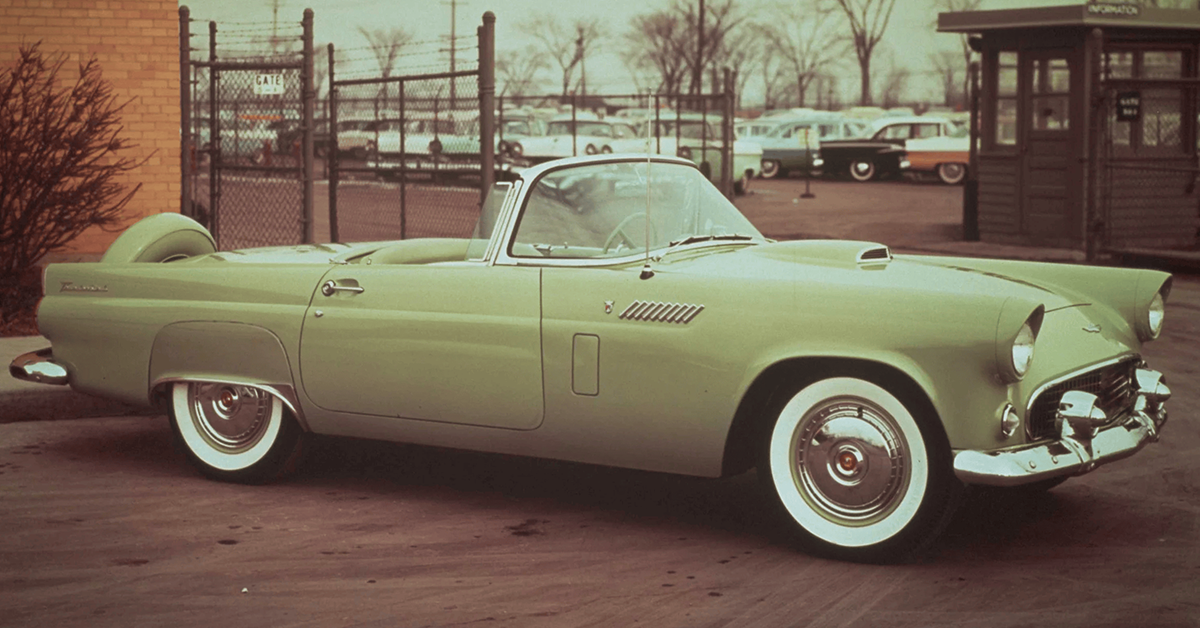
Official press image of the Ford Thunderbird. | © Ford Motor Company
The Ford Thunderbird from the 1955 two-seater and the Square Bird through the Super Coupe and the 2002 retro revival to the last car built in Wixom in 2005: engines, sales and what is known.
The Ford Thunderbird was a two-door Ford that began as a small two-seat convertible in 1955 and grew into a family of personal luxury cars. A reference history gives the model years as 1955 to 2005, with a hiatus from 1997 to 2002, across 11 generations (reported). Ford’s own history page says the car was the brainchild of two men, George Walker and Louis D. Crusoe, and that it first appeared on February 20, 1954 at Detroit’s first post-war auto show (Ford).
| Model years | 1955 to 2005 (reported) |
| Hiatus | 1997 to 2002 (reported) |
| Generations | 11, or 13 by one count (reported) |
| First shown | February 20, 1954, Detroit (Ford) |
| Credited creators | George Walker, Louis D. Crusoe (Ford) |
| On sale | October 1954 as a 1955 model (Ford) |
| Total built, one source | Over 4.4 million (reported) |
| Total sold, other source | 4.2 million to 2005 (reported) |
| Market segment | Personal luxury car (reported) |
| Last car | July 1, 2005 (reported) |
The Thunderbird is easiest to follow by era. The 1955 to 1957 cars were two-seaters, and the 1958 to 1960 cars were four-seat Square Birds. A reference history says the line was then redesigned and enlarged several times, downsized in 1977, 1980 and 1983, and ended in 1997 before a two-seat revival for 2002 to 2005 (reported). We keep distinct models separate, so we do not cover other Ford cars that shared its platforms.
Generation counts and totals differ. One reference history counts 11 generations, while another site counts 13 (reported). The first history says Ford produced over 4.4 million Thunderbirds from 1955 to 2005 (reported), but a wire report quoted in a trade site says Ford had sold 4.2 million since the nameplate was introduced in 1954 (reported). We carry both totals and use years instead of generation numbers wherever possible.
Ford’s own pages that we could read are strongest on the first generation. They include a Ford history page, a Ford heritage post from November 2024 and a Ford vehicle-history page that lists the car’s early specifications. They are thinner on the 1970s, 1980s and 1990s, and on the 2002 revival, so those eras rely on reference histories, museum records and magazines, and every such figure is tagged (reported).
The Thunderbird also set the template for a market segment. A reference history says that with the addition of seats in 1958, the Thunderbird led a new market segment, the so-called personal luxury car (reported). Another history says Ford positioned it as a personal car, not a sports car, to avoid direct competition with the Chevrolet Corvette (reported). Those are historians’ descriptions, so we present them as reported. The word personal in the segment name refers to the buyer’s own use and comfort more than to any single feature, and we use it that way here. Readers who want the exact wording should look at period brochures, which we did not find in Ford’s own pages.
Some limits apply to this article. We give no current used-car values, because prices swing widely with condition and originality, and we found no Ford figure for them. We also give no claim about a future Thunderbird, because the Ford pages we read mention none. Where two sources disagree, we show both values and say which kind of source each is, so you can judge them yourself. Our wider Ford history article gives the company context, and the sections below take the Thunderbird in order, from the 1955 original to the last car built in 2005.
The first Thunderbird went on sale in October 1954 as a 1955 model, according to Ford’s vehicle-history page (Ford). The page says it had a 102-inch wheelbase, an overall length of 175.2 inches and a 292-cubic-inch V8 with 193 horsepower with the manual transmission and 198 with the automatic (Ford). A museum record lists 193 horsepower at 4,400 rpm and 280 lb-ft at 2,600 rpm for a manual car (reported). Those two sources agree on the main numbers.
| On sale | October 1954 (Ford) |
| Wheelbase | 102 in (Ford) |
| Length, 1955 | 175.2 in (Ford) |
| Engine, 1955 | 292 cu in Y-block V8 (Ford) |
| Power, 1955 | 193 hp manual; 198 hp automatic (Ford) |
| 1955 sales | 16,155 (reported) |
| 1955 Corvette sales | 674 or 700 (reported) |
| 1956 sales | 15,631 (reported) |
| 1957 sales | 21,380 (reported) |
| Three-year total | 53,166 (reported) |
Ford’s 2024 heritage post says the car included the then-new Y-Block V8 engine, capable of producing as much as 198 horsepower and speeds in excess of 100 mph, which were highlighted in promotional materials (Ford). A reference history says the car came with a removable fiberglass top as standard, with a fabric convertible top as a commonly specified option (reported). Another source says the 1955 car returned about 18 mpg (reported), which we treat as an approximate figure.
The car was a direct answer to a rival. A reference history says the concept was a two-passenger open car with a target weight of 2,525 pounds, and that Ford intended it as a response to the Chevrolet Corvette (reported). A heritage article says Ford sold 16,155 Thunderbirds in 1955 against 674 Corvettes, and other sources give 700 Corvettes (reported). The two Corvette figures conflict, so we carry both. All sources agree on the 16,155 Thunderbird figure.
Ford had expected far fewer buyers. A heritage article says the optimistic forecast for the first year was 10,000 cars, and that Ford received 3,500 orders in the first ten days (reported). A sports-car site says 16,155 was the maximum that could be built at that time (reported). Ford’s own pages we read do not give the forecast or the order figures, so we leave them as reported, and we found no Ford figure for the original price. A reference history gives a listed retail price of $2,944 for 1955, and another gives a base price still under $3,500 for 1957 (reported), but those are not Ford price lists, so we do not treat them as official.
Ford’s vehicle-history page says the distinctive spare tyre mounting and porthole windows were introduced in 1956, and that the porthole hardtop endured as a Thunderbird signature (Ford). A reference history says the 312-cubic-inch V8 was added as an option for 1956, rated at 215 horsepower (reported). The 1956 car was the lowest-selling of the three, at 15,631 units, according to a reference history that lists 16,155, 15,631 and 21,380 for 1955, 1956 and 1957 (reported).
The 1957 car had the most engine options. A heritage post says 1957 offered 2-barrel and 4-barrel 292 engines at 212 and 245 horsepower, a dual-4-barrel 312 at 270 horsepower and two supercharged versions (reported). A different source says the 312 reached 245 horsepower in 1957, which does not match, so we carry both (reported). Sales were 21,380, including three extra months of production because the 1958 models were late, according to a reference history (reported). It was the last two-seat convertible Thunderbird until 2002 (reported).
The 1958 Thunderbird was a big change. Ford’s vehicle-history page says the 1958 T-Bird, nicknamed the Squarebird for its angular lines, was named Motor Trend magazine’s Car of the Year and was an immediate success (Ford). A reference history says it was produced from December 1957 to 1960 for the 1958 to 1960 model years (reported). It became a four-seater, and a heritage site says Ford sold more cars than with the previous model (reported).
| Second generation | 1958 to 1960, Square Bird (reported) |
| 1958 award | Motor Trend Car of the Year (Ford) |
| Seats | Four from 1958 (reported) |
| Second-generation sales | 198,191 (reported) |
| Third generation | 1961 to 1963, Bullet Bird (Ford) |
| 1961 length | 205 in (Ford) |
| 1961 inauguration | 50 cars in procession (Ford) |
| 390 V8 | 300 hp (reported) |
| Fourth generation | 1964 to 1966, Flair Bird (reported) |
| 1964 convertible | Nearly 92,500 built (reported) |
The Square Bird’s design is attributed to a stylist later famous for another Ford. A heritage site credits Joe Oros with the styling, and says his talents were later applied to the 1964 Ford Mustang (reported). The same site says Elwood Engel had also presented a design that was rejected (reported). It gives 198,191 units sold over the 1958 to 1960 lifespan (reported). Ford’s own pages we read do not name the designers of the 1958 car, so we leave the credit as reported.
The 1961 car was the Bullet Bird. Ford’s vehicle-history page says it had a rounded silhouette and grille design that gave a bullet-like appearance, was shortened slightly to 205 inches, and that John F. Kennedy included 50 in his 1961 inaugural procession (Ford). A used-car site says the 1961 Thunderbird was the pace car for the Indianapolis 500 and that Ford introduced a 390-cubic-inch V8 with 300 horsepower (reported). Those engine details come from a second-hand listing and not from Ford.
Two variants arrived for 1962. A history of the Thunderbird says that two derivative models were added for 1962, the Sports Roadster and the Landau (reported). A guide says that in 1963 Ford began putting alternators into its cars instead of the usual generator (reported). Ford’s own pages we read do not describe either change, and we found no Ford figure for the production of the Sports Roadster, so we give none.
The 1964 car was the Flair Bird. A used-car site says the 1964 Thunderbird moved from sleek styling to a blunter, more formal look (reported), and a history says the 1964 convertible set a production record of nearly 92,500 cars (reported). A Canadian site says the car needed 11 seconds to reach 100 km/h, which it describes as not exactly a dragster (reported). That time is a magazine remark, not a Ford specification, so we treat it as approximate.
Rival cars followed the Thunderbird’s lead. An American magazine says other brands followed, naming the 1962 Studebaker Gran Turismo Hawk, 1963 Buick Riviera, 1966 Oldsmobile Toronado and 1967 Cadillac Eldorado, and says they owe a debt to the 1958 Thunderbird (reported). That is the writer’s opinion, and Ford’s own pages we read make no such claim. We found no Ford sales figures for 1961 to 1963 or 1965 to 1966, and we give none. A reader who needs exact production by year should consult a registry kept by an owners’ club. Figures quoted in magazines can differ from factory records, so we label every one, and we do not round them up.
The fifth-generation Thunderbird of 1967 was bigger. A reference history lists the fifth generation as 1967 to 1971, nicknamed the Glamor Bird, with a four-door version (reported). A Canadian site says that in 1967 the Thunderbird got fatter and came in four-door versions (reported). Ford’s own pages we read do not describe those years, and we found no Ford figures for them, so we give no engine or sales numbers for the 1967 to 1971 cars.
| Fifth generation | 1967 to 1971, Glamor Bird (reported) |
| Four-door | Offered from 1967 (reported) |
| Downsized | 1977, 1980 and 1983 (reported) |
| 1977 production | 318,140 (reported) |
| 1977 platform | Shared with Torino (reported) |
| 1983 car | Smaller, turbo option (reported) |
| Ford figures, 1970s and 1980s | None found in pages read (Ford) |
| Sales trend | Good until the 1990s (reported) |
| Coupe market | Large coupes unpopular by 1990s (reported) |
| Record year, one source | 1977 (reported) |
The Thunderbird kept growing until 1977. A reference history says succeeding generations became larger until the line was downsized in 1977, again in 1980 and once again in 1983 (reported). A British magazine says the 1977 Thunderbird was popular in a way no previous version had been, and that in 1977 alone Ford built 318,140, more than the entire production run of any other generation (reported). That is the highest annual figure we found.
The 1977 car used shared parts. A Canadian site says Ford put the Thunderbird on a diet in 1977 by having it share its underpinnings with the Torino (reported). We do not have a Ford page for the car’s specifications, so we give no weight or engine figures. A Canadian site says that by 1980 the Bird was nothing but a shadow of its former self, with declining sales as the evidence (reported).
The 1980 car was smaller but not a success. A reference history lists the downsizing for 1980 and a further one for 1983 (reported). A Canadian site says Ford had to save the Thunderbird for 1983, with a smaller, more aerodynamic car that could be ordered with a turbo engine (reported). Ford’s own pages we read do not mention the turbo engine, so we give no outputs, and we make no claim about how well the 1980 and 1983 cars sold.
Commentary from the period is mixed. A motoring magazine says that over those decades the Thunderbird was often, to put it bluntly, not an attractive car (reported). A reference history says sales were good until the 1990s, when large two-door coupes became unpopular (reported). These are opinions and broad summaries. We found no Ford page that ranks the Thunderbird against rivals in the 1970s or 1980s, and we do not repeat unsourced claims about its market share. We found no Ford statement on how the 1970s cars were priced or equipped, so we give no list of options or trims for them. We also found no Ford figure for the 1980 car’s weight or its engines, so we give none, and we do not compare the 1983 car’s sales with the 1980 car’s. Readers who need those details should check period brochures or an owners’ club, and should treat magazine summaries as approximate.
Production totals for the middle generations are thin. A heritage site says the 1964 convertible set a record of nearly 92,500 cars, and a magazine says 1977 production was 318,140 (reported). We did not find reliable annual totals for the 1967 to 1971 or 1980 to 1982 cars, and Ford’s own pages we read give none. A reader who needs exact figures should use an industry production database, since magazine totals can differ from factory records.
The tenth generation arrived in 1989. A heritage site says the Thunderbird arrived later than other 1989 Ford models and was the start of the tenth generation (reported). A Canadian site says it was beautifully sleek, that it had lost its V8 but gained independent suspension (reported). A reference history lists the generation as running from 1989 to 1997 (reported).
| Tenth generation | 1989 to 1997 (reported) |
| Hardtop coupe, 1989 | $14,610 (reported) |
| LX Coupe, 1989 | $16,815 (reported) |
| Super Coupe, 1989 | $19,820 (reported) |
| 1989 production | 107,996 (reported) |
| 1989 to 1997 production | 961,625 (reported) |
| Suspension | Independent, added in 1989 (reported) |
| Super Coupe built | Through 1995 (reported) |
| Ended | September 1997 (reported) |
| Hiatus | Five years to 2002 (reported) |
Prices are listed for 1989. A heritage site says the hardtop coupe was priced at $14,610, the LX Coupe at $16,815 and the Super Coupe at $19,820 (reported). It gives total 1989 production as 107,996 units and total tenth-generation production from 1989 to 1997 as 961,625, just short of a million (reported). Ford’s own pages we read do not give those figures, so we tag them as reported, and we do not convert them to present-day money. Prices at the time depended on options and on the dealer, and we found no Ford price list, so the quoted figures are base prices from one source and are not guaranteed to match what a given buyer paid. We also found no Ford figure for how many Super Coupes were built, and we give no total for them. Ford’s own pages we read do not say when the Super Coupe was dropped, so we use the reported date.
The Super Coupe was the performance version. A writer for an American classic-car magazine says the Super Coupe was built through 1995 and was the favourite car of the 1989 to 1997 series, praising its design and the way the supercharged model drove (reported). That is one writer’s opinion. Ford’s own pages we read do not give the Super Coupe’s output or other specifications, and we found no reliable figure in the sources we read, so we give none.
Engines changed during the run. A Canadian site says the 1989 car lost its V8 (reported). An online forum post disagrees about which V8 arrived when, and we do not rely on forum posts, so we give no engine list for the 1989 to 1997 cars. Ford’s own pages we read do not settle the point.
The generation did well for a time. A magazine says that customers liked it, but the market for big coupes was dying and SUVs were taking over (reported). A reference history says large two-door coupes became unpopular in the 1990s (reported). A fan site says that, although well received by critics, the later cars never quite achieved the sales success of the previous generation (reported). We found no Ford statement for the reason, and we do not offer one of our own.
Production ended in 1997. A fan site says that in September 1997 Ford pulled the plug on the Thunderbird altogether, ending more than four decades of continuous production (reported). A museum record says Ford discontinued the Thunderbird in 1997 and revived it for 2002 (reported). A reference history lists production as October 1954 to September 1997 for the first run (reported). Ford’s own pages we read do not give an announcement date, so we give September 1997 as reported.
The Thunderbird returned for 2002 as a two-seat convertible. A reference history says the concept was introduced in 1999, and that production ran from June 2001 to July 2005 for the 2002 to 2005 model years (reported). It says the car shared mechanicals with the Lincoln LS, used Ford’s DEW platform, and was part of a retro-styling trend of the late 1990s and early 2000s (reported). A museum record says Ford revived the storied model for 2002 after discontinuing it in 1997 (reported).
| Concept | 1999 (reported) |
| Production | June 2001 to July 2005 (reported) |
| Platform | Ford DEW, shared with Lincoln LS (reported) |
| Engine | 3.9L Jaguar-designed V8 (reported) |
| 2002 power | 252 hp (reported) |
| 2003 power | 280 hp, with variable valve timing (reported) |
| 2002 torque | 267 or 261 lb-ft (reported) |
| 2002 hardtop price | $39,795 (reported) |
| 2003 base price | $40,260 (reported) |
| Built at | Wixom, Michigan (reported) |
The engine was a Jaguar-designed 3.9-litre V8. A magazine says the aluminium DOHC V8 produced 252 horsepower and drove a close-ratio five-speed automatic (reported). A museum record lists 252 horsepower at 6,100 rpm and a price of $39,795 for the 2002 hardtop (reported). Torque differs by source: 267 lb-ft in one listing and 261 lb-ft at 4,300 rpm in an industry table, so we carry both (reported). Ford’s own pages we read do not give an official figure.
The 2003 car had more power. A model-year guide says that for 2003 the engine was upgraded with variable valve timing and rose to 280 horsepower (reported), and a newspaper road test lists 280 horsepower at 6,000 rpm and 286 lb-ft at 4,000 rpm, with a base price of $40,260 (reported). A different site says an auto publication listed the 2002 car at 280 horsepower, which does not match, so we show 252 for 2002 and 280 for 2003 as the main values (reported).
The car was styled to recall the original. A reference history says the eleventh generation was noted for styling that strongly recalled the first generation (reported). It describes a two-seat convertible with an optional removable hardtop (reported). Ford’s own pages we read do not describe the design, so we do not attribute it further, and we do not claim the 2002 car was a direct copy of the 1955 car. The shape was described as retro, meaning it borrowed cues from the earlier car, but we found no Ford page that lists which cues were deliberate, and we do not name any.
Production was at Wixom, Michigan. A reference history says the eleventh generation was built at Wixom Assembly, with production reaching just over 68,090 before its discontinuation in July 2005 (reported). Another source says 68,098 units were produced, nearly half in the first year (reported). A wire report quoted in a trade site said Ford had sold 54,360 new-generation Thunderbirds since 2001 (reported). Those totals measure different things, built versus sold, so we carry all three.
Reception was mixed. A motoring site says the 2002 car was not seen as a performance car by Ford, which is why it had only the Jaguar-sourced V8 (reported). A trade magazine says it was not a true roadster, despite its two seats and rear-wheel drive (reported). A museum record says initial strong sales trailed off (reported). Ford’s own pages we read do not give sales by year, and we did not find a Ford statement about the revival’s results.
Ford confirmed the end before the last car was built. A news report says Ford said the 2005 model year would be the last for the retro-styled convertible that went on sale in August 2001 (reported). A trade site quotes the Ford Division president as saying in an interview that the company planned to stop building the car after the 2005 or 2006 model year, ending a four-year run (reported). A news report adds that Ford told employees production would end in July (reported). Ford’s own pages we read do not give the date.
| End confirmed | Before July 2005 (reported) |
| Planned end | 2005 or 2006 (reported) |
| Production end told to staff | July 2005 (reported) |
| Last car | July 1, 2005 (reported) |
| Plant | Wixom, Michigan (reported) |
| Retro run | About four years (reported) |
| Sold since 2001 | 54,360 (reported) |
| Built, one source | Just over 68,090 (reported) |
| Built, other source | 68,098 (reported) |
| All-time total | 4.2 million or over 4.4 million (reported) |
The last car was built on July 1, 2005. A history site says the last Thunderbird emerged from a Ford factory in Wixom, Michigan on that date (reported). The same site says that, despite brisk early sales and good reviews, sales of the new Thunderbird could not justify continued production, and Ford discontinued it again in mid-2005 (reported). A museum record says initial strong sales trailed off and the Thunderbird disappeared again in 2005 (reported). Those are summaries and not Ford statements.
The plant’s future was part of the discussion. A trade site said the production end was another ominous sign for the Wixom assembly plant, which it described as one of the industry’s most underutilised plants (reported). It said Wixom also built the Lincoln LS, which shared the Jaguar S-Type platform (reported). We found no Ford statement about the plant in the pages we read, and we do not repeat claims about its closure here.
A 50th anniversary was marked. A wire photo caption says the anniversary of the Ford Thunderbird was celebrated at the Wixom plant on November 5, 2004 (reported). A Ford site article from 2021 says the car celebrated its 50th anniversary in 2005 despite not being fully produced for 50 years (Ford). The article calls the 2000s car a Heritage Edition, which is not the wording used elsewhere, so we do not repeat it.
Totals at the end are reported. A wire report says Ford had sold 54,360 new-generation Thunderbirds since 2001 and 4.2 million since the nameplate was introduced in 1954 (reported). A reference history says that from 1955 to 2005 Ford produced over 4.4 million (reported). We also saw a claim about output in the final year, but we could not confirm it, so we leave it out. We found no Ford figure for the last year.
Ford has not named a successor. Ford’s own pages we read do not mention a new Thunderbird, and we found no announcement in them. Reference histories describe the 2005 car as the final Thunderbird (reported). We therefore make no claim about the name returning, and we caution readers against rumours not backed by Ford. We found no Ford statement on the final car’s price or its owner, so we give none. A buyer interested in a late car should check its build date, because the last cars were made in 2005, and ask for the full service history, including the roof mechanism.
The best-documented specifications are the first-generation car’s. Ford’s vehicle-history page lists a 102-inch wheelbase, a 175.2-inch length and a 292-cubic-inch V8 with 193 or 198 horsepower for 1955 (Ford). A museum record lists 3,350 pounds, 0 to 60 mph in 7.8 seconds, a top speed of 121 mph and 16.1 mpg for a 1957 car (reported). Those last figures are from a museum display, not a Ford test, so treat them as approximate.
| 1955 wheelbase | 102 in (Ford) |
| 1955 length | 175.2 in (Ford) |
| 1955 power | 193 or 198 hp (Ford) |
| 1957 weight | 3,350 lb (reported) |
| 1957 0 to 60 mph | 7.8 seconds (reported) |
| 1957 top speed | 121 mph (reported) |
| 2002 engine | 3.9L V8, 252 hp (reported) |
| 2002 price | $39,795 (reported) |
| Top classic values | Over $100,000 (reported) |
| Best-documented era | 1955 to 1957 (Ford) |
Later cars are less well documented in Ford’s own pages. The 2002 car is covered by museum records and magazine specifications, which give 252 horsepower and a five-speed automatic (reported). The 1989 car is covered by a heritage site that lists three trims and prices (reported). For exact figures on any year, a buyer should use the factory brochure or owner’s manual for that model year, since we found no Ford tables for most years.
Values for classic Thunderbirds are reported. A motoring site says first-generation 1955 to 1957 models remain the most coveted, with examples in prime condition routinely selling for more than $100,000 (reported). We found no Ford figure for values, and prices vary by condition, originality and engine. A buyer should have a specialist inspect any 1950s car, and should check the body, frame and the original engine number before agreeing a price.
The 2002 to 2005 cars are a different buying proposition. A museum record gives $39,795 as the 2002 price (reported), and a newspaper road test gives a base price of $40,260 for the 2003 car (reported). A used buyer should ask for the service history and check the roof and its hardtop, which are the car’s distinctive features. Ford’s own pages we read give no reliability data for the car, and we do not claim any. We also found no Ford figure for boot space, weight or fuel economy of the 2002 to 2005 car, so we give none, and a buyer who needs them should check the owner’s manual or measure the car. The same applies to towing, tyre sizes and service intervals, which we did not find in any Ford page, so please check them.
A buyer of a 1989 to 1997 car should check the specific version. A heritage site lists three body trims for 1989, including the Super Coupe (reported). A magazine writer praises the Super Coupe but we found no reliability data for it (reported). Because engines and trims changed during the run, the car’s VIN and build sheet are the reliable guides to what it has, and a seller’s listing may name the wrong version.
For the current Ford range, our Ford models page shows what the company sells today. We found no Ford statement about a new Thunderbird, and we make no claim about one. Collectors should join an owners’ club, which can help with parts and with checking authenticity, and should be wary of cars described as original without paperwork. We give no current prices for any generation, because we found no Ford price list.
