 Brands
Ford Galaxy — From Sharan Twin to Hybrid, Seats and Boot
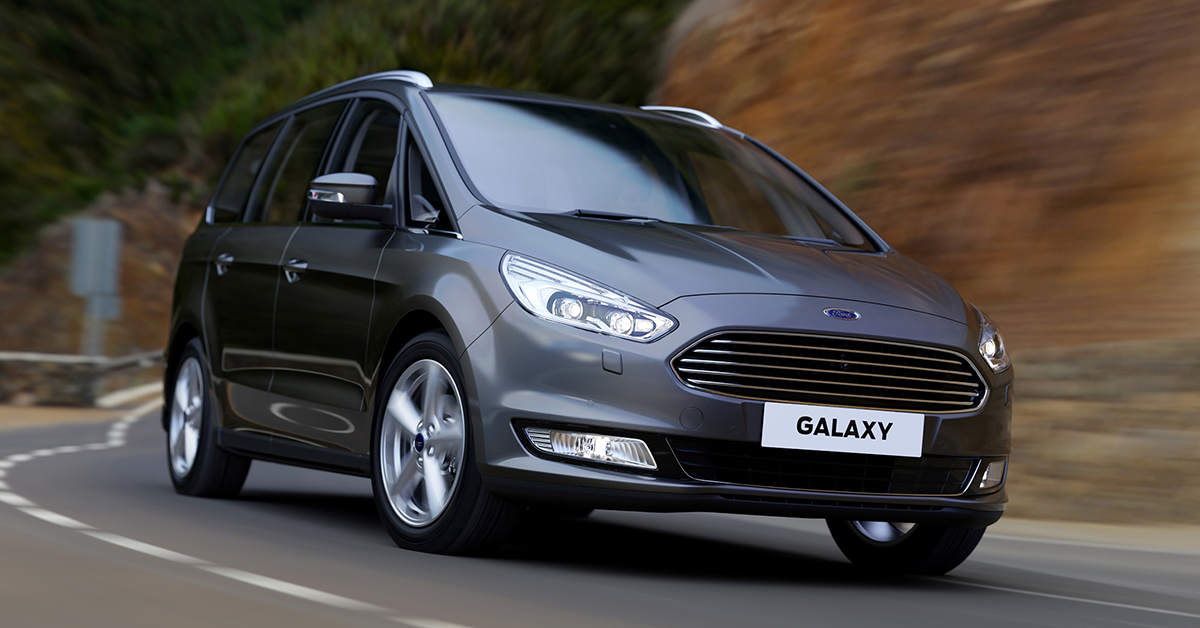
Official press image of the Ford Galaxy. | © Ford Motor Company
The Ford Galaxy from the Volkswagen joint venture of 1995 and the 2006 Genk car to the 2015 Valencia generation, the 2021 full hybrid and the April 2023 end of production, covering seats, boot, engines and all-wheel drive, showing what Ford says and what is only reported.
The Galaxy is Ford’s large European seven-seat people carrier, and this article covers that car and not the American Galaxie of the 1960s. Ford’s 2015 product pages describe it as a people mover offering luxurious travel for seven passengers (Ford). It was sold in Europe, and a reference history says it was built by Ford of Europe from 1995 until April 2023 (reported). Our S-Max article covers the sporty sister car, and this article stays on the Galaxy.
| Class | Large seven-seat people carrier (Ford) |
| Sold in | Europe (Ford) |
| First generation | Joint venture, built in Portugal (reported) |
| Second generation | 2006 Geneva debut, built at Genk (Ford) |
| Third era | 2015 car, built at Valencia (Ford) |
| Hybrid | 2021, 190 PS full hybrid (Ford) |
| End of production | April 2023, Valencia (reported) |
| Reported total sales | About 820,000 (reported) |
| European sales, 2021 | 4,700 or 4,914, two reports (reported) |
| Generation number, 2015 car | Fifth (Ford) or third (reported) |
The Galaxy had three distinct eras. The first was a joint venture with the Volkswagen Group, built in Portugal and sold as a Ford, a Volkswagen Sharan and a SEAT Alhambra (reported). The second was a Ford-designed car launched at the 2006 Geneva Motor Show and built only at Genk, Belgium (Ford). The third was the 2015 car, built at Valencia, Spain, which gained all-wheel drive and a raising third row, and a full hybrid followed in 2021 (Ford).
Ford ended it in 2023. A report quotes Ford saying it would discontinue S-MAX and Galaxy production in Valencia, Spain in April 2023 as it prepared for an electric future (reported). Reports add that about 820,000 Galaxy cars had been sold across Europe since the launch and that only 4,700 were sold in 2021 (reported). A sales database lists 4,914 for 2021, so we show both values. We found no Ford-owned page for these totals in the text we read.
The sources disagree on several points, and we show both values. Ford’s January 2015 release calls the 2015 car the fifth generation of the Galaxy, while a reference history numbers it as the third (Ford, reported). Production of the first car is dated May 1995 in one reference and June 1995 in another (reported). The 2006 luggage comparison in Ford’s own release uses 308 litres in one place and 335 litres in another (Ford).
Some Ford releases we used are not on Ford’s main media centre. The 2006 Geneva release is hosted on a motoring blog, the 2021 hybrid release on a car-history site, and the 2015 product overview on a Ford quality-assurance copy of the media centre. We tag them (Ford) because they are Ford releases, and we flag the hosting so you can check the originals. Where we found only a report quoting Ford, we tag it as reported and name no outlet. Readers who need a figure for a purchase or a repair should use Ford’s brochure for the exact year, because the pages we read do not cover every model year.
We kept the scope tight and we give no claim beyond what the pages we read support. We found no Ford figure for total Galaxy production, no Ford towing figure for the 2006 car and no Ford recall information. We give no claim about reliability, resale values or running costs. We also give no claim about trims, such as Titanium or Vignale, beyond what a report says in a price table. We give no claim about any figure we did not find on a page we could read, and the tables show a plain note where Ford gave us nothing to quote.
The first Galaxy began as a joint venture. A reference history says it was designed as a joint product between Ford and the Volkswagen Group, built at the AutoEuropa plant in Palmela, Portugal, and badge-engineered into the Ford Galaxy, the Volkswagen Sharan and the SEAT Alhambra (reported). A German report says Volkswagen and Ford founded the venture in 1991 to share development and production costs, with Volkswagen responsible for development and design (reported). Our Ford history article covers the company around these years.
| Joint venture plant | AutoEuropa, Palmela, Portugal (reported) |
| Venture founded | 1991 (reported) |
| Sister cars | Volkswagen Sharan, SEAT Alhambra (reported) |
| Production start, two references | May 1995 or June 1995 (reported) |
| Sharan Geneva debut | March 9, 1995 (reported) |
| Petrol engines | 2.0, 2.3, 2.8 VR6 (reported) |
| Diesel engine | 1.9-litre (reported) |
| Facelift | 2000 (Ford) |
| Sales, 1998 | 59,308 (reported) |
| First generation ended | 2006 (reported) |
The launch dates vary by source. The same German report says Volkswagen showed the Sharan at the Geneva show on March 9, 1995, and that both the Sharan and the Galaxy were built at Palmela from 1995 (reported). A reference history dates the start of Galaxy production to May 1995 in one passage and to June 1995 in another, so the start month differs by source (reported). We found no Ford-owned page that settles it.
The mechanicals were largely Volkswagen’s. A reference history lists petrol 2.0-litre, 2.3-litre and 2.8-litre VR6 engines and a 1.9-litre diesel, and says the 2.3-litre unit also appeared in the facelifted Scorpio (reported). A UK review says the car was even offered with Volkswagen’s VR6 and that most of the engines were sourced from Volkswagen (reported). A database lists the platform as the Volkswagen Group B-VX62 (reported).
The body was configured with four sedan-style doors. A reference history contrasts it with the American-designed Aerostar and the Voyager, which were imported to Europe, and notes the Galaxy’s layout was in line with the Renault Espace (reported). Ford’s own Dutch-language Belgian press release for the 2006 car speaks of a major facelift in 2000 that brought a more refined craftsmanship to the Galaxy (Ford). We found no Ford page giving first-generation dimensions. Where two sources differ, we show both values and name the kind of source behind each, and we do not average them or pick the one that looks more likely.
First-generation sales were reported by a database. It lists European sales of 48,126 in 1997, 59,308 in 1998, 58,243 in 1999 and 45,982 in 2000, and 52,417 in 2001 (reported). The 1998 figure is the highest in the years we saw, and the database is not Ford’s. We give these numbers as reported and make no claim about market share, because we found no Ford statement of share for those years. Readers who need a figure for a purchase or a repair should use Ford’s brochure for the exact year, because the pages we read do not cover every model year.
The first generation ended in 2006. A Volkswagen classic-parts page says production of the first-generation Galaxy stopped in 2006 while the Sharan Mk1 remained in the range until 2010 (reported). A reference history says the 2006 Galaxy was a Ford design, with the platform shared with the Mondeo and the S-Max (reported). We found no Ford statement of the number of first-generation cars built, and we give no claim about it. We give no claim about any figure we did not find on a page we could read, and the tables show a plain note where Ford gave us nothing to quote.
Ford launched a new Galaxy at the 2006 Geneva Motor Show. Ford’s February 20, 2006 release calls it an all-new version of Ford’s best-selling full-sized MPV and says it was the first Ford of Europe production vehicle to feature elements of kinetic design (Ford). The release says the car was fully developed in-house and built exclusively at Ford’s Genk plant in Belgium (Ford). The release is hosted on a motoring blog, so we flag it.
| Geneva launch | 2006 (Ford) |
| Release date | February 20, 2006 (Ford) |
| Built at | Genk, Belgium, exclusively (Ford) |
| Length | 4,820 mm, up from 4,641 mm (Ford) |
| Width | 1,854 mm, up from 1,794 mm (Ford) |
| Height | 1,676 mm, down from 1,690 mm (Ford) |
| Cargo, seven seats | 435 litres (Ford) |
| Cargo, seats folded | 2,325 litres (Ford) |
| Previous cargo baseline | 308 or 335 litres, both in release (Ford) |
| Seating configurations | 32 with FoldFlatSystem (Ford) |
Ford gave the size of the car in the release. It gives a length of 4,820 mm against 4,641 mm for the previous car, a width of 1,854 mm against 1,794 mm and a height of 1,676 mm against 1,690 mm, with the track widened by 59 mm at the front and 81 mm at the rear (Ford). The release calls the car a full seven-seater for up to seven occupants and says its FoldFlatSystem allows 32 possible seating configurations (Ford).
The luggage figures contain a conflict. Ford’s release says cargo space rises to 2,325 litres with the rear seats folded and is 435 litres with all seven seats occupied, about 30 per cent more than the previous model (Ford). The text gives the previous figure as 308 litres in one place and 335 litres in another, and 435 against 335 is the only comparison that gives about 30 per cent (Ford). We show both baselines and do not pick one.
The release lists five diesel engines. They are a 1.8 TDCi at 100 PS and 125 PS, a 2.0 TDCi at 130 PS with a particulate filter, a 2.0 TDCi at 140 PS with or without the filter, and a 2.0 Duratorq TDCi at 145 PS (Ford). The blog’s own introduction gives the largest engine as 143 hp, which is a unit difference from the release’s 145 PS (reported). The flat load floor is 2 m by 1.15 m, and up to 31 stowage compartments hold up to 110 litres (Ford).
The safety list is Ford’s. It names the Ford Intelligent Protection System with a new driver’s knee airbag, front and side airbags and air curtains, Interactive Vehicle Dynamics Control with Continuously Controlled Damping working with ESP, Hill-Launch-Assist, a Tyre Pressure Monitoring System, and Adaptive Cruise Control with Forward Alert and Collision Mitigation by Braking (Ford). The sporty sister car, the S-MAX, shared many of these features according to a trade report (reported).
We found limits. The release gives no on-sale date, saying only that the Galaxy would go on sale in Europe, and no petrol engine list, so we give no 2006 petrol engines and no 2006 price. We found no Ford figure for kerb weight or towing for this car. A reader wanting a 2006 to 2015 specification should use a Ford brochure for the exact year, because the engine range changed in 2010 according to a Ford release about the S-MAX and Galaxy. We give no claim about any figure we did not find on a page we could read, and the tables show a plain note where Ford gave us nothing to quote.
Ford confirmed the new car in January 2015. Its 2015 product roll-out release says an all-new Galaxy seven-passenger vehicle would go on sale about mid-year and calls it the fifth generation of one of Europe’s most popular seven-seat family movers (Ford). A reference history numbers the car as the third generation, so the count differs by source (reported). Ford’s April 2, 2015 reveal says the car features Ford’s global design language, a sophisticated grille and slim-line headlamps (Ford).
| Roll-out release | January 9, 2015 (Ford) |
| Reveal | April 2, 2015 (Ford) |
| Volume production start | May 20, 2015, Valencia (Ford) |
| Valencia 2015 output target | About 400,000 vehicles (Ford) |
| Seats | Seven full-size seats (Ford) |
| Maximum load space | 2,339 litres (Ford) |
| Hidden boot storage | 20 litres (Ford) |
| Headroom versus previous | Up to 10 mm more (Ford) |
| Third-row headroom versus rivals | Up to 40 mm more (Ford) |
| UK starting price, two reports | 26,445 or under 26,500 pounds (reported) |
Production moved to Valencia. Ford’s May 20, 2015 release says Ford announced volume production of the all-new S-MAX and the Galaxy seven-seat people mover plus the Mondeo Vignale at Valencia, Spain (Ford). It says Valencia was expected to yield about 400,000 vehicles that year, with capacity for up to 450,000, and that the plant makes more models and derivatives than any Ford facility in Europe (Ford). Our S-Max article covers the same plant move.
Ford’s June 24, 2015 release gives the seating and space figures. It says the Galaxy has seven full-size seats, and that a control panel in the rear luggage area folds all five second- and third-row seats flat at the push of a button, for a maximum of 2,339 litres of load space (Ford). The same panel raises the third-row seats automatically, which Ford calls a segment first, and a Cargo Management System provides 20 litres of hidden storage beneath the boot floor (Ford).
Ford adds headroom and comfort claims. It says second- and third-row headroom is up to 10 mm greater than in the outgoing Galaxy and that third-row headroom is up to 40 mm greater than key competitors (Ford). Door bins hold 1.5-litre drink bottles, and the car has a dedicated climate system for rear passengers (Ford). Ford Multi-Contour Seats have 8-way electric adjustment, heating, cooling and 11 inflatable cushions for a massage function (Ford).
A trade report explains why buyers chose the Galaxy over the S-Max. It says the rearmost pair of seats is large enough for two adults and not just children, and that the Galaxy offers more rear space than the S-Max (reported). The same report gives a starting price of 26,445 pounds, while a consumer report says from under 26,500 pounds, so we show both (reported). Ford’s own pages we read give no price. Readers who need a figure for a purchase or a repair should use Ford’s brochure for the exact year, because the pages we read do not cover every model year.
We found limits. Ford’s pages we read give no exterior dimensions for the 2015 car and no 2015 seven-seat boot volume, so we give none for it. The 2,339-litre figure is the maximum with the seats folded, and a hybrid report gives 300 litres with seven seats in place, which we tag as reported. A buyer using all seven seats should check the boot with a Ford dealer, because the figure depends on the version and the seat position. We give no claim about any figure we did not find on a page we could read, and the tables show a plain note where Ford gave us nothing to quote.
Ford’s June 2015 release lists the engines. The 210 PS 2.0-litre TDCi Bi-turbo diesel gives 450 Nm from 2,000 rpm, 5.5 l/100 km, 144 g/km of CO2 and 0 to 100 km/h in 8.9 seconds, with CO2 24 per cent lower than the outgoing 200 PS 2.2-litre TDCi automatic (Ford). The single-turbo 2.0-litre TDCi comes in 120 PS, 150 PS and 180 PS versions with 5.0 l/100 km and 129 g/km, 7 per cent lower than the outgoing 115 PS 1.6-litre diesel (Ford).
| Top diesel | 210 PS Bi-turbo, 450 Nm (Ford) |
| Top diesel 0 to 100 km/h | 8.9 seconds (Ford) |
| Top diesel CO2 | 144 g/km (Ford) |
| Single-turbo diesels | 120, 150, 180 PS (Ford) |
| Single-turbo CO2 | 129 g/km (Ford) |
| 1.5 EcoBoost | 160 PS, 149 g/km (Ford) |
| 2.0 EcoBoost | 240 PS (Ford) |
| Emissions standard | Euro Stage VI (Ford) |
| AWD towing | Up to 2,000 kg (Ford) |
| AWD engines | 150 PS manual, 180 PS PowerShift (Ford) |
The petrol engines are a 160 PS 1.5-litre EcoBoost with 6.5 l/100 km and 149 g/km, which Ford says is 11 per cent lower than the outgoing 160 PS 1.6-litre EcoBoost, and a 240 PS 2.0-litre EcoBoost (Ford). Ford says the range meets Euro Stage VI emissions standards, and lists Smart Regenerative Charging, Auto-Start-Stop and an Active Grille Shutter as efficiency features (Ford). A reference history says the 2.0 EcoBoost could only be paired with the PowerShift automatic (reported).
Intelligent All-Wheel Drive arrived on the Galaxy for the first time. Ford’s April 29, 2015 release says it is always on and aims to improve traction at low speeds, that drivers can tow up to 2,000 kilograms with it, and that it is offered with the 150 PS diesel and six-speed manual and with the 180 PS diesel and six-speed PowerShift automatic (Ford). Ford’s June release says it can send up to 100 per cent of engine torque to the front or rear wheels, checking grip every 16 milliseconds (Ford).
Ford lists a long safety package. Airbags cover the driver and front passenger, the driver’s knee, first-, second- and third-row curtains and, for the first time, second-row sides, with second-row belt pre-tensioners and load limiters and seatbelt minders for all three rows (Ford). Pre-Collision Assist with Pedestrian Detection, Curve Control, Roll Stability Control and concealed wipers designed to limit head-impact injuries are also listed (Ford). MyKey lets owners set limits such as top speed and audio volume (Ford).
The driver-assistance list is also Ford’s. It names an Intelligent Speed Limiter, Glare-Free Highbeam adaptive LED headlamps, a 180-degree Front Split View Camera on an 8-inch touchscreen, Perpendicular Parking, Park-Out Assist, Side Parking Aid and Cross Traffic Alert (Ford). Blind Spot Information System, Traffic Sign Recognition, Lane Keeping Alert, Lane Keeping Aid and Driver Alert complete the set, with SYNC 2 and a Hands-Free Liftgate opened by a kick under the bumper (Ford). Readers who need a figure for a purchase or a repair should use Ford’s brochure for the exact year, because the pages we read do not cover every model year.
Options and the ride are described as well. Ford lists an optional 10-inch driver display, an optional panoramic glass roof, an integral link rear suspension, Adaptive Steering and Continuous Control Damping with comfort, normal and sport settings (Ford). It says aluminium lower control arms cut rear suspension weight by 2 kg (Ford). We found no Ford statement of which of these items were standard in each market, and we give no claim about trim levels. We give no claim about any figure we did not find on a page we could read, and the tables show a plain note where Ford gave us nothing to quote.
Ford added a full hybrid in February 2021. Ford’s release, hosted on a car-history site, says the new Galaxy Hybrid is Ford’s first full hybrid version of the Galaxy, a seven-seat people mover available to order with the same 190 PS petrol-electric hybrid powertrain as the S-MAX Hybrid (Ford). It describes the car as offering diesel-rivalling fuel efficiency and optimised driving refinement (Ford). Our S-Max article covers the S-MAX Hybrid in more detail.
| Hybrid launch | February 2021 (Ford) |
| Powertrain | 190 PS petrol-electric full hybrid (Ford) |
| Seats | Seven (Ford) |
| Headroom, first and second row | More than one metre (Ford) |
| Isofix | All three second-row seats (Ford) |
| Boot, seats folded behind row one | 2,339 litres (Ford) |
| Boot, seven seats | 300 litres (Ford) |
| Battery assembly | Valencia, Spain (Ford) |
| CO2 versus S-Max, report | 1 g/km more (reported) |
| French price, report | 49,550 euros (reported) |
The release gives space figures for the Galaxy Hybrid. It says first- and second-row passengers have more than one metre of headroom, that all three second-row seats have Isofix points, and that boot volume is 2,339 litres behind the first row and 300 litres with all seven seats in place (Ford). It says battery packs for both hybrids are assembled at Ford’s Valencia, Spain, facility (Ford). The 2,339-litre figure matches the folded-seat maximum Ford gave in 2015 (Ford).
The powertrain details come from the S-MAX release and reports. A trade report gives a 2.5-litre Atkinson-cycle petrol engine with a small electric motor and a 1.1 kWh battery, and says the S-Max returns 43.5 mpg and 147 g/km of CO2 with the Galaxy a sole 1 g/km more (reported). Ford’s S-MAX Hybrid release gives 190 PS and 0 to 100 km/h in 9.8 seconds (Ford). The Galaxy Hybrid page we read does not state its own CO2 or fuel figure.
Prices are reported. A French report gives 49,550 euros for the Galaxy Hybrid, with a single trim level, against 45,750 euros as the lowest S-Max Hybrid price, and says the diesel stayed in the range (reported). Ford’s release gives no Galaxy Hybrid price. We therefore give the French figure as reported and make no claim about UK or other prices, because the only pound figure on the release concerns the S-MAX Hybrid.
Ford’s March 25, 2021 release explains the engine supply. It says the 2.5-litre Duratec hybrid engine, which powers the Kuga PHEV and the Kuga, Galaxy and S-MAX full hybrid models, would be built at Valencia Engine Plant from late 2022 and was then made at Chihuahua in Mexico (Ford). It says Ford was adding 5.2 million euros to battery pack assembly capacity at Valencia, following 24 million euros announced in January 2020 (Ford). Readers who need a figure for a purchase or a repair should use Ford’s brochure for the exact year, because the pages we read do not cover every model year.
The same release confirms that the Galaxy and S-MAX remained in production with full hybrid versions recently launched, and that Mondeo production would end in early 2022 (Ford). We found no Ford statement of how many Galaxy Hybrids were sold. We also give no claim about the hybrid’s real-world economy, battery life or towing limit, because the pages we read do not give them, and a buyer should check the vehicle documents for the exact limit. We give no claim about any figure we did not find on a page we could read, and the tables show a plain note where Ford gave us nothing to quote.
Ford confirmed the end in October 2022. A report quotes Ford’s statement that as it gets ready to transition to an electric future it will discontinue production of S-MAX and Galaxy in Valencia, Spain in April 2023 and discontinue Fiesta production in Cologne, Germany by the end of June 2023 (reported). Another report says orders were no longer being taken at the time (reported). We found no Ford-owned page for that statement, so we tag it as reported.
| End announced | October 2022 (reported) |
| Galaxy and S-MAX end | April 2023, Valencia (reported) |
| Reported Galaxy total | About 820,000 (reported) |
| Galaxy sales, 2021, two reports | 4,700 or 4,914 (reported) |
| Galaxy sales, 2022 | 5,614 (reported) |
| Galaxy sales, 2015 | 10,474 (reported) |
| Galaxy sales, 2016 | 20,472 (reported) |
| Main markets | Germany, UK, Belgium, Austria (reported) |
| Valencia jobs cut, report | 1,100 (reported) |
| SUV share of 2020 sales | 39 per cent (Ford) |
Reports give the volume context. They say that about 820,000 Galaxy and 570,000 S-Max cars had been sold across Europe since their launches, and that 4,700 Galaxy cars were sold in 2021 (reported). A sales database lists 4,914 for 2021 and 5,614 for 2022, so the 2021 figure differs by source (reported). The reports name Germany, the United Kingdom, Belgium and Austria as the main markets for the two models (reported).
The Galaxy’s launch year is given as 1995 in one report and as 1996 in another, which affects the year count in the headlines. A reference history says Ford announced in January 2022 that it would discontinue the Galaxy after 27 years, while the reports we saw date Ford’s statement to October 2022, so the announcement date differs by source (reported). The 1995 date also matches the Sharan debut in Geneva in March 1995 (reported). We found no Ford statement of the first Galaxy’s market launch month.
A sales database gives a long series for Europe. It lists 33,062 in 2005, 25,462 in 2006, 34,358 in 2007, 10,474 in 2015, 20,472 in 2016, 12,554 in 2019 and 8,018 in 2020 (reported). The series shows a dip in the year of the 2006 launch and a lower year in 2015, the year of the changeover to Valencia, but we make no claim about causes because the database does not give them. The figures are not Ford’s.
Job impact and successors are reported. A March 2023 report says Ford was set to cut 1,100 jobs at Valencia as it ended S-Max and Galaxy production, and that the plant would continue to build the Transit Connect and Kuga (reported). A Spanish report says the Galaxy would have no direct successor (reported). Ford’s March 2021 release said SUVs and crossovers made up 39 per cent of its European passenger vehicle sales in 2020 (Ford). Readers who need a figure for a purchase or a repair should use Ford’s brochure for the exact year, because the pages we read do not cover every model year.
We found limits. We found no Ford page that gives the date of the last Galaxy built, the final production total or the split between the Portuguese, Belgian and Spanish plants. We give no claim about collector value. A buyer of a used Galaxy should check the service history, the engine type and, for a 2021 car, the hybrid battery condition, because the diesel and hybrid versions differ in running costs and in the tax treatment of each market. We give no claim about any figure we did not find on a page we could read, and the tables show a plain note where Ford gave us nothing to quote.
This article maps Ford’s published numbers and what reports add. For the 2006 car we found Ford’s Geneva release, hosted on a motoring blog. For the 2015 car we found Ford’s roll-out release, its Valencia production release, its AWD release and its June product release, all on Ford’s media centre. For the hybrid we found a Ford release hosted on a car-history site and Ford’s Valencia engine release.
| 2006 Ford release | Geneva launch, hosted on a blog (Ford) |
| 2015 Ford releases | Roll-out, Valencia, AWD, June product (Ford) |
| Hybrid Ford release | February 2021, hosted on a car-history site (Ford) |
| 1995 launch release | No Ford page found |
| First-generation dimensions | No Ford figure found |
| 2015 exterior dimensions | No Ford figure found |
| 2015 seven-seat boot | No Ford figure found |
| Kerb weight | No Ford figure found |
| Last Galaxy built | No Ford date found |
| Total production | No Ford figure found |
Ford’s pages on the first generation are thin. We found no Ford-owned release on the 1995 launch, so the joint venture, the Portuguese plant, the engines and the sales figures for that era are tagged as reported. A Dutch-language Belgian press release for the 2006 car mentions the 2000 facelift, and we use it only for that point. We found no Ford figure for first-generation dimensions or luggage space.
Ford’s 2015 pages are strong on equipment and weak on size. The June release and the product overview give seats, load space, headroom, engines, safety and technology, but the overview’s technical specification section was empty in the text we read. We found no 2015 exterior dimensions, no 2015 seven-seat boot figure, no kerb weight and no S-MAX-style towing table, and we say so in the tables. Readers can use our Ford models article for the current range.
Source quality varies. We used Ford releases from Ford’s media centre, a quality-assurance copy of it, a Ford Belgium press site, a motoring blog and a car-history site, and we tagged those (Ford). We used trade, consumer, reference and sales-database reports only as cross-checks and tagged them as reported. Reports of Ford statements, such as the end of production, are tagged as reported because we did not find the original Ford page in text we could read.
Conflicts are shown, not resolved. The generation count, the first-generation production start, the 2006 luggage baseline, the 145 PS and 143 hp engine figure, the 2015 UK price and the 2021 sales total are all given with both values and their sources. Where the difference looks like rounding or units, we say so, but we do not pick one value unless Ford’s own page does. We never convert PS to horsepower or kilowatts unless a source does. Readers who need a figure for a purchase or a repair should use Ford’s brochure for the exact year, because the pages we read do not cover every model year.
A buyer or reader should confirm the key facts directly. The most important open questions are the exact specification of a given Galaxy year and engine, the seven-seat boot volume of the version being bought, the towing limit on the vehicle documents and, for a 2021 car, the condition of the hybrid battery. We recommend a Ford dealer or the vehicle’s registration documents for those, and we give no claim about prices or values in the used market. We give no claim about any figure we did not find on a page we could read, and the tables show a plain note where Ford gave us nothing to quote.