 Brands
Ford GT — From the GT40 Revival to the Final LM Edition
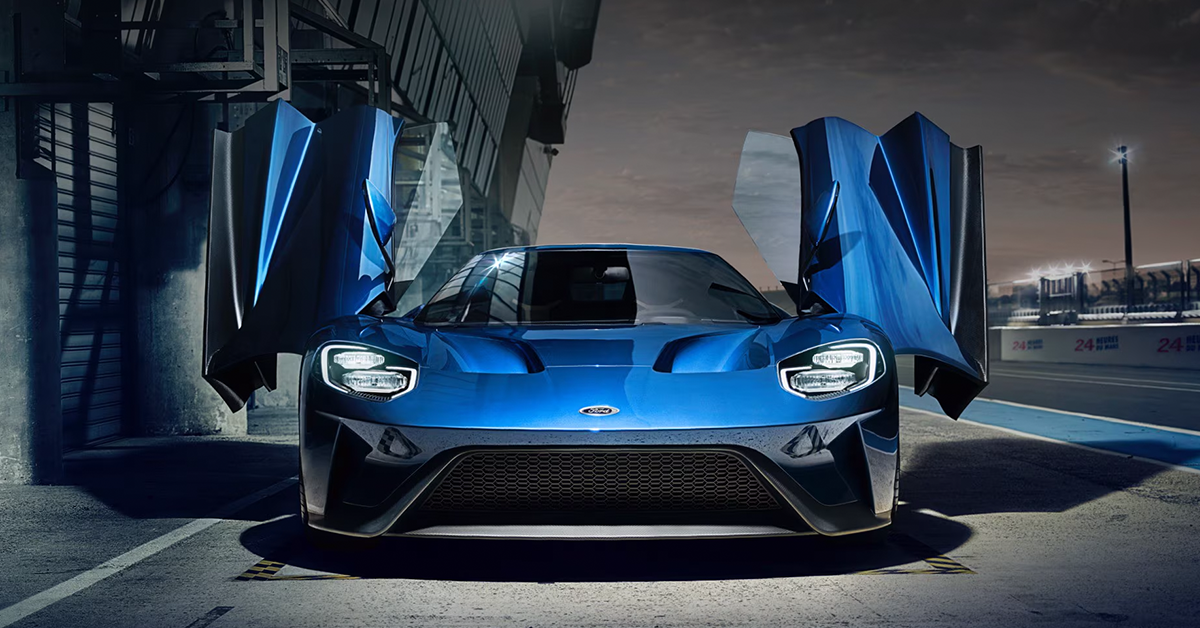
Official press image of the Ford GT. | © Ford Motor Company
The Ford GT from the GT40 revival to the final LM Edition: both generations, engines and specs, special editions, the Le Mans record, prices where sources give them, and production numbers.
The Ford GT is Ford’s mid-engined supercar, and it has been built in two separate runs. The first ran for the 2005 and 2006 model years with a supercharged 5.4-litre V8 (reported). The second ran from the 2017 model year to 2022 with a twin-turbocharged 3.5-litre EcoBoost V6 (Ford). Both cars recall the Ford GT40 that won Le Mans in the 1960s. This article covers the history, both generations, the special editions, the racing record, the prices and the production numbers. We have not driven these cars, and every fact is tagged (Ford) or (reported).
| First generation | 2005 and 2006 model years (reported) |
| First generation engine | Supercharged 5.4L V8, 550 hp (Ford) |
| First generation built | 4,038 (reported) |
| Second generation | 2017 to 2022 model years (Ford) |
| Second generation engine | 3.5L twin-turbo EcoBoost V6 (Ford) |
| Second generation output | 647 hp, later 660 hp (Ford) |
| Second generation top speed | 216 mph (Ford) |
| Second generation planned | 1,350 street cars (Ford) |
| Le Mans, GT40 | Outright wins 1966 to 1969 (reported) |
| Le Mans, Ford GT | LM GTE Pro class win, 2016 (Ford) |
Ford’s own page for the last model year gives the headline figures. It says only 1,350 Ford GT street cars were planned for what it calls the third-generation Ford GT, that deliveries of the final 2022 model year were to begin in January, and that production would wrap up in late 2022 (Ford). It lists a 660-horsepower twin-turbocharged 3.5-litre EcoBoost V6, carbon-fibre architecture and body, active aerodynamics and a 216 mph top speed (Ford). The generation count is a conflict, because most other sources call the 2017 car the second generation.
The first-generation car was built in larger numbers. Reports give a total of 4,038 cars built from 2004 to 2006, short of the 4,500 originally planned (reported). It was rear-wheel drive with a six-speed manual gearbox and a supercharged V8 rated at 550 horsepower (reported, Ford). Ford’s Performance site lists the engine as a 90-degree, 32-valve, supercharged 5.4-litre V8 with 550 horsepower and 500 lb-ft of torque (Ford). The first-generation section below covers the sources that disagree on its details.
One fact is often misstated, so we state it plainly. The Ford GT40 won the 24 Hours of Le Mans outright four times in a row, from 1966 to 1969 (reported). The modern Ford GT won its class at Le Mans in 2016, which was the LM GTE Pro category, not the overall race (Ford, reported). Ford’s page describes the car as America’s only Le Mans-winning supercar, with wins from 1966 to 1969 and again in 2016 (Ford), and we explain the difference in the racing section.
Prices are also split between the two cars. Reports give the first-generation list price as $139,995, with a second figure of $145,000 (reported). For the second generation, a listing shows a base price of $447,000 (reported), and headlines for the final year describe a $500,000 supercar (reported). Neither car is sold new today. Ford said production of the second-generation car would end in late 2022 (Ford), and a track-only Mk IV followed in a run of 67 cars (reported).
A map of what follows. Section two covers the history from the GT40 to the 2005 revival. Section three covers the first-generation car, and section four covers the second-generation car. Section five covers the Heritage editions, the GT LM Edition and the Mk IV. Section six covers the racing, section seven covers prices and production, and section eight compares the Ford GT with the Mustang GTD and lists what we could not confirm. Where sources disagree, we show both values.
The Ford GT begins with the GT40. Our Ford history article tells the story: in 1963 Henry Ford II tried to buy Ferrari, Enzo Ferrari agreed and then walked away, and Ford launched a programme to beat Ferrari at Le Mans (reported). The result was the GT40, a low, mid-engined racing car developed with Lola Cars and powered by a Ford V8 (reported). After two years of failures, the GT40 finished first, second and third at the 1966 Le Mans 24 Hours, and Ford won again in 1967, 1968 and 1969 (reported).
| GT40 programme | Began after 1963 Ferrari talks failed (reported) |
| GT40 first Le Mans win | 1966, a 1-2-3 finish (reported) |
| GT40 Le Mans wins | 1966, 1967, 1968, 1969 (reported) |
| First GT concept | 2002 Detroit Auto Show (reported) |
| First GT model years | 2005 and 2006 (reported) |
| First GT production | 28 June 2004 to 30 September 2006 (reported) |
| First GT designer | Camilo Pardo under J Mays (reported) |
| Second GT unveiled | 2015 Detroit Auto Show (reported) |
| Second GT builder | Multimatic, Markham, Ontario (Ford) |
| Second GT last model year | 2022 (Ford) |
Ford itself ties the modern car to that history. Its page for the final model year says the 2022 Ford GT pays homage to the 1964 Ford GT prototypes that led to what it calls America’s only Le Mans-winning supercar, with wins from 1966 to 1969 and again in 2016 (Ford). A report adds that no other American manufacturer has won Le Mans outright (reported). The 1966 to 1969 wins were overall victories, and the 2016 win was a class win, which matters when comparing the achievements.
The first revival came in the early 2000s. A report says the first Ford GT concept was shown at the 2002 Detroit Auto Show as a modern version of the GT40 (reported). The production car followed for the 2005 model year, in step with the company’s 2003 centenary (reported). A reported history credits Camilo Pardo with the design under J Mays, Ford’s design chief at the time (reported). We found no Ford page that names the designer, so we give the credit as reported.
Production started in 2004. A reported timeline puts the first production run from 28 June 2004 to 30 September 2006, with first customers taking delivery in August 2004 (reported). A Ford media headline from 4 August 2004, cited in one history, says “Living legend comes to life as Ford delivers first production 2005 Ford GT” (reported). The car was sold for the 2005 and 2006 model years and sales continued into 2007, according to one reference (reported).
The second revival was announced in 2015. A report says the new Ford GT was unveiled at the 2015 Detroit Auto Show (reported), and another says it was first shown to the media at Le Mans that year (reported). Ford first planned to build 500 cars over two years, then doubled that to 1,000 over four years, and then added another 350 cars to the run (reported). Ford says the second-generation car is built by Multimatic in Markham, Ontario (Ford), and a report says Multimatic built both the race and road cars (reported).
A short timeline. The GT40 raced from the 1960s. The first road-going GT was built from 2004 to 2006, and the second from 2016 to 2022 (reported). Ford says the last model year was 2022 (Ford). After that, a reported history says Ford announced a limited track-only Mk IV, which is covered in the special editions section. For the wider story of Ford, from the Model T to Le Mans, read our Ford history article.
The first-generation Ford GT used a supercharged 5.4-litre Modular V8. Ford’s Performance site lists a 90-degree DOHC 32-valve supercharged V8 of 5.4 litres, with 550 horsepower at 6,500 rpm, 500 lb-ft of torque at 3,750 rpm, a bore and stroke of 3.55 by 4.17 inches and a compression ratio of 8.4 to 1 (Ford). Reports repeat the 550 horsepower figure (reported). One report describes the engine as having a single overhead camshaft per bank and two valves per cylinder (reported), which contradicts Ford’s 32-valve description, so we follow Ford. These engine details come from Ford’s Performance collector page, and we did not find a Ford spec sheet for the first-generation car.
| Engine | 5.4L supercharged V8 (Ford) |
| Output | 550 hp at 6,500 rpm (Ford) |
| Torque | 500 lb-ft at 3,750 rpm (Ford) |
| Torque, other source | 550 lb-ft (reported) |
| Transmission | Six-speed manual (reported) |
| Top speed | 205 mph, limited (reported) |
| 0 to 60 mph | 3.4, 3.5 or 3.6 seconds (reported) |
| Curb weight | 3,485 lb (reported) |
| Built | 4,038 of 4,500 planned (reported) |
| List price | $139,995 or $145,000 (reported) |
Torque and power vary by source. Ford lists 500 lb-ft (Ford), and several reports match that figure (reported). Another report gives 550 lb-ft (reported), and a museum listing gives 541 horsepower (reported). We treat 550 horsepower and 500 lb-ft as the reference because they come from Ford. The car was rear-wheel drive with the engine behind the cabin, and a six-speed manual gearbox (reported). We found no Ford statement on the transmission supplier, though one report names Ricardo (reported).
Dimensions and weight come from reports. The wheelbase is 106.7 inches, the length 182.8 inches, the width 76.9 inches and the height 43 inches, with a curb weight of 3,485 pounds (reported). Fuel economy was about 12 miles per gallon in the city and 19 on the highway (reported), so it was not a car for the economy-minded. These dimensions are reported and not from a Ford specification sheet.
Performance claims differ. Reports give a top speed of 205 mph, limited electronically (reported). For 0 to 60 mph, different sources give 3.4 seconds, 3.5 seconds and 3.6 seconds (reported), and one gives the quarter mile as 11.2 seconds at 127 mph (reported). The spread is small, and tests of individual cars vary, but we cannot say which is right. We do not rank the three figures, and we do not know whether Ford published an official acceleration time.
Production numbers also vary. Reports give a total of 4,038 cars built, against 4,500 planned (reported). One breakdown says about 550 were built in 2004, nearly 1,900 in 2005 and just over 1,600 in 2006 (reported), while another says 2,027 were built in 2005 (reported). About 100 cars were planned for Europe and 200 for Canada, and 28 were officially imported into the UK (reported). The assembly location is also given two ways: the Wixom Assembly Plant in Michigan, and paint and final work at Saleen Special Vehicles in Troy (reported).
Prices were high, and dealers added to them. A report gives the list price as $139,995 (reported), another says $145,000 (reported), and a UK report says the new price was £125,000 (reported). One report says dealer mark-ups pushed the real price more than $100,000 above list (reported). A Heritage Edition series, of which 343 were built, mimicked the colours of GT40 race cars from 1964 to 1969 (reported). We did not find a Ford figure for the total, so we show the reported one. Those breakdowns are from reports, and Ford’s own production record was not available to us.
The second-generation Ford GT replaced the V8 with a 3.5-litre twin-turbocharged EcoBoost V6. Ford’s 2017 technical specifications list an aluminium block and heads, 647 horsepower at 6,250 rpm and 550 lb-ft of torque at 5,900 rpm, with a note that these are US values and European values were pending certification (Ford). The same sheet lists 98 RON fuel, a 57.5-litre fuel tank and final assembly in Markham, Ontario, Canada (Ford). A report says Ford’s January 2017 release gave the same figures (reported).
| Engine | 3.5L twin-turbo EcoBoost V6 (Ford) |
| Output, 2017 | 647 hp at 6,250 rpm (Ford) |
| Torque, 2017 | 550 lb-ft at 5,900 rpm (Ford) |
| Output, 2022 | 660 hp (Ford) |
| Top speed | 216 mph (Ford) |
| Construction | Carbon-fibre architecture and body (Ford) |
| Fuel | 98 RON, 57.5-litre tank (Ford) |
| Assembly | Markham, Ontario, Canada (Ford) |
| Seats | Two (reported) |
| Base price listing | $447,000 (reported) |
Power rose later. Ford’s page for the 2022 model year lists 660 horsepower from the same engine (Ford). A report says the 2020 model year brought a mid-cycle refresh with a 13-horsepower rise, a broader torque band, a lighter titanium exhaust from Akrapovič, and stiffer Track-mode suspension (reported). Another report says the final GT LM Edition still makes 660 horsepower and 550 lb-ft, with a 3D-printed titanium exhaust (reported). A car-listing page instead gives 720 horsepower and 539 lb-ft (reported), which conflicts with Ford, so we do not use it.
The chassis is built around carbon fibre. Ford says the Ford GT has a carbon-fibre architecture and body, active aerodynamics and a 216 mph top speed (Ford). A report says the 216 mph was measured in a test and was the highest of any production Ford (reported). Ford describes the car as a race car that can be driven on the street (Ford), which is marketing language and not a measurement. A report says the engine sits behind the cabin and drives the rear wheels through a seven-speed semi-automatic gearbox with paddle shifters (reported).
Practical details come from a listing. It gives two seats, a cargo capacity of 0.4 cubic feet, a combined fuel economy of 14 miles per gallon and rear-wheel drive (reported). We did not find a Ford figure for 0 to 60 mph, curb weight or the length and width, so we give none. The listing site’s base price was $447,000 (reported). Ford has not published a price list that we could read, so we treat prices as reported and show the second figure in the prices section.
How many were built is a conflict. Ford says only 1,350 street cars were planned (Ford), and a report says Multimatic built 1,350 of them (reported). Another report says Ford has not confirmed the exact final tally (reported), and one says 1,100 of the 1,350 had been built by February 2022 (reported). A report says the run was extended by 350 cars in October 2018 (reported). The original plan was 500 cars over two years, then 1,000 over four years, before the extensions (reported).
Sales figures are US numbers and not production totals. A report citing a sales-data firm says Ford sold 762 units of the GT from 2017 through 2021 and 89 in the first 11 months of 2022 (reported). That adds to 851, well short of 1,350, because it counts one market over a limited period. We therefore do not use it as a production figure, and we did not find a worldwide sales total. For Ford’s current performance cars, see our Ford Mustang article.
Special editions have been part of the Ford GT from the start. A report says a Heritage Edition of the first-generation car, 343 of which were built, was part of the 2006 model year (reported). A reported history says the Heritage editions mimicked GT40 liveries from 1964 to 1969 (reported). For the final model year, Ford showed a preproduction 2022 Ford GT Heritage Edition (Ford). Ford says that car pays homage to the 1964 Ford GT prototypes (Ford). The 2022 car shares the Heritage Edition name with the 2006 car, though the sources do not say the two are connected.
| First-gen Heritage Edition | 343 built (reported) |
| 2022 Heritage Edition | Pays homage to 1964 prototypes (Ford) |
| Alan Mann Heritage Edition | Red and gold livery (reported) |
| GT LM Edition | Final road-car special edition (Ford) |
| GT LM Edition run | 20 cars (Ford, reported) |
| GT LM Edition honours | 2016 Le Mans win (Ford) |
| GT LM Edition deliveries | Autumn 2022 (Ford) |
| Mk IV | Track-only, 67 units (reported) |
| Mk IV honours | 1967 GT Mk IV Le Mans winner (reported) |
| Mk IV power target | More than 800 hp (reported) |
The 2022 Heritage Edition has a named version. A report says the Alan Mann Heritage Edition used a red and gold livery (reported). We did not find a Ford page with its production count, so we give none.
The GT LM Edition was the last road car. Ford’s European media centre calls it the final special edition for the current-generation road cars, honouring Ford’s 2016 Le Mans win (Ford). Ford says the final 20 special-edition supercars add to its collectability, that customer deliveries start in the autumn, and that production ends by the end of the year (Ford). The European release is dated 5 October 2022 (Ford). A report says it has a unique red or blue interior and a red or blue tint on the exterior carbon fibre (reported), and a 3D-printed titanium exhaust with a cyclonic design (reported).
The count of 20 is consistent. A report says only 20 GT LM Edition cars were produced (reported), and another says the last 20 were included in the 1,350 (reported). By that reading, the LM Edition is part of the road-car total and not an addition to it. We did not find a Ford page that breaks the 1,350 down by edition, so we cannot say how many of each there were.
The Mk IV is a different kind of car. Reports say Ford and Multimatic announced a track-only Ford GT Mk IV, limited to 67 units hand-built in Markham, Ontario (reported). The number honours the 1967 GT Mk IV race car that won Le Mans that year (reported). It uses a twin-turbocharged EcoBoost V6 that targets more than 800 horsepower, a race transmission and a carbon-fibre long-tail body (reported). A report gives its price as about $1.7 million and calls it street-illegal (reported). It is not part of the 1,350 street cars (reported). Ford has not published a Mk IV price in the pages we read, so the figure above is reported.
A note on Ford’s race programme. Ford’s page for the 2022 car says the racing campaigns also conclude in 2022, and mentions a total of 45 vehicles (Ford). The text we read does not say what the 45 refers to, so we do not interpret it. The cars that raced are covered in the racing section. If you want to compare the Ford GT’s limited runs with the Mustang GTD, see the final section, and for the whole current Ford range, read our Ford models article.
Ford’s Le Mans record has two chapters. The first is the GT40, which won the race outright four times from 1966 to 1969, including the 1-2-3 finish in 1966 (reported). The second is the modern Ford GT, which won its class on 19 June 2016. Ford’s media page says the number 68 Ford Chip Ganassi Racing Ford GT of Sébastien Bourdais, Joey Hand and Dirk Müller took victory in the LM GTE Pro category (Ford). It adds that the victory came exactly 50 years after Ford’s 1-2-3 in 1966 (Ford).
| GT40 first win | 1966, finishing first, second and third (reported) |
| GT40 consecutive wins | 1966 to 1969, four (reported) |
| Ford GT class win | 19 June 2016, LM GTE Pro (Ford) |
| Winning car | No. 68, Bourdais, Hand, Müller (Ford) |
| Other Ford GT results | Third and fourth in class (reported) |
| Result in 2016 | Class win, not overall (reported) |
| Time since first run | 395 days after 20 May 2015 (reported) |
| Team | Ford Chip Ganassi Racing (Ford) |
| Engine builder | Roush Yates Engines (reported) |
| Car builder | Multimatic (reported) |
The 2016 win was a class win and not an overall win. A report page corrected its own headline to say Ford won the GTE Pro class and not the whole race (reported). Another says the top LMP1 class was led for most of the 24 hours by Toyota (reported), and Ford’s own release describes the win in the LM GTE Pro category (Ford). Ford’s page for the 2022 road car calls the Ford GT America’s only Le Mans-winning supercar and lists the 2016 win beside the 1966 to 1969 wins (Ford). The 2016 result was a class win, so the two are not the same achievement.
The rest of the result is reported. The number 69 car of Ryan Briscoe, Richard Westbrook and Scott Dixon finished third in class, and the number 66 car of Olivier Pla, Stefan Mücke and Billy Johnson finished fourth (reported), giving Ford a one-three-four result (reported). The number 67 car suffered gearbox problems early and crashed into a tyre wall at Mulsanne Corner (reported). Ford’s rivals in the class were the Chevrolet Corvette and the Ferrari 488 (reported).
The win came quickly. A report says it came 395 days after the car first turned a wheel on 20 May 2015 at Calabogie Motorsports Park in Canada (reported). Another says the new car was first unveiled to the media at Le Mans in 2015, though the road car was also shown at the Detroit Auto Show that year (reported). Ford’s executive chairman Bill Ford is quoted as calling the win an historic moment for the company (reported). Chip Ganassi, the team owner, had never fielded a team at Le Mans before (reported).
The engines were built by a NASCAR specialist. A report says the car’s power came from Roush Yates Engines, the same company that supplies the engines for Ford’s NASCAR teams (reported). Another report says Multimatic built both the race and road cars and ran the cars Ford entered in the World Endurance Championship (reported). Ford’s European media page lists the Ford Chip Ganassi drivers, including the IMSA team, and says the next round for the IMSA team was at Watkins Glen on 3 July (Ford). We did not read the full race results.
Why does this matter for the road car? Ford ties its special editions to this history. The GT LM Edition honours the 2016 win (Ford), and the Mk IV honours the 1967 win (reported). Ford’s own history of the GT40 is in our Ford article, which says the GT40 beat Ferrari in one of motorsport’s most celebrated rivalries (reported). We have not checked the full career of the racing GT, and we do not give a win total for it. If you need exact results, check a racing database.
Prices depend on the generation. For the first car, reports give a list price of $139,995 (reported), a second figure of $145,000 (reported), and a UK new price of £125,000 (reported). One report says that with so few cars built, market prices rose to more than $100,000 above the list price (reported). Those are prices when new, from the 2000s, and they are not current values. We found no current used-car valuation from a source we trust, so we give none, and a used car’s price depends on mileage, history and edition, which we did not research.
| First-gen list price | $139,995 (reported) |
| First-gen other price | $145,000 (reported) |
| First-gen UK price | £125,000 (reported) |
| Second-gen base price, 2017 | $447,000 (reported) |
| Second-gen headline price | About $500,000 (reported) |
| First-gen built | 4,038 (reported) |
| Second-gen planned | 1,350 (Ford) |
| GT LM Edition | 20 (Ford) |
| Mk IV | 67, track only (reported) |
| 2006 Heritage Edition | 343 (reported) |
For the second-generation car, a listing shows a base price of $447,000 for the 2017 model (reported). Headlines at the end of the run describe a $500,000 Ford GT (reported). The difference may reflect option packages and the special editions, but we cannot confirm it. Reported prices are US dollar figures unless stated. We did not find a Ford price list for any model year, so these remain reported figures.
The production numbers, in one place. The first-generation car: 4,038 built against 4,500 planned (reported). The second-generation car: 1,350 street cars planned (Ford), with the final 20 as the GT LM Edition (Ford). The Heritage Edition of 2006: 343 (reported). The track-only Mk IV: 67 (reported). A report says the run was extended by 350 cars in October 2018, and another says Ford has not confirmed the exact final tally (reported). We therefore describe 1,350 as the planned and widely reported figure.
A note on what the numbers mean. A Ford page says only 1,350 street cars were planned, and that the car remains exclusive and highly exotic (Ford). That is Ford’s own wording, and it is a statement of rarity, not a measurement. The ratio between the two generations is about three to one, using the reported 4,038 and 1,350. That is our division and not a Ford figure. The Mk IV adds 67 cars that were never road legal (reported).
You cannot buy a new Ford GT today. Ford said production of the second-generation car would wrap up in late 2022 (Ford), and a report says Multimatic expected to finish all 1,350 units by December 2022 (reported). The track-only Mk IV was offered to order from Multimatic and not from Ford dealers (reported). For the cars Ford sells now, read our Ford models article. If you are shopping for a Ford GT, you are shopping for a used car, and the sources here do not cover current values.
What we do not know. We did not find a Ford price list for either generation, a confirmed final production total for the second generation, current used values, or a Ford statement on acceleration times for the second-generation car. We did not read Ford’s order guide or dealer allocation rules, so we do not describe how buyers were selected. We also could not settle several conflicts, including the first-generation torque figure and the number of cars built in 2005. We have shown both values wherever the sources differ, and we will update the article if Ford publishes a fuller record.
The Mustang GTD is the closest thing Ford now sells to a Ford GT. Ford says the GTD adds an 815-horsepower option to the Mustang line-up, calls it a supercar, and says it uses active aerodynamics and carbon-fibre construction (Ford). Reports say Multimatic assembles it in Ontario using a Mustang body from Ford’s Flat Rock plant (reported). Multimatic also builds the Ford GT, so the two cars share a builder. Our Ford Mustang article covers the GTD in detail, including its Nürburgring lap.
| Ford GT layout | Mid-engine, rear-wheel drive (reported) |
| Mustang GTD layout | Front engine, rear-wheel drive (reported) |
| Ford GT output | 660 hp, last year (Ford) |
| Mustang GTD output | 815 hp (Ford) |
| Ford GT engine | 3.5L twin-turbo V6 (Ford) |
| Mustang GTD engine | Supercharged 5.2L V8 (reported) |
| Ford GT top speed | 216 mph (Ford) |
| Mustang GTD top speed | 202 mph (reported) |
| Ford GT price | About $500,000 (reported) |
| Mustang GTD price | About $325,000 (reported) |
The two cars are built very differently. The Ford GT had a mid-mounted 3.5-litre twin-turbo V6 with 660 horsepower and a 216 mph top speed (Ford). The GTD has a front-mounted supercharged 5.2-litre V8 with 815 horsepower and a reported 202 mph top speed (reported). Reported base prices are about $500,000 for the last Ford GT and about $325,000 for the GTD (reported). By those figures, the GTD has more power, a lower top speed and a lower price, though we have not compared them on a track. The GTD is a front-engined car, so it is a different kind of supercar and not a replacement for the Ford GT’s layout.
Is a new Ford GT coming? We found no Ford announcement of one. Ford’s page for the 2022 model year describes the final year of production (Ford), and a reported history ends the story with the track-only Mk IV (reported). We therefore make no prediction. Ford has not, in the pages we read, named a successor to the Ford GT, so we treat the question as open. Any claim of a new Ford GT should be treated as unconfirmed until Ford publishes it.
How should you read the figures in this article? Treat Ford’s own pages as the reference, and treat reported figures as indicative. The strongest Ford facts here are the 660 horsepower and 216 mph for the last car, the 647 horsepower and 550 lb-ft for the 2017 car, the 1,350 planned street cars and the 2016 LM GTE Pro class win. The weakest are the prices, the first-generation production breakdown and the acceleration times, where sources disagree and Ford is silent.
What we could not confirm: the exact count of second-generation cars built, a Ford price list, the first-generation torque and valve count (we follow Ford’s Performance site), the designer credit, and the Ford generation numbering. We also did not read the full Le Mans race results or the Mk IV’s official specification. We did not drive or test any of these cars, so this article reports published figures and does not rate the cars.
We will update this article if Ford announces a new supercar or publishes more detail on the final production run. For the Mustang range, including the GTD, read our Ford Mustang article, and for the company’s past, our Ford history article. Where our sources disagreed we have shown both values, and where we could not confirm a fact we have said so. That is the method we use for every brand article on this site.