 Brands
Hyundai Genesis Coupe — 2.0T, 3.8 V6, Prices and Pikes Peak
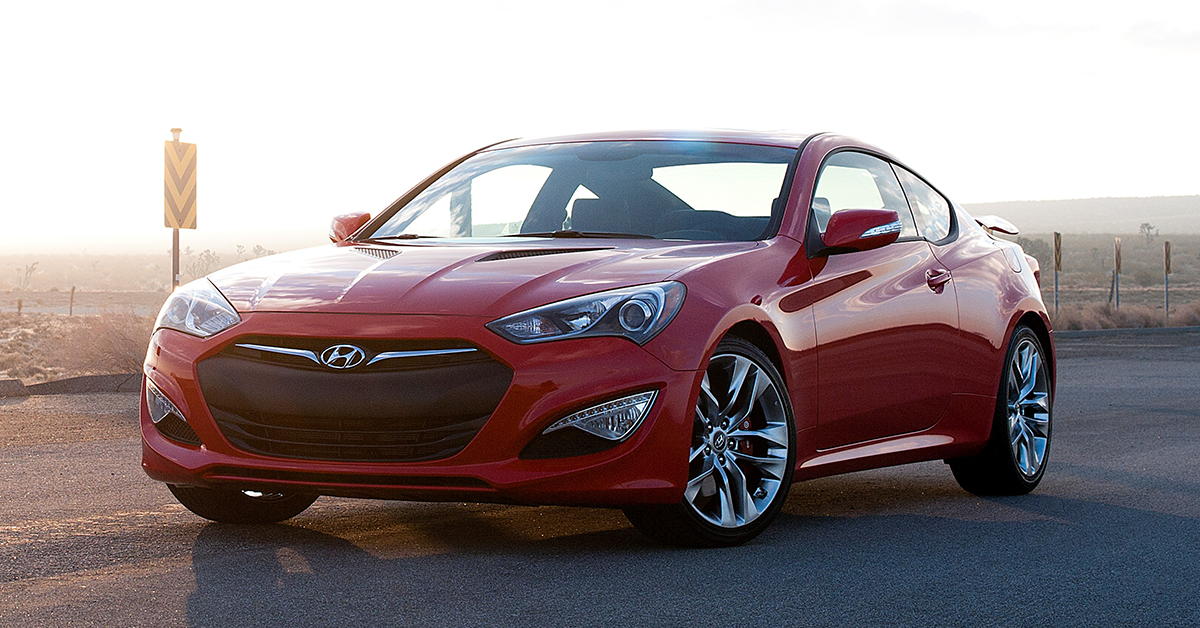
Official image of the Hyundai Genesis Coupe. | © Hyundai Motor Company
Hyundai Genesis Coupe. The rear-wheel-drive coupe of 2008 to 2016, the 210 and 306 hp engines, the 274 and 348 hp refresh, prices and the Pikes Peak record.
The Genesis Coupe was Hyundai’s rear-wheel-drive sports coupe of 2008 to 2016. Reports say it was first released on October 13, 2008 in Korea, reached U.S. dealers in February 2009 as a 2010 model, and ended after the 2016 model year (reported). It was a four-seat two-door with a turbocharged 2.0-liter four-cylinder or a 3.8-liter V6, and a report calls it Hyundai’s first rear-wheel-drive sports coupe (reported). Our Hyundai Tiburon article covers the front-wheel-drive coupe it followed. The 2013 V6 makes 91.6 horsepower per liter and the 2013 four makes 137.0, since 348 divided by 3.8 and 274 divided by 2.0 give those figures (reported, our calculation). Reports list a wheelbase of 2,820 mm and a length of 4,630 mm, which are 111.0 and 182.3 inches (reported, our calculation). Seating is for four (reported). U.S. model years 2010 to 2016 make 7 years (reported, our calculation).
| Korean launch, per reports | October 13, 2008 (reported) |
| U.S. dealer arrival, per reports | February 26, 2009 (reported) |
| First U.S. model year | 2010 (reported) |
| Last model year | 2016 (reported) |
| Layout | Front engine, rear-wheel drive (reported) |
| Seats | 4 (reported) |
| 2010 engines | 2.0T 210 hp, 3.8 V6 306 hp (reported) |
| 2013 engines | 2.0T 274 hp, 3.8 V6 348 hp (reported) |
| Rivals named in reports | Mustang, Camaro, 370Z (reported) |
| Pikes Peak course record, 2012 | 9 min 46.164 s (Hyundai) |
We read Hyundai’s own pages first. Hyundai’s worldwide vehicle-history page covers the Genesis sedan that shares the car’s name and says it launched in 2008 (Hyundai). A Hyundai Motor Group article of August 8, 2024 about Pikes Peak mentions the Genesis Coupe with three results (Hyundai). Neither page lists engines, prices, sales or crash ratings for the coupe, so reports supply those figures and carry the reported tag. Prices and availability may have changed since publication, and exchange rates are not applied.
Two engines defined the car. A turbocharged 2.0-liter four made 210 horsepower and a 3.8-liter V6 made 306 horsepower in the 2010 model, and for 2013 they rose to 274 and 348 horsepower (reported). The 2.0T gained 64 horsepower, which is 30.5 percent, and the V6 gained 42, which is 13.7 percent (reported, our calculation). Both could be had with a six-speed manual, and from 2013 the automatic had eight speeds (reported).
The U.S. price range was wide. The 2010 range ran from 22,000 dollars for the 2.0T manual to 31,000 dollars for the 3.8 Track automatic, a spread of 9,000 dollars (reported, our calculation). A 2013 price release starts at 24,250 dollars for the 2.0T (reported). Reports compare the car with the Ford Mustang, the Chevrolet Camaro and the Nissan 370Z (reported). Our Hyundai Veloster article covers the front-wheel-drive coupe that Hyundai sold alongside it.
Hyundai’s own account of the car is about racing. Its Pikes Peak article says Rhys Millen set a 2WD Time Attack record with a Genesis Coupe in 2009, that Hyundai set a course record of 9 minutes 46.164 seconds with the car in 2012, and that Millen was second in the Unlimited class in 2013 with a car based on the Genesis Coupe engine (Hyundai). We cover those results in the motorsport section.
We found no Hyundai page listing the coupe’s specifications, prices, sales or crash ratings, and none explaining why it ended. Where sources disagree, we show both values. Our Hyundai Models article lists the current range and our Hyundai history article covers the company. The first-generation car is the only generation, since reports list a single model run from 2008 to 2016, which is 8 years (reported, our calculation).
Photos of a heavily camouflaged prototype appeared online in May 2007, and the pictures suggested a rear-wheel-drive layout, with an engine bay showing a longitudinal engine and a turbocharged four-cylinder (reported). Speculation at the time ranged from that turbo four to the Tau V8 that Hyundai had developed for the Genesis sedan (reported). The V8 did not reach the production coupe, and a report says the coupe has an available V6 of more than 300 horsepower instead (reported). From the May 2007 photos to the March 2008 unveiling is 10 months (reported, our calculation). The sedan won its North American award in January 2009, about a month before the coupe reached dealers in February 2009 (Hyundai, reported, our calculation).
| Prototype photos online | May 2007 (reported) |
| New York unveiling | March 2008 (reported) |
| Korean release | October 13, 2008 (reported) |
| U.S. pricing announced | February 2009 (reported) |
| U.S. dealer arrival | February 2009 (reported) |
| First U.S. model year | 2010 (reported) |
| Front suspension | MacPherson strut (reported) |
| Rear suspension | Five-link (reported) |
| Assembly, per reports | Ulsan, South Korea (reported) |
| Name in China | Rohens Coupe (reported) |
The production car was unveiled at the New York show in March 2008, according to a reprinted Hyundai release dated March 19, 2008 (reported). It describes a purpose-built rear-wheel-drive sport coupe with a 212 horsepower estimated turbo four and a 306 horsepower estimated V6, scheduled to join the Hyundai line-up in the spring of 2009 (reported). The release calls the coupe Hyundai’s second rear-wheel-drive performance car, after the Genesis sedan (reported).
The same release says the coupe uses the flexible rear-wheel-drive architecture first developed for the Genesis sedan, with a MacPherson strut dual-link front suspension and a five-link rear setup (reported). A review adds a Torsen limited-slip differential and Brembo brakes (reported). Hyundai’s own history page confirms the sedan itself launched in 2008 and won the North American Car of the Year award in January 2009 (Hyundai). The sedan page does not mention the coupe (Hyundai).
Dates conflict across reports. The Korean market release was on October 13, 2008, according to reports (reported). Arrival at U.S. dealers is given as February 26, 2009 in one report, while another says dealers should expect first shipments later in February 2009 after a February 11 pricing announcement, and the New York release said spring 2009 (reported). A listing calls it a 2009 model in some markets and a 2010 model in North America (reported).
From the New York unveiling in March 2008 to the Korean release in October 2008 is about 7 months, since March to October is 7 months (reported, our calculation). From the Korean release to the U.S. dealer date is about 4 months, since October 13, 2008 to February 26, 2009 is 136 days (reported, our calculation). The sedan and the coupe therefore reached customers about a year apart in the United States, since the sedan was a 2009 model and the coupe a 2010 model (reported, our calculation).
Hyundai Motor America’s chief executive John Krafcik said the Genesis sedan set a new benchmark for the premium sedan segment and that he expected the coupe to do the same in the sport coupe arena (reported). A trade report from April 1, 2009 quotes him calling the coupe market tricky for economically stressed buyers (reported). In China the car was sold as the Rohens Coupe, and it was built at Ulsan in South Korea (reported). Hyundai’s pages we read do not confirm either fact (Hyundai).
The 2010 range had two engines. The 2.0T used a turbocharged 2.0-liter four rated at 210 horsepower, while the 3.8 used a V6 rated at 306 horsepower at 6,300 rpm and 266 lb-ft at 4,700 rpm (reported). The pricing release gives the four as 212 horsepower in one reprint and 210 in others (reported). The 2.0T could be paired with a six-speed manual or a five-speed automatic, and the 3.8 with a six-speed manual or a six-speed automatic (reported).
| 2010 2.0T power | 210 hp (reported) |
| 2010 3.8 power | 306 hp at 6,300 rpm (reported) |
| 2010 3.8 torque | 266 lb-ft at 4,700 rpm (reported) |
| 2010 2.0T manual price | 22,000 dollars (reported) |
| 2010 2.0T automatic price | 23,250 dollars (reported) |
| 2010 3.8 manual price | 25,000 dollars (reported) |
| 2010 top Track price | 31,000 dollars (reported) |
| 2011 3.8 R-Spec price | 26,750 dollars (reported) |
| Trunk volume | 10 cubic feet (reported) |
| Basic warranty | 5 years, 60,000 miles (reported) |
Hyundai Motor America announced pricing in February 2009. The 2.0T started at 22,000 dollars with the manual and 23,250 with the automatic, the 2.0T R-Spec at 23,750 and the 2.0T Premium at 24,250, while the 3.8 started at 25,000 and the 3.8 automatic at 26,500 (reported). The top 3.8 Track automatic was 31,000 dollars (reported). The automatic adds 1,250 dollars on the 2.0T and 1,500 on the 3.8, since 23,250 minus 22,000 and 26,500 minus 25,000 give those gaps (reported, our calculation).
Another database lists the 2.0T at 22,750 dollars and the 3.8 Track at 31,250 dollars, which are 750 and 250 dollars above the figures in the release (reported, our calculation). We could not confirm why they differ. A listing gives the 3.8 Grand Touring at 27,500 dollars with the manual and 29,000 with the automatic, and the 3.8 Track at 29,500 and 31,000 (reported). The 3.8 starts 3,000 dollars above the 2.0T, since 25,000 minus 22,000 is 3,000 (reported, our calculation). The top Track automatic costs 6,000 dollars above the 3.8 manual, since 31,000 minus 25,000 is 6,000, and the 2.0T Track at 26,750 is 4,750 above the 2.0T base (reported, our calculation).
Weights are reported as a range. A 2010 listing gives a base curb weight of 3,389 pounds for the Grand Touring, while another source gives 3,294 to 3,417 pounds for the 2.0T and 3,389 to 3,613 for the 3.8 (reported). The heaviest 3.8 is 319 pounds above the lightest 2.0T, since 3,613 minus 3,294 is 319 (reported, our calculation). A review credits the 3.8 with a 0 to 60 mph time of 5.5 seconds, and a 2009 report says under six seconds (reported).
Fuel economy was modest for a V6 coupe. A listing gives the 3.8 Grand Touring 17 mpg city and 27 highway, and the Track 17 and 26 (reported). The trunk holds 10 cubic feet, the car seats four, and the 2010 warranty was five years or 60,000 miles basic with 10 years or 100,000 miles on the drivetrain, plus seven years on rust and five on roadside help (reported). The 2.0T R-Spec joined later in the model year as a lighter track-oriented trim (reported).
A 2010 review calls the coupe one of the best deals on the market and says the 2.0T is likely the choice of young hot-rodders because aftermarket tuners can add power easily (reported). It notes the Camaro offered a 300 horsepower V6 at the 2.0T’s price, which is 6 horsepower below the Genesis Coupe 3.8, since 306 minus 300 is 6 (reported, our calculation). A September 2010 release priced the 2011 3.8 R-Spec at 26,750 dollars (reported). Prices and availability may have changed since publication, and exchange rates are not applied.
The refreshed 2013 car was shown at the Detroit show in January 2012 (reported). A reprinted Hyundai release says the 3.8-liter V6 gained direct injection and rose to 348 horsepower at 6,400 rpm and 295 lb-ft on premium fuel, while the turbocharged 2.0 gained a twin-scroll turbo and a larger intercooler, rising to 274 horsepower and 275 lb-ft (reported). Another report gives the V6 torque as 296 lb-ft and the earlier 2.0T output as 201 horsepower, so the figures conflict (reported).
| Detroit reveal | January 2012 (reported) |
| 2013 2.0T output | 274 hp, 275 lb-ft (reported) |
| 2013 3.8 output | 348 hp, 295 or 296 lb-ft (reported) |
| 2.0T power gain | 64 hp, 30.5 percent (reported, our calculation) |
| 3.8 power gain | 42 hp, 13.7 percent (reported, our calculation) |
| 2013 automatic | 8-speed with paddles (reported) |
| 2013 2.0T base price | 24,250 dollars (reported) |
| 2013 3.8 R-Spec price | 28,750 dollars (reported) |
| 2013 3.8 Track automatic | 34,250 dollars (reported) |
| Pricing announced | February 14, 2012 (reported) |
The gains were large. The 2.0T rose from 210 to 274 horsepower, which is 64 more or 30.5 percent, and the 3.8 rose from 306 to 348, which is 42 more or 13.7 percent (reported, our calculation). V6 torque rose from 266 to 295 lb-ft, which is 29 more or 10.9 percent, and the 2.0T rose from 223 to 275 lb-ft, which is 52 more or 23.3 percent (reported, our calculation). Per liter the V6 went from 80.5 to 91.6 horsepower and the four from 105.0 to 137.0 (reported, our calculation).
Both engines gained an eight-speed automatic with paddle shifts, replacing the five-speed on the 2.0T and the six-speed on the 3.8, while the six-speed manual stayed (reported). Preliminary fuel economy was 21 city and 30 highway for the 2.0T manual, 20 and 31 for the 2.0T automatic and 18 and 27 for the 3.8 manual, and 18 city and 28 highway for the 3.8 automatic (reported). Blue Link telematics became available on the 3.8 Grand Touring, the 3.8 Track and the 2.0T Premium (reported).
Hyundai Motor America announced 2013 pricing on February 14, 2012, starting at 24,250 dollars for the 2.0T and 28,750 dollars for the 3.8 R-Spec, with the 2013 car going on sale in March (reported). Further prices were 25,500 for the 2.0T automatic, 26,500 for the 2.0T R-Spec, 32,000 for the 3.8 Grand Touring, 33,000 for the 3.8 Track manual and 34,250 for the Track automatic (reported). The 2.0T base rose 2,250 dollars over 2010, or 10.2 percent, since 24,250 minus 22,000 is 2,250 (reported, our calculation).
The 3.8 Grand Touring manual rose from 27,500 dollars in 2010 to 32,000 in 2013, which is 4,500 dollars or 16.4 percent (reported, our calculation). The 2013 3.8 R-Spec at 28,750 dollars is 4,500 above the 2.0T base, since 28,750 minus 24,250 is 4,500 (reported, our calculation). A 2013 review lists the 2.0T manual at 3,362 pounds, which is about 12.3 pounds per horsepower at 274 horsepower (reported, our calculation). The 3.8 at 3,389 pounds and 306 horsepower was 11.1 pounds per horsepower in 2010, and a 3,613 pound car with 348 horsepower is 10.4 (reported, our calculation).
A Canadian listing priced the 2013 3.8 from 36,999 dollars and said it beat the Honda Accord Coupe by about 77 horsepower, which puts that rival near 271 horsepower, since 348 minus 77 is 271 (reported, our calculation). It lists an Infinity audio system with 10 speakers (reported). A German report from 2010 lists a 214 PS turbo four at 29,990 euros and a length of 4.63 meters (reported). Hyundai’s own pages give none of these figures, and we do not convert prices across currencies (Hyundai).
The car changed little after 2013. A used-car listing says 2016 was a light update with no major powertrain, safety or chassis changes, with a standard 6-inch color center display on the 3.8 and R-Spec trims (reported). From the 2013 refresh to the final year is 3 years, since 2016 minus 2013 is 3, and the listing calls 2016 the fourth year after the 2013 update (reported, our calculation). Another listing says the 2016 car had a standard 348 horsepower V6, a manual or automatic gearbox and rear-wheel drive, (reported). The listed lineup was the base 3.8, the 3.8 R-Spec and the 3.8 Ultimate, all with the V6 (reported).
| 2016 U.S. trims | 3.8, 3.8 R-Spec, 3.8 Ultimate (reported) |
| 2016 engine | 3.8 V6, 348 hp (reported) |
| 2016 base price | 27,845 or 29,045 dollars (reported) |
| 2016 R-Spec price | 30,795 dollars (reported) |
| 2016 fuel economy, manual | 17 city, 24 highway (reported) |
| 2016 fuel economy, automatic | 16 city, 25 highway (reported) |
| End confirmed | August 2016 (reported) |
| Genesis brand announced | November 4, 2015 (reported) |
| Production years | 2008 to 2016 (reported) |
| N brand launch, per Hyundai | 2015 Frankfurt show (Hyundai) |
Two lists give 2016 prices. One says the base car started at 27,845 dollars, the R-Spec at 30,795 dollars and the Ultimate near 34,600, while another gives a 3.8 starting price of 29,045 dollars when new (reported). The two base figures differ by 1,200 dollars, since 29,045 minus 27,845 is 1,200, and we could not confirm why (reported, our calculation). Fuel economy for the 2016 3.8 is 17 city and 24 highway with the manual and 16 and 25 with the eight-speed automatic, both 19 combined (reported). The 2016 R-Spec costs 2,950 dollars above the lower base figure, since 30,795 minus 27,845 is 2,950 (reported, our calculation).
Those 2016 ratings are lower than the preliminary 2013 figures, which were 18 city and 27 highway for the manual, by 1 mpg in the city and 3 on the highway, since 27 minus 24 is 3 (reported, our calculation). The 2013 numbers were preliminary and the 2016 numbers are final government data, so the comparison is imperfect (reported). Hyundai’s pages we read give no 2016 specifications for the coupe (Hyundai).
Hyundai confirmed the end in August 2016. A Hyundai product public relations manager said that, in regards to the Genesis Coupe, 2016 would in fact be the last model year for the popular rear-drive sporty coupe, and that a replacement was expected after 2017 inside the Genesis luxury sub-brand (reported). Another report cites a company spokesperson and says the car would end in both the United States and Canada (reported). Hyundai’s own pages give no end date (Hyundai).
Context matters. Hyundai announced on November 4, 2015 that Genesis would become a separate luxury brand, and the Hyundai Genesis sedan became the Genesis G80 for the 2017 model year, according to reports (reported). The coupe stayed a Hyundai and was not carried into the new brand (reported). One report says the sporty coupe left only the Veloster Turbo and the Elantra Sport as Hyundai’s performance cars (reported). Production ran 8 years from 2008 to 2016, since 2016 minus 2008 is 8 (reported, our calculation).
Hyundai’s N story offers a different lens. Its journal says the RM or Racing Midship project, a technology for high-performance cars, began in 2012, and that Hyundai launched the N brand at the 2015 Frankfurt show (Hyundai). The 2012 start came in the same year as the coupe’s Pikes Peak record, and N launched 3 years later, since 2015 minus 2012 is 3 (Hyundai, our calculation). Our Hyundai Veloster article covers the N model sold in America.
Hyundai’s Pikes Peak article of August 8, 2024 is the main Hyundai-owned source for the coupe. It says Hyundai’s participation in the hill climb continued with various models, including the Elantra, the Tiburon and the Genesis Coupe (Hyundai). It gives the course as 19.99 km long with 156 corners, a start at 2,862 meters and a finish at 4,302 meters, and says the race has run since 1916 (Hyundai). That length is 12.4 miles, since 19.99 divided by 1.609 is 12.4 (Hyundai, our calculation).
| Hyundai Pikes Peak article date | August 8, 2024 (Hyundai) |
| Course length | 19.99 km (Hyundai) |
| Corners | 156 (Hyundai) |
| Start and finish altitude | 2,862 m and 4,302 m (Hyundai) |
| 2WD Time Attack record, per Hyundai | 2009 (Hyundai) |
| 2WD Time Attack record, per reports | 2011, Rod Millen (reported) |
| 2012 course record | 9 min 46.164 s (Hyundai) |
| Margin over previous record | 5.114 s (reported, our calculation) |
| 2013 Unlimited result | Second, 9 min 2.192 s (Hyundai) |
| Rival time 2012, per report | 9 min 46.181 s (reported) |
The article says that in 2009 Rhys Millen, son of Rod Millen, set a new record in the 2WD Time Attack class with a Genesis Coupe, and gives no time (Hyundai). It says that in 2012, when the course was fully paved, Hyundai set a course record of 9 minutes 46.164 seconds with the Genesis Coupe (Hyundai). We describe the 2012 result as Hyundai does, as a course record (Hyundai). Reports date the 2WD Time Attack record to 2011 with Rod Millen at the wheel, so the year of the first record differs between Hyundai and reports (Hyundai, reported).
Reports describe the 2012 run. Millen’s time of 9:46.164 beat the previous record of 9:51.278 set in 2011 by 5.114 seconds, since 9:51.278 minus 9:46.164 is 5.114 seconds, which is 0.9 percent of the old time, and one report says closest rival Romain Dumas finished in 9:46.181, which is 0.017 seconds behind (reported, our calculation). The car was a hillclimb-prepared Genesis Coupe from Rhys Millen Racing, with a custom aero package, wide slick tires and a turbocharged V6, according to reports (reported). It was the first run on a fully paved course (reported).
A report says Rod Millen’s earlier record in the same car was 11 minutes 4.912 seconds in 2011 (reported). That is 78.7 seconds slower than the 2012 run, since 11:04.912 minus 9:46.164 is 78.748 seconds (reported, our calculation). Hyundai says the course used to be a mix of paved and unpaved roads before it was fully paved in 2012 (Hyundai). Another report says the same car was the one Millen piloted in the Formula DRIFT series (reported).
Hyundai’s article says Millen took second place in the Unlimited class in 2013 with a race car based on the Genesis Coupe engine, clocking 9 minutes 2.192 seconds (Hyundai). That is 43.972 seconds quicker than the 2012 record run, since 9:46.164 minus 9:02.192 is 43.972 seconds, although a different class and car were involved (Hyundai, our calculation). The 2012 and 2013 results came 1 year apart, and the 2009 record came 3 years before 2012 (Hyundai, our calculation).
Other racing uses are reported. A report says a team raced a Genesis Coupe in a U.S. touring car series from 2012 and won the championship in 2014 in a 3.8-liter V6 car (reported). A mid-engine special named the RM460 with a 4.6-liter Tau V8 built by Rhys Millen Racing was also shown (reported). Hyundai’s pages we read do not mention either project, and the Hyundai N Archive page does not mention the Genesis Coupe at all (Hyundai).
Hyundai does not publish a coupe-only sales figure in the United States, according to a sales database, so the figures we found combine the Genesis sedan and coupe (reported). They are 6,167 in 2008, 21,889 in 2009, 29,121 in 2010, 32,998 in 2011, 33,973 in 2012, 32,330 in 2013, 29,992 in 2014, 31,374 in 2015, 23,230 in 2016 and 1,134 in 2017 (reported). Another version of the table gives 36,485 for 2012, so that year conflicts (reported).
| Combined U.S. sales 2009 | 21,889 (reported) |
| Combined U.S. sales 2010 | 29,121 (reported) |
| Combined U.S. sales 2011 | 32,998 (reported) |
| Combined U.S. sales 2012 | 33,973 or 36,485 (reported) |
| Combined U.S. sales 2013 | 32,330 (reported) |
| Combined U.S. sales 2014 | 29,992 (reported) |
| Combined U.S. sales 2015 | 31,374 (reported) |
| Combined U.S. sales 2016 | 23,230 (reported) |
| 2010 front driver stars | 4 early, 5 later (reported) |
| Insurance Institute test of coupe | Not found (reported) |
Because the sedan launched in 2008 and the coupe in 2009, the 2008 figure is sedan only (reported, our calculation). The 2009 to 2016 total is 234,907 with the lower 2012 figure and 237,419 with the higher one (reported, our calculation). From 2012 to 2016 the combined total fell 10,743, or 31.6 percent, using 33,973, since 33,973 minus 23,230 is 10,743 (reported, our calculation). The 2016 figure was 8,144 below 2015, or 26.0 percent (reported, our calculation). The 2010 total was 7,232 above 2009, or 33.0 percent, and 2011 was 3,877 above 2010, or 13.3 percent (reported, our calculation). Using 33,973, 2012 was 975 above 2011, or 3.0 percent, and 2013 was 1,643 below 2012, or 4.8 percent (reported, our calculation). The 2014 figure was 2,338 below 2013, or 7.2 percent, and 2015 rose 1,382, or 4.6 percent (reported, our calculation).
Because these figures include the sedan, we make no claim about coupe sales alone. A report says Canadian coupe figures exist in a separate table, which we did not check (reported). Hyundai’s pages we read give no sales figures for the coupe (Hyundai). The 2017 figure of 1,134 sits after the last model year and we could not confirm what it covers (reported). The 2016 figure is about 20.5 times the 2017 figure of 1,134, since 23,230 divided by 1,134 is 20.5 (reported, our calculation).
Crash information is government data. The government’s New Car Assessment Program tested an early-release 2010 Genesis Coupe with side airbags and gave four stars for the front driver and four for the front passenger, with five for the side driver (reported). A later-release 2010 car got five stars for the front driver, four for the front passenger and five for the side driver (reported). Side passenger and rollover ratings were not tested in that listing (reported).
A different listing for the 2011 car shows rollover at five stars for every trim and no other scores (reported). The frontal driver rating rose from four to five stars between the early and later 2010 releases, which is 1 star, and the listing does not say what changed (reported, our calculation). The Insurance Institute for Highway Safety had not tested the 2010 Genesis Coupe, according to that listing, though it tested the Genesis sedan (reported).
Hyundai’s pages give no crash ratings for the coupe (Hyundai). We therefore treat the government stars as the only available rating, and we do not claim the car matches the sedan’s results. The sedan earned a Top Safety Pick Plus award for 2015, but that award applies to the sedan with optional front crash prevention and not to the coupe (reported). Prices and availability may have changed since publication, and exchange rates are not applied.
Several figures conflict across sources. The 2010 2.0T is 210 horsepower in most listings, 212 in a reprinted release and 201 in one report, the 2010 base price is 22,000 dollars in the release and 22,750 in a database, and the 2012 combined sales figure is 33,973 or 36,485 (reported). The 2013 V6 torque is 295 or 296 lb-ft, and the 2016 base price is 27,845 or 29,045 dollars (reported). These are source differences, not our estimates. The 2013 2.0T weight of 3,362 pounds sits inside the 3,294 to 3,417 pound range reported for the 2.0T, since 3,294 is below and 3,417 is above 3,362 (reported, our calculation). The 2010 2.0T base price differs by 750 dollars between the two lists, and the 2.0T Track at 26,750 dollars is 4,750 above the 22,000 base (reported, our calculation). The German 214 PS and the U.S. 210 horsepower are not converted into each other (reported).
| 2010 2.0T power | 210, 212 or 201 hp (reported) |
| 2010 base price | 22,000 or 22,750 dollars (reported) |
| 2012 combined sales | 33,973 or 36,485 (reported) |
| 2013 V6 torque | 295 or 296 lb-ft (reported) |
| 2016 base price | 27,845 or 29,045 dollars (reported) |
| Time Attack record year | 2009 (Hyundai) or 2011 (reported) |
| Platform name | BH or M1 (reported) |
| Wheelbase | 2,820 mm (reported) |
| Length | 4,630 mm (reported) |
| Width | 1,865 mm (reported) |
Hyundai pages and reports also differ on the 2WD Time Attack record, which Hyundai places in 2009 and reports place in 2011 (Hyundai, reported). The platform is named BH in one version of a reference listing and M1 in another, and the U.S. arrival date is February 26, 2009 in one report and later in February in another (reported). The sedan and coupe are described as sharing a rear-wheel-drive platform in several reports (reported).
Replacement is not settled. A report says a replacement would come after 2017 inside the Genesis luxury sub-brand and would not carry the Hyundai badge (reported). A report from the time says Hyundai had not said whether a new performance model would replace the coupe (reported). We found no Hyundai page announcing a successor, and the Hyundai pages we read name the Elantra N, the IONIQ 5 N and the i30 N as N cars, not the coupe (Hyundai).
Several items are not confirmed. We found no Hyundai page for the coupe’s specifications, prices, dimensions, weights, sales or crash ratings, and none for the end of production. We did not verify prices in markets outside the United States except the single German and Canadian listings mentioned. The coupe was not sold officially in Australia, according to one report, while another said it was at least two years away, so that point conflicts (reported).
Dimensions are reported. A reference listing gives a wheelbase of 2,820 mm, a length of 4,630 mm and a width of 1,865 mm (reported). In inches those are 111.0, 182.3 and 73.4, since 2,820 divided by 25.4 is 111.0 (reported, our calculation). The German report gives the length as 4.63 meters, which matches 4,630 mm (reported). Hyundai’s pages give none of these figures (Hyundai).
To check this guide, begin with Hyundai’s Pikes Peak article and the worldwide vehicle-history page, then compare model years before comparing numbers, because the 2010 to 2012 cars and the 2013 to 2016 cars use different engines. Our Hyundai Tiburon article covers the earlier coupe and our Hyundai Veloster article the later one. Prices and availability may have changed since publication, and exchange rates are not applied.
