 Brands
Hyundai Staria — Prices, Engines, Electric and Specs
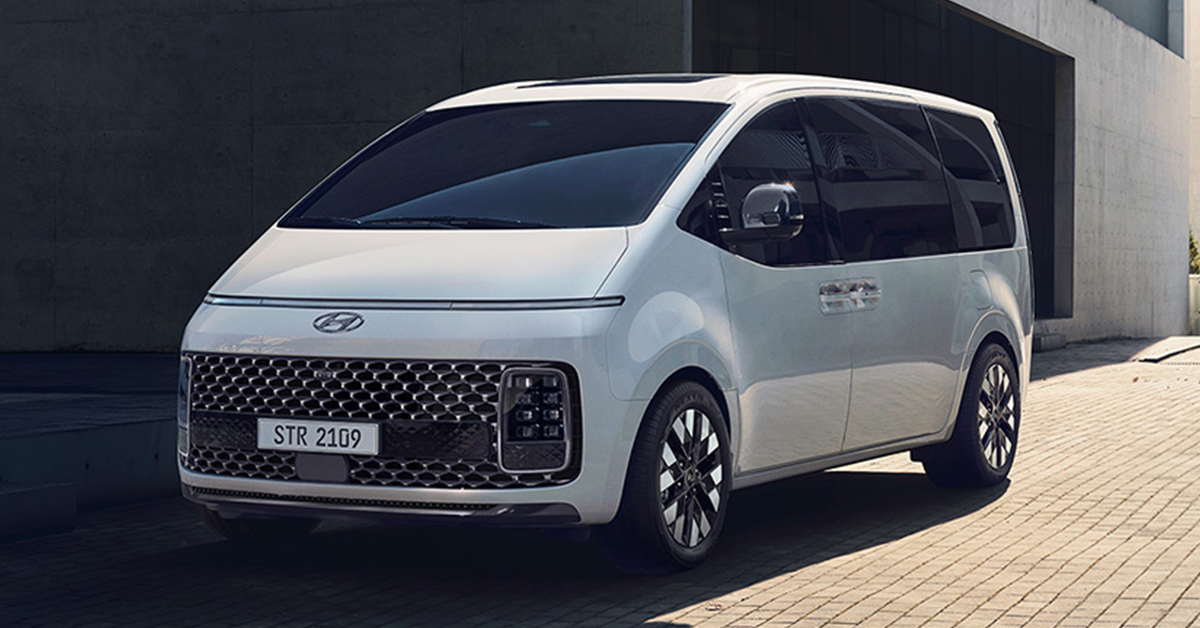
Official image of the Hyundai Staria. | © Hyundai Motor Company
The Hyundai Staria is a big, tall people carrier that also comes as a cargo van. It first appeared in Seoul in April 2021, and a hybrid and an electric version have followed. This guide covers the engines, size, range, prices and safety, using Hyundai’s own pages and showing where they disagree.
The Staria is Hyundai’s large multi-purpose vehicle, a tall, boxy people carrier that also comes as a cargo van. It was launched through a digital world premiere in Seoul on April 12, 2021, and Hyundai described it then as a model for its future Purpose Built Vehicles (Hyundai). Since then the range has grown to include a hybrid, a long-wheelbase Lounge, a Load van and, from 2026, a fully electric version (Hyundai).
| Body | Large MPV and cargo van (Hyundai) |
| World premiere | Seoul, April 12, 2021 (Hyundai) |
| Length | 5,253 mm (Hyundai) |
| Wheelbase | 3,273 mm (Hyundai) |
| Original diesel | 2.2 liter, 130 kW, 430 Nm (Hyundai) |
| Original petrol | 3.5 liter, 200 kW, 331 Nm (Hyundai) |
| Hybrid | 1.6 turbo, 245 PS system (Hyundai) |
| Electric premiere | Brussels, January 9, 2026 (Hyundai) |
| Electric battery | 84 kWh (Hyundai) |
| Korea Hybrid Lounge price | 44,990,000 won (Hyundai) |
Everything here comes from Hyundai’s own pages, including its worldwide, European, Australian, Korean, Thai, Philippine and Indonesian sites, its press sites on hyundai.news and hyundainews.com, and its price lists. Where two pages disagree we show both numbers, and we do not convert currencies. Prices and availability may have changed since publication. We found no Hyundai U.S. page for the Staria, so this guide does not cover a U.S. model.
The original Staria is 5,253 mm long on a 3,273 mm wheelbase, with a width of 1,997 mm and a height of 1,990 mm (Hyundai). Hyundai’s 2021 engines were a 2.2-liter turbo diesel and a 3.5-liter petrol, and Hyundai Australia lists 130 kW and 430 Nm for the diesel and 200 kW and 331 Nm for the petrol (Hyundai). A 1.6-liter turbo hybrid with 245 PS of system output followed, according to Hyundai Korea’s catalog (Hyundai).
The Staria Electric made its world premiere at the Brussels Motor Show on January 9, 2026 with an 84 kWh battery and a 160 kW (218 PS) front motor (Hyundai). Hyundai Europe gives an estimated WLTP range of up to 400 km, and its charging time for 10 to 80 percent is about 20 minutes on a fast charger (Hyundai). Hyundai said the car would go on sale in Korea and Europe in the first half of 2026 (Hyundai).
Prices depend on the market. Hyundai Korea’s price list for the Staria Hybrid Lounge dated December 17, 2025 starts at 44,990,000 won, and its electric price lists carry a release date of April 23, 2026 (Hyundai). Hyundai Australia lists the Staria Load Premium from 51,240 dollars as a manufacturer’s list price (Hyundai). We found no euro price for the Staria in Europe.
Later sections cover the 2021 debut and body styles, the original engines, the hybrid update, the electric models, the Lounge, Load, Cargo and Camper variants, prices by market, and safety and production with the places where Hyundai’s pages disagree. Our Hyundai Models article lists the range, our Hyundai history article covers the company, and our Santa Fe and Palisade articles cover its family SUVs. Hyundai Indonesia sells the Staria in Hybrid and Electric forms, and its leaflet lists the hybrid with 245 PS and 304 Nm of motor torque and the electric with 218 PS and 350 Nm (Hyundai). The same leaflet gives an electric range of 544 km on the NEDC test cycle, which is a different test from WLTP, so it should not be set beside the European 400 to 430 km (Hyundai). Hyundai Europe also introduced a Staria Cargo electric light commercial vehicle (Hyundai).
Hyundai’s release datelined Seoul on April 12, 2021 says Hyundai officially launched its new Staria multi-purpose vehicle lineup through a digital world premiere, establishing a model for its future Purpose Built Vehicles (Hyundai). The release ties the car’s shape to what Hyundai calls innovative use of interior space, which it says is made possible by a 3,273 mm wheelbase, an overall length of 5,253 mm and a width of 1,997 mm (Hyundai). The car is 3,256 mm longer than it is wide and 3,263 mm longer than it is tall, and the wheelbase is about 62 percent of the overall length, by our arithmetic (Hyundai, our calculation).
| Premiere | Digital, Seoul, April 12, 2021 (Hyundai) |
| Length | 5,253 mm (Hyundai) |
| Wheelbase | 3,273 mm (Hyundai) |
| Width | 1,997 mm (Hyundai) |
| Width, Philippine brochure | 1,970 mm (Hyundai) |
| Height | 1,990 mm (Hyundai) |
| Ground clearance | 186 mm (Hyundai) |
| Cargo, 2 or 3 seats | Almost 5,000 liters (Hyundai) |
| Pallets | Three Euro pallets (Hyundai) |
| Body styles | Premium, Wagon, Van (Hyundai) |
The same release gives an overall height of 1,990 mm and says that is tall enough for an average school-aged child to stand upright and move around (Hyundai). Hyundai says the cargo space depends on how the seats are arranged, and that the two- and three-seat versions made for business use offer almost 5,000 liters (Hyundai). It also says the cargo space was made big enough to carry three Euro pallets at once (Hyundai).
Hyundai’s worldwide highlights page says the Staria comes in Premium, Wagon and Van configurations, with a 3.5 MPI petrol engine or a 2.2 CRDi diesel and either an 8-speed automatic or a 6-speed manual gearbox (Hyundai). The European press release says the diesel could be mated to a six-speed manual or an eight-speed automatic transmission (Hyundai). Hyundai’s Philippine brochure lists 8-speed automatic and 6-speed manual versions of the diesel (Hyundai).
Hyundai pages give slightly different widths. The 2021 release and Hyundai Australia say 1,997 mm, while Hyundai’s Philippine brochure says 1,970 mm, which is 27 mm narrower by our subtraction (Hyundai, our calculation). The Philippine brochure also gives a ground clearance of 186 mm and a height of 1,990 or 2,000 mm depending on the version (Hyundai). We use 1,997 mm and show the other value.
Wheel track also varies. Hyundai Australia’s specification sheet gives 1,721 mm at the front and 1,732 mm at the rear, and Hyundai Thailand gives 1,732 mm and 1,743 mm (Hyundai). Hyundai Thailand also lists a front overhang of 910 mm and a rear overhang of 1,070 mm, and a fuel tank of 75 liters for the diesel (Hyundai). We do not know whether the differences come from tires or from market specifications.
Hyundai Australia sold the Staria in three trims, the Staria, Elite and Highlander, and later added a cargo version called Staria Load (Hyundai). Hyundai’s Australian page says the Staria Load Premium arrived with extra standard safety, style and convenience features (Hyundai). Hyundai Korea lists Tourer versions with 9 or 11 seats and Cargo versions with 2, 3 or 5 seats, as covered in our prices section (Hyundai). Hyundai Australia lists the Staria Load as a 2-seater van or a 5-seater crew van, with a standard Liftback rear door or an optional Twin Swing door, and a braked towing capacity of 2,500 kg (Hyundai). Its people-mover page lists petrol, diesel and hybrid, with 7 seats on the Lounge only and 8 seats on the other versions (Hyundai). Hyundai Korea names its versions Tourer 9, Tourer 11, Cargo 2, Cargo 3 and Cargo 5 (Hyundai).
Hyundai Australia’s specification sheet lists two engines. The petrol is a Smartstream G3.5 MPI making 200 kW at 6,400 rpm and 331 Nm at 5,000 rpm (Hyundai). The diesel is an R2.2 CRDi making 130 kW at 3,800 rpm and 430 Nm (Hyundai).
| Petrol engine | 3.5 liter Smartstream MPI (Hyundai) |
| Petrol output | 200 kW, 272 PS (Hyundai) |
| Petrol torque | 331 Nm (Hyundai) |
| Diesel engine | 2.2 liter CRDi turbo diesel (Hyundai) |
| Diesel output | 130 kW, 177 PS (Hyundai) |
| Diesel torque | 430 Nm, 431 Nm in Thailand (Hyundai) |
| Gearbox | 8-speed automatic, 6-speed manual (Hyundai) |
| Drive | 2WD petrol, on-demand AWD diesel (Hyundai) |
| Australian emissions standard | Euro 5 (Hyundai) |
| Diesel tank, Thailand | 75 liters (Hyundai) |
Hyundai’s worldwide performance page gives the same engines in metric horsepower, with 272 PS and 33.8 kgf-m for the petrol and 177 PS and 44.0 kgf-m for the diesel (Hyundai). Those match the kilowatt figures, because 200 kW is about 272 PS and 130 kW is about 177 PS by our conversion (Hyundai, our calculation). The 331 Nm is about 33.8 kgf-m, and the 430 Nm is about 43.8 kgf-m, so the diesel torque differs slightly between pages (Hyundai, our calculation). In imperial units, 331 Nm is about 244 lb-ft and 430 Nm is about 317 lb-ft, and 200 kW is about 268 horsepower (Hyundai, our calculation). The petrol therefore makes 70 kW more than the diesel, and the diesel makes 99 Nm more than the petrol, by our subtraction (Hyundai, our calculation). By our division, the petrol output is about 1.54 times the diesel output, while the diesel torque is about 1.30 times the petrol torque (Hyundai, our calculation).
Hyundai Australia pairs the petrol engine with two-wheel drive and the diesel with an active on-demand all-wheel drive system, both with an 8-speed automatic (Hyundai). The sheet gives bore and stroke of 92 by 87 mm for the petrol and 85.4 by 96.0 mm for the diesel, compression ratios of 10.6 to 1 and 16 to 1, and a Euro 5 emissions standard for both (Hyundai).
Hyundai Thailand lists the diesel with 177 hp and 431 Nm of torque, and Hyundai’s Philippine brochure lists 177 PS, 430 Nm and a Euro 4 standard (Hyundai). Hyundai Australia lists the 2.2 as a Euro 5 engine, so the emissions standard differs by market (Hyundai). The Staria Load, Hyundai’s cargo version, uses the same 2.2 diesel with 130 kW and 430 Nm and a 75 liter fuel tank in Australia (Hyundai).
Other drive details come from the specification sheets. Hyundai lists an electronic shift-by-wire gear selector, an HTRAC all-wheel-drive system and a Drive Mode Select function on the worldwide performance page (Hyundai). We do not give acceleration or fuel consumption because we did not find a Hyundai figure for the original cars. The later Staria Load sheet from Hyundai Australia lists a 2.2 CRDi diesel with engine code D4HB and a 1.6 T-GDi hybrid engine with code G4FT, both transverse and driving the front wheels, which differs from the on-demand all-wheel drive on the earlier Staria sheet (Hyundai). It gives displacements of 2,199 cc and 1,598 cc, and says the diesel has a turbocharger with an E-VGT intake (Hyundai).
Not every market got both engines. The Philippine brochure lists only the 2.2 CRDi diesel, while Hyundai Australia lists both the diesel and the 3.5 petrol, and Hyundai Korea offers an LPG 3.5 on some Tourer and Cargo trims (Hyundai). Hyundai’s Korean price sheets list a Smartstream LPG 3.5 engine with an 8-speed automatic (Hyundai).
Hyundai Korea’s price sheet for the Staria Hybrid Lounge gives a current-model release date of March 5, 2024, with the Limousine following on February 19, 2025 (Hyundai). The sheet lists a Smartstream gasoline 1.6 turbo hybrid engine with a 6-speed automatic transmission, Drive Mode Select, a congested-area control function, shift-by-wire and a rear multi-link suspension (Hyundai).
| Korea Hybrid Lounge release | March 5, 2024 (Hyundai) |
| Korea Limousine release | February 19, 2025 (Hyundai) |
| Hybrid engine | 1.6 turbo, 180 PS (Hyundai) |
| Hybrid motor | 54 kW, 304 Nm (Hyundai) |
| Hybrid system power | 245 PS (Hyundai) |
| Hybrid battery, Indonesia | 1.49 kWh (Hyundai) |
| Europe hybrid seats | 7 or 9 (Hyundai) |
| Europe Van cargo | 4,935 liters (Hyundai) |
| Europe Wagon cargo | 1,303 liters (Hyundai) |
| Australia Load Hybrid fuel | 6.2 L/100 km (Hyundai) |
Hyundai’s Korean catalog gives the hybrid’s system output as 245 PS, made of a 180 PS gasoline engine and a 54 kW electric motor, with a motor torque of 304 Nm (Hyundai). Hyundai Indonesia lists the same figures, with an engine torque of 265 Nm at 1,500 to 4,500 rpm, a motor of 73.4 PS (54 kW) and a hybrid battery of 1.49 kWh (Hyundai). The 54 kW motor is about 73.4 PS, by our conversion, and 180 plus 73 would be 253 PS, so the 245 PS system figure is not a simple sum (Hyundai, our calculation).
Hyundai Europe’s press kit for the new Staria calls it the fourth generation of Hyundai’s versatile minivan and says it blends futuristic design with practical function (Hyundai). The kit says the hybrid uses a 1.6 T engine with a 54 kW hybrid motor, and that the car stands out for its advanced driver-assistance systems (Hyundai). Hyundai’s own wording of fourth generation refers to the minivan line, and we did not find a Hyundai page that explains the count.
Hyundai Europe offers the Staria Hybrid in 7- and 9-seat layouts, and says the 9-seater Wagon has 1,303 liters of cargo space (Hyundai). Its Hybrid Van is a 3-seater with 4,935 liters of cargo space and room for three Euro pallets (Hyundai). The 4,935 liter figure is 65 liters below the almost 5,000 liters of the 2021 release, so the two pages are using different measures or rounding (Hyundai, our calculation).
Hyundai Australia calls the Staria Lounge Hybrid its new flagship variant, with a 7-seat layout and, for the first time in the nameplate’s history, a hybrid powertrain (Hyundai). The page adds first- and second-row recliner seats, a new 12.3-inch digital multimedia touchscreen, a sleeker steering wheel and a redesigned cabin, plus Bluelink and over-the-air connectivity and a smart key with push-button start (Hyundai).
Hyundai Australia also lists a Staria Load Hybrid, calling it the first-ever Staria Load Hybrid, with a fuel figure of 6.2 liters per 100 km on its Load page (Hyundai). It says the Load now has three powertrains, diesel, hybrid or fully electric (Hyundai). Hyundai Korea’s December 2025 Lounge Hybrid sheet lists built-in cam 2 Plus and augmented reality navigation as options and a column-type shift-by-wire (Hyundai). Hyundai Korea’s 2024 Hybrid Lounge sheet lists the Limousine at 12.1 km per liter combined, with 13.2 in the city and 11.0 on the highway, CO2 emissions of 135 g/km, a displacement of 1,598 cc and a curb weight of 2,440 kg (Hyundai). Hyundai Indonesia lists a 65 liter fuel tank for the hybrid (Hyundai). Hyundai Korea’s catalog lists a 4.2-inch color cluster, a 12.3-inch display audio screen and wireless software updates among the equipment (Hyundai).
Hyundai’s release datelined Offenbach, Germany and Seoul on January 9, 2026 says Hyundai unveiled the Staria Electric at the Brussels Motor Show (Hyundai). It gives an 84 kWh battery, a 160 kW (218 PS) front-wheel-drive motor, an advanced 800 volt system and DC fast charging of 10 to 80 percent in about 20 minutes (Hyundai). Hyundai says the car would go on sale in Korea and Europe in the first half of 2026 (Hyundai).
| Premiere | Brussels, January 9, 2026 (Hyundai) |
| Battery | 84 kWh (Hyundai) |
| Motor | 160 kW, 218 PS, 350 Nm (Hyundai) |
| 0 to 100 km/h | 9.5 seconds (Hyundai) |
| Top speed | 184 km/h (Hyundai) |
| WLTP range, press release | Up to 400 km (Hyundai) |
| WLTP range, Germany and Norway | Up to 430 km (Hyundai) |
| WLTP range, Load Electric | 450 km (Hyundai) |
| 350 kW charge, 10 to 80 percent | About 20 minutes (Hyundai) |
| Cargo payload, Europe | 1,040 kg (Hyundai) |
Hyundai Europe’s technical data gives a combined power of 160 kW (218 PS), a torque of 350 Nm, a battery output of 182 kW, a maximum speed of 184 km/h and a 0 to 100 km/h time of 9.5 seconds (Hyundai). The data repeats the original body dimensions of 5,253 mm, 3,273 mm, 1,997 mm and 1,990 mm, and a luggage space of 4,935 liters by VDA and 5,462 liters by SAE (Hyundai). Hyundai Europe’s data lists ventilated front discs of 325 mm in diameter (Hyundai).
The range figure differs by page. The Brussels release and Hyundai Europe’s show page say an estimated WLTP range of up to 400 km, while Hyundai Norway and Hyundai Germany say up to 430 km (Hyundai). Hyundai Germany gives a combined consumption of 21.8 kWh per 100 km, which would imply about 385 km from 84 kWh by our division, and the German release notes that the car was not yet on sale (Hyundai, our calculation).
Charging times come from the European data sheet. A standard 230 V charge from 10 to 100 percent takes 7 hours 35 minutes, a 50 kW fast charge from 10 to 80 percent takes 81 minutes and a 350 kW charge takes 20 minutes (Hyundai). The 20 minutes works out to about 176 kW on average over 58.8 kWh, by our calculation, and the 81 minutes to about 44 kW on average (Hyundai, our calculation). Hyundai Norway adds that AC charging can reach 11 kW (Hyundai). Hyundai Indonesia’s leaflet gives an NEDC range of 544 km for the electric Staria, which is a different test cycle from WLTP, so we do not compare it with the European figures (Hyundai). Hyundai Australia lists a CCS Combo2 charging port and an active air flap in the front lower intake for cooling (Hyundai).
Hyundai Australia’s September 2026 Load specification sheet lists the Staria Load Electric with the same 160 kW motor, 350 Nm, 84 kWh battery, 182 kW battery output and a voltage of 697 V (Hyundai). It gives a WLTP range of 450 km, a 10.5 kW AC charger, 350 kW fast charging, 41 minutes at 100 kW for 10 to 80 percent and a vehicle-to-load output of 250 V at 16 A (Hyundai).
Hyundai Europe also introduced the Staria Cargo, a fully electric light commercial vehicle with a WLTP range of up to 450 km, 800 volt architecture and 10 to 80 percent charging in 20 minutes (Hyundai). It lists a payload of 1,040 kg, towing capacity of 2,000 kg and space for three Euro pallets (Hyundai). Hyundai Korea’s Cargo Electric sheet lists a maximum load of 900 kg for the 3-seater, so the two markets differ (Hyundai).
Hyundai Korea’s catalog lists the Staria Lounge and Limousine in hybrid and electric forms. The Lounge Hybrid has a 1.6 turbo hybrid with 245 PS (Hyundai). The catalog describes the hybrid as delivering superior driving performance and a more premium mobility experience through a dedicated system (Hyundai).
| Lounge Hybrid system power | 245 PS (Hyundai) |
| Lounge Hybrid seats, Korea | 9 (Hyundai) |
| Limousine rear screen | 17.3 inches (Hyundai) |
| Limousine roof | Panoramic Sky Roof (Hyundai) |
| Lounge wheels, Korea | 18-inch alloy (Hyundai) |
| Camper concept shown | CMT Stuttgart, January 16, 2026 (Hyundai) |
| Camper basis | Staria Electric (Hyundai) |
| Camper features | Pop-up roof, solar power (Hyundai) |
| Australia airbags | 7 (Hyundai) |
| Australia braked towing | 2.5 tonnes (Hyundai) |
The Limousine pages list a Panoramic Sky Roof, a 17.3-inch roof-mounted rear entertainment system and a rear electric side step on the right side (Hyundai). The catalog also lists a Traffic Jam Control function that uses navigation road data to reduce unnecessary engine starts in stop-and-go traffic, and hybrid-specific screens showing fuel efficiency and energy flow (Hyundai). Hyundai Korea’s catalog says the Limousine has exclusive specifications that raise the sophistication of the private space, and describes mood lamps on the ceiling that resemble gentle ripples on water (Hyundai).
Hyundai Korea’s Korean-language Hybrid Lounge sheet lists a Lounge-specific design with chrome grille, bumper, mirrors and door handles, lounge-specific 18-inch alloy wheels and suede-style interior parts on the headliner, pillars and sun visors (Hyundai). It lists a full-size center console, ambient mood lamps, metal door scuff plates and metal pedals, and an 8-way power driver’s seat with four-way lumbar support (Hyundai). The Korean sheet also lists heated and ventilated front seats, a full automatic air conditioner with a fine dust sensor and an air purifier mode, and a rear roof air vent (Hyundai). It lists a 4.2-inch color LCD cluster, LED interior lamps and a luggage net (Hyundai).
Hyundai unveiled the Staria Camper Concept at the CMT trade fair in Stuttgart on January 16, 2026, soon after the electric premiere in Brussels (Hyundai). The concept previews a future fully electric camper based on the Staria Electric, with a pop-up roof and solar power (Hyundai). Hyundai calls it a concept study, not a production model (Hyundai). The Camper Concept was shown seven days after the January 9 premiere of the Staria Electric, by our count (Hyundai, our calculation).
Hyundai Norway and Germany both describe the electric Staria as offering a lounge-like interior based on the multi-open-space concept (Hyundai). We found no Hyundai statement of a price or on-sale date for the Camper. Hyundai Australia describes the Lounge Hybrid as a flagship people mover that blends expansive, refined space with hybrid performance (Hyundai). Hyundai Korea lists the Lounge Hybrid with nine seats, and its Limousine Electric as a 6-seater Inspiration version (Hyundai).
Safety and convenience features vary by market. Hyundai Europe says the Staria stands out for its advanced driver-assistance systems and hybrid powertrain (Hyundai). Hyundai Australia lists wireless charging, a 360-degree Surround View Monitor, 7 airbags including a front center airbag, 16 cup holders and a 2.5 tonne braked towing capacity for the eight-seat Staria (Hyundai). The Korean sheet lists a multi-collision brake system, crosswind stability control, a tire pressure warning system and child seat anchors for two seats in the second row and two in the third (Hyundai). Hyundai Korea’s catalog lists combined ranges of 387 and 371 km for the electric Cargo in its 3- and 5-seat forms on 17-inch tires, a Korean test result that we do not compare with the European WLTP figures (Hyundai).
Hyundai Korea’s price page as of January 1, 2024 lists the Tourer 11 at 30,120,000 won for the Smart and 31,690,000 won for the Modern, and the Tourer 9 Modern at 31,690,000 won (Hyundai). The same page lists the Cargo 3 at 28,060,000 won for the Smart and 29,570,000 won for the Modern, and the Cargo 5 at 28,750,000 won and 30,370,000 won (Hyundai). Because that page is dated January 1, 2024, we treat these as older prices.
| Korea Tourer 11 Smart, 2024 | 30,120,000 won (Hyundai) |
| Korea Tourer 11 Modern, 2024 | 31,690,000 won (Hyundai) |
| Korea Hybrid Lounge, 2024 | 41,100,000 won (Hyundai) |
| Korea Hybrid Lounge, 2025 | 44,990,000 won (Hyundai) |
| Korea Hybrid Smart | 38,760,000 won (Hyundai) |
| Korea Electric Modern | 60,290,000 won (Hyundai) |
| Korea Cargo Electric Modern | 57,920,000 won (Hyundai) |
| Korea Limousine Electric | 89,220,000 won (Hyundai) |
| Australia Load Premium | 51,240 dollars, older figure (Hyundai) |
| Euro or pound price | Not found |
For the hybrid, Hyundai Korea’s Lounge sheet of March 5, 2024 lists a 9-seat Prestige at 41,100,000 won, and its December 17, 2025 sheet lists 44,990,000 won for the new Lounge Hybrid, which is 3,890,000 won more, by our subtraction (Hyundai, our calculation). The same sheet lists 50,980,000 won and 50,210,000 won for other Lounge Hybrid versions without labeling them clearly in the text we read (Hyundai).
Hyundai Korea’s Hybrid price sheet lists a Smart at 38,760,000 won, a Cargo Hybrid 2-seater with a 900 kg maximum load at 36,250,000 won and another Cargo Hybrid trim at 36,990,000 won, whose label we did not confirm (Hyundai). A Cargo 3 is listed at 32,590,000 won in a different file, and we did not confirm its engine or context (Hyundai). These are different bodies and engines.
For the electric models, Hyundai Korea’s sheets with a release date of April 23, 2026 list the Staria Electric Modern at 60,290,000 won and the Cargo Electric Modern at 57,920,000 won (Hyundai). The Lounge Electric sheet lists 63,590,000 won and 65,490,000 won for two versions, which differ by 1,900,000 won, by our subtraction (Hyundai, our calculation). The Limousine Electric Inspiration is listed at 89,220,000 won, with 84,930,000 won shown in another column (Hyundai). The Cargo Electric Modern at 57,920,000 won is 2,370,000 won below the Staria Electric Modern at 60,290,000 won, and the two Limousine Electric figures differ by 4,290,000 won, by our subtraction (Hyundai, our calculation).
Hyundai Australia lists the Staria Load Premium from 51,240 dollars as a manufacturer’s list price, and describes it as arriving in dealerships with new standard safety, style and convenience features (Hyundai). That price is an older figure on Hyundai’s page, and we found no current Australian price for the Lounge Hybrid, Load Hybrid or Load Electric, which are listed as available to order or register interest (Hyundai).
We found no Hyundai price in euros or pounds for the Staria, and Hyundai Germany notes that its electric model was not yet on sale when the release was written (Hyundai). Hyundai Europe says the Staria Electric would go on sale in Europe in the first half of 2026, and we did not find a price list afterward (Hyundai). We therefore give no European price. Hyundai Korea lists its Staria Hybrid Smart at 38,760,000 won, which is 6,230,000 won less than the 44,990,000 won Lounge Hybrid, by our subtraction (Hyundai, our calculation). Its Lounge Electric versions sit 18,600,000 to 20,500,000 won above that Lounge Hybrid, by our subtraction, but the labels in the files we read are not clear enough to compare them trim by trim (Hyundai, our calculation).
Hyundai Australia says the Staria has a five-star ANCAP safety rating and lists wireless charging, a 360-degree Surround View Monitor and 7 airbags including a front center airbag (Hyundai). It says the Staria Load was the first and only commercial van in Australia to receive a Platinum level of crash avoidance as well as a five-star ANCAP rating (Hyundai). Hyundai Australia lists a 360-degree Surround View Monitor, Blind-Spot Collision-Avoidance Assist and 7 airbags including a front center airbag among the Staria Load’s safety features (Hyundai).
| Australia ANCAP rating | Five stars (Hyundai) |
| Australia Load crash avoidance | Platinum level (Hyundai) |
| Euro NCAP result | Not found |
| Electric production site | Ulsan, Korea (Hyundai) |
| Earlier production site | Not found |
| Sales total | Not found |
| Width, sources | 1,997 or 1,970 mm (Hyundai) |
| Electric range, sources | 400, 430 or 450 km (Hyundai) |
| Van cargo, sources | Almost 5,000 or 4,935 liters (Hyundai) |
| Camper price | Not found |
ANCAP is the independent body behind those ratings, and Hyundai’s Australian pages describe the results as current at the time of publication (Hyundai). We found no Euro NCAP result for the Staria on Hyundai pages, and we found no separate result for the Staria Electric, so we apply neither to the other models (Hyundai). Hyundai Korea’s price sheet lists 7 airbags, made up of first-row airbags, side airbags, a driver’s knee airbag and rollover-resistant curtain airbags, plus 3-point center seat belts and headrests for all seats (Hyundai).
On production, Hyundai’s Brussels release says production of the Staria Electric was set to begin at Hyundai’s manufacturing plant in Ulsan, Korea (Hyundai). We found no Hyundai statement of where the earlier diesel, petrol and hybrid cars were built, and no global sales total for any Staria model, so we state neither. Hyundai says additional markets would follow the Korean and European launches of the Staria Electric, and we found no list of them (Hyundai).
Several Hyundai pages conflict. The width is 1,997 mm on most pages and 1,970 mm in the Philippine brochure, and the diesel torque is 430 Nm or 431 Nm (Hyundai). The electric range is up to 400 km in the premiere release, up to 430 km on the German and Norwegian pages and 450 km for the Load Electric, and the van cargo space is almost 5,000 liters or 4,935 liters (Hyundai).
Two more points differ by market. The Australian sheet lists a Euro 5 diesel and the Philippine brochure a Euro 4 one, and Hyundai Europe calls the new Staria the fourth generation of its minivan while other pages simply call it the new Staria (Hyundai). Cargo payload is 900 kg for the Korean Cargo Electric 3-seater and 1,040 kg for the European Staria Cargo, which are different markets and versions (Hyundai).
Not confirmed: we found no U.S. model, no Hyundai price in euros or pounds, no current Australian price for the newer variants, no sales totals, no Euro NCAP result and no price or date for the Camper. Things to watch are European pricing for the Staria Electric, a decision on the Camper, Australian pricing for the hybrid and electric Load, and any Euro NCAP result. Our Hyundai Models article lists the range and our Hyundai history article covers the company. Hyundai Korea also lists a Multi-Collision Brake System and Crosswind Stability Control on its hybrid sheet (Hyundai). Hyundai Australia’s people-mover page says the Lounge Hybrid is available now, while a separate Lounge Hybrid page still invites buyers to register their interest, so those two pages conflict (Hyundai).