 Brands
Hyundai Terracan — Specs, Engines, Prices, Sales and Legacy
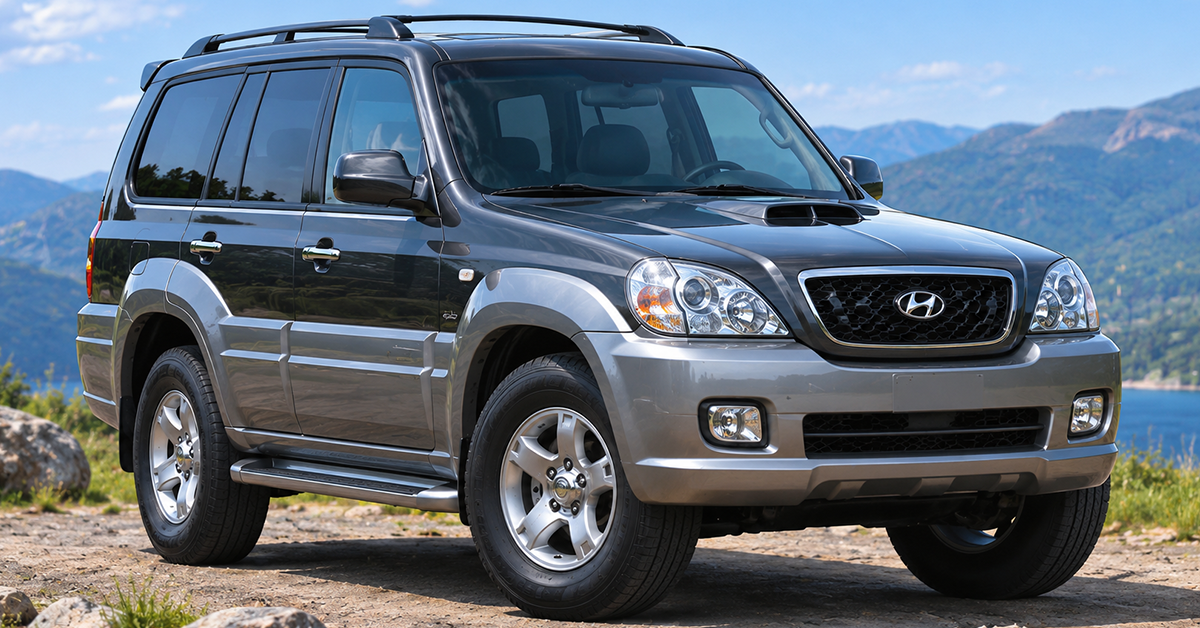
AI-generated illustration of the Hyundai Terracan, not an official Hyundai image. | Rev N Rise
The Hyundai Terracan is a full-size body-on-frame SUV that Hyundai built from 2001 to 2006, with a 3.5-liter V6 and a 2.9-liter common-rail diesel, and launched in India in 2003. Hyundai’s own pages give the years, the launch and the Ulsan plant but no specifications. Reports give its size, engines, prices and sales, including 55,664 European sales from 2001 to 2007. This guide covers the history, updates, markets, sales and the open questions.
The Terracan was Hyundai’s big body-on-frame SUV of the early 2000s. Hyundai’s worldwide vehicle history page lists it as a full-size SUV from 2001 to 2006 that evolved with a rigid and traditional body-on-frame structure (Hyundai). Hyundai’s 2001 to 2005 history page lists the launch of the Tuscani sports coupe, the Terracan and the Lavita in 2001 (Hyundai). Reports say it replaced the Galloper and was later succeeded by the Veracruz (reported). Hyundai’s 2001 timeline calls it a luxury SUV (Hyundai).
| Class | Full-size SUV, body-on-frame (Hyundai) |
| Years, Hyundai page | 2001 to 2006 (Hyundai) |
| Launched | 2001 (Hyundai) |
| India launch | August 4, 2003 (Hyundai) |
| Petrol engine | 3.5 V6, 145 kW, 302 Nm (reported) |
| Diesel engine | 2.9 CRDi, 150 or 163 PS (reported) |
| Length | 4,710 mm (reported) |
| Wheelbase | 2,750 mm (reported) |
| Europe sales, 2004 | 13,686 units (reported) |
| Successor | Veracruz (reported) |
We read Hyundai’s own pages first. They were the vehicle history entry, the 2001 to 2005 chronicle, the 2001 and 2002 annual reports and an India milestones page seen in a search excerpt. Motoring reports, catalogs, retail listings and sales databases fill the gaps and carry the reported tag. Prices and availability may have changed since publication, and exchange rates are not applied. The Terracan is out of production, so every price here is a period price. Where Hyundai gives a fact we use it, and where only reports give it we say so.
Reports give a 3.5-liter Sigma V6 petrol engine of 145 kW and 302 Nm and a 2.9-liter common-rail turbo-diesel, first quoted at 150 PS and later at 163 PS or 120 kW (reported). A reprint of the 2002 German launch figures gives the diesel 333 Nm, while Australian figures give it 345 Nm (reported). Hyundai’s 2001 annual report says the Terracan was introduced with a new 2.9-liter common-rail diesel engine (Hyundai). We do not convert between kW, PS and horsepower, and we print each source’s figure as given. Hyundai gives no engine power for the Terracan on any page we read (Hyundai).
Reports give the Terracan as 4,710 mm long, 1,860 mm wide and 1,840 mm tall on a 2,750 mm wheelbase, built on a ladder frame with a live rear axle, a dual-range gearbox and a choice of five-speed manual or four-speed automatic (reported). Australian cars were seven-seaters, and a German review lists five seats (reported). An Australian review adds that the entry cars had part-time four-wheel drive and the Highlander had full-time on-demand all-wheel drive (reported).
A sales database gives European Terracan sales of 935 units in 2001, rising to 13,686 in 2004 and falling to 3,430 in 2007, a total of 55,664 units (reported, our calculation). Australian reports give 1,785 sales in 2004 and 2,656 in 2005, with about 1,793 in 2006 (reported). An Australian sales database gives 9,762 Terracans in all years, with 2005 as the peak at 2,656 (reported). We found no Hyundai page that gives Terracan sales by year.
This guide covers the history, engines, body and equipment, the updates, the markets, safety, sales and the points where figures conflict. Our Hyundai Santa Fe article covers the Santa Fe, which Hyundai cites with the Terracan, our Hyundai Palisade article covers Hyundai’s current large SUV, our Hyundai Models article lists the range and our Hyundai history article covers the company. No currency conversion is given. The Terracan is no longer sold, so nothing here is a current price or specification.
Hyundai’s 2001 annual report says Hyundai “also rolled out Terracan, an SUV” in 2001, and its timeline lists the Terracan luxury SUV and a 2WD edition of the Terracan as rolled out that year (Hyundai). The same report says the Terracan SUV was introduced with a new 2.9-liter common-rail diesel engine (Hyundai). It says the Terracan, Lavita and Matrix, and Tuscani and Coupe were highly acclaimed by the media and public in overseas markets (Hyundai). The report does not link that comment to sales figures (Hyundai). Hyundai’s reports are the strongest sources here, because they are Hyundai’s own.
| Hyundai history entry | 2001 to 2006 (Hyundai) |
| Annual report, 2001 | Terracan rolled out (Hyundai) |
| 2WD edition | Rolled out in 2001 (Hyundai) |
| 2.9 CRDi | Introduced with Terracan (Hyundai) |
| Plant | Ulsan, Korea (Hyundai) |
| Australia arrival | Late 2001 (reported) |
| German review | January 2002 (reported) |
| Predecessor | Galloper (reported) |
| Concept preview | Highland (reported) |
| Name origin | Tarascan (reported) |
Hyundai’s 2001 report lists the Terracan among the models built at the Ulsan complex, and its 2002 report lists it at the No. 5 plant with the Galloper and the Porter truck (Hyundai). Hyundai’s 2002 report says the company’s recreational vehicle sector recorded 12.7 percent growth to 175,579 cars, helped by Santa Fe and Terracan sales (Hyundai). The reports do not give Terracan figures separately (Hyundai). The 2002 report’s corporate history also lists the launch of the 2WD Terracan and of the Terracan with a 2.9-liter common-rail diesel (Hyundai).
Hyundai’s 2001 to 2005 history page lists the launch of Tuscani, Terracan and Lavita in 2001, alongside the establishment of the Hyundai European Design Center and the unveiling of Korea’s first fuel cell electric vehicle, the Santa Fe (Hyundai). The same page lists the Tucson as Hyundai’s first compact SUV in 2004 (Hyundai). The Terracan therefore sits in the same years as the Santa Fe and the Tucson. Hyundai’s India page lists the Terracan as a premium SUV in 2003 (Hyundai).
Reports disagree on the exact date. One reference says the Terracan launched in February 2001, an Australian review says it arrived in late 2001 as that market’s second Hyundai SUV, and a German review of January 2002 says Hyundai added it at the end of 2001 (reported). A Dutch report of December 7, 2001 describes a Terracan 4x4 passenger model presented alongside Terracan van versions (reported). Dates therefore depend on the market, and Hyundai’s pages give only the year (Hyundai, reported).
Reports say the Terracan replaced the Galloper, which was based on a Mitsubishi design, and was previewed by a concept called the Highland (reported). One report says the name comes from Tarascan, a Mesoamerican empire in west-central Mexico (reported). Another report says the Terracan was developed as a counter to a rival Korean SUV, the Rexton, which had a minor change in 2003 (reported). None of these points is on a Hyundai page we read. A reference site marks the Highland preview claim as needing a citation (reported).
Hyundai’s vehicle history page gives the Terracan years as 2001 to 2006 and says it “made progressive developments” over that time (Hyundai). It shows five images, which we have not described, and gives no engines or sales (Hyundai). Its summary paragraph is the only narrative on the page (Hyundai). Our Hyundai Santa Fe article covers the Santa Fe, which Hyundai’s 2002 report cites with the Terracan, and our Hyundai history article covers the company.
An Australian review gives the 3.5-liter G6AU Sigma V6 petrol engine as 145 kW at 5,500 rpm and 302 Nm at 3,000 rpm, with a 10.0 to 1 compression ratio and four valves per cylinder (reported). The same review says the engine has a cast-iron block, aluminum cylinder heads and double overhead camshafts on each bank (reported). Another catalog lists the same engine at 194 hp or 143 kW, and a third lists 200 hp and 313 Nm, so the V6 figures do not agree between sources (reported). We print the Australian figures as the main set.
| Petrol engine | 3.5 V6 Sigma (reported) |
| Petrol output | 145 kW, 302 Nm (reported) |
| Diesel engine | 2.9 CRDi, 4 cylinders (reported) |
| Diesel output, Australia | 120 kW, 345 Nm (reported) |
| Diesel output, Germany 2002 | 150 PS, 333 Nm (reported) |
| Diesel output, Germany later | 163 PS, 120 kW (reported) |
| Gearboxes | 5-speed manual, 4-speed automatic (reported) |
| Low range ratio | 2.48 to 1 (reported) |
| Entry 4WD | Part-time, to 80 km/h switch (reported) |
| Highlander 4WD | Full-time, up to 50 percent front (reported) |
The 2.9-liter J3 turbo-diesel is described as a common-rail direct-injection four-cylinder with injection at 1,600 bar, giving 120 kW at 3,800 rpm and 345 Nm from 1,750 to 3,000 rpm in Australian figures (reported). The review gives the diesel a compression ratio of 18.4 to 1 (reported). A German review of January 2002 gives the same engine 150 PS and 333 Nm at 2,000 rpm, a top speed of 166 km/h, 0 to 100 km/h in 13.7 seconds and 8.6 liters per 100 km according to Hyundai (reported).
Later German listings give the diesel 163 PS (120 kW), with 0 to 100 km/h in 13 to 13.4 seconds, a top speed of 168 to 172 km/h and 8.7 to 9.1 liters per 100 km combined (reported). A catalog lists the 2001 diesel at 150 hp and 110 kW and the 2004 diesel at 163 hp and 120 kW (reported). The rise from 150 to 163 PS is therefore reported across several sources, though the timing is not on a Hyundai page. A catalog lists consumption of 8.6 liters per 100 km for the manual 2.9 CRDi and 9.8 for the automatic (reported).
The Australian review says the CRDi arrived in Australia in 2005, and a trade page dates it to January 2005, while European sales used the diesel from the start (reported). A reference site also lists a 2.5-liter diesel licensed from Mitsubishi and a 2.4-liter petrol engine for China (reported). A Russian catalog lists the 2.5 diesel at 101 horsepower, with torque figures of 294 Nm and 240 Nm for different versions (reported). Engine availability depended on market.
Both main engines were offered with a five-speed manual or a four-speed automatic, a dual-range transfer case with a 2.48 to 1 low ratio and a limited-slip rear differential, according to an Australian review (reported). Automatics had a hill-descent mode that works in first-gear low range and reverse (reported). A trade page also lists hill descent for automatic models (reported). The German review adds that the all-wheel drive is switchable and has a rear differential lock (reported).
The entry cars used a part-time system with an electric shift transfer that could switch from two-wheel drive up to 80 km/h, and the Highlander used full-time on-demand all-wheel drive with Active Torque Transfer, normally rear-biased and sending up to 50 percent of torque forward if traction is lost (reported). Hyundai’s own pages give no drivetrain detail, so this section is reported. Our Hyundai Santa Fe article covers another Hyundai SUV.
An Australian review gives the Terracan as 4,710 mm long, 1,860 mm wide and 1,840 mm tall on a 2,750 mm wheelbase (reported). A reference site gives 4,700 mm long and 1,840 mm tall, and a retail catalog gives 1,795 mm tall (reported). The 4,710 mm length is 1,960 mm more than the wheelbase, which is our calculation (reported, our calculation). 1,960 mm more than the wheelbase, which is our calculation (reported, our calculation). A catalog lists service intervals of 15,000 km or 12 months and a five-year, 130,000 km warranty in Australia (reported).
| Length | 4,710 mm (reported) |
| Width | 1,860 mm (reported) |
| Height | 1,840 mm (reported) |
| Wheelbase | 2,750 mm (reported) |
| Chassis | Ladder frame (reported) |
| Wheels, Australia | 16 inch alloys, 255/65 (reported) |
| Cargo, Germany | 750 to 1,125 liters (reported) |
| GL price, Germany 2002 | 24,490 euros (reported) |
| GLS price, Germany 2002 | 29,390 euros (reported) |
| Towing, sources | 700 to 3,500 kg (reported) |
The chassis is a ladder frame, with double wishbones and torsion bars at the front and a five-link coil-sprung live axle at the rear with a Panhard rod (reported). The review says the front also has a stabiliser bar, and the rear has twin lower longitudinal arms and angled upper rods (reported). A German review of 2002 describes a body-on-frame off-roader, 4.71 m long, with a five-seat layout, 750 liters of cargo space growing to 1,125 liters and a weight over two tonnes (reported). Australian cars were sold as seven-seaters (reported). A UK listing gives luggage space of 1,170 liters, while a German club test gives a boot of 490 liters (reported).
Standard equipment on Australian cars included 16-inch alloy wheels with 255/65 tyres, a six-speaker stereo with CD, air conditioning, cruise control, fog lights, central locking, power windows and mirrors, an alarm and an immobiliser, and the Highlander added climate control, leather and woodgrain trim (reported). In Germany the GL had four electric windows, central locking, a load cover and two airbags, and the GLS added air conditioning, alloy wheels, roof rails and a radio remote with alarm (reported). A German comfort package lists partial leather seats, front seat heating, a wood-trimmed leather steering wheel, a leather gear knob and automatic climate control (reported).
German prices at the 2002 launch were 24,490 euros for the GL and 29,390 euros for the 2.9 CRDi GLS, an automatic cost 2,030 euros extra and a comfort package cost 2,300 euros extra (reported). The GLS was 4,900 euros above the GL, by our subtraction (reported, our calculation). A later German listing gives the GL at 28,040 euros and the GLS at 32,340 euros, a 4,300 euro gap, and a Team 06 edition at 30,990 euros (reported, our calculation).
A Dutch report of December 2001 gives Terracan van prices from 22,175 euros excluding VAT, 23,175 euros for the high-roof version and 27,495 euros for the high-roof Executive, a spread of 5,320 euros (reported, our calculation). An Australian page says the SLX added a body-colour roof spoiler and side steps for about 1,000 dollars over the GL (reported). Prices and availability may have changed since publication, and exchange rates are not applied.
Towing figures conflict. The German review says up to 3.5 tonnes depending on the gradient, an Australian review mentions a 2,500 kg tow-bar kit on the May 2002 World Cup models, a UK listing gives 2,800 kg braked and 700 kg unbraked and a German listing gives 700 to 2,610 kg (reported). We found no Hyundai towing figure.
An Australian review lists the updates in order. In May 2002 World Cup special editions were launched, including a tow-bar kit rated at 2,500 kg (reported). Hyundai’s 2001 annual report says Hyundai signed on as the exclusive automotive sponsor for the 2002 FIFA World Cup, though the sources do not link the editions to it explicitly (Hyundai). When the Terracan entered its second year the only changes were some additional colours, according to a reference site (reported).
| World Cup editions | May 2002 (reported) |
| ABS and EBD standard | February 2004 (reported) |
| Facelift, Australia | February or October 2004 (reported) |
| 2005 model-year update | October 2004 (reported) |
| CRDi in Australia | January 2005 (reported) |
| Team 06, Germany | February to September 2005 (reported) |
| HP.II | November 2006 (reported) |
| SLX introduced | First quarter 2007 (reported) |
| Range size, 2007 | 12 variants (reported) |
| Hyundai page on updates | Progressive developments only (Hyundai) |
In February 2004, the Australian review says, ABS and EBD became standard across the range, and the cars gained MP3 compatibility, new alloy designs and a dark grey mesh grille and headlight housing (reported). It says the first Australian shipment had included discounted Highlanders without ABS or EBD (reported). A trade page says a 2004 facelift added a new nose and tail lamps, and a reference site says the light facelift came in 2004 or 2005 depending on the source (reported). A trade page puts the CRDi launch three months after the facelift, which suggests late 2004 (reported).
In October 2004, for the 2005 model year, the Australian review lists a new centre console, white-faced dials, satin-chrome interior finishes, a middle-row 12-volt outlet, matt charcoal honeycomb grille inserts, slimmer front bumpers with rectangular fog lights, rounder rear bumpers and reshaped side cladding (reported). The review says the cabin changed as well as the exterior, with a new centre console and white-faced dials (reported). A German listing dates a Team 06 edition to February to September 2005 (reported).
The CRDi diesel arrived in Australia in January 2005, according to a trade page, with around 80 CRDi cars a month forecast out of an expected 300 Terracans a month that year (reported). The monthly numbers are a forecast and not a result (reported). The same page says the previous year averaged just under 150 a month for a total of 1,785 units, up 87.5 percent on 2003 (reported). We do not convert these Australian figures to other markets.
The HP.II came in November 2006, according to the Australian review, with a body-coloured rear roof spoiler and matt black side steps with alloy chequerplate inserts, and safety and features substantially unchanged (reported). The review table covers 2001 to 2006 for the HP.I and 2006 to 2008 for the HP.II (reported). The Highlander was dropped and the entry car was renamed SLX, and a trade page says the range reached 12 variants with the SLX in the first quarter of 2007 (reported). The page names the entry and top trims as GL and GLS (reported).
None of these updates is on a Hyundai page. Hyundai’s vehicle history entry says only that the Terracan “made progressive developments” between 2001 and 2006 (Hyundai). Hyundai’s 2002 annual report also lists the launch of a 2WD Terracan, which we cannot place within these updates (Hyundai). Dates therefore come from market reports, and a facelift date can differ by market. Our Hyundai Models article lists the current range and our Hyundai history article covers the company.
Hyundai’s India milestones page, seen in a search excerpt, lists August 4, 2003 as the date Hyundai Motor India launched its premium SUV, the Terracan (Hyundai). We could not open the page itself, so this date rests on the excerpt. It is the only market launch date for the Terracan that we found on a Hyundai page (Hyundai). A reference site says Indian assembly ran from 2003 to 2007 in Chennai (reported). The excerpt gives no Indian prices or engines.
| India launch | August 4, 2003 (Hyundai) |
| India assembly | 2003 to 2007, Chennai (reported) |
| China production | 2003 to 2011 or other (reported) |
| Europe sales, 2001 | 935 units (reported) |
| Europe sales, 2002 | 10,227 units (reported) |
| Europe sales, 2003 | 10,864 units (reported) |
| Europe sales, 2004 | 13,686 units (reported) |
| Europe sales, 2005 | 10,099 units (reported) |
| Europe sales, 2006 | 6,423 units (reported) |
| Europe sales, 2007 | 3,430 units (reported) |
A reference site says Chinese production ran from 2003 to 2011 under a Hawtai brand, in a joint venture with Hyundai that lasted until 2010, and lists a 2.4-liter petrol engine for China (reported). Another catalog says a Huatai-Hyundai Terracan was built from 2001 and a Hawtai version from 2008 (reported). The sources disagree on the start year and we found no Hyundai page on the Chinese cars.
In Germany the listings we saw feature only the 2.9 CRDi, and one listing says Hyundai sold the Terracan there from 2001 to 2006 (reported). The sales database lists European sales of 935 units in 2001, 10,227 in 2002, 10,864 in 2003, 13,686 in 2004, 10,099 in 2005, 6,423 in 2006 and 3,430 in 2007 (reported). That is 9,292 more units in 2002 than in 2001 (reported, our calculation). A listing shows the GL and GLS trims with the 2.9 CRDi in Germany (reported).
For Australia, a trade page says the Terracan was Hyundai’s second SUV there, built on a much-modified Galloper platform, a traditional off-roader with a separate chassis, a live rear axle and a dual-range gearbox (reported). It gives 1,785 sales in 2004, and a later report gives 2,656 in 2005 and about 1,793 in 2006 (reported). Those numbers are 48.8 percent growth from 2004 to 2005 and a 32.5 percent fall to 2006 (reported, our calculation). A report says Hyundai Australia sold 42,510 new cars in 2004, up 37 percent on 2003, so the 1,785 Terracans were about 4.2 percent of that total (reported, our calculation).
An Australian sales database gives 9,762 Terracans sold in all years, with 2005 the peak at 2,656 sales (reported). The three years above add to 6,234, which leaves 3,528 units across the other years, by our subtraction (reported, our calculation). A 2007 report says Hyundai Australia had discontinued the Terracan, that only a couple of hundred units remained in stock and that a right-hand-drive Veracruz would not replace it any time soon (reported). The same report gives Hyundai Australia’s 2006 total as 46,523 cars, so 1,793 Terracans was about 3.9 percent of that (reported, our calculation). Both shares are for Hyundai Australia only (reported, our calculation).
Markets listed by one reference include Asia, Europe, Africa, Australia, New Zealand and parts of South America (reported). We found no Hyundai page that lists Terracan markets in full. A reference site also says the Terracan was sold in South Korea, Europe, India, Australia, New Zealand and South America (reported). Our Hyundai Santa Fe article covers the Santa Fe, and our Hyundai Palisade article covers Hyundai’s current large SUV.
An Australian review lists dual front airbags, anti-submarining front seat pans and front seatbelts with pretensioners and load limiters as standard, with ABS and EBD on the Highlander at first and standard across the range from February 2004 (reported). It gives no ANCAP or Euro NCAP rating (reported). A UK listing says Euro NCAP safety data was not found for the Terracan (reported). We found no result and give none. Hyundai’s 2001 annual report says the Terracan was highly acclaimed by the media and public in overseas markets, which is not a safety rating (Hyundai).
| Standard airbags, Australia | Dual front (reported) |
| ABS and EBD standard | February 2004 (reported) |
| Euro NCAP result | None found |
| ANCAP result | None found |
| Europe sales, 2001 to 2007 | 55,664 units (reported, our calculation) |
| Peak year in Europe | 2004, 13,686 units (reported) |
| Fall, 2004 to 2005 | 26.2 percent (reported, our calculation) |
| Fall, 2004 to 2007 | 74.9 percent (reported, our calculation) |
| Hyundai end year | 2006 (Hyundai) |
| Successor | Veracruz (reported) |
A German motoring club test of December 2004 of the 2.9 CRDi GLS automatic lists no side or head airbags, no ESP, high fuel use and costly upkeep among its weak points, and a boot of 490 liters that it compared with a BMW X5 and a Lexus RX (reported). The test also describes the Terracan as having a stable chassis off road (reported). It is a single test, and we use it for equipment, not as a rating. It is a single test, and we use it for equipment, not as a rating. Hyundai’s 2002 annual report says recreational vehicle sales were helped by the Terracan but gives no figure for it (Hyundai).
A sales database gives European sales of 55,664 units across 2001 to 2007, with 34,777 units in the three years 2002 to 2004 (reported, our calculation). From the 2004 peak of 13,686 to 2005 is a fall of 26.2 percent, to 2006 a fall of 36.4 percent and to 2007 a fall of 46.6 percent (reported, our calculation). Those percentages are our calculation from database figures and are rounded. The 2004 peak was 12,751 units above 2001 (reported, our calculation).
Reports say the Terracan was replaced by the Veracruz, based on the second-generation Santa Fe, which became the flagship SUV (reported). Another report says it was replaced by the Veracruz and the Kia Borrego, and a third says it was withdrawn in Europe in 2007 without a direct successor (reported). One reference says it was discontinued in 2007 because of weak sales (reported). These claims conflict, and none is a Hyundai statement. The Australian report says Hyundai ran the Terracan out from stock already landed in the country (reported).
Hyundai’s vehicle history page gives the end year as 2006, while Australian and German sources show sales continuing into 2007 and an Australian HP.II launched in November 2006 (Hyundai, reported). A catalog lists the Terracan as in production until 2009 in one place and until 2007 elsewhere (reported). We treat 2006 as Hyundai’s stated end and 2007 as the last sales year in the sources. The Australian review table covers the HP.II as running to 2008 (reported).
A UK listing says an MOT pass rate of 53 percent applied to Terracans registered in 2003, from 219 tests in 2021, with brakes the most common failure at 22 percent (reported). That is a used-car statistic and not a Hyundai figure. Our Hyundai Models article lists today’s range, our Hyundai Palisade article covers Hyundai’s current large SUV and our Hyundai history article covers the company.
Several figures conflict. The 2.9 CRDi is 150 PS and 333 Nm in a 2002 German review, 163 PS in later German listings, and 120 kW and 345 Nm in Australian figures (reported). The 3.5 V6 is 145 kW and 302 Nm, 143 kW and 194 hp or 200 hp and 313 Nm, depending on the source (reported). Heights are 1,840 mm in one source and 1,795 mm in another, and towing ranges from 700 to 3,500 kg (reported). Cargo space is 750 to 1,125 liters in the German review and 1,170 liters in a UK listing (reported).
| 2.9 CRDi, sources | 150 PS, 163 PS, 120 kW (reported) |
| Diesel torque, sources | 333 Nm or 345 Nm (reported) |
| 3.5 V6, sources | 145 kW, 143 kW or 200 hp (reported) |
| Height, sources | 1,840 mm or 1,795 mm (reported) |
| Towing, sources | 700 to 3,500 kg (reported) |
| End year, sources | 2006, 2007 or 2009 (Hyundai, reported) |
| CRDi in Australia | January 2005 (reported) |
| Hyundai specification page | Not found |
| Hyundai sales table | Not found |
| Euro NCAP and ANCAP | Not found |
The dates conflict as well. Hyundai says 2001 to 2006, one reference says 2001 to 2007 in Korea, and another says the Terracan was produced until 2009 (Hyundai, reported). The launch is February 2001 in one source and late 2001 in the market reports (reported). The CRDi appears in Europe from 2001 and in Australia from January 2005 (reported). The 2004 facelift is also dated 2005 by one reference (reported). The Australian review names the first generation HP.I and the 2006 update HP.II (reported).
Hyundai’s own pages are thin on numbers. The vehicle history page gives the years and a single paragraph, and the annual reports give launch events, the Ulsan plant and the recreational vehicle sector growth (Hyundai). They give no Terracan engine power, price or sales (Hyundai). The India date comes from a search excerpt of a Hyundai page that we could not open, so it is as seen in that excerpt. The India date comes from a search excerpt of a Hyundai page that we could not open, so it is as seen in that excerpt. The annual reports are company reports and not model pages (Hyundai).
Not confirmed: we found no Hyundai page with Terracan specifications, no Hyundai sales table, no Euro NCAP or ANCAP result and no Hyundai statement on what replaced the car. We also did not read a Hyundai page on the Chinese Hawtai Terracan or the Chennai assembly. The 2001 and 2002 annual reports are the only Hyundai documents we found with launch details beyond the vehicle history page (Hyundai). The sales databases are references and not official counts, and the German and Australian prices are period list prices. Any figure for the Chinese Terracan should be treated as reported until Hyundai confirms it.
Things to watch are a Hyundai statement on the Terracan’s successor, any new Hyundai heritage page with Terracan specifications and any change to Hyundai’s history pages. Hyundai’s vehicle history entry may be updated, and our figures would then need checking. We will update this guide if Hyundai publishes new Terracan information.
To check this guide, begin with Hyundai’s vehicle history page and its 2001 and 2002 annual reports, then compare dates before comparing numbers. Our Hyundai Santa Fe then compare dates before comparing numbers. The places to check a missing figure are Hyundai’s Korean and worldwide history pages. Our Hyundai Santa Fe article covers the Santa Fe, our Hyundai Palisade article covers Hyundai’s current large SUV, our Hyundai Models article lists the range and our Hyundai history article covers the company.