 Brands
Toyota Coaster — The Bus Named After a Cargo Ship
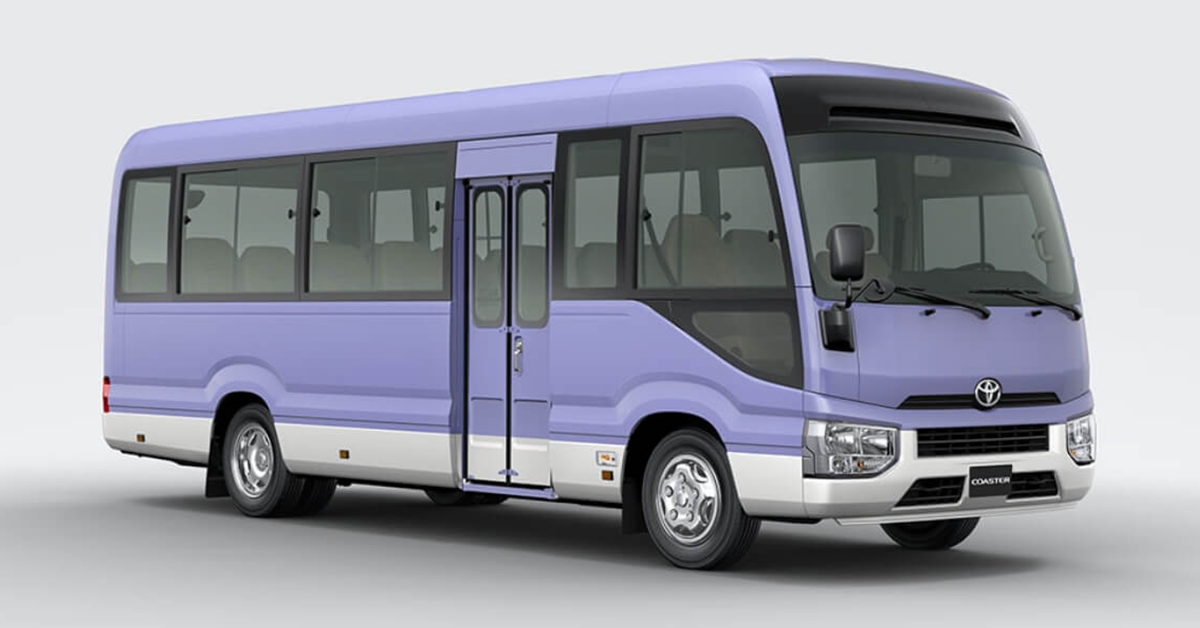
Official press image of the Toyota Coaster. | © Toyota Motor Corporation
A coaster, in the original sense of the word, is a small cargo ship that travels steadily along a coastline, calling at port after port, carrying whatever needs carrying without fuss or fanfare. Toyota borrowed that name deliberately for its small bus in 1969, and the choice has proven genuinely fitting. For over five decades, the Coaster has quietly done exactly that job on land — moving passengers reliably across school routes, hotel shuttles, tour circuits and public transit lines in more than 110 countries, without ever becoming a headline vehicle the way Toyota's cars regularly do.
The Coaster’s lineage traces back to 1956, when Toyota built route-truck-based small buses derived directly from the Toyota Dyna platform. By 1963, this had evolved into the “Light Bus” (K170B), a genuine early attempt at a purpose-built small bus that still shared its underlying frame with the Dyna truck — a common, cost-effective approach at the time, but one that inherently limited how much Toyota could optimise the vehicle purely for passenger use. According to Toyota’s own official company history, the turning point came in February 1969, when the company fully remodelled the Light Bus and released it under an entirely new name: the Coaster.
Critically, this was not simply a badge change. Toyota gave the new Coaster its own original frame, extending the wheelbase by 270mm over the outgoing Light Bus specifically to accommodate its role as a dedicated bus rather than a repurposed truck. Lowering the floor and redesigning the body substantially enlarged the cabin, and the standard model’s seating capacity grew to 26 passengers — one more than the Light Bus it replaced. Toyota offered the original Coaster with a choice of a 2.0-litre, 93-horsepower petrol engine (5R) or a more efficient 2.5-litre, 70-horsepower diesel unit (J), and demand grew steadily alongside Japan’s broader post-war economic expansion, as private transportation operators, small tour companies and pickup services increasingly found genuine use for a small, purpose-built bus.
The Coaster went on to genuinely dominate Japan’s small bus segment alongside its closest rival, the Nissan Echo, and Toyota extended the wheelbase further in a 1977 update, growing cabin space again while also improving safety equipment.
The second generation (B20/B30), launched in 1982, refined the formula without disturbing its fundamentals, and the third generation (B40/B50) arrived in January 1993 with a genuinely more aerodynamic body and considerably larger glass windows — a deliberate move to set the standard for the next generation of small buses more broadly, according to contemporary Toyota positioning. This generation offered three distinct diesel engine choices: a 4.2-litre turbocharged unit producing 170 horsepower (1HD-T), a naturally aspirated 4.2-litre unit at 140 horsepower (1HZ), and a smaller 3.4-litre engine at 98 horsepower (3B). Toyota also repositioned the engine further forward in the chassis, creating a flatter floor beneath the second row of seats and genuinely improving visibility and comfort for passengers seated further back — alongside deliberate engineering work to minimise cabin noise and vibration, achieving what Toyota described at the time as superior quietness for its category. In November 1995, Toyota extended the range further with a genuine full-time four-wheel-drive variant, featuring a high-roof extended body, a larger 4.1-litre diesel engine (15B-F) and an electronically controlled transmission — aimed at operators needing genuine off-road or adverse-condition capability rather than pure urban shuttle duty.
Toyota kept this third generation in production for an unusually long span, applying meaningful facelifts in both 2001 and 2007 to keep the design visually current, and completely removing asbestos from the vehicle’s construction as part of the ongoing safety and environmental improvements made across this generation’s extended run.
The current fourth-generation Coaster (B60/B70/B80) launched on 22 December 2016, and represents a genuinely more significant departure from its predecessors than any previous Coaster redesign. Toyota grew the overall body size, adopted larger “medium” window glazing, and relocated the gear selector to the dashboard rather than a traditional floor-mounted position — small but genuinely deliberate changes aimed at improving both driver ergonomics and the overall sense of cabin modernity for passengers. The current generation is offered with seating configurations spanning approximately 23 to 30 passengers depending on regional specification, powered by a choice of a 2.8-litre turbocharged diesel four-cylinder or a 2.7-litre petrol four-cylinder engine, with a single drivetrain configuration keeping the mechanical lineup deliberately straightforward for fleet operators.
Toyota positions the current Coaster explicitly as a medium-sized bus — larger and more capable than a simple shuttle van, yet still compact and manoeuvrable enough for genuine urban route use. Standard equipment across the current range includes air conditioning, adjustable seating, ample onboard storage and, on higher specifications, integrated entertainment systems for tour and charter operators. Safety equipment has kept pace with modern expectations as well, including ABS, traction control, stability control and multiple airbags — genuinely comprehensive coverage for a vehicle class that historically prioritised mechanical simplicity above all else.
The Coaster is sold through Toyota’s dealer network across Japan, but the model’s genuine commercial reach extends far beyond its home market — Toyota confirms sales across more than 110 countries and regions, with cumulative sales exceeding half a million units. Export markets rely on it in genuinely varied and specific ways: it serves as a widely used commercial minibus across Taiwan and Hong Kong, functions as a common school bus platform throughout much of the Middle East, and is even produced under licensed manufacture in China to serve that market directly rather than relying purely on imports. Australia represents another genuinely significant export market, where the Coaster has built a long-standing reputation among tour operators, community transport services and school districts specifically for its combination of reliability and manageable running costs.
The Coaster has never been sold new in the United States, following the same market-availability pattern as several other Toyota commercial vehicles built primarily around right-hand-drive and export-focused production planning rather than the specific regulatory and dealer-network investment required for US sale. American buyers wanting a Coaster have generally relied on specialist grey-market importers, though the vehicle’s commercial-fleet-first positioning means genuine demand for individual private import remains considerably smaller than for passenger-oriented JDM imports like the Hilux Surf or older HiAce generations.
For nearly five decades, the Coaster held a genuinely unique position within Toyota's own lineup: it was, quite simply, the only bus the company built. That changed in 2017, when Toyota launched the Sora — a considerably larger, purpose-built city bus powered entirely by hydrogen fuel cell technology, developed specifically for high-capacity public transit fleets in Japan rather than the smaller-scale charter, school and tour duty the Coaster has always specialised in. The Sora's fuel cell technology draws directly on the same underlying research programme that produced the Mirai passenger car, extending Toyota's hydrogen strategy from personal transportation into public transit infrastructure. The two buses now serve genuinely complementary roles within Toyota's commercial lineup: the Coaster remains the smaller, mechanically conventional workhorse serving the vast majority of the world's small-bus demand, while the Sora represents Toyota's much more experimental, environmentally driven bet on hydrogen-powered mass transit, largely confined to Japan's domestic public transport network for now.