 Brands
Toyota Hydrogen Cars — Every Model in the Lineup, Explained
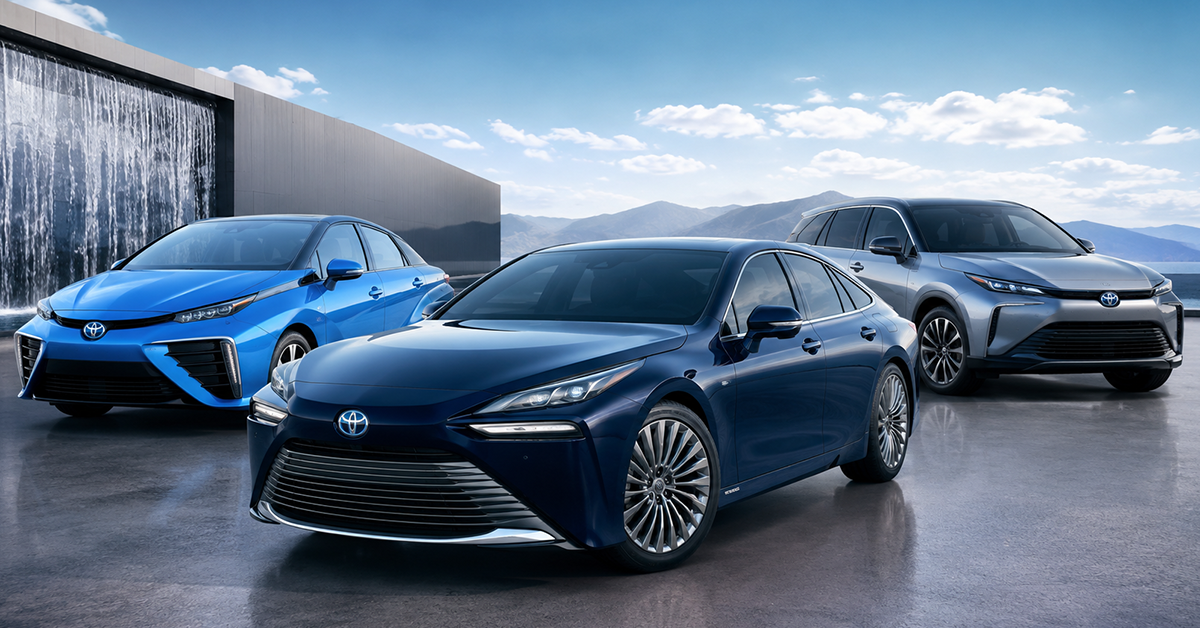
AI-generated concept illustration — Toyota's hydrogen fuel cell lineup. | Rev N Rise
Toyota has spent over two decades betting on hydrogen while much of the industry quietly walked away. The Mirai remains the only hydrogen passenger car most Americans could name, and it's the clearest window into what that bet actually looks like today: a genuinely capable, continuously updated car held back almost entirely by how few places in the country can actually refuel it. Here's what the 2026 Mirai gets right, and why Toyota keeps building it anyway.
A hydrogen fuel cell vehicle isn't a hybrid, and it isn't a battery-electric vehicle in the way people usually mean the term — though it is, technically, still an EV. Inside the car, compressed hydrogen from the fuel tank meets oxygen drawn in from outside air inside a device called the fuel cell stack. That chemical reaction generates electricity on demand, which powers the electric motor directly, with the only byproduct being water vapour released from the tailpipe. There's a small battery on board too — on the current Mirai, genuinely smaller than the battery used in Toyota's own 4Runner Hybrid — but it exists mainly to smooth out power delivery and capture regenerative braking energy, not to store the car's primary energy supply the way a battery-electric vehicle's pack does.
The practical upside of this approach is refuelling speed: a hydrogen tank fills in around five minutes, essentially identical to a conventional gasoline stop, and considerably faster than even the quickest DC fast-charging session for a battery-electric vehicle. The practical downside is infrastructure. Building a hydrogen refuelling station is a genuinely expensive, specialised undertaking, and North America currently has only 56 public hydrogen stations total, with 49 of them concentrated in California alone. That single fact explains almost everything about where Toyota does and doesn't sell the Mirai, and why hydrogen has remained a genuinely regional proposition in the US rather than the nationwide alternative it was originally pitched as back in 2014.
Hydrogen itself isn't a primary energy source the way oil or natural gas is — it's an energy carrier, meaning it has to be produced first, typically either by splitting water molecules using electricity (a process called electrolysis) or by extracting it from natural gas through a process called steam methane reforming. The genuinely important distinction here is “green” hydrogen, produced using renewable electricity, versus “grey” hydrogen, produced from natural gas and carrying a considerably larger carbon footprint despite the vehicle itself emitting nothing but water. Toyota has been careful in its own marketing to acknowledge this nuance rather than claim the Mirai is automatically zero-carbon regardless of where its hydrogen comes from, a level of honesty that genuinely sets the company's messaging apart from some competitors' more sweeping environmental claims.
Compared with a conventional gasoline engine, a hydrogen fuel cell is considerably more efficient at converting stored energy into forward motion, though it still falls short of a pure battery-electric vehicle's overall efficiency once losses from hydrogen production, compression and transport are factored into the full picture. This is precisely why Toyota's own engineers have described hydrogen and battery-electric technology as complementary rather than directly competing solutions, each suited to genuinely different use cases depending on vehicle type, typical range requirements and how quickly a given fleet needs to refuel between duty cycles.
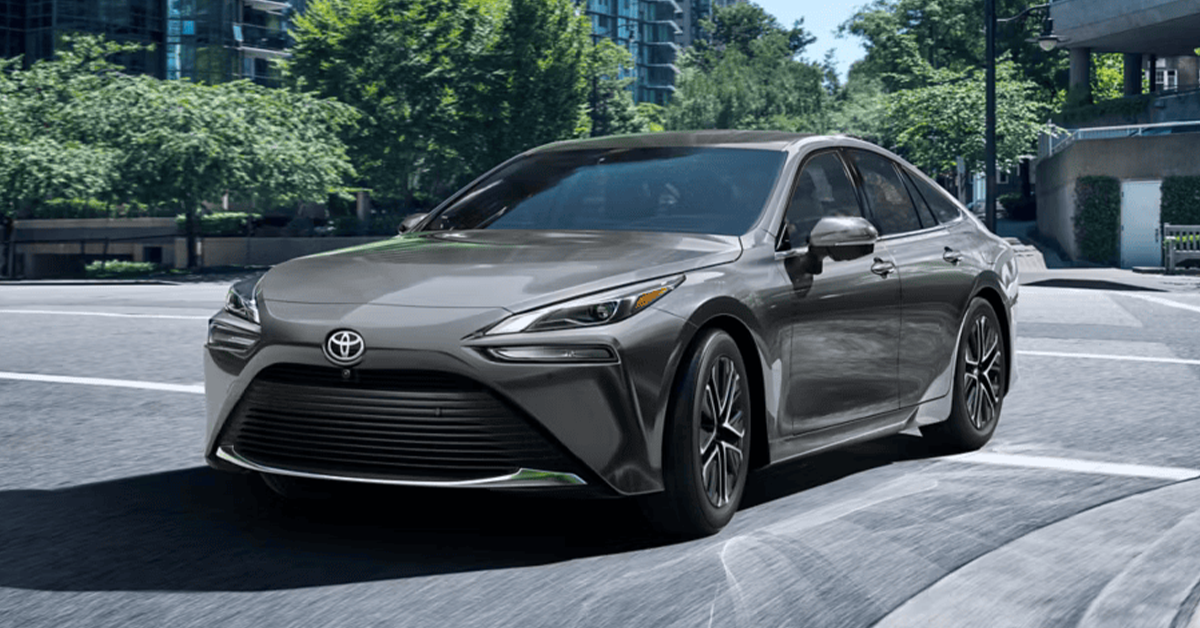
Official press image of the Toyota Mirai. | © Toyota Motor Corporation
The world's first mass-produced hydrogen fuel cell passenger car, launched in Japan in 2014 and now in its second generation since 2020. The 2026 Mirai delivers 182 horsepower and an EPA-estimated range of up to 402 miles on a full tank, starting at $51,795, with new-for-2026 19-inch black machine-finished wheels. Toyota backs every Mirai with an 8-year/100,000-mile FCEV warranty, plus $15,000 of complimentary hydrogen fuel for six years on a purchase or three years on a lease — genuinely aggressive incentives for a car this niche.
The honest number that matters most: Toyota sold just 147 Mirai units through Q3 2025, a 54 percent decline, and the car remains sold exclusively in California for the simple reason that it's the only US state with meaningful hydrogen refuelling infrastructure. Toyota has openly acknowledged the Mirai functions partly as a real-world development platform for its broader hydrogen ambitions rather than purely as a mass-market product — a genuinely unusual thing for a car company to admit about a vehicle it still actively sells and continues to update annually.
Inside the cabin, the second-generation Mirai moved decisively away from the awkward, three-box proportions of the original toward a considerably sleeker, rear-wheel-drive-based platform shared with the Toyota Crown and, internationally, the Lexus LS. That platform switch genuinely transformed the driving experience — reviewers consistently note the current Mirai handles with a poise closer to a proper Lexus sedan than a science experiment on wheels, a real departure from how the original generation was typically described. Standard equipment includes a 12.3-inch touchscreen, a 14-speaker premium JBL audio system, and Toyota Safety Sense's full driver-assistance suite, positioning the Mirai as a genuinely well-equipped, comfortable daily driver rather than a stripped-down technology demonstrator.
For the specific California buyer who can genuinely make use of it, the Mirai's ownership proposition is more compelling than the sales figures alone suggest. The complimentary hydrogen fuel allowance alone can be worth more than the price difference between the Mirai and a comparably equipped gasoline or hybrid sedan, and Toyota has continued expanding its network of preferred hydrogen retailers specifically to make fuelling more convenient for existing owners. The car also qualifies for California's Clean Vehicle Rebate Project and carpool lane access in most configurations, stacking additional real-world savings and convenience on top of the free-fuel offer for commuters navigating the state's notoriously congested urban corridors.
Toyota Hydrogen Headquarters, or H2HQ, is the company's lead North American office for developing, engineering and commercialising hydrogen fuel cell technology across every application in this guide — passenger cars, heavy-duty trucks and stationary power systems for commercial and industrial customers. At the May 2026 ACT Expo in Las Vegas, Toyota showcased its hydrogen ecosystem expansion directly, including a dual-nozzle dispenser capable of fuelling both light-duty Mirai sedans and heavy-duty trucks at the same station — a genuinely practical piece of shared infrastructure that helps justify the enormous cost of building hydrogen refuelling capacity in the first place.
Whether Toyota's hydrogen bet ultimately pays off remains a genuinely open question the company itself doesn't pretend to have settled. But the strategy has grown considerably more coherent over the past decade: rather than fighting battery-electric vehicles for the same passenger-car buyers, Toyota has increasingly steered hydrogen toward the specific use cases — heavy trucking, mass transit, stationary power — where its core advantages of fast refuelling and lighter weight matter most, while keeping the Mirai on sale as a visible, continuously updated proof that the underlying technology works.
Toyota isn't pursuing this alone. The company has consistently framed hydrogen adoption as something that genuinely requires industry-wide collaboration rather than a single manufacturer's unilateral effort, pointing out that no automaker, however large, can single-handedly fund the refuelling infrastructure a genuine hydrogen economy would need. To that end, Toyota has partnered with energy companies, port authorities and other automakers on shared infrastructure projects, and has continued lobbying alongside industry groups for public investment in hydrogen refuelling networks similar to the subsidies that helped jump-start early battery-electric vehicle charging infrastructure a decade earlier.
A third-generation fuel cell system, unveiled at February 2026's H2 & FC Expo in Tokyo, is planned for heavy-duty commercial vehicles across Japan, Europe, North America and China starting after 2026, representing a genuinely significant technical step-change over the system currently powering the Mirai. Toyota has described this next-generation system as central to what it calls achieving a genuine “hydrogen society” — not a single product launch, but a coordinated, multi-decade effort spanning how hydrogen is created, transported, stored and ultimately used across passenger vehicles, commercial fleets and stationary power applications alike. For a company that correctly called the hybrid market shift decades before most rivals took it seriously, that patient, infrastructure-first approach to hydrogen deserves to be judged on a similarly long timeline rather than by the Mirai's modest current sales figures alone.