 Brands
Toyota Models — The Complete History, From 1936 to Today
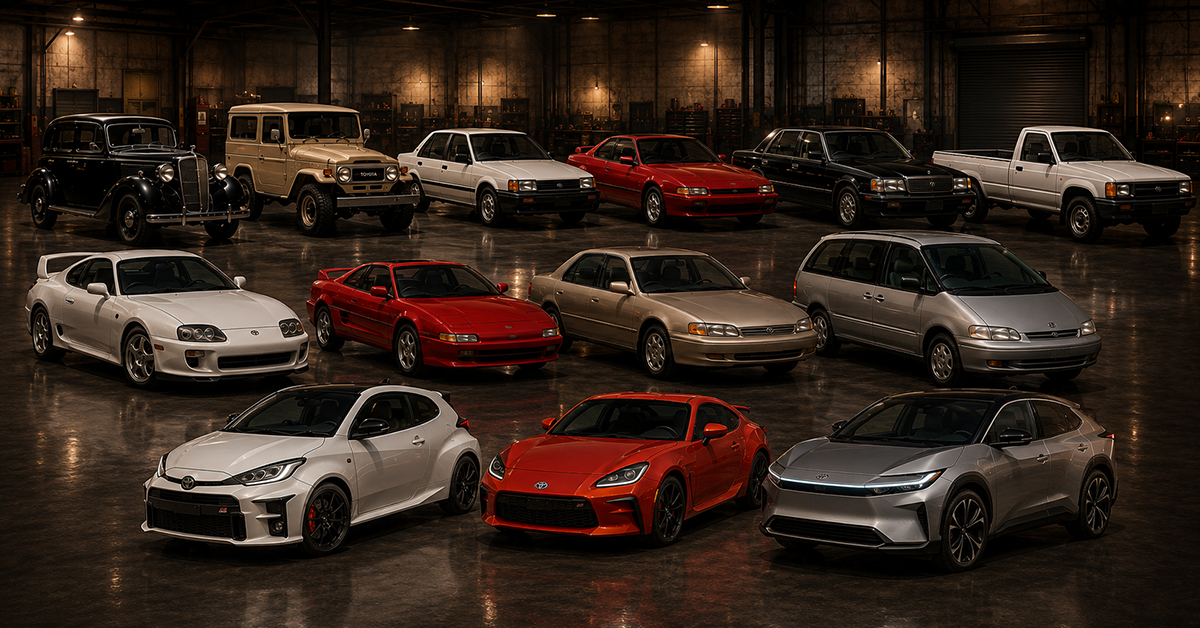
AI-generated concept illustration — Toyota's model history through the decades. | Rev N Rise
Almost ninety years and well over 100 distinct nameplates separate Toyota’s very first car from the lineup sold today. In that time the company has produced the best-selling passenger car in automotive history, invented mass-market hybrid technology, built one of the most trusted off-roaders on earth, and quietly discontinued dozens of models along the way that enthusiasts still search for by name. This is the complete story of Toyota’s models — not just what is on sale right now, but everything that came before it.
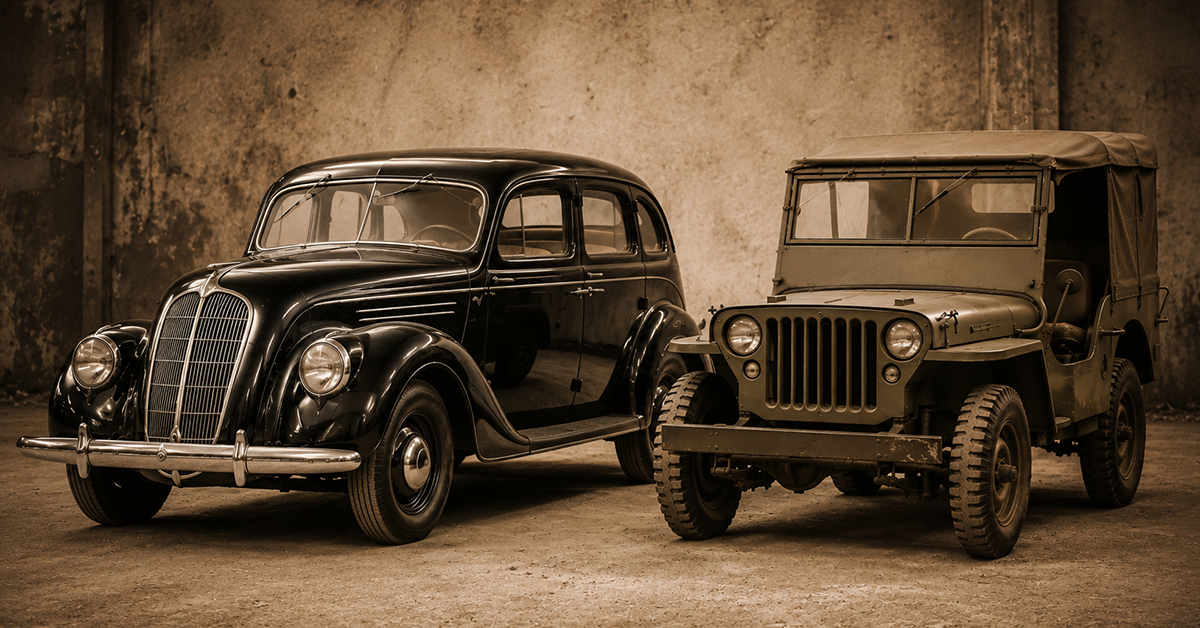
AI-generated concept illustration of the Model AA and original Land Cruiser — Toyota's founding era. | Rev N Rise
Toyota’s very first passenger car was the Model AA, launched in 1936 — closely modelled on the styling of the Chrysler Airflow and DeSoto Airflow, reflecting the American design influence common to early Japanese automobiles. Alongside it came the Model AB phaeton and various light commercial trucks, including the Toyota SG, produced from 1952 to 1954. This foundational period was defined less by any single iconic nameplate and more by Toyota establishing the manufacturing discipline that would define the company for the rest of its history — the earliest seeds of what became the Toyota Production System.
The most consequential launch of this era arrived in 1951: the original Land Cruiser, initially developed as a military-style utility vehicle. It was not yet the global icon it would become, but the durability and mechanical simplicity that defined it from the very first generation were already evident — qualities that would make it Toyota’s first genuinely successful export vehicle and the foundation of a nameplate still in production more than 70 years later.
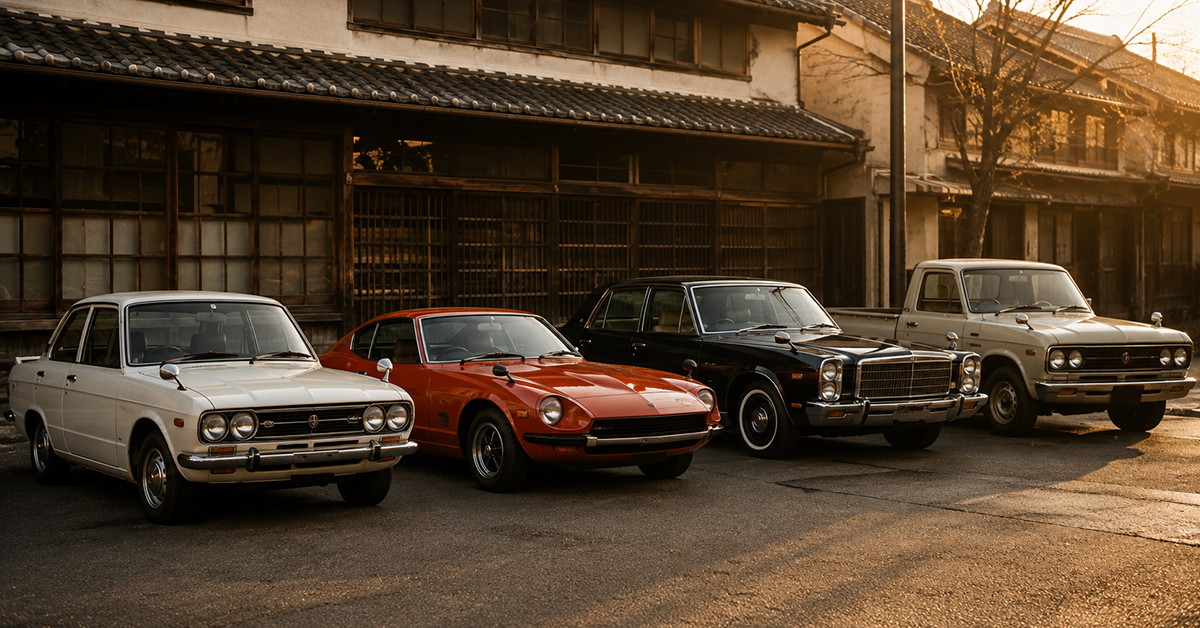
AI-generated concept illustration of the Corolla, Celica, Crown and Hilux — the era Toyota went global. | Rev N Rise
This is the era that transformed Toyota from a domestic Japanese manufacturer into a genuine international force. The Corolla arrived in 1966 and would go on to become the best-selling nameplate in automotive history, with over 50 million units sold to date. Its combination of affordability, reliability and genuine engineering competence gave international buyers — particularly in the United States, where Japanese cars had previously been viewed with scepticism — a reason to take Toyota seriously.
The Celica launched in 1970, giving Toyota a genuine sporting coupe to sit alongside its practical models, while the Crown continued to serve as the brand’s flagship rear-wheel-drive luxury sedan — a nameplate that has run continuously since the 1950s and remains in production today. The Hilux pickup, launched in 1968, began building the reputation for indestructibility that would eventually make it one of the most recognisable trucks on earth, found today from the driest deserts to the densest jungles, with more than 19 million units sold across its history.
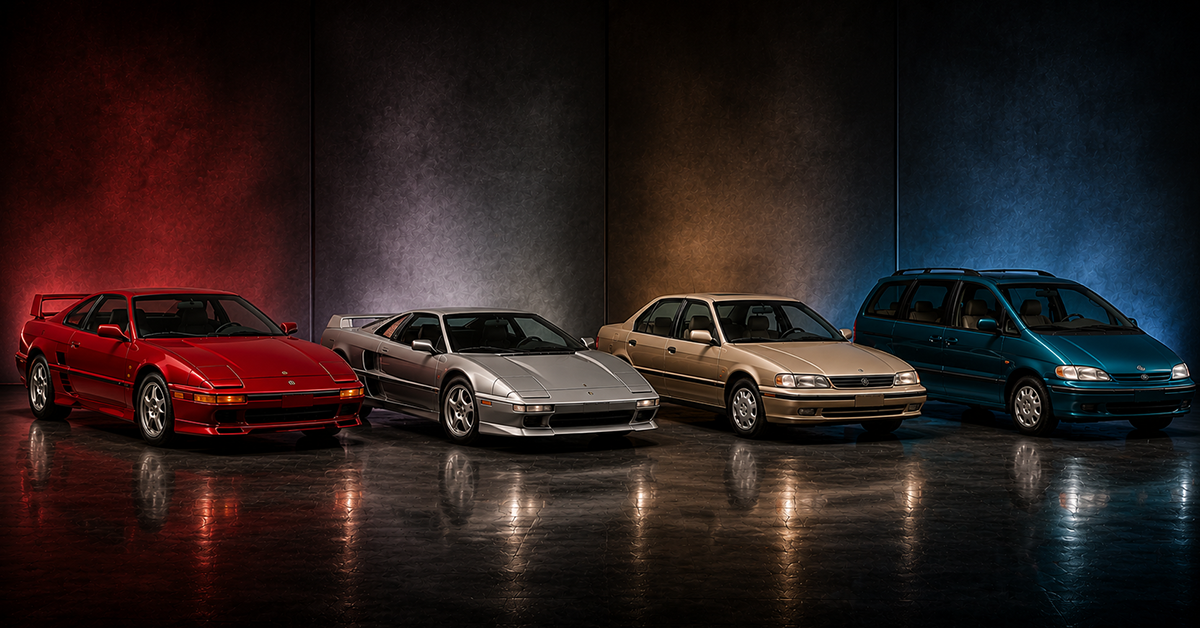
AI-generated concept illustration of the Supra, MR2, Camry and Previa — Toyota's golden era. | Rev N Rise
If any two decades define Toyota’s reputation among enthusiasts, it is these. The Supra emerged as its own standalone nameplate in 1986, evolving through its legendary Mk IV generation into one of the most celebrated performance cars of the 1990s. The mid-engined MR2 launched in 1984, offering genuinely engaging rear-wheel-drive handling in an affordable, compact package — a formula that earned it lasting enthusiast devotion across three generations. The Camry arrived in 1982 and would go on to become America’s best-selling passenger car for multiple consecutive decades.
This period also produced a wave of nameplates now largely forgotten outside dedicated enthusiast circles: the Cressida, a rear-wheel-drive luxury sedan sold internationally through the 1980s; the Cresta, part of the related Mark II platform family sold primarily in Japan; and the Previa, a genuinely unusual mid-engine minivan that arrived in 1990 unlike anything else in its segment. In 1989, Toyota launched an entirely new luxury division — Lexus — to compete directly with Mercedes-Benz and BMW, a move that fundamentally repositioned how the world viewed Japanese manufacturing quality.
The single most significant launch of the era, and arguably in the company’s entire history, came right at the end of the decade: the original Prius, launched in Japan in 1997 as the world’s first mass-produced hybrid car. It reached international markets in 2000 and fundamentally changed the direction of the entire automotive industry — every hybrid vehicle sold by any manufacturer today traces its commercial viability back to what Toyota proved with the Prius.
The 2000s saw Toyota rationalise its sprawling nameplate list while simultaneously becoming the world’s largest automaker, briefly overtaking General Motors in 2008. The RAV4, launched in 1994, grew into the company’s SUV backbone through this decade. The Highlander arrived in 2000 to serve growing three-row family demand. The Tundra launched in 1999 and was substantially redesigned in 2007, giving Toyota a genuine full-size truck competitor in the North American market for the first time.
Several long-running nameplates from earlier decades were quietly retired during this period as Toyota streamlined its global model strategy — the Celica ended production in 2006, the MR2 in 2007, and the Cressida and Cresta had already been discontinued years earlier as the Mark II platform family was consolidated. A series of large-scale safety recalls in 2009 and 2010 tested the company severely, but a renewed focus on quality processes and the Toyota Production System restored its standing within a few years.
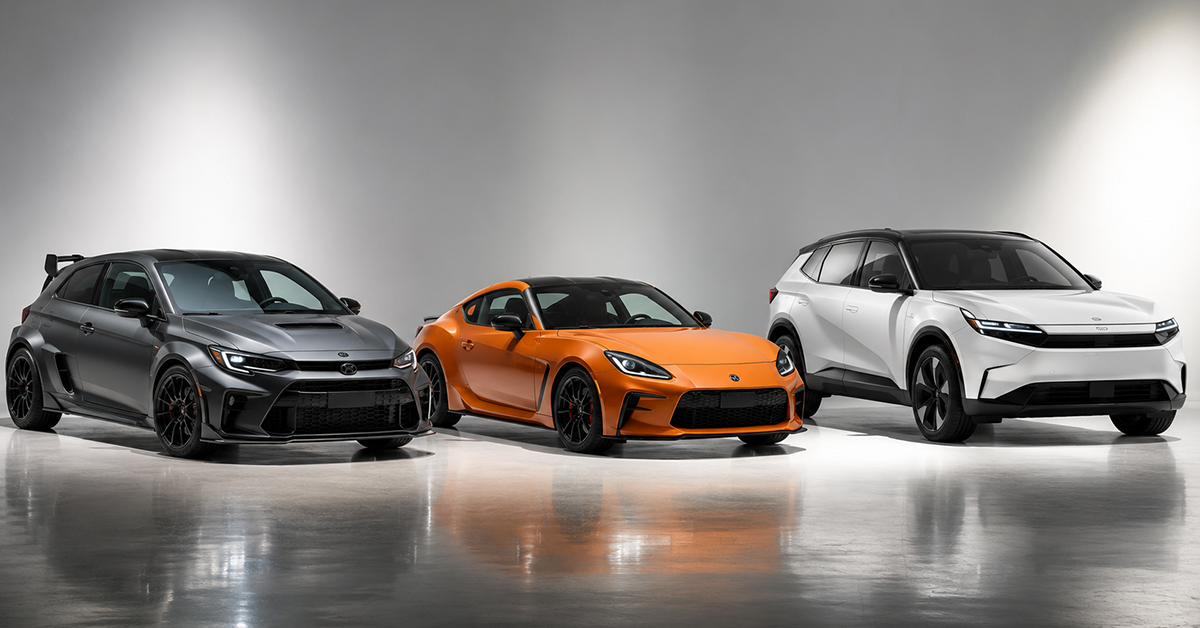
AI-generated concept illustration of the GR Yaris, GR86 and bZ — Toyota's electrified and GR performance era. | Rev N Rise
The most recent era of Toyota’s model history has been defined by two parallel pushes: deepening hybrid and electric technology across nearly the entire lineup, and rebuilding genuine performance credibility through the Gazoo Racing (GR) division, formally established in 2015. GR’s World Rally Championship involvement produced the GR Yaris in 2020, followed by the GR Corolla and a revived GR86 developed jointly with Subaru. The Supra nameplate itself returned in 2019 after a 17-year absence, developed in collaboration with BMW — before Toyota confirmed 2026 as its final model year, closing that chapter with a MkV Final Edition.
On the electrification side, Toyota has moved from pure hybrids toward genuine battery-electric models with the bZ4X (now simply bZ), its rugged bZ Woodland variant, and an electric-only C-HR. The RAV4 transitioned to hybrid-only power entirely for its sixth generation. Meanwhile, the Land Cruiser, Hilux and 4Runner continue to anchor Toyota’s reputation for genuine, unkillable durability — the same quality that made the original 1951 Land Cruiser successful is still the reason buyers in remote and demanding markets choose Toyota above every other option available to them.