 Brands
Toyota Racing Cars Explained With Specs and History
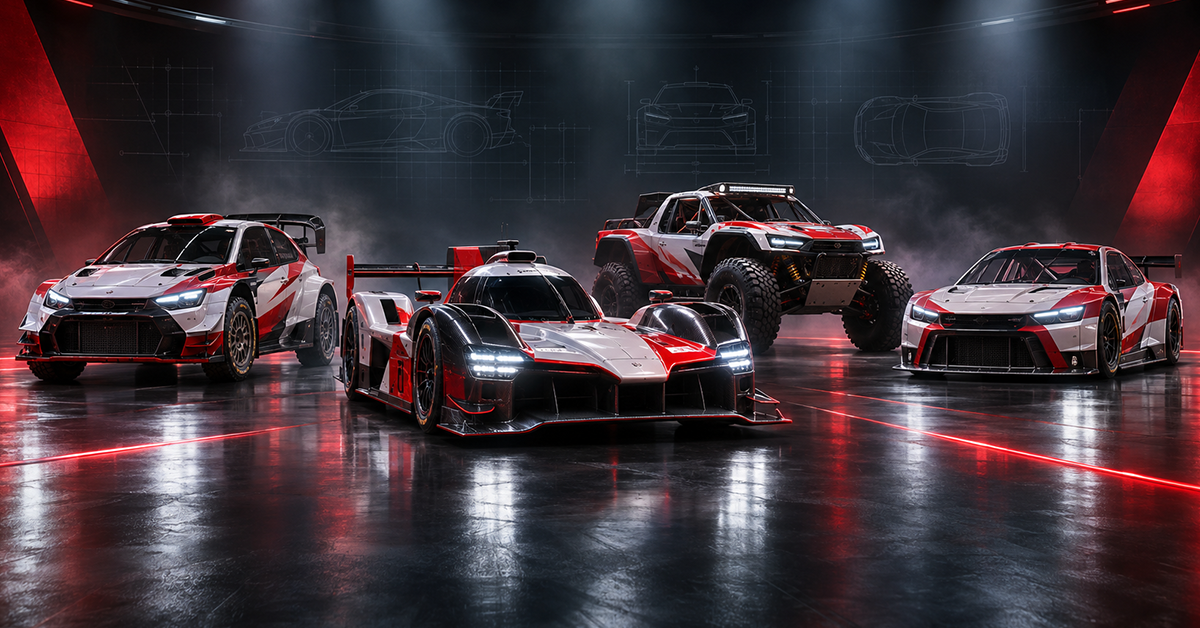
AI-generated concept illustration — Toyota race cars. | Rev N Rise
Toyota's racing programme is built around a small group of extraordinary machines: a rally car that has won championship after championship, a hybrid Hypercar that just won Le Mans, a Dakar truck engineered to survive deserts and a NASCAR Camry with a roaring V8. Here is what makes each Toyota race car tick, with the key specifications, and the legends that came before them.
The Toyota GR Yaris Rally1 is the machine that has carried Toyota's World Rally Championship campaign since 2022, and it is one of the most extensively engineered competition cars the company has ever built. Although it shares its name and some of its styling with the GR Yaris road car, it is a purpose-built competition machine rather than a modified production hatchback. Rally1 regulations allow a tubular space frame, a bespoke powertrain and heavily modified suspension, wrapped in a bodyshell that looks like the road car but is engineered for speed, strength and repairability on the roughest surfaces in the sport.
The heart of the car is a 1.6-litre turbocharged four-cylinder engine with direct injection, with a bore of 83.8 mm and a stroke of 72.5 mm. Rally regulations require an air restrictor to limit the power, and for 2025 Toyota reduced its size from 36 mm to 35 mm. In its current form the engine produces more than 370 PS and more than 425 Nm of torque, which is a substantial output for a car that weighs so little. Toyota revised the exhaust and camshafts for 2025 as part of its development work, and it also changed the gear ratios to suit the new power delivery.
A significant change is the removal of the hybrid unit. When the Rally1 formula began in 2022, the cars used a hybrid system that added a boost of electric power, and in that form the GR Yaris Rally1 was quoted at more than 500 PS in total. From 2025 the hybrid unit was removed from the regulations, which means the current car relies on its turbocharged engine alone. Toyota says the minimum weight of the car is 1,180 kg, around 80 kg lighter than the previous hybrid-equipped car, largely because the heavy battery and motor are no longer needed. That weight saving is a major part of why the car remains so quick.
The transmission is a five-speed mechanical-shift gearbox, driven through a double-plate sintered clutch, and the car has four-wheel drive with two mechanical differentials, one at the front and one at the rear. The suspension uses MacPherson struts at the front and rear, with a generous damper travel of 270 mm that allows the car to absorb jumps and rough gravel at speed. Steering is hydraulic rack and pinion, and braking uses 300 mm discs on gravel and larger 370 mm discs on tarmac, where brake loads are far higher. The car measures 4,225 mm long including its aero devices, 1,875 mm wide, and has a wheelbase of 2,630 mm.
The car's design reflects the demands of rallying, where a single car must handle gravel, tarmac, snow and ice, sometimes within the same event. Ride height, track width and aerodynamic settings are adjustable, and teams change them between stages and between rallies. Toyota has raced Yaris-based rally cars since returning to the sport in 2017, and tyre supply changed in 2025, when Hankook replaced Pirelli as the championship's supplier. That change meant Toyota had to adapt its car to new tyre characteristics, another example of how development never stops.
The 2026 season is due to be the last under the current technical regulations, which makes the GR Yaris Rally1 a car with a clear and successful chapter behind it. It carried Toyota to a string of manufacturers' championships and, in 2026, to the drivers' title with Elfyn Evans, as covered in our Toyota motorsport guide. For readers interested in the road-going relatives of this machine, our guides to the GR range and to Toyota's hatchbacks explain how the rally programme shaped the GR Yaris and the GR Corolla that customers can buy.
The Toyota TR010 Hybrid is the car that won the 2026 24 Hours of Le Mans, and it represents the latest step in a line of endurance prototypes that stretches back decades. It competes in the Hypercar class of the FIA World Endurance Championship, the top category of sports-car racing, where it faces factory teams from Ferrari, Porsche, Cadillac and others. For 2026 Toyota introduced a new team identity under the Toyota Racing name, with the slogan “For the Engineering Race,” and the car received a new look, reflecting the company's focus on engineering as the heart of its endurance programme.
The powertrain combines a 3.5-litre twin-turbocharged V6 petrol engine with a hybrid system, and Toyota says the car produces more than 700 bhp. The engine runs on 100 per cent renewable racing fuel, which is a significant point because it demonstrates that high-performance combustion engines can use low-carbon fuel without losing power. The hybrid system was developed at Toyota's Higashi-Fuji technical centre in Japan, and it recovers energy under braking and redeploys it to add power on acceleration, with regulations controlling how and when the electric power can be used.
The TR010 is the successor in spirit to the car Toyota called the GR010 Hybrid, which raced from 2021, and before that to the TS050 Hybrid, which raced from 2016 to 2019. The TS050 used a 2.4-litre twin-turbocharged V6 together with two motor-generators, delivering roughly 1,000 horsepower in total, and it won the 24 Hours of Le Mans in 2018 and 2019. In qualifying for the 2017 race, Kamui Kobayashi set a lap in a TS050 Hybrid that is widely regarded as the fastest ever recorded at Le Mans, showing just how extreme the hybrid prototype formula became before regulations were changed to rein in costs and performance.
Modern Hypercars are built to regulations that limit power and aerodynamic efficiency and use a balance-of-performance system to keep different manufacturers' cars competitive. That means the TR010 is not simply the fastest car Toyota could build, but the best car it can build within a framework designed to keep the racing close. For engineers, this puts a premium on efficiency, reliability and driveability, since the car that uses less fuel, wears its tyres more gently and avoids mechanical problems over 24 hours will often beat one that is faster over a single lap.
The 2026 season shows what the car can do. The number 8 TR010 won at Imola in April, and the car then took victory at the 94th running of the 24 Hours of Le Mans in June, with the number 7 crew of Kamui Kobayashi, Mike Conway and Nyck de Vries beating the field in a grid of 18 Hypercars from eight manufacturers. It was Toyota's 28th Le Mans entry, and the win was its sixth overall at the circuit. The strength of the result lay partly in reliability, and in the way the two cars worked together over the long race.
For fans, the TR010 matters because endurance racing is where Toyota's hybrid expertise is tested hardest. Lessons about energy recovery, thermal management and component durability feed into the hybrid technology described in our Toyota hybrid cars guide, and the use of renewable fuel supports the company's argument that multiple routes to lower emissions will be needed. The TR010 is not a road car, and Toyota has not announced one, but its engineering philosophy runs through the performance models the company sells.
If the GR Yaris Rally1 is built for speed on stage roads and the TR010 for efficiency over 24 hours, the DKR GR Hilux is built for survival. This is the truck Toyota Gazoo Racing entered in the 2026 Dakar Rally, an event that demands vehicles which can cross thousands of kilometres of sand, rock and mountain terrain with little more than a spare wheel and a small team of mechanics at the end of each day. It is an all-new design that replaces the previous Hilux race truck, and it shares its styling with the ninth-generation road-going Hilux.
Under the skin, the DKR GR Hilux is a purpose-built competition machine. It uses a tubular frame chassis, which increases torsional stiffness while reducing weight compared with the older design, with a full composite body in the shape of the Hilux Double Cab. The FIA-regulated minimum dry weight is 2,010 kg, and the aim of the new chassis was to be stronger and lighter within that limit. Toyota's engineers also fitted a new, strengthened transmission, since the gearbox is among the components that suffer most from the repeated impacts of high-speed desert driving.
The engine is a V35A twin-turbocharged petrol V6, a production engine sourced from the Land Cruiser 300, which is notable because it shows how closely the race truck relates to road vehicles. In competition form it produces 354 bhp (about 264 kW) at 5,300 rpm and 620 Nm of torque, with the figures set within the regulations. Using a production-based engine is a deliberate choice, since the Dakar rewards reliability above all else, and a well-proven design is less likely to fail in the middle of a desert.
The drivetrain and suspension are designed for punishment. The gearbox is a Sadev six-speed sequential unit, paired with a 215 mm ceramic twin-plate clutch, and limited-slip differentials are fitted at the front, centre and rear to maximise traction on loose surfaces. The suspension uses double wishbones at both ends with an enormous 350 mm of travel, allowing the truck to absorb jumps and crests at speed. The truck rides on 17-inch wheels with 37-inch BF Goodrich tyres, and it carries a 540-litre safety-cell fuel tank, large enough to cover the longest stages of the rally without refuelling.
Toyota entered three DKR GR Hiluxes in the 2026 rally, driven by Henk Lategan and Brett Cummings, Seth Quintero and Andrew Short, and Toby Price and Armand Monleón. The trucks showed strong pace early in the event, with Toyota filling the top five on the second day, and Lategan was running second overall until a wheel bearing failure on stage 11 cost him his challenge. The best Toyota finish was eighth overall. The results show that the truck's pace is competitive, but that reliability in the toughest conditions remains the factor that separates a good Dakar from a great one.
For Hilux owners, the connection between the race truck and the road vehicle is more than cosmetic. The Hilux has built its reputation on toughness, and the Dakar programme is a way of testing that reputation in the most punishing conditions available. Lessons about suspension durability, cooling and drivetrain strength can flow into the vehicles sold to customers, and the common styling of the race truck and the road truck keeps the connection visible. Our dedicated Hilux guide covers the road truck's history, and the Dakar truck represents its most extreme interpretation.
In American stock-car racing, the Toyota that matters is the Camry. The car Toyota races in the NASCAR Cup Series is a purpose-built competition machine that carries Camry bodywork, a design choice that links the sport to one of the best-selling sedans in the United States. For the 2024 season Toyota introduced a new Camry XSE body shape for the series, which was designed to match the styling of the latest road car, and an interesting side effect of the process is that the NASCAR Camry carries a conventional petrol engine at a time when the road-going Camry is hybrid-only.
Since 2022 all Cup Series teams have used the Next Gen car, a platform designed to make racing closer and cheaper by standardising many components. Parts such as the chassis, the suspension and the transaxle are shared by all manufacturers and supplied by common vendors, which means the differences between Toyota, Chevrolet and Ford come down to the bodywork and the engine, as well as how teams set up and race their cars. The Next Gen car replaced a design that had been in use for years and introduced modern features including independent rear suspension, a composite body and a rear-mounted five-speed sequential transaxle.
The engines are where Toyota's own engineering effort is concentrated. Toyota Racing Development builds a naturally aspirated pushrod V8 of around 5.86 litres, which produces roughly 670 horsepower at most tracks and about 510 horsepower at the largest superspeedways, where a tapered spacer limits the airflow to keep speeds in check. These engines are built to a strict formula and are very different from a production V6 or hybrid, but they are among the most highly developed engines in motorsport, and a few horsepower either way can decide a race that comes down to the final lap.
Because most hardware is common, the competitive advantage comes from details. Teams work endlessly on aerodynamics, on tuning the suspension to a particular track, and on strategy, such as when to pit and which tyres to use. Toyota's teams, including Joe Gibbs Racing, 23XI Racing and Legacy Motor Club, have taken advantage of the shared platform to field cars that are both fast and consistent, as demonstrated by the 2026 Daytona 500 win of Tyler Reddick in the number 45 Toyota. The car's results show that even in a spec-style series, the quality of engineering and execution still separates the front from the back.
There is also a safety dimension to the car's design. The Next Gen car was developed with a strong emphasis on driver protection, with a stronger centre section, improved crash structures and a redesigned cockpit, in response to lessons learned from years of high-speed accidents. Toyota's engineers work within these regulations, and the safety improvements benefit every driver in the field, regardless of manufacturer. That shared approach is one reason the series' cars have become considerably safer than they were a generation ago.
For fans of the road-going Camry, the NASCAR car is a reminder of the breadth of the nameplate. The same name appears on a hybrid family sedan, on a Top Safety Pick+ crash-test winner, and on a 670-horsepower race car, which is one of the more unusual things about the Camry's history. Our dedicated Camry guide covers the road car's long story, while the racing version shows how Toyota uses the name to connect with American fans of the sport.
Not every Toyota race car is built for the factory team. A growing part of the company's racing activity involves customer cars, machines designed to be sold to independent teams and drivers who race them in national and international series. The most important new addition is the GR GT3, which Toyota Gazoo Racing unveiled in December 2025 alongside the GR GT road car as part of a new flagship pairing, and which is engineered to the FIA's GT3 regulations, the most popular category of customer racing in the world.
The GR GT3 shares its architecture with the GR GT road car, which is a significant statement. The GR GT is a new front-engined supercar with a newly developed 4.0-litre twin-turbocharged V8 hybrid, producing 641 bhp and at least 627 lb-ft of torque, with rear-wheel drive through a rear-mounted transaxle and a carbon-fibre torque tube. It is built around Toyota's first all-aluminium monocoque, with carbon-fibre-reinforced plastic body panels, and its development followed an “aero first” process. Toyota has set a weight target below 1,750 kg and a weight distribution of 45:55, and it projects a top speed beyond 199 mph, although these are targets rather than confirmed figures.
The GR GT3 racing version is engineered for the different demands of competition. Reports indicate that it uses the V8 without the road car's hybrid system, which is typical of GT3 racing, where regulations favour simplicity, cost control and reliability for customer teams. Toyota has not published power figures, a homologation date or a list of series entries for the car, and the company says it plans a dedicated customer-service structure to support teams who buy it. The cars were revealed as developmental prototypes, tested through simulator work and track running at Fuji Speedway, the Nürburgring and Toyota's Shimoyama proving ground, with the road car expected to launch around 2027.
GT3 racing is a business as well as a sport. Customer teams buy cars from manufacturers and race them in series ranging from international endurance events to national championships, and a successful GT3 car can sell in large numbers, which supports a manufacturer's brand around the world. For Toyota, entering the category with a car built in its own right, rather than through a partner, is a clear signal that the company wants a bigger presence in sports-car racing beyond its factory programmes. It also gives the GR brand a new halo product at the top of its range.
Toyota already has experience supplying customer cars. The GR Supra GT4, for example, has been offered to teams for racing in the GT4 category, which sits below GT3 and uses cars based more closely on production models. Programmes of this kind help build a pipeline of drivers and teams who know the brand, and they give Toyota an ongoing source of feedback on how its cars perform in the hands of independent racers. The GR GT3 is designed to extend that approach to the sport's highest customer level.
As with any new racing programme, much depends on what happens next. A GT3 car has to be developed, homologated, tested and supported over several seasons before it can be judged, and the first results are often a poor guide to its eventual success. Even so, the announcement of the GR GT and GR GT3 together shows how Toyota is thinking about the connection between road and track, and our guide to Toyota's GR models covers the road car and its place in the performance range in more detail.
Toyota's current race cars stand on the shoulders of machines that made the company's reputation. The most famous of them for rally fans is the Celica GT-Four, the all-wheel-drive turbocharged coupe that carried Toyota to its first world titles. Through the early 1990s Celica GT-Four drivers won the World Rally Championship for drivers four times in five seasons: Carlos Sainz in 1990 and 1992, Juha Kankkunen in 1993 and Didier Auriol in 1994, while Toyota took its first two manufacturers' championships in 1993 and 1994. The Celica remains one of the most celebrated rally cars of all time, and our Celica guide tells the full story of the nameplate.
The Corolla WRC followed in the late 1990s and gave Toyota another manufacturers' title in 1999, the last it would win until its return to the championship with the Yaris WRC. The car was campaigned by Toyota Team Europe, the company's long-time competition arm in Cologne, Germany, and it marked the end of an era before Toyota withdrew from the sport at the end of 1999 to focus on other forms of racing. The company would not compete as a factory team in the championship again until 2017, a gap of nearly two decades that makes its later success all the more remarkable.
In endurance racing, the most famous Toyota of the late 1990s was the GT-One, also known as the TS020, a car that was built to the GT1 regulations but was effectively a prototype, designed to win the 24 Hours of Le Mans. It was fast and spectacular, and it came tantalisingly close to a victory in 1999, but misfortune meant the win never came. The car is remembered as one of the most extreme racing machines of its era, and our GT-One guide covers its design, its racing history and the road-going version Toyota built to satisfy the rules.
Toyota's hybrid era began with the TS030 and TS040 prototypes in the early 2010s, and it reached its peak with the TS050 Hybrid, which finally delivered the company's first Le Mans victory in 2018, followed by a second in 2019. Those cars used advanced hybrid systems, and they paved the way for the GR010 and TR010 Hypercars that followed. The long road from near misses in the 1990s to a string of victories from 2018 is one of the great stories of modern endurance racing, and it demonstrates the value of persistence in an environment where the rewards come slowly.
Toyota's earlier racing history includes the Toyota 7, a Japanese sports prototype from the late 1960s that helped establish the company's racing reputation at home, and a long record of touring-car and Super GT competition, in which the Supra has been a leading contender. Racing in Japan, in Europe and in America has given Toyota a broad understanding of what makes a competitive car in different environments, and each discipline has contributed something to the company's engineering knowledge. The Supra's racing success is part of the story told in our Toyota Supra guide.
What links all these cars is a willingness to learn from failure. Toyota lost Le Mans in agonising circumstances more than once before it won, and it withdrew from the World Rally Championship before returning with a stronger programme. That patience and determination, combined with a belief that racing makes better road cars, explains why the company's modern race cars, from the GR Yaris Rally1 to the TR010 Hybrid and the DKR GR Hilux, are so highly developed. The history is as important as the specification, because it shows where the engineering culture behind today's machines comes from.