 Brands
Volkswagen ID.5 — History, Range, GTX and Specs

Official press image of the Volkswagen ID.5 Pro with 210 kW, shown in October 2023. | © Volkswagen AG
The Volkswagen ID.5 is the coupe-styled electric SUV that Volkswagen premiered on 3 November 2021 and has built in Zwickau since January 2022. Here is the full ID.5 story, from the MEB platform it shares with the ID.4 to the batteries, the GTX, the 2023 upgrade and the ID. Tiguan that succeeds it.

Official press image of the Volkswagen ID.5 GTX at its world premiere in November 2021. | © Volkswagen AG
The Volkswagen ID.5 is the coupe-styled electric SUV that Volkswagen introduced in November 2021 as the sportier sibling of the ID.4. Volkswagen’s own release of 3 November 2021 called it the first electric SUV coupé from Volkswagen, and said it and the ID.5 GTX with dual-motor all-wheel drive were the new long-range top models of the ID. family. Both are built on the Modular Electric Drive Matrix, known as the MEB, and both were assembled in Zwickau. In October 2026 Volkswagen confirmed, in its ID. Tiguan announcement, that the new ID. Tiguan would succeed the ID.4 and the ID.5. This article follows the ID.5 from premiere to that succession.
| World premiere | 3 November 2021 (Volkswagen) |
| Pre-sales start | 22 November 2021 (Volkswagen) |
| German entry price, 2021 | 46,515 euros, ID.5 Pro (Volkswagen) |
| Production start | 27 January 2022, Zwickau (Volkswagen) |
| International presentation | April and May 2022 (Volkswagen) |
| Launch versions | Pro, Pro Performance, GTX (Volkswagen) |
| Platform | MEB (Volkswagen) |
| Major upgrade | 10 October 2023 (Volkswagen) |
| Successor | ID. Tiguan, shared with ID.4 (Volkswagen) |
| Sold in the United States | No (reported) |
The premiere came on 3 November 2021, in Volkswagen Media Information No. 185/2021 with a Wolfsburg dateline. Volkswagen said the cars would launch in 2022 with three engine options, and both models were marked as not yet available for sale. Ralf Brandstätter, then head of the Volkswagen brand, said the ID.5 offered locally carbon-neutral driving enjoyment for a discerning customer group. Thomas Ulbrich, board member for technical development, said the GTX brought an entirely new level of sporty driving pleasure, traction and driving safety. Jozef Kabaň, head of Volkswagen Design, described the ID.5 as the body style of the future, with a spacious interior despite its sloping roofline.
Orders opened soon after. Volkswagen’s release No. 199/2021 of 22 November 2021 says pre-sales of its first e-SUV coupé had started, with a German entry price of 46,515 euros. Three versions were available at the pre-sales launch: the ID.5 Pro with 128 kilowatts (174 PS), the ID.5 Pro Performance with 150 kilowatts (204 PS) and the all-wheel-drive ID.5 GTX with 220 kilowatts (299 PS). All three used a 77 kilowatt-hour net battery. Klaus Zellmer, board member for sales, marketing and after sales, said the elegant e-SUV coupé already gave customers the new ID.Software 3.0, and called the ID.5 a crucial milestone on the way to ZERO.
Production followed in January 2022. Volkswagen’s release of 27 January 2022 marked the official start of ID.5 and ID.5 GTX production in Zwickau, which it said completed the transformation of the plant into a dedicated electric-vehicle factory. A second step came in April and May 2022, when Volkswagen held an international vehicle presentation of the ID.5 and ID.5 GTX. The newsroom also lists a September 2022 show car called the ID.5 GTX “Xcite”, built by apprentices of Volkswagen Sachsen. In October 2023 the ID.5 received the same major upgrade as the ID.4, which our Volkswagen ID.4 guide covers.
The ID.5 never became a volume model. A German computer-magazine report of 10 October 2026 says Volkswagen is ending the car after only four years of production, without a direct successor (reported). A news-site report quotes a Volkswagen spokesperson, Stefan Voswinkel, saying there will be no direct replacement and that the new ID. Tiguan will combine the ID.4 and ID.5 into one model (reported). The same report says the ID.5 was never sold in the United States (reported). An Australian car-news site reported on 19 October 2026 that the ID.5 was being discontinued in Australia after about 18 months, ending with model year 2026 (reported).
A note on sources. Specifications and dates come from Volkswagen’s own press releases and newsroom pages wherever possible. Figures from a reference source, a trade report or a news site are labelled “reported”. Battery sizes are net energy content unless stated, and prices are German snapshots from the launch period that no longer apply. The sections below cover the platform and the link to the ID.4, the design and specifications, the batteries and charging, the Zwickau factory, the GTX, the 2023 upgrade and the end of the model.

Official press image of the Volkswagen ID. CROZZ show car. | © Volkswagen AG
The ID.5 is the coupé body style of the ID.4, and Volkswagen says so openly. The ID.4 was the first compact electric SUV on the MEB, premiered in September 2020, and the ID.5 added a sloping roofline on the same platform. Volkswagen’s release says that, like all ID. models, the first e-SUV coupé from Volkswagen is based on the Modular Electric Drive Matrix. A German computer-magazine report says the two cars are technically identical (reported), and an American news site called the ID.5 a coupé version of the ID.4 (reported). The wheelbase is the one you would expect: 2,766 millimetres for the ID.5, against 2,765 for the ID.4.
| Body style | E-SUV coupé (Volkswagen) |
| Shares platform with | ID.4, MEB (Volkswagen) |
| Wheelbase | 2,766 mm (Volkswagen) |
| Rear headroom vs ID.4 | 12 mm less (Volkswagen) |
| Drag coefficient | 0.26 Pro, 0.27 GTX (Volkswagen) |
| Boot | 549 litres (Volkswagen) |
| Drive | Rear motor, GTX adds front motor (Volkswagen) |
| Gearbox | Single-speed (Volkswagen) |
| Battery at launch | 77 kWh net only (Volkswagen) |
| ID.4 and ID.5 deliveries | More than 950,000 since 2021, combined (Volkswagen) |
The idea of an electric SUV coupé goes back to the concept cars. Volkswagen showed the I.D. Crozz at Auto Shanghai in 2017 and a revised I.D. Crozz II in Frankfurt that September, and a trade report at the time described a coupé-like SUV shape (reported). The production ID.4 followed in 2020 as a conventional SUV. The ID.5 therefore completes an idea that the Crozz concept suggested, although Volkswagen does not claim the concept was a direct preview of the ID.5.
MEB stands for Modularer E-Antriebs-Baukasten, which Volkswagen translates as the Modular Electric Drive Matrix. The platform places the battery low under the passenger compartment, and the ID.5 pre-sales release says this gives a low centre of gravity. The motor sits on the rear axle in the Pro and Pro Performance versions, and the GTX adds a second motor on the front axle for all-wheel drive. All versions have a single-speed gearbox, according to Volkswagen’s press kit. Our Volkswagen ID.3 guide tells the story of the first MEB model, and the ID.4 guide the story of the SUV that shares the ID.5’s body.
What does the coupé shape change? Volkswagen’s press release says the rear headroom is 12 millimetres less than in the ID.4, which is a small price for the sloping roof. The drag coefficient falls to 0.26 for the Pro versions and 0.27 for the GTX, while the ID.4 premiere release gave 0.28 and the ID.4 GTX press kit 0.29. The boot is slightly larger at 549 litres, against 543 litres in the ID.4. The ID.5 is also marginally longer in its Pro form, at 4,599 millimetres, against 4,582 millimetres for the ID.4.
Volkswagen positioned the ID.5 as a premium model. Its release called it the top-of-the-range electric model of the ID. family at the time, and the German entry price of 46,515 euros was higher than the ID.4’s. A trade report listed the ID.4 at 38,915 euros and the ID.3 at 35,460 euros in the same period (reported). Because the ID.5 launched only with the large 77 kilowatt-hour battery, an EV news site noted that Volkswagen had not mentioned the smaller 52 kilowatt-hour battery of the ID.4 in its release (reported).
The shared platform also explains the shared fate. Because the ID.5 used the same drivetrain as the ID.4 and sat above it in price, it competed for the same buyers. Volkswagen’s 2026 release treats the two together, saying the ID. Tiguan succeeds the ID.4 and the ID.5 and that the two models have delivered more than 950,000 units since 2021 combined. The ID.5’s own share of that total is not published in the sources used for this article, so we do not give one. For a view of where the ID.5 sits among all Volkswagen cars, see our list of Volkswagen models.

Official press image of the Volkswagen ID.5 Pro with 210 kW. | © Volkswagen AG
The ID.5 is a five-door, five-seat coupé SUV, and Volkswagen’s press kit gives its dimensions in detail. The ID.5 Pro measures 4,599 millimetres long, 1,852 wide and 1,613 high on a wheelbase of 2,766. The ID.5 GTX is shorter and taller at 4,582 millimetres long and 1,619 high, with the same width and wheelbase. The boot holds 549 litres in the basic configuration and up to 1,561 litres with the rear seatbacks folded and the space loaded to roof height. Ground clearance is 16 centimetres and the turning circle for the rear-motor models is 10.2 metres.
| Length | 4,599 mm Pro, 4,582 mm GTX (Volkswagen) |
| Width | 1,852 mm (Volkswagen) |
| Height | 1,613 mm Pro, 1,619 mm GTX (Volkswagen) |
| Wheelbase | 2,766 mm (Volkswagen) |
| Boot | 549 litres, up to 1,561 seats folded (Volkswagen) |
| Ground clearance | 16 cm (Volkswagen) |
| Turning circle | 10.2 m, rear-motor models (Volkswagen) |
| Launch 0 to 100 km/h | 10.4 s, 8.4 s, 6.3 s GTX (Volkswagen) |
| Launch top speed | 160 km/h, GTX 180 km/h (Volkswagen) |
| Braked towing | 1,200 kg, GTX 1,400 kg (Volkswagen) |
The shape is the point of the car. Volkswagen says its drag coefficient is 0.26 for the Pro and Pro Performance and 0.27 for the GTX, helped by electrically opened cooling air vents that open only when needed and by an integrated tailgate spoiler. Wheels range from 19 to 21 inches. Volkswagen’s release describes light strips at the front, as an option, and at the rear, along with IQ.Light LED matrix headlights with intelligent high beams, which are standard on the GTX, and 3D LED tail lights on the GTX as well.
Inside, the ID.5 follows the ID.4 closely. The premiere release lists ambient lighting with up to 30 colours, optional Top Sports seats with perforated ID. logos, and an optional augmented-reality head-up display. The software is ID.Software 3.0, with over-the-air updates, “Hello ID.” voice control and cloud-based online information. Travel Assist with swarm data is available, and so is Park Assist Plus with a memory function. Car2X communication, with a radius of up to 800 metres, is part of the assist systems, and the We Connect services include real-time traffic, map updates and charging-station information.
Volkswagen quotes the performance of each version in its press kit. The Pro takes 10.4 seconds from 0 to 100 kilometres per hour with a top speed of 160 kilometres per hour, the Pro Performance takes 8.4 seconds at the same top speed, and the GTX takes 6.3 seconds with a top speed of 180 kilometres per hour. Torque is 310 newton metres for the rear-motor cars. The GTX adds 162 newton metres from its front asynchronous motor and keeps 310 from the rear. These are launch figures. The 2023 upgrade changed several of them, as the later section explains.
Towing is part of the SUV pitch. The press kit gives 1,200 kilograms braked on an 8 per cent gradient for the rear-motor models, with an optional electric ball coupling, and 1,400 kilograms for the GTX. The release notes that all of these figures apply to the German market and that the equipment specifications are German ones. It also says rear-seat headroom is 12 millimetres below the ID.4’s. Weights and a price list are not given in the press kit, so this article gives neither, and readers should check the current specification sheet for their market.
A short word on the premiere images. The November 2021 newsroom photographs show the GTX, which Volkswagen described as the expressive top-of-the-line model, with the shorter 4,582 millimetre body. A conflicting detail is worth knowing: the press kit’s short version once gives the GTX output as 200 kilowatts, while the rest of the document and the pre-sales release give 220 kilowatts, so this article uses 220. The press kit also marks the GTX output as provisional, which was normal for a car shown before sales began.
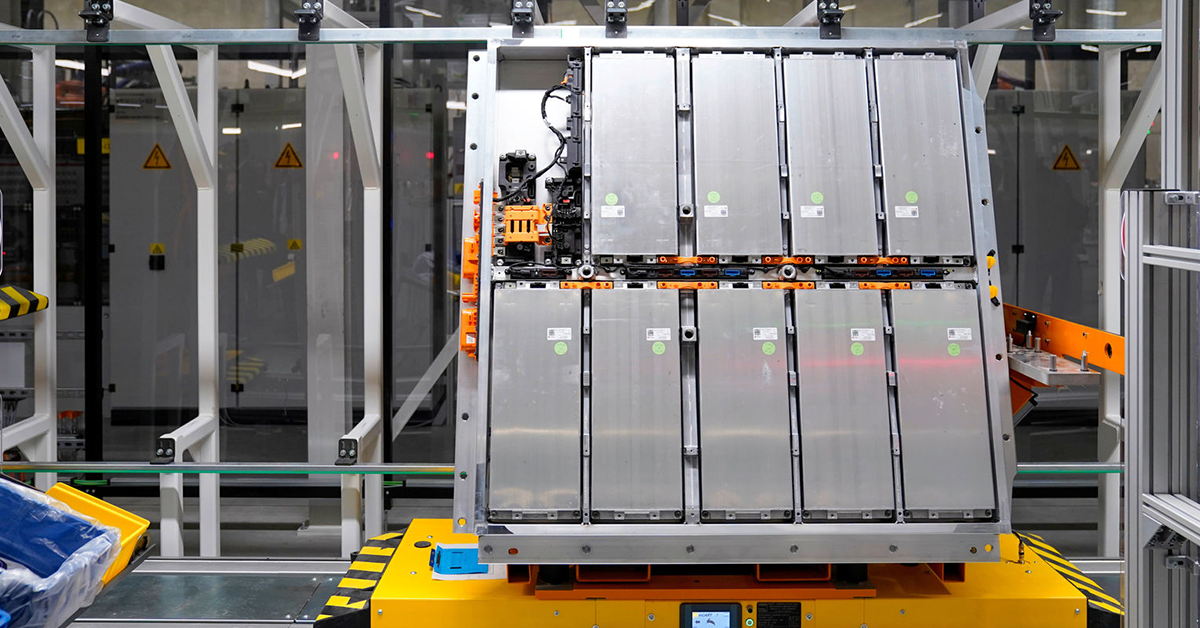
Official press image of the MEB battery system in production at the Volkswagen Group Components plant in Brunswick. | © Volkswagen AG
The ID.5 launched with one battery and three motor options. Volkswagen’s press kit gives a 77 kilowatt-hour net lithium-ion battery with 12 modules, and says it retains at least 70 per cent of its original capacity after eight years or 160,000 kilometres. The pre-sales release repeats that all three versions share the large 77 kilowatt-hour battery. An EV news site noted that Volkswagen made no mention of the 52 kilowatt-hour battery of the ID.4 in its release (reported). Every ID.5 version therefore carried the same battery, and the differences came from the motors.
| Battery | 77 kWh net, 12 modules (Volkswagen) |
| Warranty | 70 per cent after 8 years or 160,000 km (Volkswagen) |
| ID.5 Pro | 128 kW (174 PS), 310 Nm (Volkswagen) |
| ID.5 Pro Performance | 150 kW (204 PS), 310 Nm (Volkswagen) |
| ID.5 GTX | 220 kW (299 PS), 30 s peak (Volkswagen) |
| Launch range, Pro | Up to 520 km WLTP (Volkswagen) |
| Launch range, GTX | 480 km (press kit), 490 km (pre-sales) (Volkswagen) |
| AC charging | Up to 11 kW (Volkswagen) |
| DC charging, Pro | Up to 135 kW (Volkswagen) |
| DC charging, GTX | Up to 150 kW peak (Volkswagen) |
The motors were the ID.5 Pro with 128 kilowatts (174 PS), the ID.5 Pro Performance with 150 kilowatts (204 PS) and the ID.5 GTX with 220 kilowatts (299 PS). The Pro and Pro Performance have a rear-mounted motor with 310 newton metres. The GTX adds a front motor of the asynchronous type, which delivers 162 newton metres, to the same rear motor. Volkswagen’s pre-sales release says the GTX peak output of 220 kilowatts is available for a maximum of 30 seconds, so the figure is a peak and not a continuous rating.
Range figures differ between Volkswagen’s documents. The premiere press kit gives a projected WLTP range of up to 520 kilometres for the Pro and Pro Performance and up to 480 kilometres for the GTX. The pre-sales release of 22 November 2021 raises the GTX figure to up to 490 kilometres, and the 520 kilometre figure applies to rear-wheel drive. A US-based enthusiast site also gave 490 kilometres for the GTX (reported). This article shows both Volkswagen values, 480 and 490 kilometres, and treats the later release as the more recent of the two.
Charging is the other place where the documents disagree. The premiere press kit gives up to 135 kilowatts at a fast-charging station as standard for the family, and the AC limit of 11 kilowatts with the standard Mode 3 cable. It says about 30 minutes adds enough energy for 390 kilometres in the ID.5 or 320 kilometres in the GTX, on the WLTP basis. Volkswagen’s pre-sales release then says the GTX has a peak charging power of up to 150 kilowatts, measured under test conditions of 5 to 80 per cent state of charge at about 23 degrees Celsius on a charger such as Ionity. An EV news site said the GTX gained a higher charging capacity than first stated (reported).
Energy consumption gives a feel for efficiency. Volkswagen’s January 2022 production release lists NEDC consumption of 16.2 kilowatt-hours per 100 kilometres for the ID.5 and 17.1 for the ID.5 GTX, both with an A+++ efficiency rating, compared with 16.3 to 15.6 for the ID.4. A newsroom image caption from December 2022 gives combined consumption for the ID.5 GTX of 19.2 to 16.9 kilowatt-hours per 100 kilometres, which is on the newer WLTP basis, so the two sets of numbers should not be compared directly. WLTP is the figure to use when comparing the ID.5 with other cars today.
The 2023 upgrade changed the picture, and the later section covers it. In short, the Pro became a 210 kilowatt car with 545 newton metres, the GTX rose to 250 kilowatts, and the maximum range of the Pro went up to 556 kilometres. For a used-car buyer the practical lesson is to identify the production year before comparing outputs. A 2022 ID.5 Pro with 128 kilowatts and a 2024 ID.5 Pro with 210 kilowatts are very different cars, even though the body and the 77 kilowatt-hour battery look the same from the outside.

Official press image of the production of the ID.5 at the Zwickau vehicle plant. | © Volkswagen AG
The ID.5 was built in one place only. Volkswagen’s premiere and pre-sales releases both say the ID.5 and ID.5 GTX are manufactured at the Volkswagen plant in Zwickau, in Saxony, and are carbon-neutral on handover to the customer. The pre-sales release adds that, when charged with 100 per cent green energy, the cars are already virtually climate-neutral. Zwickau had built the ID.3 since November 2019 and the ID.4 since August 2020, and our ID.3 and ID.4 guides cover those starts.
| Plant | Zwickau, Saxony (Volkswagen) |
| Production start | 27 January 2022 (Volkswagen) |
| Last combustion car at Zwickau | 26 June 2020 (Volkswagen) |
| Models built there | Six, from three brands (Volkswagen) |
| Annual capacity | More than 300,000 vehicles (Volkswagen) |
| Investment since 2018 | About 1.2 billion euros (Volkswagen) |
| Robots | 1,200 to 1,625 (Volkswagen) |
| Saxony output, 2021 | About 180,000 vehicles (Volkswagen) |
| Green power | 100 per cent external supply since 2017 (Volkswagen) |
| Ended in Australia | Model year 2026 (reported) |
The official production start was on 27 January 2022, in Volkswagen release No. 7/2021. The release says it completed the world’s first full conversion of a large-scale factory from combustion-engine production to dedicated electric-vehicle production. Six models from three brands were then made in Zwickau on the MEB: the Volkswagen ID.3, ID.4 and ID.5, the Audi Q4 e-tron and Q4 Sportback e-tron, and the CUPRA Born. The plant’s newsroom page says the last combustion car was produced on 26 June 2020.
The numbers in that release show the scale of the conversion. Annual capacity exceeds 300,000 vehicles, which the release called the most efficient electric-vehicle plant in Europe. About 1.2 billion euros had been invested since 2018, the number of robots rose from 1,200 to 1,625, and body-shop automation reached nearly 90 per cent. The release says around 9,000 permanent staff received electric-vehicle training and 3,000 production workers completed the e-mobility programme. External power has been 100 per cent green electricity since 2017, according to the release.
Volkswagen quoted several people at the start of production. Dr. Christian Vollmer, board member for production, said the plant had paved the way for the Group with six ramp-ups from three brands in just 26 months. Dr. Stefan Loth, chairman of Volkswagen Saxony, said the start of the ID.5 and ID.5 GTX marked the successful transformation of the plant on the product side, and that the focus was now on reaching full capacity, depending on the semiconductor situation. Jens Rothe, chairman of the general works council, said the workforce was a trailblazer of change and had repaid the Group’s trust.
Volkswagen Saxony built about 180,000 vehicles in 2021, according to the release, which counts Zwickau and the Transparent Factory in Dresden together, and Loth’s goal was to exceed that figure in 2022. The release also gives the group targets of the time: 1.2 million all-electric vehicles in 2022 across Europe, the United States and China, and at least 70 per cent of European unit sales to be all-electric by 2030. Those were 2022 plans and not results, and the ID.5 was one of the cars meant to contribute to them.
Sales did not match the ambition. An Australian car-news site reported on 19 October 2026 that the ID.5 was leaving that market after about 18 months, and it cited sales data published that month (reported). A news-site report said the ID.5 was never sold in the United States (reported). Earlier, in 2025, a trade publication had reported that company insiders expected ID.5 production to end (reported). A January 2026 trade report quoted the trade union IG Metall as saying ID.4 production in Zwickau was being phased out and the ID. Tiguan would be built only in Emden (reported). Volkswagen has not published a total for ID.5 production, so this article does not give one.

Official press image of the Volkswagen ID.5 GTX. | © Volkswagen AG
The ID.5 GTX is the flagship of the range. Volkswagen’s premiere release introduced it as the sporty ID.5 with dual-motor all-wheel drive, built on the same MEB platform, and its press kit calls it the expressive top-of-the-line ID. model. It has one electric motor on each axle and a maximum output of 220 kilowatts (299 PS), according to the pre-sales release, and it takes 6.3 seconds from 0 to 100 kilometres per hour with a top speed of 180 kilometres per hour. The ID.4 GTX had already introduced dual-motor all-wheel drive to the family, and the ID.5 GTX carried it into the coupé body.
| Output, 2021 | 220 kW (299 PS), 30 s peak (Volkswagen) |
| Drive | Dual-motor all-wheel drive (Volkswagen) |
| 0 to 100 km/h, 2021 | 6.3 s (Volkswagen) |
| Top speed | 180 km/h (Volkswagen) |
| Range, 2021 | 480 km (press kit), 490 km (pre-sales) (Volkswagen) |
| Peak DC charging | Up to 150 kW (Volkswagen) |
| Towing | 1,400 kg braked (Volkswagen) |
| German price, 2021 | 53,615 or 53,515 euros (reported) |
| Xcite show car | 9 September 2022, ID. Meet (Volkswagen) |
| Output, 2023 | 250 kW (340 PS) (Volkswagen) |
Several details set the GTX apart. Volkswagen lists IQ.Light LED matrix headlights with intelligent high beams and 3D LED tail lights as standard, and a drag coefficient of 0.27. The GTX body is 4,582 millimetres long and 1,619 high, slightly different from the Pro. The towing limit is 1,400 kilograms, against 1,200 for the rear-motor cars. The premiere release also lists a Vehicle Dynamics Manager linked to the all-wheel control function, and an optional adaptive DCC chassis, which together support the sporty character. The GTX range of up to 480 or 490 kilometres is shorter than the Pro’s 520 because of the second motor.
Pricing reached the public in November 2021. Volkswagen’s release gave only the German entry price of 46,515 euros for the Pro. Trade sites gave the other prices, and they do not agree: one German site listed the GTX at 53,615 euros and another site at 53,515 euros, with the Pro Performance at 47,550 euros (reported). Because the sources conflict by 100 euros, this article shows both values. The same German report said the GTX would receive a smaller purchase grant than the cheaper versions because its price was above the 40,000 euro net limit of the time (reported).
In June 2022 Volkswagen gave the GTX models a new identity. A car-news site reported on 15 June 2022 that the ID.4 GTX and ID.5 GTX received an exclusive design and more standard equipment, and described a new brand being developed around the GTX name (reported). That fits the direction Volkswagen later took with the ID.3 GTX and the ID.7 GTX, which our ID.3 guide covers. The Volkswagen image caption for a December 2022 photograph of the ID.5 GTX gives combined consumption of 19.2 to 16.9 kilowatt-hours per 100 kilometres.
The Xcite show car is a one-off. Volkswagen’s newsroom lists a premiere on 9 September 2022 at the ID. Meet, where apprentices from Volkswagen Sachsen presented an ID.5 GTX called “Xcite”. The image captions describe a high-quality trimmed interior with seats made of Alcantara and vegan leather, and custom-made 22-inch forged aluminium wheels that are powder coated. Robert Janssen, chair of the board of management of Volkswagen Sachsen, and Jens Rothe, chairman of the general works council, appear in the newsroom photo with the apprentices and the project mentors.
The 2023 upgrade lifted the GTX again. Volkswagen’s release of 10 October 2023 gives the ID.5 GTX a system output of 250 kilowatts (340 PS), 30 kilowatts more than before, and combined WLTP consumption of 18.6 to 16.2 kilowatt-hours per 100 kilometres. The same release says the ID.5 Pro uses 18.0 to 15.5 kilowatt-hours per 100 kilometres. By then the GTX was the most powerful ID.5, and for buyers who want a used coupé SUV on the MEB it is the version that holds the most performance, though also the most demanding on range.

Official press image of the upgraded Volkswagen ID.5 Pro. | © Volkswagen AG
On 10 October 2023 Volkswagen announced a major upgrade for the ID.4 and ID.5 in release No. 150/2023, titled “Upgrade for the ID.4 and ID.5: new infotainment system with intuitive operation, new electric drive with more power and efficiency”. Pre-sales opened for the upgraded cars. The release says both models get a new standard infotainment system with a 12.9-inch screen. Imelda Labbé, board member for sales, marketing and aftersales, said that software and infotainment are state-of-the-art.
| Release | 10 October 2023, No. 150/2023 (Volkswagen) |
| Screen | 12.9 inches (Volkswagen) |
| Pro output | 210 kW (286 PS), +60 kW (Volkswagen) |
| Pro torque | 310 to 545 Nm (Volkswagen) |
| Pro range | Up to 556 km WLTP (Volkswagen) |
| Pro top speed | 160 to 180 km/h (Volkswagen) |
| GTX output | 250 kW (340 PS), +30 kW (Volkswagen) |
| GTX 0 to 100 km/h | 5.4 s (Volkswagen) |
| Pro consumption | 18.0 to 15.5 kWh/100 km WLTP (Volkswagen) |
| GTX consumption | 18.6 to 16.2 kWh/100 km WLTP (Volkswagen) |
The headline change was the drive. The ID.5 Pro now has 210 kilowatts (286 PS), which the release says is 60 kilowatts more than before, and the rear motor’s torque rises from 310 to 545 newton metres, an increase of 235 newton metres or about 75 per cent. The release gives the ID.5 Pro a WLTP range of up to 556 kilometres, 11 more than the predecessor, using the 77 kilowatt-hour net battery. A trade report says the new rear motor comes from the ID.7 (reported). The ID.5 Pro’s top speed also rises from 160 to 180 kilometres per hour, according to the release.
The GTX rose to 250 kilowatts (340 PS), and the release says 0 to 100 kilometres per hour takes 5.4 seconds with the specified maximum power. A Volkswagen newsroom summary page gives combined WLTP consumption of 18.0 to 15.5 kilowatt-hours per 100 kilometres for the ID.5 Pro and 18.6 to 16.2 for the ID.5 GTX. It compares these with 18.4 to 15.9 for the ID.4 Pro and 18.7 to 16.7 for the ID.4 GTX, which shows the coupé was slightly more efficient in both cases. The summary page does not give a drag coefficient or a price for the upgraded cars.
Charging also improved. Volkswagen’s release says the all-wheel-drive models raise DC charging from 135 to 175 kilowatts, and the summary page lists up to 175 kilowatts and a thermally pre-conditioned battery for the ID.5. The ID.5 had no Pure version with the small battery, so the 115 kilowatt figure the release gives for the ID.4 Pure does not apply here. Because reports differ on whether the long-range rear-wheel-drive versions also reach 175 kilowatts, owners should check the specification of the exact car, as our ID.4 guide also notes.
The cabin changes are shared with the ID.4. The summary page lists a new infotainment generation, illuminated touch sliders for volume and temperature, the enhanced augmented-reality head-up display, a 480 watt Harman Kardon sound system and an optional exit warning system. Volkswagen says it significantly enhanced the cockpit landscape, with a focus on intuitive operation. The driving-mode selector was separated from the instrument-cluster housing, a detail the release mentions. The ID.5 Pro also appears in the newsroom images from that day in a 210 kilowatt specification, as the captions show.
The upgrade matters most for second-hand buyers. A 2022 ID.5 had software that drew criticism for its operation, and the 2023 release is candid that intuitive operation was the aim. The faster, more efficient drive and the larger screen make later cars the better choice, though they cost more. Because the ID.5 is being phased out, an upgraded 2024 or 2025 car is the final form of the model, and the ID. Tiguan that succeeds it will bring a new design, as the final section describes.

Official press image of the Volkswagen ID. Tiguan, the successor to the ID.4 and ID.5. | © Volkswagen AG
The ID.5 story ends with a merger. Volkswagen’s ID. Tiguan announcement says the new ID. Tiguan would succeed the ID.4 and the ID.5 and would be offered alongside the Tiguan with combustion and hybrid powertrains. The newsroom dates the ID. Tiguan premiere 9 October 2026, with arrival on markets at the beginning of 2027. A German computer-magazine report of 10 October 2026 noted that Volkswagen named the ID. Tiguan as the successor of the ID.4 explicitly, and mentioned the ID.5 only in passing in its release (reported). Volkswagen has not published an ID.5 end-of-production date in the sources used here.
| Successor | ID. Tiguan (Volkswagen) |
| Premiere | 9 October 2026 (Volkswagen newsroom) |
| Market arrival | Beginning of 2027 (Volkswagen) |
| Platform | MEB+ (Volkswagen) |
| Batteries | 58 kWh LFP and 77 kWh net (Volkswagen) |
| Outputs | 140, 210 and 220 kW (Volkswagen) |
| Range | Up to 600 km WLTP (Volkswagen) |
| Towing | Up to 2.0 tonnes (Volkswagen) |
| Deliveries, ID.4 and ID.5 | More than 950,000 since 2021 (Volkswagen) |
| Direct ID.5 replacement | None, per spokesperson (reported) |
Volkswagen’s own words about the pair are positive. Its release calls the ID.4 and ID.5 among the most successful battery-electric model series of Volkswagen AG and says they have delivered more than 950,000 units since 2021. A news-site report quotes a spokesperson saying there will be no direct replacement for the ID.5, since the ID. Tiguan combines the two models (reported). The ID.5 was, in the words of that report, a car that never caught on, and it was never sold in the United States (reported).
The end had been predicted. A trade publication reported in 2025 that company insiders expected ID.5 production to stop, and several outlets repeated it, with one saying production could cease for the 2027 model year (reported). Another report said the cut was part of a broader effort to trim under-performing models, in a year when Volkswagen was also reported to be dropping the Touareg (reported). Those reports predate Volkswagen’s confirmation that the ID. Tiguan would replace the model, so they should be read as industry reporting and not as company statements.
The ID. Tiguan itself is a different shape. Volkswagen’s press pack lists a drive on the MEB+ platform, with rear-wheel drive and optional all-wheel drive, and net battery sizes of 58 and 77 kilowatt-hours, the smaller being a lithium-iron-phosphate battery. The three performance levels are 140 kilowatts (190 PS) with 58 kilowatt-hours, 210 kilowatts (286 PS) with 77 kilowatt-hours, and a 220 kilowatt (299 PS) 4MOTION all-wheel-drive version, also with 77. Volkswagen quotes a WLTP range of up to 600 kilometres and a towing capacity of up to 2.0 tonnes. It is a conventional SUV and not a coupé, so the sloping-roof body style of the ID.5 has no direct successor.
Where will it be built? Volkswagen’s Group article says the ID. Tiguan from Emden is part of one of the strongest SUV duos in Europe alongside the Tiguan from Wolfsburg. A January 2026 trade report quoted the union IG Metall as saying ID. Tiguan production in Emden would continue until the end of 2031 and that Zwickau would keep the Audi Q4 e-tron and likely the CUPRA Born and part of the ID.3 (reported). That means the ID.5’s home plant moves on to other MEB models, and the ID.5 will remain a short-lived chapter, built mainly from 2022 to 2026.
For readers, the practical advice is simple. A used ID.5 is a rarer car than the ID.4, which may help or hurt resale depending on the market, and the press kit gives the 77 kilowatt-hour battery a warranty of at least 70 per cent capacity after eight years or 160,000 kilometres. For the story of the SUV that the ID.5 grew from, read our Volkswagen ID.4 guide, and for the full range of cars the company has built, see our list of Volkswagen models.