 Brands
Volkswagen ID.6 — History, Range, CROZZ and Specs

Official press image of the Volkswagen ID.6 CROZZ and ID.6 X at their world premiere in April 2021. | © Volkswagen AG
The Volkswagen ID.6 is the large electric SUV with up to seven seats that Volkswagen unveiled at Auto Shanghai in April 2021 and sells only in China. Here is the full ID.6 story, from the ID. ROOMZZ concept and the MEB platform to the batteries, the CROZZ and X versions, the 2024 update and the car's place in Volkswagen's China line-up today.

Official press image of the Volkswagen ID. ROOMZZ at the Brand SUV Night, Auto Shanghai 2019. | © Volkswagen AG
The Volkswagen ID.6 is a large electric SUV with up to seven seats, and it is sold only in China. Volkswagen unveiled it at Auto Shanghai in April 2021 as the third fully electric model of the ID. family, and described it as the first ID. model developed specifically for a single market. It is built on the Modular Electric Drive Matrix, known as the MEB, and it comes in two versions from two joint ventures, the ID.6 CROZZ and the ID.6 X. Volkswagen’s own release says the car will not be available in Germany, so this article follows a model that European readers will not find in a showroom.
| Concept premiere | April 2019, ID. ROOMZZ (Volkswagen) |
| ID.6 unveiling | 17 April 2021, Auto Shanghai (Volkswagen) |
| Physical premiere | 21 April 2021 show, online launch two days before (Volkswagen) |
| Family position | Third fully electric ID. model (Volkswagen) |
| Market | China only (Volkswagen) |
| Versions | ID.6 CROZZ and ID.6 X (Volkswagen) |
| Platform | MEB (Volkswagen) |
| ID.6 X on sale | Mid-June 2021 (reported) |
| ID.6 CROZZ deliveries | From 18 July 2021 (reported) |
| Sold in Germany | No (Volkswagen) |
The story starts with a concept. Volkswagen presented the ID. ROOMZZ at the “Brand SUV Night” before Auto Shanghai in April 2019, and its release said the series version would launch first in China in 2021. The ID.6 followed that plan closely. Volkswagen’s release of 17 April 2021, Media Information No. 58/2021, announced the world premiere of the ID.6 at Auto Shanghai 2021. A second release of 21 April 2021, No. 62/2021, says the ID.6 X and ID.6 CROZZ made their physical world premiere at the show following an online launch just two days before.
Volkswagen framed the ID.6 as part of its China strategy. The 17 April release calls it a continuation of the company’s regionalisation strategy and an important step towards becoming the most sought-after brand for sustainable mobility in China. Ralf Brandstätter, then head of the Volkswagen brand, said that with the ID.6 Volkswagen was laying the foundations for at least 50 per cent of its cars sold in China being electric by 2030. The 21 April release adds that Volkswagen planned eight ID. models in China by 2023.
Sales began in the summer of 2021. An EV news site reported that the ID.6 X entered the market in mid-June 2021, and that more than 500 units were delivered in its first two weeks, according to the manufacturer (reported). A trade site reported that FAW-Volkswagen began delivering the ID.6 CROZZ on 18 July 2021, in five variants priced from 239,800 to 334,800 yuan after subsidies (reported). Those are launch-period prices in China and no longer apply. Volkswagen’s own releases of April 2021 give no price and no sales start date.
The ID.6 then ran into weak sales. A refreshed 2024 ID.6 CROZZ launched in September 2023 with a lower starting price, according to a trade report (reported). By February 2025 a business-news site reported that FAW-Volkswagen was cutting the ID.6 CROZZ to 195,900 yuan, and that it had sold only 4,300 units in 2024 (reported). Volkswagen’s May 2026 page on the brand in China does not list the ID.6 among its models, though it gives no end date, so this article treats the car as a model that has faded from the current line-up.
A note on sources. Specifications and dates come from Volkswagen’s own press releases and newsroom pages wherever possible. Because the ID.6 is a China-only car, many details come from joint-venture announcements and market reports, and those are labelled “reported”. Range figures on the Chinese NEDC and CLTC cycles are not comparable with European WLTP figures. The sections below cover the concept and platform, the design and specifications, the batteries, the two factories, the X and CROZZ versions, the 2024 update and the car’s place today. Our guides to the Volkswagen ID.4 and Volkswagen ID.5 cover the global siblings.
Official press image of the Volkswagen ID. ROOMZZ show car. | © Volkswagen AG
The ID.6 grew out of the ID. ROOMZZ, a concept car that Volkswagen showed in April 2019. The newsroom dates its images 14 April 2019, and Volkswagen’s release says the car was presented at the “Brand SUV Night” before Auto Shanghai. It was described as a zero-emission SUV in the five-metre class, and the release says the series version was to be launched first in China in 2021. A trade report at the time quoted Volkswagen’s chief executive of the period calling the ROOMZZ the brand’s flagship electric car (reported). Volkswagen’s own release does not carry that quote.
| Concept | ID. ROOMZZ, April 2019 (Volkswagen) |
| Concept battery | 82 kWh (Volkswagen) |
| Concept system output | 225 kW (306 PS), 75 kW front, 150 kW rear (Volkswagen) |
| Concept range | 450 km WLTP, 475 km NEDC China (Volkswagen) |
| Concept charging | 150 kW DC, 80 per cent in about 30 min (Volkswagen) |
| Concept 0 to 100 km/h | 6.6 s (Volkswagen) |
| Concept top speed | 180 km/h, limited (Volkswagen) |
| Seats | Three rows (Volkswagen) |
| Series launch plan | China first, 2021 (Volkswagen) |
| Platform | MEB (Volkswagen) |
The concept had real numbers. Volkswagen’s release gives two electric motors driving both axles, with a system output of 225 kilowatts (306 PS), and an 82 kilowatt-hour battery. It quotes a range of up to 450 kilometres on the WLTP cycle or 475 kilometres on the Chinese NEDC cycle, and says fast charging at 150 kilowatts takes about 30 minutes to reach 80 per cent. The concept accelerated from 0 to 100 kilometres per hour in 6.6 seconds, with a top speed limited to 180 kilometres per hour. The newsroom caption for the show car repeats the motor split of 75 kilowatts at the front and 150 kilowatts at the rear.
The interior was where the ROOMZZ went furthest. The release says it has three rows of seats with several seating configurations, and that in fully automatic driving the seats can turn inward by 25 degrees. In the ID. Pilot Relax mode they can recline. Volkswagen offered optional Level 4 fully automatic driving in the ID. Pilot mode, using the IQ.DRIVE systems. Klaus Bischoff, chief designer of the Volkswagen brand, said the SUV was a monolith that appeared to be seamlessly machined from one solid block. A car magazine said the concept had four seats, while Volkswagen admitted the production car would come with three rows (reported).
What survived into the production ID.6? The three-row layout, the large panoramic glass roof, the long wheelbase and the 6-or-7-seat flexibility all carried over. The 225 kilowatt figure also returns in the 4MOTION version of the production car, as Volkswagen’s April 2021 release says, and so does the 6.6 second time from 0 to 100 kilometres per hour. The automatic-driving features and rotating seats did not carry over, and the production car instead gets the IQ.Drive assist systems with Travel Assist. The 82 kilowatt-hour battery also gave way to 58 and 77 kilowatt-hour options.
MEB stands for Modularer E-Antriebs-Baukasten, which Volkswagen translates as the Modular Electric Drive Matrix. The ID.3 was the first MEB car, the ID.4 followed, and the ID.6 was the third production model. Volkswagen’s April 2021 release calls the ID.6 the first regionalisation of the MEB, a model of the ID. family developed specifically for one market. A news site said the platform leaves room to develop models for certain regions of the world, repeating Volkswagen’s own wording (reported). Our guides to the ID.3 and ID.4 explain the platform in more detail.
The ID.6 also repeated the dual-version approach of the ID.4 in China. Just as the ID.4 was sold as the ID.4 CROZZ by FAW-Volkswagen and the ID.4 X by SAIC Volkswagen, the ID.6 split into a CROZZ and an X. The name CROZZ itself dates back to the 2017 I.D. CROZZ concept, which our ID.4 guide describes, and the ROOMZZ spelling follows the same pattern. The ID.6 is therefore the product of two concept lines: the CROZZ naming from 2017 and the ROOMZZ size and layout from 2019.
Official press image of the Volkswagen ID.6 three-row electric SUV. | © Volkswagen AG
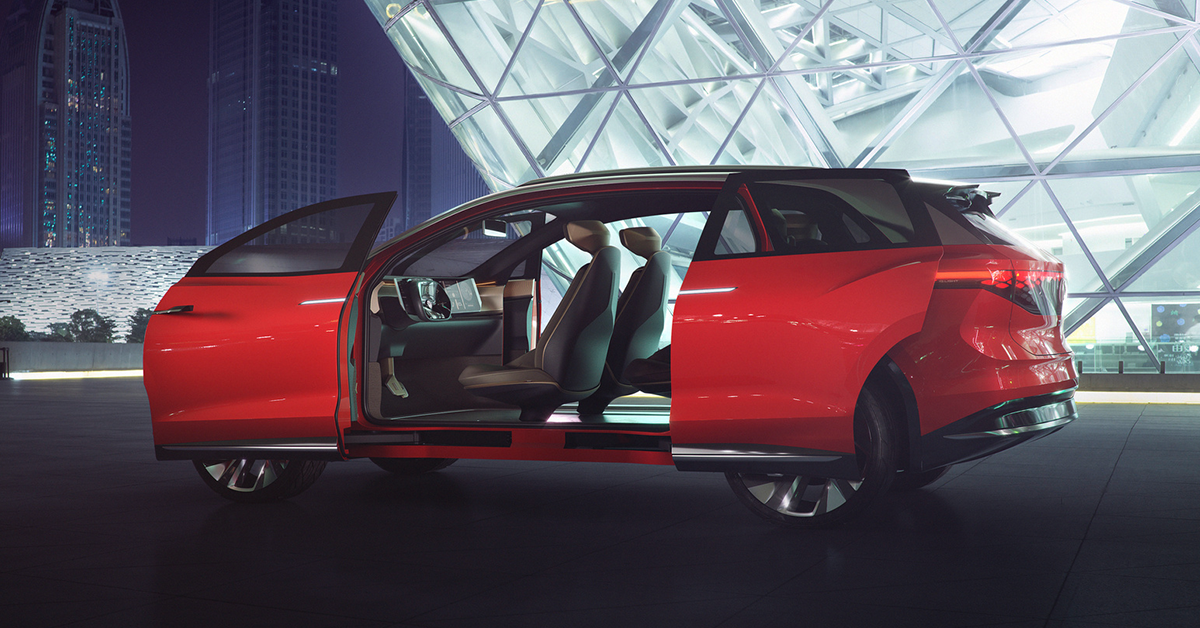
The ID.6 is the largest car on the MEB, and its size is its main selling point. Volkswagen’s release of 17 April 2021 gives a length of 4.88 metres, which it says is 30 centimetres more than the ID.4 and makes room for a third row of seats. The later release of 21 April 2021 gives a wheelbase of 2,965 millimetres. A car-news site gave the full dimensions as 4,876 millimetres long, 1,848 wide and 1,680 high, and noted that it is close in size to the seven-seat Tiguan Allspace (reported). A later trade database lists the 2024 CROZZ at 4,891 millimetres long and 1,679 high (reported).
| Length | 4.88 m, 30 cm more than ID.4 (Volkswagen) |
| Wheelbase | 2,965 mm (Volkswagen) |
| Width, height | 1,848 mm, 1,680 mm (reported) |
| Seats | 6 or 7 (Volkswagen) |
| Wheels | 19 to 21 inches (Volkswagen) |
| Roof | Panoramic glass, opening roof optional (Volkswagen) |
| Screen | 12-inch touchscreen (Volkswagen) |
| Head-up display | Augmented reality, optional (Volkswagen) |
| Top version output | 225 kW (305 PS), 4MOTION (Volkswagen) |
| 0 to 100 km/h, top version | 6.6 s (Volkswagen) |
Seating is flexible. Volkswagen’s release says the ID.6 comes with a 6- or 7-seat layout. The 6-seater has comfortable captain’s chair seats, while the 7-seater is arranged to suit all needs. The second row can be adjusted longitudinally, and a large panoramic glass roof is standard with an optional opening panoramic sunroof. A trade site noted that the seating can be arranged from two-two-two to two-three-two to allow seven passengers (reported). The third row reduces boot space when it is in use, and an EV site said the trunk is limited with the third row up (reported).
The exterior follows the ID. design language. Volkswagen lists wheels from 19 to 21 inches, and illuminated Volkswagen logos at the front and rear. Both versions carry their own headlight and tail-light designs, according to a news report (reported). The release describes a powerful, aerodynamic and modern exterior, and does not publish a drag coefficient. The ID. Light strip below the windscreen communicates with the driver, for example by signalling an upcoming turn, and the ID.6 shares this feature with the ID.4 and ID.5.
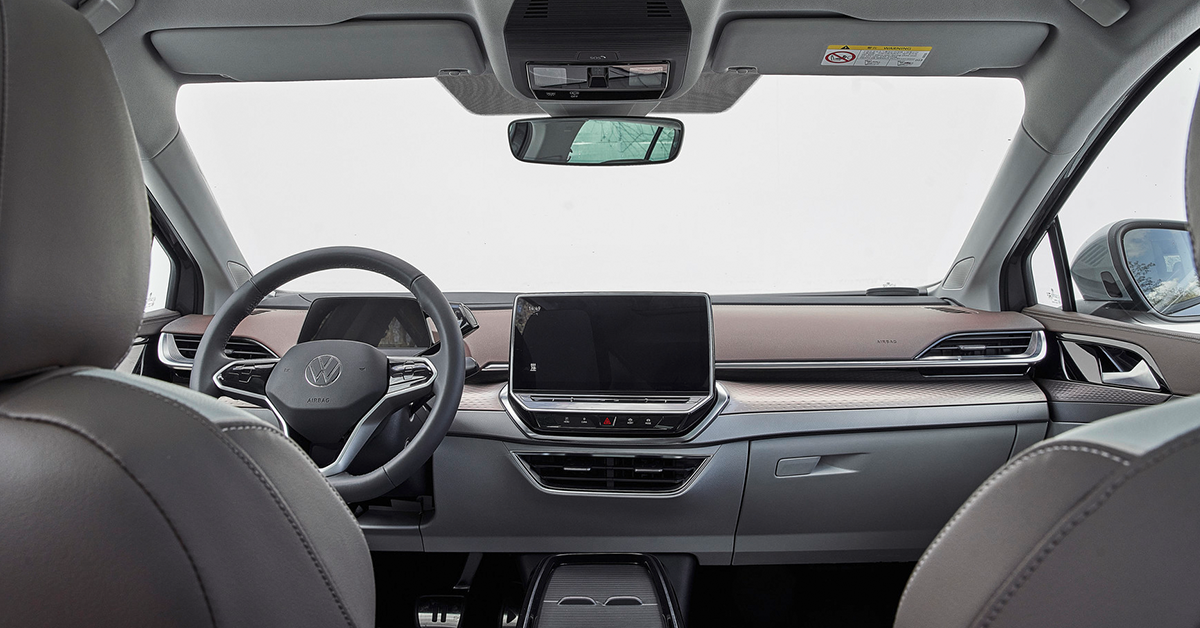
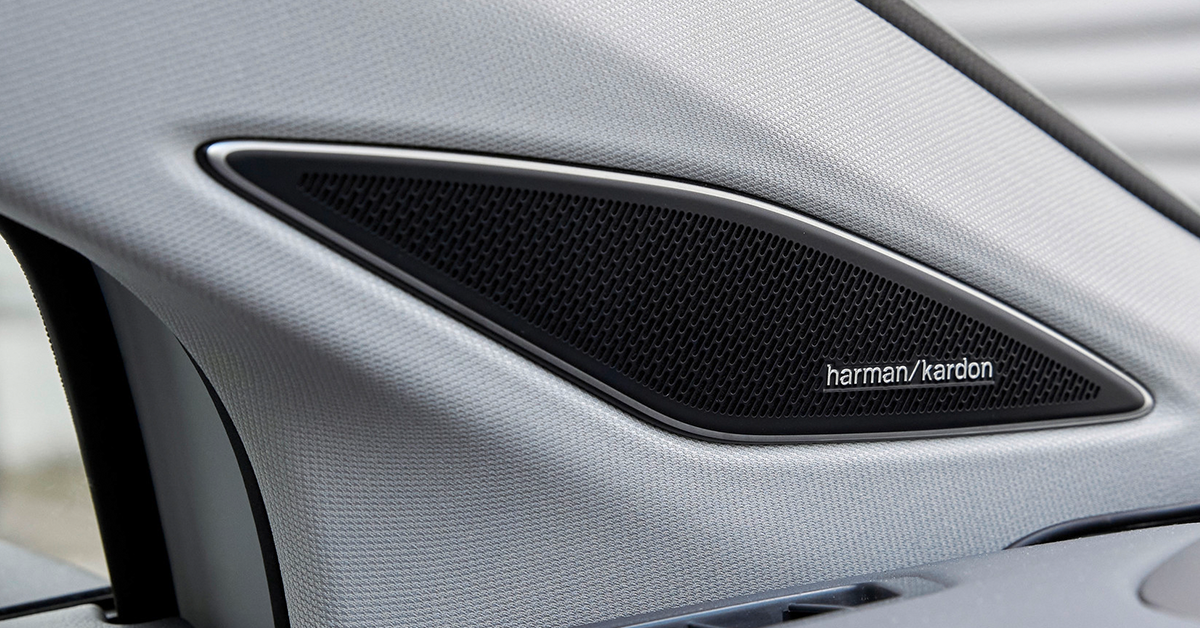
The cabin is also familiar. Volkswagen’s April 2021 release lists a 12-inch touchscreen, “Hello ID.” voice control, and an operating concept with no physical buttons or switches. An optional augmented-reality head-up display is available, and the IQ.Drive assistance systems include the latest-generation Travel Assist. Software and hardware allow over-the-air updates after purchase. A car-news site noted that the buttons below the touchscreen use capacitive touch sensitivity, and that a Harman Kardon sound system and leather seats are available on certain variants (reported).
Performance is given for the top version. The 4MOTION model has 225 kilowatts (305 PS), takes 6.6 seconds from 0 to 100 kilometres per hour and has a top speed of 160 kilometres per hour, according to Volkswagen’s April 2021 release. A Japanese car site quoted a torque figure of 310 newton metres for the all-wheel-drive e-machine (reported), but Volkswagen’s own release does not state torque, so this article gives no official figure.
Volkswagen stresses that the ID.6 was tested to its highest standards, and the 21 April release says the car carries the IQ.DRIVE package. Weights are not given in Volkswagen’s releases. A trade database lists a curb weight of 2,383 kilograms for the 2024 CROZZ (reported), which is a figure for the later six-seat car and not for the 2021 launch version. Readers who need accurate weights, towing limits or boot volumes should check the specification sheet of the exact Chinese-market variant, because Volkswagen has not published them for a global audience.
Official press image of the MEB battery system in production at the Volkswagen Group Components plant in Brunswick. | © Volkswagen AG
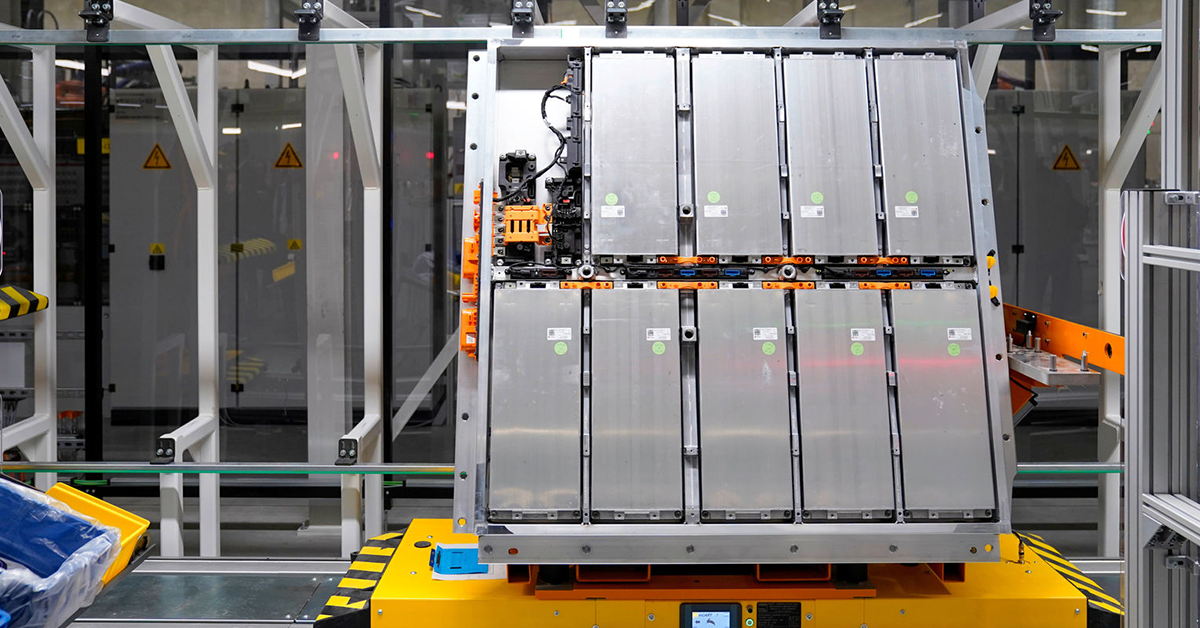
The ID.6 launched with two battery options. Volkswagen’s release of 17 April 2021 gives net capacities of 58 and 77 kilowatt-hours. An EV news site gave the smaller battery as 58 kilowatt-hours net and 62 kilowatt-hours gross (reported). A British car site wrote that the ID.6 uses the same battery technology as the ID.3 and ID.4 even though it is the largest car on the MEB (reported).
| Batteries at launch | 58 and 77 kWh net (Volkswagen) |
| Top version output | 225 kW (305 PS), 4MOTION (Volkswagen) |
| NEDC range, 17 April 2021 | 436 to 588 km (Volkswagen) |
| NEDC range, 21 April 2021 | Up to 580 km (Volkswagen) |
| Charging, production car | Not stated by Volkswagen (Volkswagen) |
| Torque | Not stated by Volkswagen (Volkswagen) |
| 2024 CROZZ batteries | 62.6 and 84.8 kWh (reported) |
| 2024 CROZZ range | Up to 601 km CLTC (reported) |
| 2024 CROZZ power, top trim | 308 hp (reported) |
| 2025 database range | 560 km CLTC, six-seat (reported) |
Range is quoted on the Chinese NEDC cycle, and Volkswagen’s documents give two figures. The release of 17 April 2021 gives a range of 436 to 588 kilometres, while the release of 21 April 2021 says up to 580 kilometres. Because the 588 figure appears in one document and the 580 figure in the other, this article shows both. An Australian car-news site wrote that the ID.6 had close to 600 kilometres of NEDC range (reported), and another site gave the same span as 271 to 365 miles (reported), which matches 436 to 588 kilometres.
The motors are less well documented than in Europe. Volkswagen’s April 2021 release gives only the top version, a 4MOTION all-wheel-drive car with 225 kilowatts (305 PS). It does not state the output of the rear-wheel-drive versions or any torque figure. Volkswagen’s own text does not give the output of the other versions. For the 2024 CROZZ, a trade site listed 177, 201 and 308 horsepower for the Pure, Pure+/Pro and Prime trims (reported), and another database listed 230 kilowatts of total power with 472 newton metres (reported).
Charging is the gap in the official record. The April 2021 releases give no charging power or charging time for the production ID.6. A British car site said at the time that Volkswagen had revealed nothing about the car’s charging (reported). The only official charging number connected to this car is the 150 kilowatt figure of the ID. ROOMZZ concept, which reached 80 per cent in about 30 minutes, and it would be wrong to treat that as a production specification. Readers should check the current Chinese specification for any ID.6 they plan to buy.
The 2023 refresh changed the batteries, according to reports. A trade site listed the 2024 ID.6 CROZZ with 62.6 and 84.8 kilowatt-hour batteries and cruising ranges on the Chinese CLTC cycle of 298, 373, 373 and 347 miles for the four trims (reported). Another report gave a maximum range of 601 kilometres for the 2024 model (reported). A trade database gave 560 kilometres for a six-seat version in 2025 (reported). CLTC is a more generous cycle than WLTP, and the figures should not be compared directly with European cars such as the ID.4.
Warranty and battery chemistry are not covered in Volkswagen’s April 2021 releases for the ID.6. For the ID.4 and ID.5, Volkswagen’s European press kits give a battery warranty of at least 70 per cent after eight years or 160,000 kilometres, but the Chinese terms for the ID.6 may differ. A trade site reported that the first owner of an ID.6 CROZZ got free lifetime maintenance, roadside assistance and a year of free charging through the CAMS charging venture (reported). Those were dealer-level offers at the 2021 launch and are not part of Volkswagen’s own specification.

Official press image of the ID.4 X and ID.4 CROZZ preview in China. | © Volkswagen AG
The ID.6 is built by two joint ventures. Volkswagen’s release of 17 April 2021 says the ID.6 CROZZ is manufactured by FAW and the ID.6 X by SVW, the abbreviation of SAIC Volkswagen. The release names the plants as Anting and Foshan, though it spells the second one “Foshang”. A trade site reported that the CROZZ is built at the FAW-Volkswagen plant in Foshan and the X by SAIC Volkswagen in Anting, near Shanghai (reported). Anting and Foshan are therefore the two sites, and the ID.4 had followed the same pattern before it.
| ID.6 CROZZ maker | FAW-Volkswagen (Volkswagen) |
| ID.6 X maker | SAIC Volkswagen (Volkswagen) |
| Plants named | Anting and Foshan (Volkswagen) |
| SAIC Volkswagen founded | 1984, Shanghai (Volkswagen) |
| FAW-Volkswagen founded | 1991 (Volkswagen) |
| Brand deliveries in China, 2025 | 2.015 million incl. joint ventures (Volkswagen) |
| Sold in Europe | No (Volkswagen) |
| ID.6 CROZZ sales, 2024 | 4,222 units (reported) |
| ID.6 CROZZ sales, H1 2025 | 820 units (reported) |
| VW electric output in China | 67,500 in 2025, 173,500 in 2024 (reported) |
There is a small conflict in the geography. Volkswagen’s April 2021 release says the CROZZ is being manufactured in the north of China and the X in the southern part of the country. Foshan, however, lies in the south, in Guangdong, and Anting lies near Shanghai on the east coast. Several reports match the plants and the versions as above, with the CROZZ in Foshan and the X in Anting (reported), while one British magazine reversed the assignment (reported). This article follows Volkswagen’s naming of the joint ventures, FAW for the CROZZ and SVW for the X, and treats the north and south wording as loose.
The two joint ventures have different histories. Volkswagen’s newsroom says SAIC Volkswagen, the company’s first joint venture in China, was established in Shanghai in 1984, followed by FAW-Volkswagen in 1991. Its May 2026 page lists six SAIC Volkswagen vehicle plants, in Shanghai (three), Yizheng, Ningbo and Changsha, and six FAW-Volkswagen plants, in Changchun (two), Chengdu, Foshan, Qingdao and Tianjin. A third partner, Volkswagen Anhui, runs the Hefei MEB plant. The brand and its partners delivered 2.015 million vehicles in China in 2025, according to the same page.
Both partners sell the same technology under different names. A trade report explained that when Volkswagen releases a new model in China, both joint ventures produce and sell it under different names, so FAW-Volkswagen makes the ID.4 CROZZ and ID.6 CROZZ, while SAIC Volkswagen sells the ID.4 X and ID.6 X (reported). A trade site noted that the Foshan factory is an MEB plant, and that FAW-Volkswagen’s 27 millionth vehicle, an ID.7 VIZZION, rolled off its line there (reported). The ID.6 was not built outside China.
The ID.6 never left China. Volkswagen’s release carries a footnote that the ID.6 CROZZ and ID.6 X will not be available in Germany, and the 21 April release notes that these models are not sold in Europe. A 2021 report quoted a Volkswagen spokesperson as saying a United States launch was conceivable (reported), and another site said exports to Europe were under consideration (reported). Neither happened, and the Volkswagen Group’s later electric SUV for those markets was the ID.4 and ID.5, which our guides cover.
For production volumes, the public record is thin. Volkswagen has not published a total for the ID.6. A trade site listed sales of the ID.6 CROZZ at 4,222 units for 2024 and 820 units for the first half of 2025, with only one unit in June 2025 (reported). A car-news database listed 12 sales in May 2025 (reported). An industry analyst said that Volkswagen’s battery-electric production in China fell to 67,500 units in 2025 from 173,500 in 2024 (reported), a figure that covers all electric Volkswagens and not just the ID.6.

Official press image of the Volkswagen ID.6 CROZZ and ID.6 X. | © Volkswagen AG
Buyers in China can choose between two versions of the ID.6, and the difference is mostly about styling and the joint venture that sells it. Volkswagen’s April 2021 release describes them together, and it does not distinguish between them in its text. The ID.6 CROZZ comes from FAW-Volkswagen and the ID.6 X from SAIC Volkswagen. Both are built on the MEB, share the 2,965 millimetre wheelbase and offer 6- or 7-seat layouts. The differences are in the detail, and they come mainly from market reports.
| Versions | ID.6 CROZZ and ID.6 X (Volkswagen) |
| CROZZ partner | FAW-Volkswagen (Volkswagen) |
| X partner | SAIC Volkswagen (Volkswagen) |
| Shared wheelbase | 2,965 mm (Volkswagen) |
| Seat layouts | 6 or 7 (Volkswagen) |
| CROZZ look | More rugged trim, aluminium scuff plates (reported) |
| X look | More road-focused (reported) |
| Launch CROZZ price | 239,800 to 334,800 yuan (reported) |
| Launch X price | 239,900 to 335,900 yuan (reported) |
| Name origin | I.D. CROZZ concept, 2017 (Volkswagen) |
Reports agree on the visual differences. A British car site said the CROZZ has a more off-road-inspired design with aluminium scuff plates at the front and rear, while the X appears to be the more road-focused version, and both have their own headlights and tail lights (reported). A US site noted that the CROZZ appears to sit a little higher off the ground than the X and features more rugged plastic trim and differently styled headlights and front bumper (reported). An Australian site listed the differences as the LED headlight signatures, lower bumper designs, tail-light shapes and tailgate designs, including the licence-plate position (reported).
A trade site added one more detail about the grille. It said the CROZZ has a slimmer grille that merges into the headlight cluster, and that apart from styling nuances the two models look rather similar (reported). That judgement fits Volkswagen’s own approach, since the company also sold the ID.4 as a CROZZ and an X. The official Volkswagen photographs show both cars together, and the newsroom caption is simply “ID.6 CROZZ by FAW and ID.6 X by SVW”, which makes no distinction between them.
The names themselves have a history. CROZZ comes from the 2017 I.D. CROZZ concept, and X is the label SAIC Volkswagen applies to its versions of Volkswagen’s electric cars in China. The ID.4 introduced the same split in 2020, and our Volkswagen ID.4 guide notes that the newsroom also published a preview of the ID.4 X and ID.4 CROZZ in China. The ID.6 repeated the approach.
Prices also differed slightly at launch. A trade site reported the CROZZ at 239,800 to 334,800 yuan after subsidies (reported), while a sales-data site gave the X at 239,900 to 335,900 yuan (reported). The 100 and 1,100 yuan gaps between those figures show how the two versions tracked each other, and also how reports differ. Because the source for each number is a different outlet, this article shows both ranges and labels them as reported. Volkswagen’s own releases give no price for either version.
Which should a buyer prefer? That depends on the dealer network, the available variants and the price at the time, and not on any major technical difference. Both versions use the same IQ.Drive assist systems, the same 12-inch screen and the same battery options in Volkswagen’s description. For readers outside China, the question is largely academic, since neither is sold in Europe or the United States. For the global electric SUV from the same family, our Volkswagen ID.4 guide is the better starting point.
Official press image of the Volkswagen ID.6 electric SUV. | © Volkswagen AG
The ID.6 received one visible update. A trade report said FAW-Volkswagen launched a refreshed 2024 ID.6 CROZZ in September 2023, with a starting price of about 258,900 yuan (reported). A second trade site said the car was offered in four trims, Pure, Pure+, Pro and Prime, the last with all-wheel drive, and that the starting price ran from 258,900 to 336,900 yuan (reported). The site listed battery sizes of 62.6 and 84.8 kilowatt-hours and CLTC ranges of up to 373 miles (reported). The Volkswagen newsroom pages used for this article carry no press release for the update.
| Refresh | Launched September 2023, 2024 model (reported) |
| Trims | Pure, Pure+, Pro, Prime AWD (reported) |
| Starting price | 258,900 yuan (reported) |
| Launch discount | Up to 45,000 yuan (reported) |
| Q1 2023 sales | 2,894 units (reported) |
| 2024 sales | 4,222 or 4,300 units (reported) |
| February 2025 price | 195,900 yuan, CROZZ (reported) |
| April 2025 sales | 614 units (reported) |
| June 2025 sales | 1 unit (reported) |
| Chinese EV incentives cut | From 1 January 2026 (reported) |
The refresh came with a discount. The FAW-Volkswagen website offered the 2024 ID.6 CROZZ with a limited-time discount of up to 45,000 yuan, according to the same reports (reported). A news site wrote that the 2024 car had a maximum range of 601 kilometres and a starting price of 35,000 dollars (reported). Another site said the refresh brought more range and design updates (reported). The seating can run from a two-two-two six-seat layout to a two-three-two seven-seat layout, according to the reports, so the family-oriented role of the car did not change.
Sales were weak even before the refresh. A trade site reported that Volkswagen sold 2,894 ID.6 in the first quarter of 2023, compared with 8,950 ID.4 and 5,767 ID.3 (reported). The same site said the Volkswagen ID. series sold 48,147 units in China in the first half of 2023, down 19 per cent from a year earlier (reported). The ID.6 was therefore the smallest seller of Volkswagen’s three MEB cars in China at that time.
Price cuts continued in 2025. A business-news site reported in February 2025 that FAW-Volkswagen was lowering prices of the ID.4 CROZZ 2025 and the ID.6 CROZZ to 139,900 and 195,900 yuan respectively (reported). It said the ID.4 CROZZ sold 37,500 units in 2024 while the ID.6 CROZZ sold only 4,300 (reported). A sales-data site gave 4,222 for the ID.6 CROZZ in 2024, with 614 in April 2025, 13 in May and 1 in June (reported). The two annual totals differ by 78 units, which is a normal gap between data sources.
The wider market explains the collapse. An industry analyst wrote that the Chinese government increased taxes on electric vehicles and cut purchase incentives from 1 January 2026, and that the ID.3, ID.4, ID.6 and ID.7 together represented less than one per cent of the Chinese battery-electric market in 2025 (reported). The same analyst said Volkswagen was expected to cease production of those four models by 2026 and to work with a local carmaker (reported). That is the analyst’s expectation and not a Volkswagen announcement, so readers should treat it with caution.
Volkswagen’s own response has been a new generation of Chinese-developed electric cars. Its newsroom says the brand plans 13 new electric, plug-in hybrid and range-extender models in China by 2026, rising to more than 30 by 2029. It names the ID. UNYX 06, 07 and 08 from Volkswagen Anhui, the ID. ERA 9X from SAIC Volkswagen and the ID. AURA T6 from FAW-Volkswagen. A trade site said the ID. AURA T6 uses the CEA architecture developed with Xpeng (reported). None of those models is an ID.6 successor by name, which the next section explains.

Official press image of the Volkswagen ID.6 electric SUV. | © Volkswagen AG
What is the status of the ID.6 now? Volkswagen has not announced an end of production in the sources used for this article. Its newsroom page on the brand in China, with facts and figures as of May 2026, lists the SAIC Volkswagen models as the ID. ERA 9X, the ID.3 and a range of combustion cars, and the FAW-Volkswagen models as the ID. AURA T6 and combustion cars. The ID.6 does not appear on that page, and neither does the ID.4 or ID.7 in the line-up. That absence is a sign of the model’s status, though the page does not say the ID.6 has ended.
| Official end of production | Not announced in sources used (Volkswagen) |
| Listed on Volkswagen China page, May 2026 | No (Volkswagen) |
| Named successor | None (Volkswagen) |
| 2025 CROZZ sales, June | 1 unit (reported) |
| Share of China BEV market, 2025 | Under 1 per cent, four MEB models (reported) |
| New models planned, 2026 | 13 electric, plug-in and range-extender (Volkswagen) |
| Planned by 2029 | More than 30 (Volkswagen) |
| ID. ERA 9X | Full-size extended-range SUV (reported) |
| Nearest global SUV | ID. Tiguan, five seats (Volkswagen) |
| Sold outside China | Never (Volkswagen) |
The sales data point the same way. A trade site recorded a single unit of the ID.6 CROZZ in June 2025 (reported), and an industry analyst said the four MEB models built in China together held under one per cent of the Chinese battery-electric market in 2025 (reported). Volkswagen’s own releases for 2026 concentrate on new cars. An industry analyst expected production of the ID.3, ID.4, ID.6 and ID.7 in China to cease in 2026 (reported), but Volkswagen has not confirmed that.
The ID.6 has no named successor. Volkswagen’s China models announced for 2026 use new names and new architectures. The ID. UNYX range comes from Volkswagen Anhui, and the ID. ERA 9X is a full-size extended-range SUV from SAIC Volkswagen, with a CLTC battery range above 400 kilometres, according to a trade report (reported). The report calls it a first for the Volkswagen line-up, and it targets the same family-and-space buyers that the ID.6 addressed. The report does not call it the ID.6’s replacement, and neither does Volkswagen.
Outside China, the closest Volkswagen counterpart is a different kind of car. The ID. Tiguan, which Volkswagen premiered on 9 October 2026, succeeds the ID.4 and ID.5, and it is a five-seat SUV with up to 600 kilometres of WLTP range, according to Volkswagen’s press pack, so it does not offer the ID.6’s third row. Volkswagen’s larger electric models for Europe today are the ID.7 saloon and the ID. Buzz van. Our Volkswagen ID.5 guide covers the end of the coupé SUV and the arrival of the ID. Tiguan, which gives context for the wider family.
For enthusiasts, the ID.6 matters as a record of how Volkswagen tried to localise its electric cars. It was the first ID. model made for one market, and it did not last long. Volkswagen’s later “In China, for China” strategy, visible in the new line-up, is built around new models developed with local partners.
A short checklist for anyone considering a used ID.6. First, confirm whether it is a CROZZ or an X, because spare parts and service differ by joint venture. Second, check the model year, because the 2024 CROZZ has a different battery and range from the 2021 launch car. Third, ask for the exact range figure on the cycle you care about, since NEDC and CLTC are more generous than WLTP. Fourth, be aware that Volkswagen has not published a global specification sheet. For a full list of the cars Volkswagen has built, see our Volkswagen models list.