 Brands
Volkswagen Santana — History, Generations, China and Specs
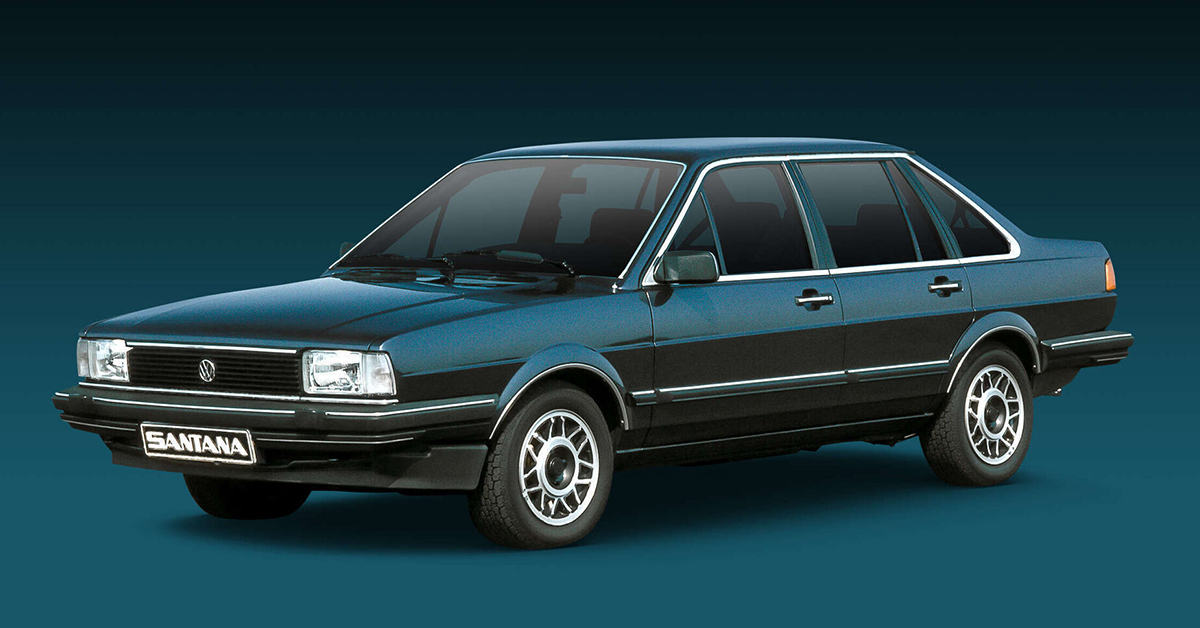
Official press image of the Volkswagen Santana. | © Volkswagen AG
The Volkswagen Santana is the Passat-based notchback saloon that Volkswagen presented in 1981 and that became the car that put China on wheels, built in Shanghai from 11 April 1983 and, in several forms, for decades afterwards. Here is the full Santana story, from the Emden original to the Santana 2000, 3000 and Vista, the Corsar, Carat and Nissan versions, the all-new Santana of 2012 and the end of the name.
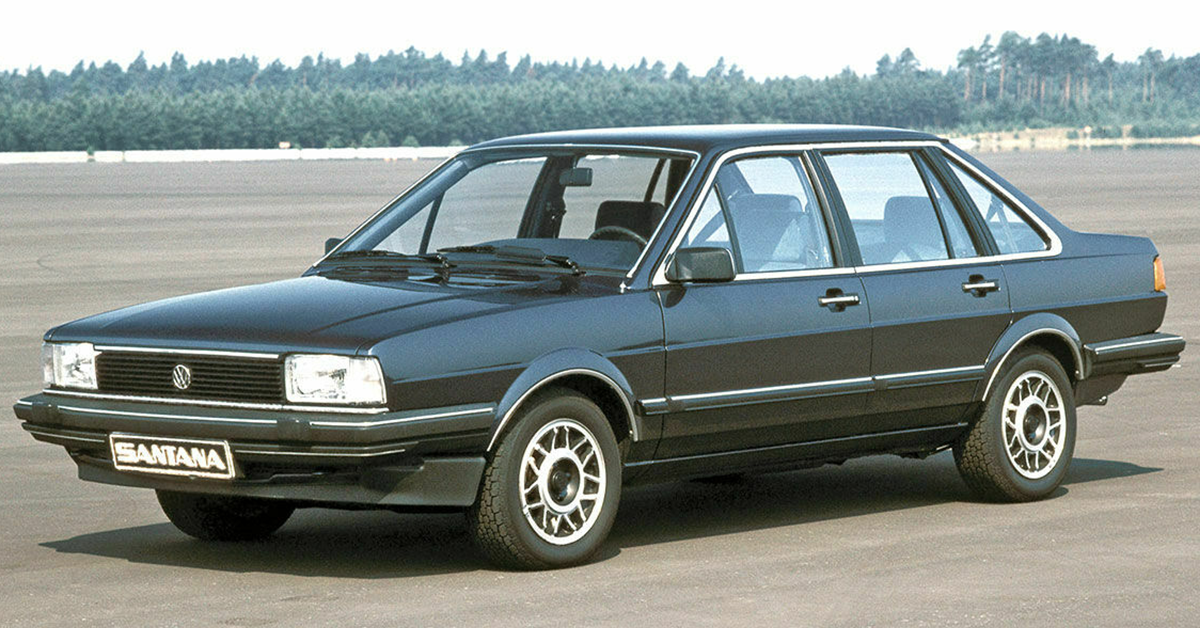
Official press image of the Volkswagen Santana (1981). | © Volkswagen AG
The Volkswagen Santana is one of the longest-running names in Volkswagen history, and also one of the most confusing. It began in 1981 as a four-door notchback version of the second-generation Passat, sold in Europe for only a few years. It then became the car that put China on wheels, built in Shanghai from 1983 and, in different forms, for decades afterwards. A reference source gives the Chinese production span as 1983 to 2022, the European span as 1981 to 1984, the Japanese span as 1984 to 1989 and the Brazilian span as 1984 to 2006, which shows how far the name travelled.
| Factory code | Type 321 (B2) notchback (Volkswagen) |
| Presented | 1981 (Volkswagen) |
| Based on | Passat B2 |
| European plant | Emden (Volkswagen) |
| Name dropped in Europe | December 1984 (Volkswagen), January 1985 (reported) |
| German notchback production ended | December 1987 (Volkswagen) |
| First Chinese-built car | 11 April 1983, Anting (Volkswagen) |
| Joint venture founded | 16 February 1985 (Volkswagen) |
| Chinese production | 1983 to 2012, later as Santana Vista (Volkswagen) |
| European output | 198,505 (reported) |
Volkswagen’s own history page starts with the original car. It gives the factory code as Type 321 (B2), a notchback saloon built on the Passat B2 and presented in 1981. The page says Volkswagen wanted to appeal to customers looking for a large Volkswagen with a higher level of equipment than the Passat. It quotes the 1981 sales brochure, which called the Santana “larger and more elegant” than earlier models and a large classic touring saloon “the likes of which Volkswagen had never produced before”. The name was inspired by the Santa Ana winds in California, and it was chosen to distinguish the car from the Passat.
The car was built in Emden, in the same plant as the Passat, according to Volkswagen. A reference source says Volkswagen wanted to position the Santana above the Passat but was cautious that it could take sales from the Audi 80 B2, and that the Santana badge echoed the way the company used different names for the notchback versions of the Polo (Derby) and Golf (Jetta). That naming habit is why a Volkswagen notchback can carry a different name from its hatchback sibling, and it is the reason the Santana story sits so closely beside the Passat guide on this site.
The European Santana did not last long under its own name. Volkswagen’s history page says that in December 1984 the Santana was discontinued and continued as a four-door Passat saloon with a notchback and the Passat front end, and that German production of the notchback ended in December 1987 while it continued in other countries. A reference source dates the name change to January 1985 and says the Santana name was kept in Spain, so the exact month is shown here as reported. Reference sources give European production at 198,505 cars, of which 174,900 were petrol and 23,600 diesel, while another gives 193,540 for Germany.
The real success came elsewhere. Volkswagen’s Group chronicle says a trial assembly contract with the Shanghai Tractor and Automobile Corporation was signed on 8 June 1982, and that the first Chinese-built Santana rolled off the production line at the Anting plant on 11 April 1983. The joint venture agreement was signed in Beijing on 10 October 1984, and on 16 February 1985 it resulted in the founding of Shanghai-Volkswagen Automotive. Volkswagen’s history page notes that the Chinese version ran from 1983 to 2012 under the Santana name and later as the Santana Vista, and that the generation was renamed simply Santana in 2013.
This guide follows the Santana through six parts: the original design and platform, the engines and specifications, the Chinese joint venture, the Santana 2000, 3000 and Vista, the Latin American, Japanese and Passat notchback story, and finally the all-new Santana of 2012 and the end of the name. Where sources disagree, both figures are shown and marked as reported. For the car the Santana was based on, see our guide to the Volkswagen Passat. The table lists the key dates.

Official press image of the Volkswagen Santana (1981–1984). | © Volkswagen AG
The Santana was a Passat in a different suit. A reference source says it used the Volkswagen Group B2 platform, shared with the Audi 80 B2 and the Passat B2, and gives a wheelbase of 2,550 millimetres and a length of 4,545 millimetres for the original saloon. Volkswagen’s history page describes it as a four-door saloon with a notchback, which meant a proper separate boot rather than the hatchback of the standard Passat. That boot was one of the main selling points, because Volkswagen’s page says the new model had a larger boot than the Passat.
| Platform | Group B2, shared with Passat B2 and Audi 80 B2 (reported) |
| Body | Four-door notchback saloon (Volkswagen) |
| Wheelbase | 2,550 mm (reported) |
| Length | 4,545 mm (reported) |
| Boot | Larger than the Passat (Volkswagen) |
| Front end | Own grille, white-lens indicators, extra chrome (Volkswagen) |
| Launch trims | CL and GL (Volkswagen) |
| 1982 trims | LX and GX (Volkswagen) |
| 1983 trim | Basic CX added (Volkswagen) |
| Name origin | Santa Ana winds, California (Volkswagen) |
The changes at the front were small but visible. According to Volkswagen, the Santana differed from the Passat by a modified front end, including a redesigned radiator grille and indicator lights with white lenses, with additional chrome trim to emphasise its higher positioning. Inside, the page describes a high-quality interior that rounded off the elegant impression. For a buyer in the early 1980s the result was a Passat-based car that looked more formal and more expensive, which was the whole point of the exercise.
Trim levels changed over the car’s European life. Volkswagen says the initial trim levels were CL and GL, that in summer 1982 they were renamed LX and GX, and that a simplified basic CX version was added in 1983. These letters are useful for anyone trying to identify a surviving car, because they tell you roughly when it was built and how it was equipped. The history page also says the 1.6-litre engine was optionally available with Formula E equipment, which included a stop-start function, an early example of fuel-saving technology on a family saloon.
The Santana was not alone on the road in Europe. A classic-car report says that, as little luck as Volkswagen had with its notchback models in Europe, naming the Derby and the Vento as examples, the same cars were more successful in other parts of the world. The Santana was no exception to that pattern. In Europe it was a small chapter, but the same body shape went on to be built in China, Brazil, Mexico, Argentina, Japan and other markets, and that is why the Santana is the more famous name outside Germany.
The newsroom picture library carries several press photographs of the original car, captioned Santana (1981), Santana (1983) and Santana (1981–1984). They show a conventional three-box saloon with rectangular headlights and a grille in the Volkswagen style of the period. Volkswagen’s Group chronicle also carries a photograph of a Santana with the number plate reading “SANTANA”, parked against a forest background. The design was never meant to be radical, because the Santana was a practical, conservative car for customers who wanted size and equipment rather than novelty.
That conservatism turned out to be an advantage. A car with simple mechanical underpinnings is easy to build from kits in a new factory and easy to repair afterwards, which is exactly what China needed in the 1980s. A Volkswagen newsroom caption says the Chinese version differed only minimally from its German siblings in the 1980s, and a Chinese-car retrospective describes the later Chinese car as a model that taxi drivers liked because, after so many years in production, all the faults had been filtered out. The table summarises the original car.
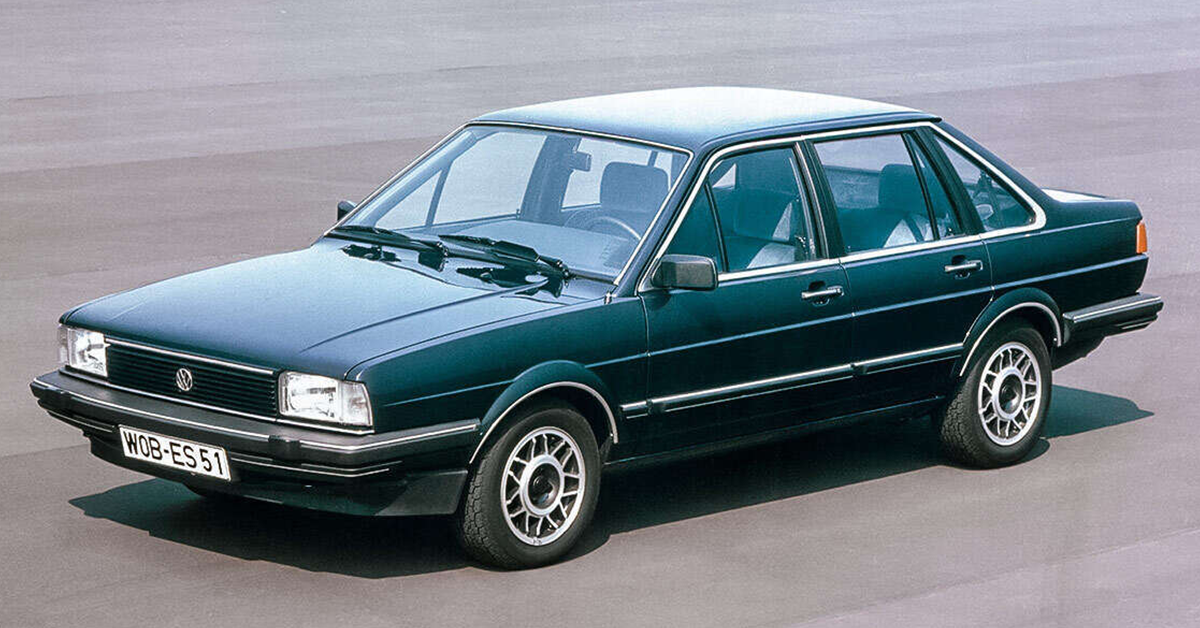
Official press image of the Volkswagen Santana (1981–1984). | © Volkswagen AG
The original European Santana offered a wide range of engines for a family saloon. Volkswagen’s history page lists a 1.6-litre petrol engine in two outputs, 55 kilowatts (75 PS) and 63 kilowatts (85 PS), a 1.9-litre five-cylinder petrol engine with 85 kilowatts (115 PS), a 1.6-litre diesel with 40 kilowatts (54 PS) and a turbodiesel with 51 kilowatts (70 PS). The five-cylinder engine gave the Santana its flagship, and the two diesels reflect the strong market for economical saloons in Europe at that time.
| 1.6 petrol (low output) | 55 kW (75 PS) (Volkswagen) |
| 1.6 petrol (high output) | 63 kW (85 PS) (Volkswagen) |
| 1.9 five-cylinder petrol | 85 kW (115 PS) (Volkswagen) |
| 1.6 diesel | 40 kW (54 PS) (Volkswagen) |
| Turbodiesel | 51 kW (70 PS) (Volkswagen) |
| Catalytic converter on 1.8 injection | 1984 (Volkswagen) |
| European petrol cars | 174,900 (reported) |
| European diesel cars | 23,600 (reported) |
| First China engine | 1.6 litres, 87 hp (reported) |
| Santana 3000 engines (2004) | 1.6, 1.8 and 2.0 petrol (reported) |
Updates followed. The history page says the 1.8-litre fuel-injection engine gained a regulated catalytic converter in 1984, which is an early example of emissions equipment on a Volkswagen of this class. A reference source says that of the 198,505 European Santanas, 174,900 were petrol and 23,600 diesel, so roughly one car in eight was a diesel. Those proportions are reported rather than official, but they show that petrol power dominated the range, and that the five-cylinder and 1.8-litre petrol cars were the typical choice.
The Chinese car had simpler engines. A Chinese-car retrospective says production started in 1985 with a 1.6-litre engine producing 87 horsepower, and a reference source says a 1.8-litre petrol engine was added in 1987, first available in the Santana Variant station wagon that Shanghai introduced in 1986. A market report says the first generation used a 1.6-litre petrol engine with a four-speed manual gearbox, later joined by a 1.8-litre with a five-speed manual. By 2012 a Chinese-car blog was quoting a 95 horsepower 1.8-litre engine for the old car, so power barely changed in more than two decades.
The Santana 2000 brought a new level of equipment. A market report says it had a fuel-injected 1.8-litre engine with an optional four-speed automatic gearbox, and a Chinese-car retrospective gives 97 horsepower for the 1.8-litre engine in the Santana 2000. The Santana 3000 that followed in 2004 was offered with 1.6-litre, 1.8-litre and 2.0-litre petrol engines, and the same report says it was the first Santana with ABS, electronic brake-force distribution and a factory sunroof. These are figures from reports, so they are marked as reported.
The all-new Santana of 2012 changed the technical basis completely. A reference source says it was based on the Group platform shared with the Polo, with a transverse engine, and a Shanghai magazine describes it as built on a stretched version of the Polo platform and more than 20 centimetres shorter than the Santana Vista it replaced. A car magazine says it offered significantly more rear-seat legroom and a larger 480-litre boot. That is a very different car from the rear-boot Passat-based original, even though it carried the same name.
The sensible way to read the Santana’s specifications is by generation, because there is no single set of figures for the name. A buyer looking at a European 1980s car should check the engine code and trim against the registration document. A buyer looking at a Chinese car should identify whether it is a first-generation Santana, a Santana 2000, a Santana 3000, a Vista or the post-2012 car, because the platform, the gearbox choices and the equipment differ at each step. The table lists the original European engines and the main Chinese figures.
Official press image of the Volkswagen Santana (China version, 1986). | © Volkswagen AG
In China the Santana became something far larger than a Passat variant. Volkswagen’s Group chronicle describes the June 1982 trial assembly contract with the Shanghai Tractor and Automobile Corporation as the beginning of the Volkswagen Group’s involvement in the People’s Republic of China, and says the contract was the precursor to a successful German-Chinese undertaking that began on 11 April 1983, when the first Chinese-built Santana rolled off the production line at Anting. A reference source says 100 cars were assembled from kits delivered from Germany in the trial phase.
| Trial assembly contract | 8 June 1982 (Volkswagen) |
| First Chinese-built Santana | 11 April 1983, Anting (Volkswagen) |
| Joint venture agreement | 10 October 1984, Beijing (Volkswagen) |
| Joint venture founded | 16 February 1985, 50 percent VW (Volkswagen) |
| Vehicles built by end of 1985 | About 1,700 (Volkswagen) |
| Annual output 1986 to 1991 | 8,471 to 35,000 (Volkswagen) |
| Local content 1991 | 70.4 percent (Volkswagen) |
| Output reached 100,000 | By 1993 (reported) |
| Local content 1995 | 89 percent (reported) |
| Santana Variant | Introduced 1986 (reported) |
The joint venture followed. Volkswagen says the agreement was signed in Beijing on 10 October 1984, in the presence of Chancellor Helmut Kohl, and that it established Shanghai-Volkswagen Automotive on 16 February 1985, with Volkswagenwerk holding a 50 percent share. The chronicle says the venture built about 1,700 vehicles by the end of 1985, and describes Volkswagen as the first joint venture partner in the automotive industry in China. A market report says that early cars were completely-knocked-down kits imported from Germany, with local content of 6 percent in 1985.
Production grew steadily. Volkswagen’s chronicle says that between 1986 and 1991 annual production rose from 8,471 to 35,000 vehicles and that the workforce grew from 1,911 to 3,064. A training centre opened in August 1988, a new paint shop in October 1989, and in 1990 a press shop and engine production started. By 1991 local content had reached 70.4 percent, so from June 1991 the venture no longer needed import licences for vehicle kits. The chronicle says Shanghai Volkswagen became China’s largest and most modern car plant.
Other sources add numbers. A reference source says the 10,000th Santana was built in China in September 1986, that production of Santana models reached nearly 19,000 vehicles in 1990 and that the venture’s output reached 100,000 vehicles by 1993. A market report says local content rose to 89 percent by 1995. A Chinese-car history says the Santana reigned supreme within the joint venture for nearly 15 years, until the end of the 1990s when the Chinese market began to explode and a single-model policy could no longer sustain the company’s growth.
The Santana’s role in Chinese motoring was unusual. A car magazine says the Santana was the first mass-produced modern passenger car built in China, and a reference source says the model laid the groundwork for China’s mass motorisation and was popular with taxi and police fleets as well as private buyers. Volkswagen’s own history page marks the first Chinese car, on 11 April 1983, as the first “Made in China” Santana. For many people in Shanghai and beyond, the Santana was simply what a taxi looked like.
The station wagon followed the saloon. A reference source says the Santana Variant was introduced by Shanghai in 1986, while another reference table gives production years of 1992 to 2008 for it, so the dates are shown here as reported. In either case the Variant gave the Chinese range a load-carrying version of the same car, and it stayed on sale alongside the later models. The table lists the main steps of the Shanghai joint venture.

Official press image of the Volkswagen Santana (China). | © Volkswagen AG
The original Chinese Santana was joined by newer versions over time rather than replaced. A Chinese-car retrospective lists the original Santana, the Santana Variant, the Santana 2000, the Santana 3000 and the Santana Vista, and says the old car continued to be sold alongside the newer ones. That is why Chinese roads in the 2000s carried several different Santanas at once, some looking like 1980s Volkswagens and others looking modern, and why buyers needed to know which one they were looking at.
| Santana 2000 development | From 1991 with Volkswagen do Brasil (reported) |
| Santana 2000 introduced | 1994, mass production April 1995 (reported) |
| Santana 2000 engine | Fuel-injected 1.8, optional four-speed automatic (reported) |
| Santana 3000 introduced | 2 March 2004 (reported) |
| Santana 3000 first | Redesign by the joint venture itself (reported) |
| Santana 3000 engines | 1.6, 1.8, 2.0 petrol (reported) |
| Santana Vista | January 2008 (reported) |
| Units to May 2009 | 3,213,710 (reported) |
| 2011 output | About 70,000 (reported) |
| Vista taxi phased out | October 2018 (reported) |
The Santana 2000 was a Brazilian-influenced design. A reference source says it was put into development for China in 1991 with the aid of Volkswagen do Brasil, was introduced in 1994 and started mass production in April 1995, with a longer wheelbase and rear doors than its Brazilian counterpart. A Chinese-car retrospective agrees that it was based on the Brazilian-built Santana 2000 rather than on the original German car, and says the Chinese car had a slightly longer wheelbase and longer rear doors. A reference source gives its production as 1995 to 2004.
The Santana 3000 arrived in 2004. A reference source says that on 2 March 2004 Shanghai Volkswagen Automotive introduced a heavily facelifted Santana 2000 as the Santana 3000, and the Chinese-car retrospective says the redesign was done for the first time by the Shanghai-Volkswagen joint venture itself rather than by Volkswagen in Germany. A market report says the car offered 1.6-litre, 1.8-litre and 2.0-litre petrol engines and was the first Santana with ABS, electronic brake-force distribution and a factory sunroof, and that production ran to 2008.
The Santana Vista followed in 2008. A reference source says Shanghai Volkswagen Automotive released the Santana Vista, known in Chinese as the Zhijun, and a Santana Vista taxi version in January 2008, with front and rear visual updates and minor chassis modifications. A market report describes it as a new body on existing drivetrains. A reference source adds that a 1.6-litre Santana Vista with 1,595 cc was added to the bottom of the range to boost sales, and that the Vista was popular with taxi and police fleets and with private buyers.
Sales figures show how successful the formula was. A reference source says that 3,213,710 Santanas had been made from the start of kit production in 1983 up to May 2009, and a Chinese-car blog repeated the same figure in July 2012. A market report says that in 2009 the Santana became China’s most popular foreign nameplate, with more than 3.2 million sold. A retrospective published in early 2012 says Shanghai-Volkswagen made some 70,000 in 2011, which was impressive for a design that was already nearly three decades old.
The old Santana outlived its own replacement in the showroom. A reference source says the classic Santana Vista taxi was phased out in October 2018 in favour of 100 new electric cabs for Shanghai’s taxi fleet as well as the Volkswagen Touran, which offered greater comfort for passengers. By then the name was attached to a completely different car, which is covered in the New Santana section. The table lists the Chinese generations and the dates reported for them.

Official press image of the Volkswagen Santana (1983). | © Volkswagen AG
Outside China the Santana wore several names. A reference source says that in Mexico it was named the Volkswagen Corsar and in Argentina the Volkswagen Carat, while in Brazil and other South American countries it was known as the Santana and the Passat Variant B2 wagon was marketed as the Quantum. The same source says that in the United States both the Santana sedan and station wagon were sold as the Quantum. Volkswagen’s history page confirms the wider footprint, saying that from December 1987 the notchback continued to be built or assembled in Argentina, Belgium, Brazil, China, Mexico, Nigeria, Japan and South Africa.
| Mexico name | Corsar (reported) |
| Argentina name | Carat (reported) |
| United States name | Quantum (reported) |
| Brazil wagon | Quantum (reported) |
| Brazil production | 1984 to 2006 (reported) |
| Japan | Nissan Santana, production ended October 1989 (reported) |
| Nissan sales target | 4,000 to 5,000 a month (reported) |
| Nissan sales reached | About 50,000 in seven years (reported) |
| Other producers (Volkswagen) | Argentina, Belgium, Brazil, China, Mexico, Nigeria, Japan, South Africa |
| German Passat B2 output | 3,345,248 (reported) |
Brazil was the most important of these markets. A reference source gives Brazilian production as 1984 to 2006, and says that in 1991 the car was reskinned with Passat B4-like sheet metal, with a longer-wheelbase Santana 2000 version. The Brazilian car also gave the Chinese Santana 2000 its starting point. A reference source says Mexican production under the Corsar name ran from 1984 to 1988 and the Argentine Carat from 1987 to 1991, though dates like these vary by source and are marked as reported.
Japan had its own Santana. A classic-car report says Nissan built the car under licence as the Nissan Santana from 1984, and that sales, originally targeted at 4,000 to 5,000 vehicles per month, only reached 50,000 in seven years, so Nissan discontinued production in October 1989. The report adds that instead of renewing the production licence, Nissan began selling the new third-generation Volkswagen Passat through its dealer network. Volkswagen’s group history says the licence agreement for the Polo, Passat and Santana was intended to make Volkswagen number one in Europe, which shows how large the ambitions for the arrangement were.
In Europe the car lived on as a Passat. Volkswagen says the Santana was discontinued in December 1984 and continued as a four-door Passat saloon with a notchback and the Passat front end. A reference source says the Santana name was dropped in Europe from January 1985 except in Spain, and that the notchback remained on sale through a facelift until the Passat B2 ended in 1988. The reference source says the total German Passat B2 production was 3,345,248 cars, and world production around 4.5 million, a total that includes the Santana-based cars built elsewhere.
The result was a global family of cars built on one platform. A car-history source calls the Santana something of a badge-engineered Passat B2 and says Volkswagen saw the opportunity to use specific names for specific markets. That approach explains why a single set of body panels could appear as a Santana in Brazil and China, a Corsar in Mexico, a Carat in Argentina, a Quantum in the United States and a Nissan in Japan. It also explains why production figures for the Santana alone are hard to pin down.
For enthusiasts, the Latin American and Japanese cars are the most interesting survivors. They show how the same basic design adapted to local needs, from the engines to the trim, and they are a useful reminder that the Santana was much more than a Chinese taxi. If you are comparing sources, check which country and year they refer to, because Santana production dates differ widely between markets. The table summarises the main names and markets.
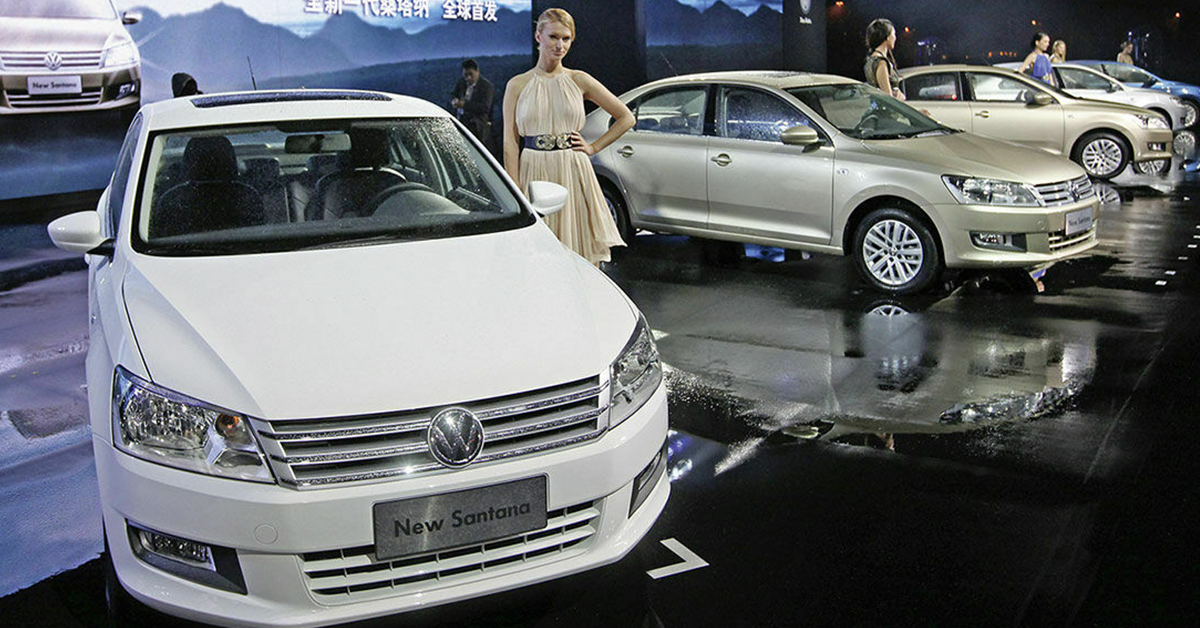
Official press image of the Volkswagen New Santana (2012). | © Volkswagen AG
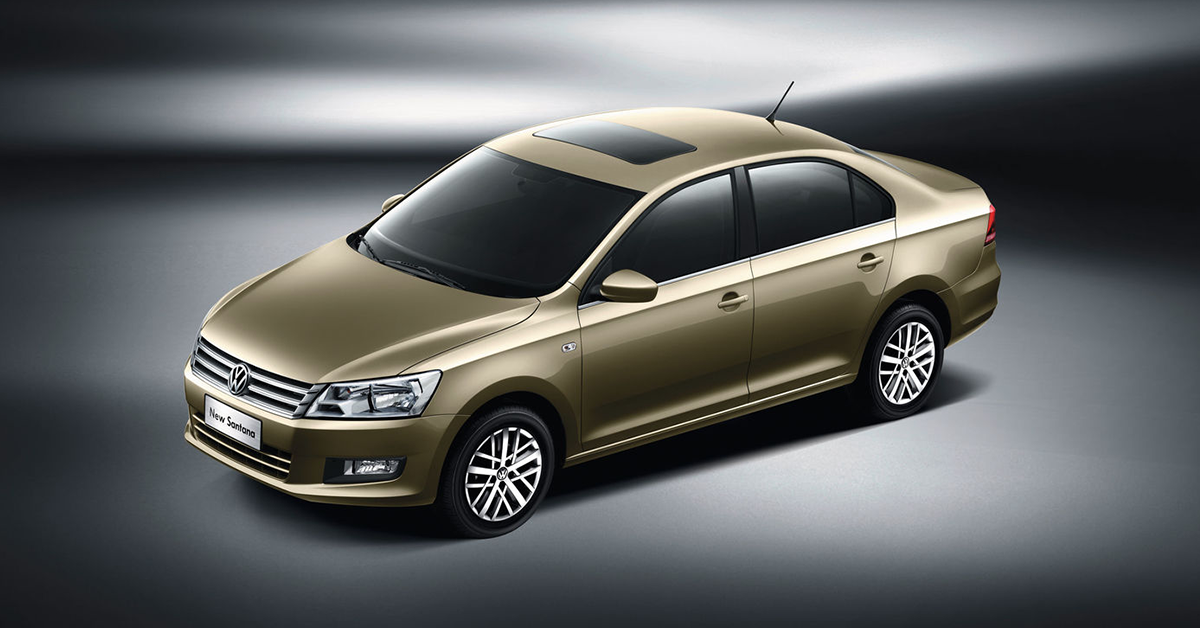
In 2012 Volkswagen replaced the old Chinese car with a completely new Santana. The press release from Wolfsburg on 30 October 2012 says that, with nearly four million units sold, the Santana was one of the most successful models in China and that the notchback saloon maintained a greater presence on Chinese roads than any other car. It also says the world debut took place the evening before at the Volkswagen plant in Wolfsburg, the development site for the first Santana, in the presence of the then chairman of the board, Martin Winterkorn. The new car was to be produced in China by Shanghai Volkswagen Automotive.
| World premiere | 29 October 2012, Wolfsburg (press release 30 October) |
| Sold before premiere | Nearly four million (Volkswagen) |
| Public roll-out | Guangzhou motor show, November 2012 (reported) |
| Production start | December 2012 (reported) |
| Platform | Polo-based, transverse engine (reported) |
| Boot | 480 litres (reported) |
| Gran Santana hatchback | From June 2015 (reported) |
| Cross Santana | A year later (reported) |
| Chinese production ended | 2022 (reported) |
| Renamed simply Santana | 2013 (Volkswagen) |
The choice of Wolfsburg for the premiere was unusual. A trade report says the world debut took place at the main Volkswagen plant apparently because it was the development site of the first-generation Santana, and a car-trade site says the car was publicly rolled out at the Guangzhou motor show in November 2012. Volkswagen’s Group chronicle carries a photograph from the event, showing several Santana models at the premiere with a white New Santana in the foreground and screens reading “New Santana World Premiere”.
Technically the new car was a different animal. A reference source says it was based on the Group platform shared with the Polo, with a transverse engine, and a Shanghai magazine says it was built on a stretched version of the Polo platform and was over 20 centimetres shorter than the Santana Vista. A car-news site says that complying with China’s demand for maximum interior space, the new Santana offered significantly more rear-seat legroom and a larger 480-litre boot. A reference source says production of the New Santana started in December 2012.
The range grew. A reference source says a hatchback variant, the Gran Santana, was sold after a facelift from June 2015, and that the Cross Santana was launched a year later. A market report says the late-model lineup in China included the fourth-generation sedan and the Gran Santana hatchback, plus a fifth-generation Jetta-based model introduced in 2012. The generation counts differ between sources, because some count the Chinese versions separately from the German original, so they are shown as reported. Volkswagen’s own history page says the Chinese generation was renamed simply Santana in 2013.
The new car did not repeat the old one’s success. A German-language classic-car report says the new Santana stayed unlucky as a replacement for the car that had put the Chinese behind the wheel, and a market report says that by 2021 the ageing model was clearly losing ground. The Chinese market was changing, and buyers were moving toward SUVs and electric cars. A reference source gives Chinese production as running to 2022, so the name outlived the original generation by about a decade.
This part of the story shows how a nameplate can survive its own car. By 2012 the Santana name meant something to Chinese buyers that no spec sheet could capture: reliability, simplicity and a familiar shape on every street. Volkswagen kept it for a cheaper, more modern car and sold that for another decade. The table lists the main facts of the New Santana.

Official press image of the SAIC-Volkswagen Santana (China). | © Volkswagen AG
The end of the Santana came in stages. The old Passat-based car was discontinued in China in 2012, and a reference source says production actually stopped on 16 January 2013. A retrospective from the time says almost four million Santanas had been built by Shanghai Volkswagen, and a car-trade report from November 2012 called it one of the longest automotive production runs in history, ending after more than three decades. A reference source says the classic Santana Vista taxi lasted until October 2018, and Chinese production of the New Santana and the Gran Santana continued until 2022.
| Old Santana discontinued | 2012 decision, last built 16 January 2013 (reported) |
| Vista taxi phased out | October 2018 (reported) |
| End announced | November 2021 (reported) |
| Plant | Yizheng, capacity 224,400 a year (reported) |
| Reason (Volkswagen quote) | Shift away from notchback internal-combustion models |
| Chinese production ended | 2022 (reported) |
| Chinese total (trade report) | Over 6 million since 1985 (reported) |
| Total by 2012 (retrospective) | Almost 4 million (reported) |
| Named replacements | T-Cross, Polo, Lamando (reported) |
| First mass-produced modern car in China | Santana (reported) |
The final end was announced in November 2021. A trade report says Volkswagen would stop building its Chinese-made Santana sedan after more than three decades at the Yizheng plant run by the joint venture with SAIC Motor, which has a capacity of 224,400 vehicles a year. The report says the reason was that Chinese buyers were shifting toward SUVs and battery-electric models, and quotes Volkswagen as saying that customer preferences were gradually shifting away from notchback internal-combustion models. Volkswagen did not say whether production would continue elsewhere.
The totals are large but vary by source. The trade report says that over 6 million had been built since 1985 across five generations, which is a count of the Chinese Santana family only. A reference source gives 3,213,710 up to May 2009, a retrospective gives almost four million by 2012, and a Russian-language news site also says more than 6 million Santanas had been produced in total. These figures count different things, so none of them should be read as the production total for the European original or for all markets together.
The replacements show how the market moved. The trade report names the T-Cross SUV, the Polo hatchback and the Lamando, a Jetta-based sedan, as models due before 2023, and says new joint ventures with FAW Group and JAC were expected to bring new all-electric models. A data site lists the Lavida XR as a successor, and a trade report published before 2012 said the company was well prepared to replace the Santana with the Lavida. The Santana’s job as the entry-level family saloon passed to newer cars.
The Santana’s legacy is in the numbers and in the factory. A reference source says Shanghai Volkswagen began automobile production in 1985, and Volkswagen’s chronicle says the venture became China’s largest and most modern car plant. A car magazine says the Santana was the first mass-produced modern passenger car built in China. For a car that began as a Passat with a different boot and a different grille, that is a remarkable record, and it is why the name appears alongside much more glamorous cars in a brand series like this one.
For readers, the practical advice is to treat the Santana as a family of cars rather than a single model. The European Santana of 1981 to 1984, the Passat notchback that followed, the Chinese Santana, Santana 2000, Santana 3000 and Vista, the Latin American Corsar and Carat and the post-2012 New Santana all have different specifications and different histories. The Passat guide covers the car the Santana came from, and the models list places it among the other Volkswagen families. The table summarises the end of the line.