 Brands
Volkswagen Phaeton — History, W12, V10 TDI and Specs

Official press image of the Volkswagen Phaeton. | © Volkswagen AG
The Volkswagen Phaeton is the hand-built luxury saloon that Volkswagen launched in 2002 and made at the Transparent Factory in Dresden until 18 March 2016, with 84,235 cars built. Here is the full Phaeton story, from the Concept D to the W12 and V10 TDI, the facelifts, the American exit and the Phaeton D2 that never reached production.

Official press image of the Volkswagen Phaeton (2002). | © Volkswagen AG
The Volkswagen Phaeton is a full-size luxury saloon that Volkswagen built by hand in Dresden from December 2001 to March 2016. Volkswagen’s own history page gives it the factory code 3D and describes it as a premium saloon in the highest passenger car class that “sets new standards in technology and comfort” with more than 100 patents. It was the most ambitious car Volkswagen ever built, a flagship meant to compete with the best from Mercedes-Benz, BMW and Audi, and it is still the car that people point to when they ask whether a mass-market brand can sell a luxury saloon.
| Factory code | 3D (Volkswagen) |
| Concept D | 1999 |
| Production started | December 2001, Dresden |
| World premiere | 6 March 2002, Geneva (Volkswagen) |
| Platform | D1, shared with Bentley Continental GT (reported) |
| Updates | 2007, 2008, 2010, 2013 (Volkswagen) |
| Production ended | 18 March 2016 (Volkswagen) |
| Total built | 84,235 including pre-series (Volkswagen) |
| North America sales ended | 2006 (reported) |
| Successor | Phaeton D2 concept, never built |
The project was launched by Ferdinand Piëch, then chairman of the Volkswagen board, at the end of the 1990s. Volkswagen’s 20-year anniversary press release says he wanted to open up a new market segment for Volkswagen with a luxury saloon, and quotes his words at the start of production in Dresden in December 2001, that the flagship vehicle in the luxury car segment would be manufactured there. A reference source adds that Piëch wanted Volkswagen engineers to build a car that would surpass the German prestige market leaders, and a classic-car article says he saw the car as a weapon for the large markets of South East Asia and the Americas, with Germany less important.
The Phaeton had a clear forerunner. Volkswagen’s history page says it began as a luxury-class design study, the Concept D, in 1999, and that the series car was completed less than three years later. A reference source says the Concept D was shown at the 1999 Frankfurt motor show as a hatchback prototype with a very similar design, a V10 TDI engine, air suspension and all-wheel drive. The production saloon had its world premiere at the Geneva Motor Show on 6 March 2002, according to Volkswagen, and it went on sale that year. The name comes from the phaeton, a type of horse-drawn carriage and a car body style, a reference source says, and from the Greek myth of Phaethon.
Volkswagen shared the underlying engineering with other brands. Reference sources say the Phaeton used a Volkswagen Group platform called D1, shared with the Bentley Continental GT and the Bentley Flying Spur, and that it was built of steel rather than the aluminium used by the Audi A8. That shared platform helps explain why the Phaeton felt closer to a cut-price Bentley than to a Passat, as a UK classic-car article puts it. Volkswagen built the car at a purpose-made glass factory in Dresden, the Transparent Factory, which is covered in the design section.
Over its life the range ran from the six-cylinder 3.0-litre TDI with 165 kilowatts, or 224 PS, to the V10 TDI with 230 kilowatts, or 313 PS, and the W12 petrol engine with 331 kilowatts, or 450 PS, according to Volkswagen’s chronology. The car was updated in 2007, 2008, 2010 and 2013, and production ended on 18 March 2016 after 84,235 cars, including pre-series cars, were built in Dresden. A reference source says sales in North America ended in 2006. The Phaeton never reached the sales volumes Piëch hoped for, but it remains a remarkable piece of engineering.
This guide covers the Phaeton in eight parts: the design, platform and factory, the engines, the W12 and V10 TDI, the interior and technology, the updates, the American and export markets, and the end of production with the Phaeton D2 concept that never reached the showroom. Where sources disagree, both figures are shown and marked as reported. For the other large Volkswagen saloons, see our guides to the Volkswagen Passat and the Arteon. The table lists the key dates.

Official press image of the Transparent Factory, Dresden. | © Volkswagen AG
The Phaeton’s styling was deliberately restrained. Volkswagen’s history page names Hartmut Warkuß as chief designer and describes the design as a prime example of an elegant, unobtrusive design language with maximum longevity, which is a polite way of saying that it was meant not to shout. The body was at least 5.05 metres long. Volkswagen’s vehicle data gives the length as 5,055 to 5,175 millimetres, the width as 1,903 millimetres, the height as 1,450 millimetres and the wheelbase as 2,881 to 3,001 millimetres, with the two figures in each pair covering the standard and long-wheelbase cars.
| Chief designer | Hartmut Warkuß (Volkswagen) |
| Length | 5,055 to 5,175 mm |
| Width | 1,903 mm |
| Height | 1,450 mm |
| Wheelbase | 2,881 to 3,001 mm |
| Long-wheelbase extension | 120 mm (Volkswagen) |
| Boot | 500 litres (reported) |
| Bonnet, doors, boot lid | Aluminium (Volkswagen) |
| Platform | D1, steel (reported) |
| Planned capacity | 20,000 cars a year (reported) |
The long-wheelbase version was aimed at chauffeur-driven customers. Volkswagen’s 2010 press material says the extended wheelbase is 120 millimetres longer and gives an interior length of 1,995 millimetres for that version, and a data site gives a boot capacity of 500 litres, a figure that should be treated as reported. The 2022 anniversary release says the bonnet, doors and boot lid were made of aluminium, which helped keep weight down on a car that, according to a data site, weighed between about 2,250 and 2,430 kilograms depending on specification.
The platform was shared across the group. Reference sources say the Phaeton used the D1 platform, which it shared with the Bentley Continental GT and the Bentley Flying Spur, and that it differed from the Audi A8 by using steel rather than aluminium. A UK classic-car article says Volkswagen had a head start on the Bentley models because of this, since the company knew it would be producing the new Bentleys after the Rolls-Royce brand passed to BMW. A reference source adds that the Dresden plant also assembled the Bentley Flying Spur for the European market until October 2006, when assembly of the Bentleys moved to Crewe.
The factory was part of the product. Volkswagen’s newsroom says the name “Transparent Factory” stands for an entirely new production concept created in Dresden especially for the Phaeton, with the goal of a world-leading level of quality. Volkswagen’s anniversary release says the car was assembled almost completely by hand in light-flooded halls, with workers in white clothing and many wearing gloves, and floors of Canadian maple and German moor oak. A reference source credits the architect Gunter Henn and says the planned capacity was 20,000 cars a year.
The logistics were unusual. According to Volkswagen, two zero-emission logistics trains, called CarGoTrams, ran on the city’s public tram network between a freight centre outside Dresden and the factory. The 60-metre trains took 18 minutes for the trip and delivered prefabricated components to the factory just in time, in sequence, immediately before assembly. Volkswagen’s example is the marriage of the chassis, drivetrain and body, which was carried out as a distinct step. The system helped keep trucks out of the city centre and gave the plant its showpiece character.
After the Phaeton the building was reused. A reference source says all vehicle production at the factory ended in March 2016, that the e-Golf was assembled there from April 2017 and that the ID.3 has been produced there since 2021. The glass factory is therefore one of the longest-lasting parts of the Phaeton project. The table summarises the design and body figures.

Official press image of the Volkswagen Phaeton V6 TDI 3.0. | © Volkswagen AG
The Phaeton came with one of the widest engine ranges in the luxury class. Volkswagen’s chronology says the range spanning the car’s fourteen years of production extended from the six-cylinder 3.0-litre TDI with 165 kilowatts, or 224 PS, to the V10 TDI with 230 kilowatts, or 313 PS, and the twelve-cylinder W12 petrol engine with 331 kilowatts, or 450 PS. The two flagship engines, the V10 TDI and the W12, are covered in the next section. This section covers the more common V6 and V8 engines that most buyers chose.
| 3.2 V6 petrol | 177 kW (241 PS), front-wheel drive (Volkswagen) |
| 3.6 V6 petrol | About 280 PS (reported), replaced the 3.2 |
| 4.2 V8 petrol | 246 kW (335 PS), from 2003 (Volkswagen) |
| 3.0 V6 TDI (launch) | 165 kW (224 PS) |
| 3.0 V6 TDI (2008) | 176 kW, Euro 5 (Volkswagen) |
| 3.0 V6 TDI (2013) | 180 kW (245 PS), most popular variant |
| 3.0 TDI torque (2010) | 500 Nm, 1,500 to 3,000 rpm (reported) |
| Drive | 4MOTION all-wheel drive, except 3.2 V6 |
| Engine plant (reported) | Győr, Hungary, except W12 |
| 0–100 km/h range | 6.1 to 8.9 s (reported) |
The entry-level car was the 3.2-litre V6. Volkswagen’s anniversary release says early customers could choose between two naturally aspirated petrol engines and a TDI, and that the entry-level engine was the compact 3.2-litre V6 with 177 kilowatts, or 241 PS, whose cylinder banks sit at a 15-degree angle. Volkswagen’s vehicle data says front-wheel drive was fitted to the 3.2 V6 only, so every other engine came with the 4MOTION permanent all-wheel-drive system. The 3.2 V6 was later replaced by a 3.6-litre engine and a 3.0-litre version, Volkswagen says, and a data site gives 280 PS for the 3.6.
The 4.2-litre V8 arrived in 2003, according to Volkswagen. Image captions in the newsroom give its output as 246 kilowatts, or 335 PS, in the long-wheelbase car, and a reference source gives the same 335 PS at 6,500 rpm. A data site gives the later V8 as 250 kilowatts, which is the same 335 PS expressed with a slightly different measurement. The V8 was offered with the long wheelbase and with the standard body, and Volkswagen’s 2010 press material says that by then the range consisted of four engines, one turbodiesel and three petrol, a V6, a V8 and the W12.
The most popular engine was the diesel. Volkswagen’s anniversary release says the 3.0-litre V6 TDI arrived in 2004 and, in its final form with 180 kilowatts, or 245 PS, was the most popular variant. The history page records the stages: a 224 PS version at launch, a new 3.0 TDI with 176 kilowatts and Euro 5 compliance in 2008, a 2010 revision that made the engine 0.5 litres more economical, and a final increase to 180 kilowatts in the 2013 update. A data site lists the 2010 car at 240 PS with 500 newton metres of torque between 1,500 and 3,000 rpm, which shows how the outputs differ slightly between sources.
Where the engines were built differs too. A reference source says that most Phaeton engines, with the W12 as the notable exception, were built at the Volkswagen, Audi and Porsche engine plant in Győr, Hungary. The same source lists the 3.2 and 3.6 VR6 petrol engines, the 4.2 V8 and the 6.0 W12 as the petrol range, and the 3.0 V6 TDI and 5.0 V10 TDI as the diesels. Performance covered a wide range, with a data site giving 0 to 100 km/h times from 6.1 to 8.9 seconds across the 2010 range, which should be read as reported rather than official.
For buyers, the engine decision comes down to use. The V6 TDI suits long-distance drivers who want economy, the V8 is the smooth petrol option and the twelve-cylinder is the car for collectors. Volkswagen’s own pages are careful to state the output of each engine in kilowatts and PS, so used buyers should check the registration document, because the Phaeton was sold with several slightly different tunes of the same engine over fourteen years. The table lists the main engines.
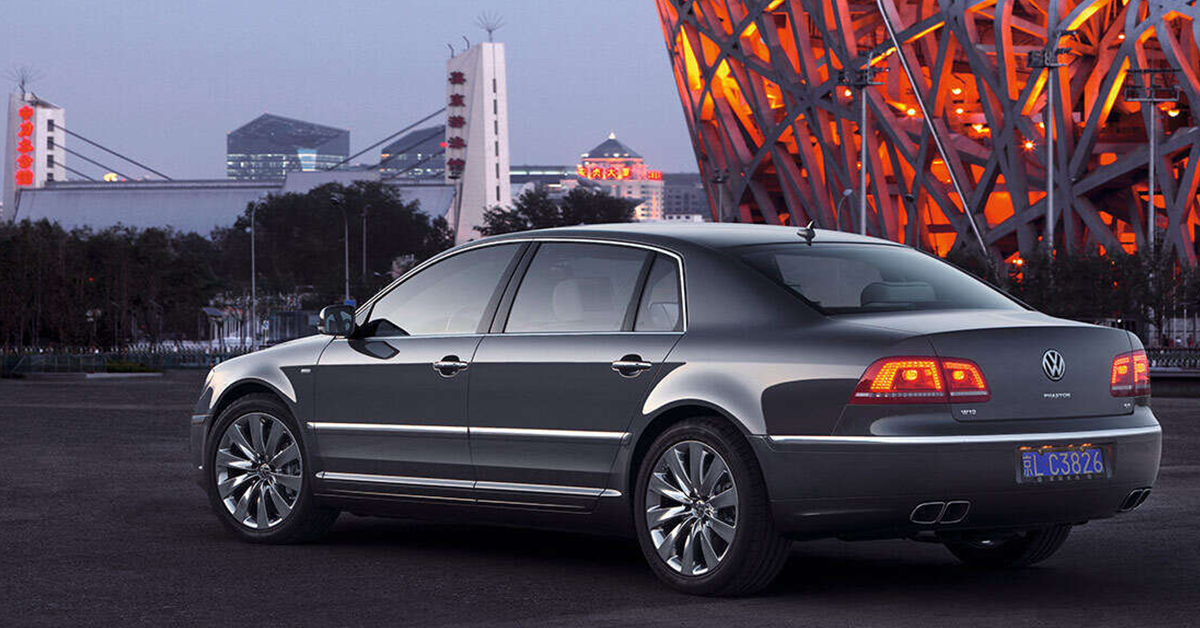
Official press image of the Volkswagen Phaeton W12. | © Volkswagen AG
Two engines made the Phaeton famous, and neither was ordinary. Volkswagen’s anniversary release describes the W12 as a 6.0-litre petrol engine that was unusually short because it was built in the form of a “W” using two V6 engines. It developed 309 kilowatts, or 420 PS, from six litres at launch, and Volkswagen’s later newsroom captions give the Phaeton W12 as 331 kilowatts, or 450 PS, so the figure rose during the car’s life. A reference source adds that the W12 was one of the platform-sharing links with the Bentley Flying Spur.
| W12 capacity | 6.0 litres, two V6 banks in a W layout |
| W12 output (launch) | 309 kW (420 PS) (Volkswagen) |
| W12 output (later) | 331 kW (450 PS) (Volkswagen) |
| W12 torque | 560 Nm, 2,750 to 5,200 rpm (reported) |
| W12 0–100 km/h | 6.1 s, 250 km/h limited (reported) |
| W12 discontinued | 2011 (Volkswagen) |
| V10 TDI capacity | 5.0 litres, two VTG turbochargers |
| V10 TDI output | 230 kW (313 PS), 750 Nm (Volkswagen) |
| V10 TDI discontinued | 2006 (Volkswagen) |
| Ceramic brakes (W12) | Introduced in 2008 (Volkswagen) |
The W12 was fitted with 4MOTION all-wheel drive and an automatic gearbox, Volkswagen says. A reference source gives the later 450 PS car 560 newton metres of torque between 2,750 and 5,200 rpm, a 0 to 100 km/h time of 6.1 seconds and a limited top speed of 250 km/h. Volkswagen’s history page says that in 2008 high-performance ceramic brakes were introduced for the W12, a sign that the company took the engine’s performance seriously. The W12 was discontinued in 2011, five years after the V10 TDI, according to Volkswagen.
The V10 TDI was even more unusual. Volkswagen’s release says the 5.0-litre diesel had two turbochargers with variable turbine geometry and produced 230 kilowatts, or 313 PS, and 750 newton metres of torque, and that these figures made the Phaeton the most powerful diesel saloon in the world at the time. A reference source gives the capacity as 4,921 cc and says the V10 TDI was the first use of a V10 engine in a production saloon. The same source says the 1999 Concept D already used a V10 TDI, so the engine was part of the Phaeton idea from the start.
Both engines were offered in the standard and long-wheelbase bodies with 4MOTION all-wheel drive. The newsroom image library shows Phaeton press photographs captioned “V10 TDI” from 2003, and a long-wheelbase Phaeton with Volkswagen Exclusive equipment and the W12 engine with 331 kilowatts, or 450 PS, from 2010. Volkswagen’s anniversary release says the V10 TDI was discontinued in 2006, which means it was offered for only about four years, and it explains why the engine is now one of the rarest and most discussed Phaeton variants.
The reasons the engines were short-lived are not stated by Volkswagen, but the broader story is visible in the sales data. A reference source says the plant’s production fell to 10,190 cars in 2012 and 5,812 in 2013, which suggests that the expensive twelve-cylinder cars were always a small fraction of the total. A US news site says the Phaeton cost nearly 100,000 dollars new in America and could exceed 120,000 dollars with the W12, a price at which the Phaeton competed with some of its own relatives at Bentley and Audi.
For enthusiasts, the W12 and V10 TDI Phaeton are the cars that make the model interesting. They combine a luxury saloon body with engines that Volkswagen used almost nowhere else, and the W12 in particular is linked to the Bentley family. Because of their complexity, buyers should check service history carefully and budget for running costs that match a luxury car rather than a Volkswagen. The table lists the main figures for the two engines.
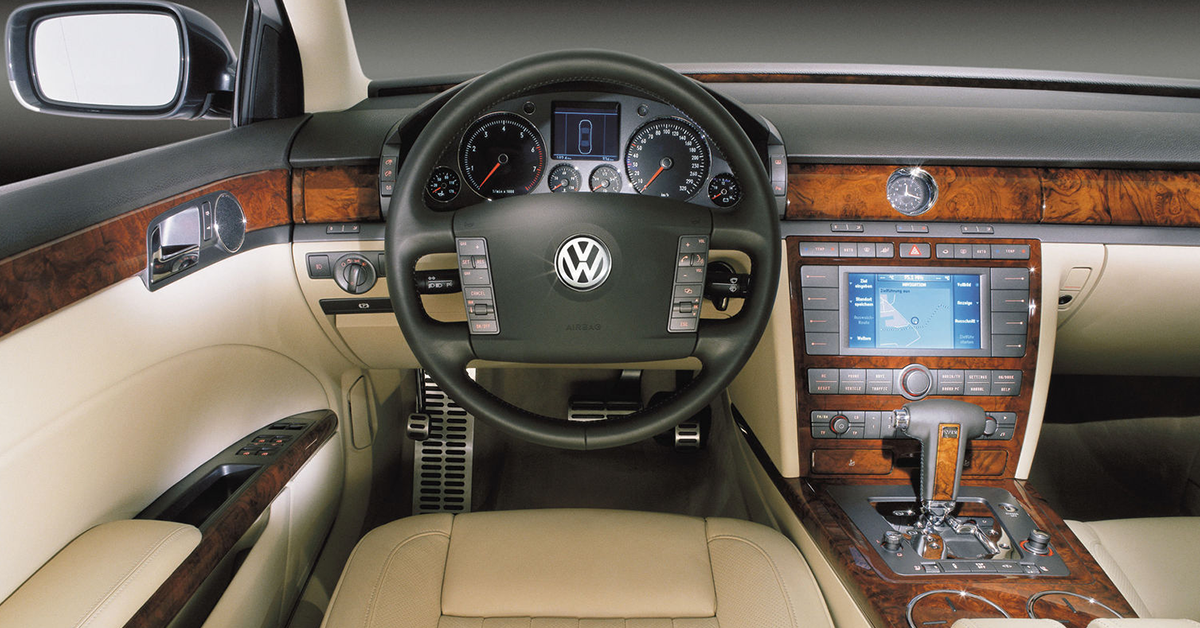
Official press image of the Volkswagen Phaeton interior. | © Volkswagen AG
The Phaeton’s equipment list was one of the most complete in the luxury class. Volkswagen’s history page says it came as standard with a newly developed networked infotainment system, air suspension and a draught-free four-zone air conditioning system, and offered optional 18-way seats that it describes as having the seating comfort of a first-class lounge. The anniversary release adds that the standard pneumatic suspension had adaptive damping, which allowed the car to glide smoothly over poor surfaces. These features were all available on the car from the start of production in 2002.
| Suspension | Standard air suspension with adaptive damping |
| Climate control | Draught-free four-zone system, standard |
| Seats | Optional 18-way seats |
| Seating layouts | Five seats, or optional four seats (Volkswagen) |
| Trim | Up to 30 layers of wood veneer, chrome, leather |
| Optional audio | Dynaudio sound system |
| Radar cruise control | First in a Volkswagen (reported) |
| Front Assist and Side Assist | 2007 update (Volkswagen) |
| RNS 810 with 30 GB drive | 2008 and 2010 (Volkswagen) |
| WiFi hotspot | Optional, 2013 update (Volkswagen) |
The climate system was a particular point of pride. Volkswagen’s 2010 press material says the four-zone system is absolutely draught-free because the large air outlets discharge conditioned air at low speed, with indirect ventilation keeping the interior temperature constant. A German magazine says the system was a personal passion of Ferdinand Piëch, who admired the air conditioning of American luxury cars in the 1970s, though that is tradition rather than documented fact. The 2010 press material also says the 18-way seats had won awards for their ergonomics and offered the car in a basic five-seat layout or an optional four-seat version.
Materials were upmarket. The anniversary release lists chrome, leather and up to 30 layers of wood veneer, an optional Dynaudio sound system, and massage and ventilated seats. It also says self-luminous number plates using electroluminescence technology were offered for a few years. The 2010 press material says customising services from Volkswagen R GmbH were available for the interior, and a long-wheelbase chauffeur version had 1,995 millimetres of interior length, which gives rear passengers a great deal of space.
Assistance technology arrived early. A reference source says the Phaeton was the first Volkswagen with radar adaptive cruise control, the automatic distance regulator, called ADR. Volkswagen’s history page says that with the 2007 update an optional Front Assist system with adaptive cruise control up to 200 km/h and follow-stop function became available, together with Side Assist. The 2008 update brought the RNS 810 infotainment system with an optional rear-view camera, and the 2010 update added electronic traffic sign recognition and, according to Volkswagen’s press material, dynamic main beam control.
Connectivity was also ahead of its time. Volkswagen’s 2010 press material says the new Phaeton offered, for the first time, an Internet-based Google function as a supplement to the map display of the RNS 810 radio-navigation system with a 30-gigabyte hard drive. The 2013 update added a removable rear climate panel and an optional WiFi hotspot, according to the history page. Many of these features are now commonplace, but in a Volkswagen of the 2000s they showed how seriously the company took the brief of building the best car it could.
The Phaeton’s technology had a long reach. Volkswagen says a curved display planned for the Phaeton successor, the D2, later appeared in the Innovision Cockpit of the 2018 Touareg, so some of the ideas developed for the Phaeton survived in later models. The table lists the main equipment items and the model year in which Volkswagen says they arrived.

Official press image of the Volkswagen Phaeton (2010). | © Volkswagen AG
Volkswagen refreshed the Phaeton several times. Volkswagen’s history page lists the updates by year: 2007, 2008, 2010 and 2013, while the anniversary release says four model updates came between 2007 and 2014 with a major facelift in 2010. The one-year difference may reflect the model-year dating of the last update, so this guide uses the history page’s 2013 date and notes the other as reported. The pace of change shows that Volkswagen kept investing in the car even as sales fell.
| 2007 (GP1) | Front Assist, Side Assist, new lights, revised navigation |
| 2008 (GP2) | RNS 810, 3.0 TDI 176 kW Euro 5, ceramic brakes for W12 |
| 2010 (GP3) | Most extensive facelift, new front and rear |
| 2010 diesel | 3.0 TDI 0.5 litres more economical |
| 2010 reveal (reported) | Beijing motor show |
| 2013 (GP4) | New front, interior changes, WiFi hotspot |
| 2013 diesel | 3.0 TDI 180 kW (245 PS) |
| V10 TDI withdrawn | 2006 |
| W12 withdrawn | 2011 |
| Number of updates | Four, 2007 to 2013 or 2014 (Volkswagen) |
The 2007 update, which the history page labels GP1, brought optional Front Assist with adaptive cruise control up to 200 km/h and follow-stop, optional Side Assist, redesigned headlights and rear lights and chrome inserts in the bumpers. It also introduced a revised navigation system. These were changes that a customer could see and use, and they kept the car competitive with the S-Class and the 7 Series on technology without altering the shape of the body.
The 2008 update, labelled GP2, brought the RNS 810 infotainment system with an optional rear-view camera, a new 3.0 TDI with 176 kilowatts that met the Euro 5 emissions standard, and the high-performance ceramic brakes for the W12. The Phaeton was therefore keeping pace with emissions rules at a time when diesels were under pressure. In the same period, the V10 TDI had already been withdrawn, in 2006, and the W12 would follow in 2011, so the range was gradually becoming simpler.
The 2010 update, GP3, was the most extensive in the car’s history, according to Volkswagen, with new front and rear styling, a 3.0 TDI that was 0.5 litres more economical, and electronic traffic sign recognition. Volkswagen’s press material says the new Phaeton had fundamentally new front-end styling, and its anniversary release says the 2010 facelift was especially popular among customers in China. A reference source says the facelifted car was unveiled at the 2010 Beijing motor show, and a car-history wiki credits the new front to the brand design chief Klaus Bischoff and says it took on the corporate look of the Scirocco.
The final update, in 2013 according to the history page and labelled GP4, brought a new front design with a chrome strip and new interior features including a new steering wheel, gear selector, lighting and leather seats, with a removable rear climate panel and an optional WiFi hotspot. The 3.0 TDI was raised to 180 kilowatts, or 245 PS. A data site lists a 3.0 V6 FSI petrol engine of 250 PS from 2013 to 2016, though that figure is not confirmed by Volkswagen’s own pages.
Taken together, the four updates show a car that Volkswagen was prepared to keep developing for fourteen years. For buyers of used cars, the facelifts matter: later cars have newer infotainment, better assistance systems and more efficient diesels, while earlier cars are cheaper and, in V10 TDI and W12 form, rarer. The table lists the main updates by year.

Official press image of the Volkswagen Phaeton V10 TDI. | © Volkswagen AG
The Phaeton was marketed worldwide, but its sales were always modest. A reference source says it was introduced at the 2002 Geneva Motor Show, that sales in North America ended in 2006 and that global sales ended in 2016. A classic-car article says Piëch regarded South East Asia, North and South America as the big markets for the car, with Germany less important, and that the planned annual volume of 20,000 vehicles was realistic in his view. Reality fell well short of that, as the production figures show.
| Planned capacity | 20,000 cars a year (reported) |
| Four-year total to 2006 | About 25,000 (reported) |
| US sales period | 2004 to 2006 (reported) |
| US price (reported) | Nearly 100,000 dollars, over 120,000 with W12 |
| US sales 2005 (reported) | 820 |
| Europe peak (database) | 4,526 in 2005 |
| Europe 2013 (database) | 1,793 |
| Europe 2016 (database) | 160 |
| China launch event | Sanya, June 2010 (Volkswagen) |
| Total built | 84,235 (Volkswagen) |
In the United States the Phaeton went on sale for the 2004 model year. A US news site says the car cost nearly 100,000 dollars new and could exceed 120,000 dollars with the W12 engine, and a car-history wiki says Volkswagen responded to weak initial sales with a 10,000-dollar buyer incentive and sold just 820 cars in the United States in 2005. The same wiki gives 2,204 sold in 2004, of which 265 had been completed in 2003. These are secondary figures and should be treated as reported, but they agree that the United States took only a few thousand cars in total.
Europe was the largest market. A sales database lists annual European sales of 2,261 in 2002, 3,865 in 2003, 3,745 in 2004 and a peak of 4,526 in 2005, followed by 3,443 in 2006, 3,862 in 2007 and 3,705 in 2008. The same database shows sales falling to 2,608 in 2009 and 2,159 in 2010, recovering to 2,953 in 2011, then declining to 1,793 in 2013, 1,510 in 2015 and 160 in 2016. These are database figures rather than Volkswagen’s own, but they show that the Phaeton was a car sold in the low thousands each year, not the tens of thousands that the Dresden plant was built to produce.
China became important later. Volkswagen’s 2010 launch of the facelifted car took place at an international driving presentation in Sanya, China, and Volkswagen’s anniversary release says the 2010 facelift was especially popular among customers in China. The long-wheelbase chauffeur version, with 120 millimetres more wheelbase and 1,995 millimetres of interior length, suited a market where owners are often driven. A reference source says the car was unveiled at the Beijing motor show in 2010, which fits with that focus.
Production volumes tell the same story. A reference source says the manufacturer stated the annual capacity of the Dresden plant at 20,000 in 2002, but that by September 2006 a four-year total of 25,000 cars had been built, with production running at about 6,000 cars a year. It also says production fell to 10,190 cars in 2012 and 5,812 in 2013, which does not match the European sales figures above, so one of the two sources is likely to include exports or be in error. Volkswagen’s own total is 84,235 cars, including pre-series cars.
For buyers outside Europe, the Phaeton’s limited distribution matters. North American cars were only sold for a few model years, while European cars were available until 2016, and equipment, engine and emissions specifications varied by market. The table summarises the main markets and the figures that are reported rather than official.
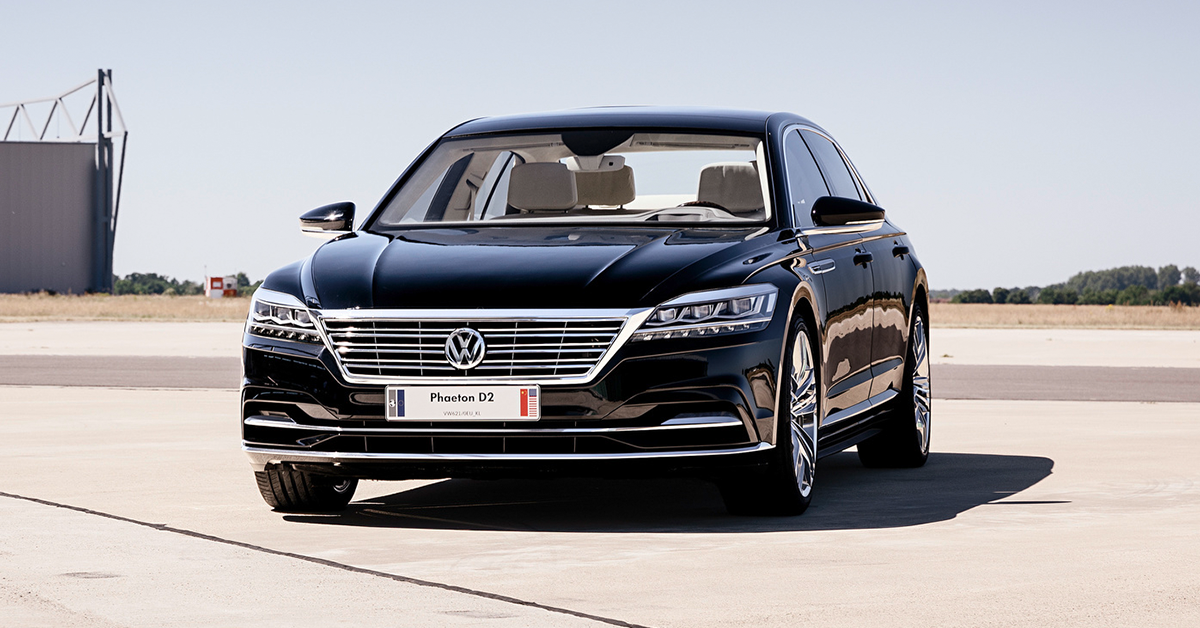
Official press image of the Volkswagen Phaeton D2 concept. | © Volkswagen AG
Volkswagen’s history page says that production of the Phaeton ended on 18 March 2016, after 84,235 cars, including pre-series cars, had been built in Dresden. Other sources give slightly different totals, with a reference source quoting 84,325 and 84,253 in different places and another giving just under 85,000. Volkswagen’s anniversary release does not state a total, so the chronology figure is the one this guide uses. The Phaeton was therefore built for about fourteen years, and a reference source says the plant produced its last car almost anonymously.
| Production ended | 18 March 2016 (Volkswagen) |
| Total built (Volkswagen) | 84,235 including pre-series |
| Total (reference) | 84,325 or 84,253 |
| Reason (Volkswagen) | Board decision in 2016 to refocus on electric mobility |
| Successor | Phaeton D2, one-off concept, not approved |
| D2 designers | Marco Pavone (exterior), Tomasz Bachorski (interior) |
| D2 prototype platform | MLB (Volkswagen) |
| D2 curved display | Appeared in the 2018 Touareg |
| Plant afterwards | e-Golf from April 2017, ID.3 from 2021 (reported) |
| D2 images shown | 2022 |
Volkswagen’s explanation is that the brand’s board of management decided in 2016 to discontinue the saloon and to refocus on electric mobility. The anniversary release says the planned successor, called the Phaeton D2, never went into series production. A sales database says Volkswagen cited slow sales and changing market dynamics, which is an interpretation rather than a Volkswagen statement. The Dresden plant was left with nothing to build until the e-Golf arrived in April 2017.
The Phaeton D2 is the most interesting part of the story. Volkswagen’s anniversary release says it was a drivable one-off concept and that four concepts were considered before the design by Marco Pavone, head of exterior design, and Tomasz Bachorski, head of interior design, was selected. A near-series prototype based on the MLB platform was presented to the Supervisory Board, but it was not approved as resources shifted to electric mobility. Volkswagen showed images of the car for the first time in 2022, and the newsroom image library carries the D2 photographs.
Some of the D2’s ideas lived on. Volkswagen says the curved display planned for the D2 debuted in the Innovision Cockpit of the 2018 Touareg, and Tomasz Bachorski said the D2 was ahead of its time in features such as that display. The Phaeton also left a larger industrial legacy, because the Transparent Factory continued to produce Volkswagens, first the e-Golf and, from 2021, the ID.3. The reference source adds that the Phaeton’s D1 platform lives on in the Bentley models that shared it.
For used buyers, the Phaeton has become an unusual proposition. A UK classic-car magazine has asked whether it is an emerging classic, and enthusiasts are drawn to the rare V10 TDI and W12 versions. The practical advice is the same as for any complex luxury car: check the service history, test every electronic feature and the air suspension, and make sure the engine output matches the registration document. Prices vary widely by engine, condition and market, so check current listings rather than relying on any figure printed here. Running costs, parts availability for the air suspension and the age of the electronics are the questions to put to a seller before the engine size.
It also helps to read the Phaeton against the cars that followed it. The Passat remained Volkswagen’s large saloon, and the Arteon later took the brand’s design flagship role at a much lower price than a Phaeton W12 ever asked. Volkswagen’s own anniversary release frames the Phaeton as the key to entering the premium segment, and the production total of 84,235 cars shows that, while it did not become a volume model, it did become a lasting reference point for what the company could build when it set out to.
The Phaeton remains the car that showed how far Volkswagen could go. It was built with extraordinary care in an extraordinary factory, it introduced technology that later became normal and it never found the customers its creator hoped for. The Arteon later took on a similar role as Volkswagen’s flagship saloon, though at a very different price. The table summarises the end of production.