 Brands
Volkswagen Vento — From Mk3 Saloon to India Sedan

Official press image of the Volkswagen Vento. | © Volkswagen AG
The Volkswagen Vento is two cars under one name, the 1992 saloon that was the Jetta III in Europe and the Polo-based sedan built in India from 2010. Here is the full Vento story, with history, engines, the VR6, the Indian launch, facelifts, Mexico exports and the Virtus that replaced it.
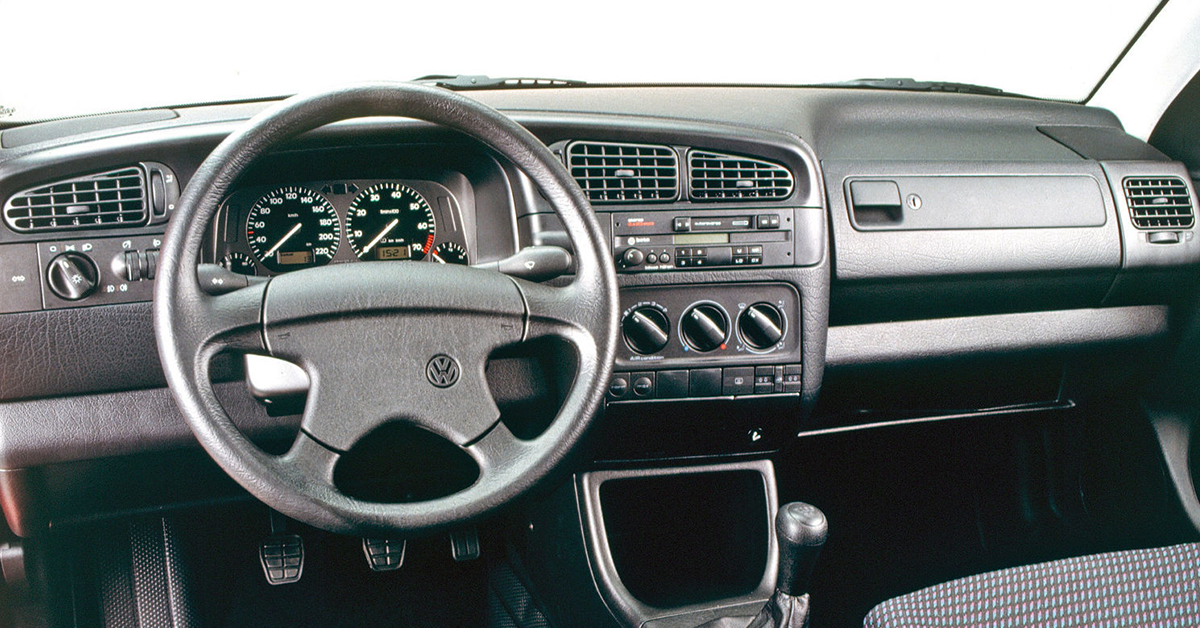
Official press image of the Volkswagen Vento (1991). | © Volkswagen AG
The Volkswagen Vento is really two different cars that share one name. The first was the European name for the third-generation Jetta, a four-door saloon that Volkswagen unveiled on 19 January 1992 as the successor to the Jetta II. Volkswagen’s own history page explains that the name means “wind” in Italian, which fits the habit of naming Volkswagen saloons after winds, as with the Passat, the Bora and the Scirocco. The car was based largely on the Golf III, it kept the notchback saloon shape of its predecessor, and in Europe it was sold as a younger and more distinctive alternative to the old Jetta.
| First Vento unveiled | 19 January 1992 (Jetta III, Europe) |
| Meaning of the name | Wind (Italian) |
| Base of the first car | Golf III, A3 platform |
| German production ended | July 1998 |
| Second Vento | Polo sedan for India and export |
| Indian production start | August 2010, Chakan near Pune |
| Indian deliveries began | 6 September 2010 |
| Indian production ended | 2022 (reported) |
| Successor in Europe | Volkswagen Bora |
| Successor in India | Volkswagen Virtus (2022) |
The second Vento arrived almost two decades later and in a very different place. In August 2010 Volkswagen began production of a new compact sedan at its Chakan plant near Pune in India, and it called the car the Vento. This was a sedan version of the Polo, and Volkswagen described it as the first Volkswagen-brand car designed for the special needs of Indian customers and manufactured exclusively in India. It was the car that opened the company’s Indian production era and, as later sections show, it also became a major export product that sold in large numbers in Mexico.
The name was not used everywhere. A reference source lists the Polo-based sedan as the Vento in India, Malaysia, Brunei and Mexico, and as the Polo Sedan in South Africa, Argentina, Russia, Jordan, Morocco, Algeria, Tunisia, the wider Middle East, Thailand and Taiwan. In the Philippines it was sold as the Polo Notch. This matters for anyone searching for used cars or parts, because the same car can appear under several names, and because the European Vento of the 1990s shares nothing mechanical with the later sedan except the badge.
Putting the two cars side by side helps explain why the Vento name is worth a guide of its own. The European car is a piece of the Golf III and Jetta story, with a famous VR6 version and a range of diesel engines. The Indian car is a piece of the story of how Volkswagen built a mass-market business outside Europe, with local production, a price that started at 6.99 lakh rupees and later facelifts that added a seven-speed DSG gearbox and a small turbo petrol engine. Both cars were notchback saloons, and both were replaced by a newer name, the Bora in Europe and the Virtus in India.
This guide follows both cars in order. The first sections cover the 1992 car, its design, its engines and the way it was sold around the world, including the markets where the same car kept the Jetta name. The later sections cover the Indian Vento from the production start in 2010, its engines and facelifts, its life in Mexico and other export markets, and the end of production in 2022. Readers who want the broader family can read the Jetta, Polo and Virtus guides, which are linked below. The table lists the key dates for both cars.

Official press image of the Volkswagen Vento (1992). | © Volkswagen AG
The first Vento was a conventional three-box saloon with a long boot and rectangular headlights. Volkswagen’s own figures give its length as 4,380 millimetres, its weight as 1,120 kilograms and its boot capacity as 550 litres, a space the company called almost unrivalled for the class. A reference source lists slightly different dimensions, with a length of 4,400 mm, a width of 1,690 mm, a height of 1,430 mm and a wheelbase of 2,470 mm, and it gives the drag coefficient as 0.32. The two lengths differ by 20 mm, so the table below shows both and says which source each comes from.
| Length (Volkswagen) | 4,380 mm |
| Length (reference source) | 4,400 mm |
| Width (reference source) | 1,690 mm |
| Height (reference source) | 1,430 mm |
| Wheelbase (reference source) | 2,470 mm |
| Boot (Volkswagen) | 550 litres |
| Weight (Volkswagen) | 1,120 kg |
| Drag coefficient (reference source) | 0.32 |
| Gearboxes | 5-speed manual, 4-speed automatic |
| Equipment lines | CL, GL, GT; Trendline, Comfortline, Highline from 1996 |
| Four-wheel drive | Never offered |
The car sat on the Volkswagen Group A3 platform and was related to the Golf Mk3, which is why the Vento is often described as a Golf with a boot. That description is fair, though Volkswagen worked to give it a character of its own. The company says the standard equipment was richer than the Golf’s, with painted bumpers, a modified dashboard and 14-inch wheels, and that the safety structure was more complex than on its predecessors. A stabiliser on the rear axle was fitted to keep the car steady when the boot was loaded and the speed was high, which was a sensible extra on a car meant to carry luggage.
The Vento was sold only as a four-door saloon. The reference source notes that the two-door model of the previous Jetta was dropped, and Volkswagen confirms that four-wheel drive was not available at any point during the production run. The transmissions were a five-speed manual or a four-speed automatic. That is a narrower choice than the Golf offered, and it reflects how Volkswagen positioned the saloon: a comfortable family car with a large boot rather than a sporting or off-road model.
Equipment came in named lines. At the start the lines were CL, later CLX, then GL, later GLX, and at the top GT. In 1996 Volkswagen reorganised them into Trendline, Comfortline and Highline, names that the company kept using on later models, including the Indian Vento. Volkswagen says the most popular version was the GL with the 90 PS petrol engine, which suggests that most buyers chose the middle of the range with a modest engine rather than the top models.
Several visual changes marked the car’s life. The VR6 was set apart by an extra rear spoiler, and from 1993 it received darkened rear lights. In September 1995 a major update gave the whole range tinted rear lights and body-coloured grilles. These details are the quickest way to date a car in a photograph or a listing, and they are useful for buyers who want to know whether a Vento is an early or a late example. German production of the Vento ended in July 1998, when the Bora took over in Europe, though a reference source says the car was built in other countries until 1999 and the next section explains where.
A short timeline pulls the updates together. In 1993 the VR6 gained darkened rear lights and the 1.9 SDI and 1.9 TDI engines arrived in June. In 1994 a 100 PS 1.6-litre petrol engine was added. In September 1995 the range received tinted rear lights and body-coloured grilles, and in March 1996 an all-aluminium 1.6-litre engine joined, with the equipment lines renamed that year. Reading a car against this list is the simplest way to place it, and it explains why two Ventos of the same year can look different at the back.
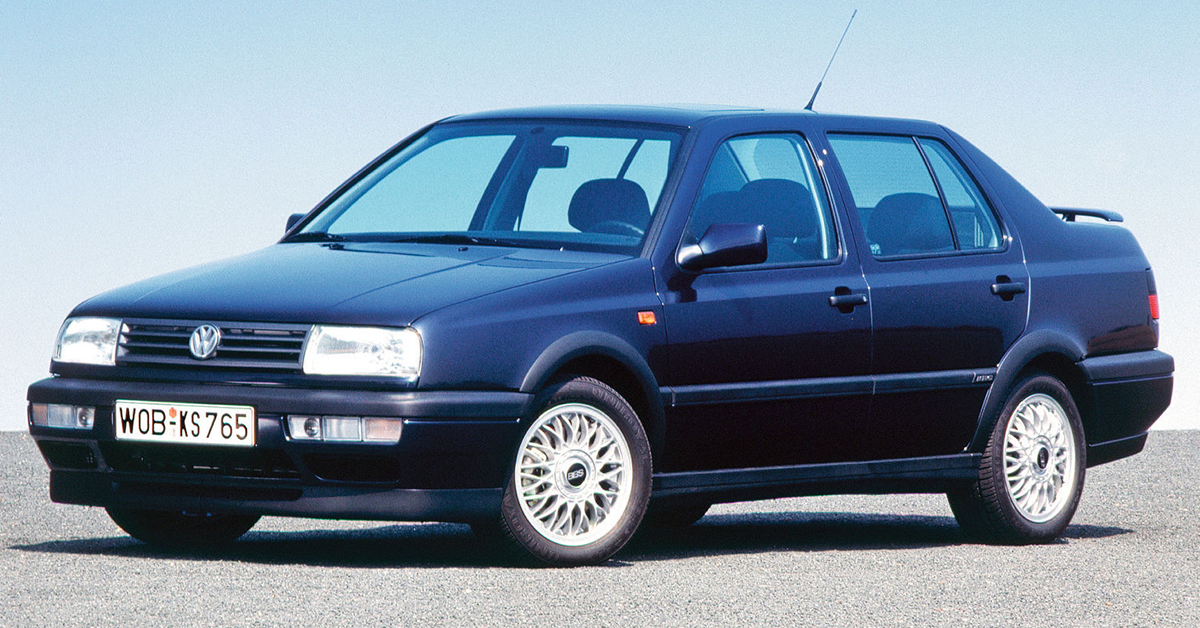
Official press image of the Volkswagen Vento VR6 (1992). | © Volkswagen AG
The Vento offered a wide range of engines, and the choice is one of the main reasons the car is still discussed today. Volkswagen lists four petrol families. The 1.6-litre came with 55 kW (75 PS) and 74 kW (100 PS), the 1.8-litre with 55 kW (75 PS) and 66 kW (90 PS), the 2.0-litre with 85 kW (115 PS), and at the top the 2.8-litre VR6 with 128 kW (174 PS). A reference source gives the same engines with slightly different PS roundings, such as 101 PS for the stronger 1.6 and 116 PS for the 2.0, and the differences come from rounding rather than from different engines.
| 1.6 petrol | 55 kW (75 PS) and 74 kW (100 PS) |
| 1.8 petrol | 55 kW (75 PS) and 66 kW (90 PS) |
| 2.0 petrol | 85 kW (115 PS) |
| 2.8 VR6 petrol | 128 kW (174 PS) |
| 1.9 diesel | 47 kW (64 PS) |
| 1.9 turbo diesel | 55 kW (75 PS) |
| 1.9 TDI | 66 kW (90 PS) |
| 1.9 TDI direct injection | 81 kW (110 PS), September 1995 per Volkswagen |
| 1994 addition | 1.6 petrol with 100 PS |
| March 1996 addition | 1.6 all-aluminium, switchable intake, 100 PS |
| Most popular version | GL with the 90 PS petrol engine |
The VR6 deserves a closer look. It is a narrow-angle six-cylinder engine that Volkswagen designed to fit in a transverse engine bay, and in the Vento it produced 174 PS. Volkswagen marked the model with an additional rear spoiler, and from 1993 it carried darkened rear lights, so the car could be recognised as the flagship. The VR6 was the closest the Vento came to a performance saloon, and in North America, where the car was sold as the Jetta, the same engine appears in the reference listing with 172 hp.
The diesels formed the other half of the range and were important in Europe. The 1.9-litre diesel was offered as a 47 kW (64 PS) unit, as a 55 kW (75 PS) turbo diesel, as a 66 kW (90 PS) engine and, later, as an 81 kW (110 PS) turbo diesel with direct injection. Volkswagen says the 1.9 SDI with 64 PS and the 1.9 TDI with 90 PS were introduced in June 1993, and that a 110 PS TDI arrived with the September 1995 update, identifiable by a red “I” in the TDI emblem. A reference source dates the 110 PS version to 1996 to 1998, so buyers should check the registration date and the engine code rather than trust a listing.
Volkswagen also kept updating the petrol range. In 1994 a 1.6-litre petrol engine with 100 PS was added, and from March 1996 a 1.6-litre all-aluminium engine with a switchable intake manifold and 100 PS joined the line-up. These changes show how the company used the Vento to introduce new engine technology through the mid-1990s, and they gave the car a better mix of power and fuel economy at the lower end of the range. The reference source lists the transmissions as a five-speed manual or a four-speed automatic across these engines.
For a buyer or a reader comparing the engines, the table summarises what Volkswagen and the reference source publish. The best-selling version was the GL with the 90 PS petrol engine, so that is the car most likely to appear in used listings. The VR6 and the 110 PS TDI are the rarer and more desirable versions, and the extra rear spoiler or the red “I” on the TDI emblem is the quickest check. The Golf guide and the Jetta guide cover the same engines in the cars they were fitted to, and they are linked below.

Official press image of the Volkswagen Vento (1991). | © Volkswagen AG
The Vento name belonged to Europe. In North America the same car kept the Jetta name, and a reference source says it debuted there in 1993 and was sold in the model years 1993 to 1999. This is the reason that the Vento and the Jetta III are often treated as one model in books and databases. A reference source lists the production dates as January 1992 to February 1999 and says that the car was built at Wolfsburg and Osnabrück in Germany, at Uitenhage in South Africa and at Puebla in Mexico, although the Osnabrück entry is flagged in that source as needing a citation. Volkswagen’s own history page confirms German production ended in July 1998.
| Europe | Sold as the Vento from the first quarter of 1992 |
| United Kingdom | On sale from September 1992 (reported) |
| North America | Sold as the Jetta, 1993 to 1999 model years (reported) |
| Plants (reported) | Wolfsburg, Osnabück, Uitenhage, Puebla |
| Production span (reported) | January 1992 to February 1999 |
| German production ended | July 1998 (Volkswagen) |
| US sales in 1993 (reported) | 43,902 cars |
| Platform | A3, shared with the Golf Mk3 |
| Successor | Volkswagen Bora |
Europe received the car first. The reference source says sales began in most of Europe in the first quarter of 1992, and that the British market followed in September 1992. The Vento was therefore on sale for more than six years in Germany, and for a few months longer in the countries that kept building it. The reference source says the car was renamed Vento in Europe to appeal to a younger market, which is why the third generation carried a different name there from the Jetta name used in North America.
North American sales show how a new generation can start badly and recover. The source reports that Volkswagen of America sold 43,902 cars in 1993, its lowest total since the 1950s, and that sales rebounded later in the decade, with the Jetta again becoming the best-selling Volkswagen in the United States. These are third-party figures, so they are marked as reported, but they show that the shared platform could deliver very different results in different markets. The Jetta guide covers the full North American story, including the later generations.
The successor was the Volkswagen Bora, which the reference source names as the replacement. The Bora kept the saloon layout and, like the Vento, took a wind name, but it was based on the Golf IV rather than the Golf III. This is the point at which the Vento name left the European range. The name did not disappear, because the second Vento was already waiting more than a decade away in India, and it carried the same notchback shape to a new market.
For readers who want to understand the two cars, the main lesson is that the first Vento was a global car sold under two names. Outside Europe it was a Jetta, inside Europe it was a Vento, and in each place it took the same A3 platform and engines from the Golf. The table below lists the production places and the names. Anyone buying a European Vento should also read the engine and equipment sections above, because the year of manufacture and the badge determine what the car has under the bonnet.
Mexico shows how long the platform lived. The reference source lists Puebla among the plants that built the third-generation car, and in 2013 the Indian Vento arrived in Mexico and replaced the Jetta Classico, as the later sections explain. The same country therefore received two very different cars that carried the Jetta or Vento name within about twenty years, one assembled locally on the A3 platform and the other shipped from India on the PQ platform. For readers tracing the family, that contrast is the quickest way to see how far the company’s small-saloon strategy moved between 1992 and 2013.

Official press image of the Volkswagen Vento (India). | © Volkswagen AG
The Indian Vento was a landmark for Volkswagen. The company started production at its new plant at Chakan near Pune in early August 2010, and a report dated 4 August 2010 said production began the previous evening. Volkswagen presented the Vento as the first Volkswagen-brand car designed for the special needs of Indian customers and exclusively manufactured in India, and described it as a complete made-in-India car. The plant used local suppliers and mainly employed people from the surrounding region.
| Production start | Early August 2010, Chakan near Pune |
| Deliveries began | 6 September 2010 |
| Plant investment | 3,800 crore rupees (about 580 million euros) |
| Target capacity | 110,000 cars a year by end 2011 |
| Launch engines | 1.6 petrol and 1.6 diesel, about 105 bhp each |
| Petrol Trendline | 6.99 lakh rupees ex-showroom Delhi |
| Petrol Highline | 8.23 lakh rupees |
| Petrol automatic | 9.21 lakh rupees |
| Diesel Trendline / Highline | 7.99 lakh / 9.23 lakh rupees |
| Anti-rust warranty | Six years |
| Position | Upper end of the mid-size sedan class |
The investment behind it was large. The same report gave the total plant investment as 3,800 crore rupees, about 580 million euros, which it called the largest investment to date by a German company in India. Volkswagen planned to reach a full annual capacity of 110,000 cars by the end of 2011, with more than 2,000 employees working after a second shift had been added about a month earlier. The Vento was described as the 18th Volkswagen Group model in India, with three models produced fully in Pune and eight assembled at Aurangabad, and the company set a goal of eight to ten percent market share within four to six years.
Sales began soon after. A launch report said bookings were open and that deliveries of the Vento saloon would start on 6 September 2010. Prices ex-showroom Delhi started at 6.99 lakh rupees for the petrol Trendline, 8.23 lakh for the petrol Highline and 9.21 lakh for the petrol automatic, with the diesel at 7.99 lakh for the Trendline and 9.23 lakh for the Highline. Both launch engines were 1.6-litre units rated at about 105 bhp, with the petrol offered with a five-speed manual or a six-speed automatic and the diesel with a five-speed manual only.
The launch equipment was generous for the segment. Reports list automatic climate control, a beige interior, 185/60 R15 tyres, a front passenger seat that could be adjusted from the rear through a lever on the seat back, a rear air-conditioning vent and reading lamp on all variants, coat hooks, front and rear centre armrests and Livon fabric upholstery with chrome inlays. Volkswagen also fitted a rough-road suspension package with increased ground clearance, and the body was partly zinc-coated with a six-year anti-rust warranty. One gap was the lack of steering-mounted audio controls on the first cars.
Volkswagen positioned the Vento at the upper end of the mid-size sedan segment and said it had the longest wheelbase in the premium mid-size class. A reference source says the wheelbase is 50 mm longer than the Polo hatchback and that the boot holds 500 litres, while the launch report notes that the fuel tank and suspension struts intrude into the boot somewhat. The same reference reports that in March 2011 the Vento sold 3,973 units, which it says was the first time the car overtook its best-known Japanese rival, and that the Škoda Rapid of November 2011 was a rebadged Vento without the 1.2 TSI engine. These figures are reported, not confirmed by Volkswagen.
The Indian Vento also sat beside the Polo hatchback. A report on the end of Polo production says the Polo had been built at Chakan since 2009, that it was Volkswagen’s first locally produced model in India and that more than 2.5 lakh units had been sold, so the Vento extended a car that already had a local supply chain. That is part of why Volkswagen could price the sedan from 6.99 lakh rupees and why the company later fitted the same 1.5 TDI diesel to the Polo and the Vento. The Polo guide covers the hatchback in detail.

Official press image of the Volkswagen 1.0 TSI engine. | © Volkswagen AG
The Indian Vento changed several times in its twelve years, and the engine and gearbox changes are the best way to tell the generations apart. The first major update was the facelift launched on 24 September 2014, with prices starting at 7.44 lakh rupees. It offered a 1.6 MPI petrol with a manual gearbox in the Trendline, Comfortline and Highline trims, a 1.2 TSI petrol with a seven-speed DSG in the Comfortline and Highline, and a 1.5 TDI diesel in both manual and DSG form. The 1.5 TDI was described as a 103 bhp engine shared with the Polo, and it was the main change in the update.
| 24 September 2014 | Facelift, from 7.44 lakh rupees; 1.6 MPI, 1.2 TSI DSG, 1.5 TDI manual and DSG |
| 1.5 TDI (2014) | About 103 bhp, shared with the Polo |
| Early September 2019 | Polo GTI-style facelift, from 8.76 lakh rupees |
| 2019 engines (reported) | 1.6 petrol 105 hp, 1.2 TSI 105 hp, 1.5 diesel 110 hp |
| Volkswagen Connect (2019) | Standard on Highline and above |
| 3 March 2020 | BS6 range: 1.0 TSI only, up to 110 PS, 175 Nm |
| Gearboxes (BS6) | 6-speed manual or 6-speed automatic |
| Trims (BS6) | Trendline, Comfortline, Highline, Highline Plus |
| BS6 manual | 8.86 to 11.99 lakh rupees |
| BS6 automatic | 12.09 to 13.29 lakh rupees |
The reported prices show how the range was structured. The 1.6 MPI manual ran from 7.44 to 8.87 lakh rupees, the 1.2 TSI DSG from 9.35 to 9.92 lakh, the 1.5 TDI manual from 8.57 to 9.90 lakh and the 1.5 TDI DSG from 10.49 to 10.94 lakh. A diesel automatic was unusual in the segment at the time, and the same report noted that a rival Korean sedan was the only other car offering one. The facelift also brought a refreshed face with restrained chrome, reprofiled headlamps, new alloy wheels, a restyled rear bumper and tail-lights, and inside the Polo’s three-spoke steering wheel and an optional two-tone dashboard.
The second facelift came in early September 2019. A report dated 4 September 2019 said Volkswagen had rolled out another round of updates for the Polo and the Vento, with prices starting at 8.76 lakh rupees, while a reference source gives the date as 3 September, so the exact day differs by source. The design borrowed from the Polo GTI, with a honeycomb-mesh grille, a new front bumper and new tail-lights, and the higher variants received gunmetal-finish alloy wheels. Engines carried over, with a 105 hp 1.6-litre petrol, a 105 hp 1.2-litre turbo petrol and a 110 hp 1.5-litre diesel.
Equipment grew too. Volkswagen Connect, a dongle-based suite with features such as trip tracking and fuel cost monitoring, became standard on the Highline and above, and all variants gained a seat-belt reminder, rear parking sensors and a speed alert system. Dual airbags and ABS remained standard. A five-year warranty applied to the diesel versions of the Polo, Ameo and Vento, which Volkswagen said cut the cost of ownership by 30 percent, a company claim that readers should treat as marketing.
The last change came with the BS6 emission rules. On 3 March 2020 Volkswagen India announced that the Vento would be offered only with a 1.0 TSI petrol engine of up to 110 PS and 175 Nm, with a six-speed manual or a six-speed automatic, and that this engine replaced the 1.2 TSI. The 1.5 TDI diesel was discontinued under the new rules, according to a reference source. Trims were Trendline, Comfortline, Highline and Highline Plus, with prices from 8.86 to 11.99 lakh rupees for the manual and 12.09 to 13.29 lakh rupees for the automatic. The table gives the stages in order.
The 2019 facelift also reached Mexico. The reference source says the facelifted Polo and Vento were released in India on 3 September 2019 and arrived in Mexico during 2020, and a Mexican report on the 2020 car says the mechanical offer was unchanged, with the 1.6-litre engine of 105 hp and no changes to the interior or safety equipment. That means a Mexican Vento of this period and an Indian Vento of the same period can differ in engine and trim even though they look the same, which matters for anyone comparing specifications across markets.

Official press image of the Volkswagen plant in Puebla, Mexico. | © Volkswagen AG
The Vento became Volkswagen India’s most important export. A reference source says the car went on sale in Mexico in late 2013 as a 2014 model and that it was built by Volkswagen India, and an August 2015 report adds that exports to Mexico started less than two years before and that the Vento replaced the Jetta Classico there. The Polo followed as an export from late 2014. The Vento “climbed the sales charts in Mexico rapidly”, and in the first half of 2015 it was among the three best-selling cars in the country and Volkswagen’s best-selling model there.
| Mexican sales start (reported) | Late 2013, 2014 model year |
| Replaced in Mexico | Jetta Classico |
| 100,000th Mexico export | Red Vento 1.6 MPI, 20 August 2015 |
| Port and ship | Mumbai, Höegh Asia |
| Mexico ranking, first half of 2015 | Among the top three best sellers |
| Sold in Mexico since 2013 | More than 400,000 units |
| Names | Vento in India, Malaysia, Brunei, Mexico; Polo Sedan elsewhere; Polo Notch in the Philippines |
| Latin NCAP 2015 (reported) | 5 stars adult, 3 stars toddler, two airbags |
| Final Mexican editions (2022) | Join 312,990 pesos; Startline 272,990 pesos |
The numbers show the scale. On 20 August 2015 Volkswagen India shipped its 100,000th car to Mexico, a red Vento with a 1.6-litre MPI engine, from Mumbai on the vessel Höegh Asia on a seven-week journey. The same report says that nearly every second car built at the Pune plant in 2014 went to Mexico, and that Volkswagen India exported to more than 32 countries across Asia, Africa and North America, with South Africa the first export market in 2011. The Vento was therefore an Indian car in production terms but a global car in sales terms.
The Mexican range was simple. A reference source lists a 1.6-litre naturally aspirated petrol engine with a five-speed manual or a six-speed DSG, and a 1.6 TDI diesel with a five-speed manual, and it names the trims as Style, Active and Highline. A report on the 2020 car says the Mexican Vento launched that year without the Highline version, which made way for the Virtus, and that the engine was a 1.6-litre unit of 105 hp. In April 2022 a Mexican business report said the Vento had been Volkswagen’s best-selling model in Mexico in 2021, with a price under 300,000 pesos, and that the final editions were the Join at 312,990 pesos and the Startline at 272,990 pesos.
Elsewhere the car had other names. The reference source says it was sold as the Vento in Malaysia and Brunei, with sales in Malaysia since April 2012, as the Polo Notch in the Philippines from late 2013 until May 2018 when the Santana replaced it, and as the Polo Sedan in Taiwan from 2014 with rebadged India-built cars. Volkswagen Russia and Thailand built the sedan as the Polo Sedan from 2010, and Thailand offered only a petrol engine. The Škoda Rapid, launched in November 2011, was a close relation.
Safety results were reported for the Latin American car. The reference source says Latin NCAP tested the basic Latin American specification with two airbags in 2015 and gave it five stars for adult occupants and three stars for toddlers, with scores of 14.73 out of 17.0 for adults and 34.16 out of 49.00 for children. This is a third-party figure and applies to that specification, not to every Vento. For the later and much safer Virtus, which replaced the Vento in several markets, readers can compare the ratings in the Virtus guide, linked below.
Price was a large part of the Vento’s success in Mexico. The April 2022 report says the car cost under 300,000 pesos, that it was often in stock during a wider shortage of models, and that it was Volkswagen’s best seller in 2021. A 2020 report speculated that the 2020 car could be the last Vento in Mexico and that cheaper Virtus versions would replace it the following year, but also said strong sales might keep the Vento on sale for a while, and that is what happened. These are reports and not Volkswagen statements, so they are best read as context.

Official press image of the Volkswagen Virtus. | © Volkswagen AG
The Indian Vento ended because of the platform it was built on. A report in 2022 said that the Polo and the Vento were the only models left on Volkswagen’s older PQ platform in India, that keeping a line running for one platform was not viable, and that capacity was expected to move to the Taigun and the new sedan. The report added that production of the Vento would also end, though it gave no date, and that the Polo had been built at Chakan since 2009 with more than 2.5 lakh units sold and roughly 1,000 sales a month at the end.
| Last Indian engine | 1.0 TSI, up to 110 PS, 175 Nm |
| Last Indian gearboxes | 6-speed manual, 6-speed automatic |
| Last Indian price range | 8.86 to 13.29 lakh rupees (March 2020) |
| Platform | PQ (older) |
| Virtus launch (India) | 9 June 2022, 11.21 lakh rupees |
| Virtus engines | 1.0 TSI 115 PS; 1.5 TSI EVO 150 PS |
| Virtus length (India) | 4,561 mm |
| Virtus platform | MQB A0 IN |
| Mexico Vento end | Production and sales stopped, announced 28 April 2022 |
| Polo in India | Built at Chakan from 2009, production ending in 2022 (reported) |
Mexico followed. On 28 April 2022 a Mexican business report said that Volkswagen would stop producing and selling the Vento in Mexico, that the reason was the end of the PQ platform at the Indian plant, and that the Polo would pause during an update to the newer MQB platform. Volkswagen said it would keep servicing the more than 400,000 Vento cars sold in Mexico since 2013. The report named the Virtus as the natural successor, then coming from Brazil and possibly from India later, and it noted that cheaper versions and a 1.0-litre turbo engine were planned.
The Virtus did replace the Vento in India. Volkswagen launched the new sedan on 9 June 2022 at 11.21 lakh rupees, built on the MQB A0 IN platform at the same Chakan plant, and the Virtus guide covers its engines, its Global NCAP five-star result and its sister models. The Virtus is 4,561 mm long in India and comes with a 1.0 TSI of 85 kW (115 PS) and a 1.5 TSI EVO of 110 kW (150 PS), while the final Vento engine was the 1.0 TSI with up to 110 PS.
For anyone looking at a used Vento, the history above gives a checklist. Identify which generation the car is, because a 2010 car, a 2014 facelift, a 2019 facelift and a BS6 car differ in engine, gearbox and equipment. Check the gearbox, because the 1.2 TSI and 1.5 TDI cars used a seven-speed DSG while the final 1.0 TSI automatic was a six-speed unit. Confirm the trim, because Trendline, Comfortline, Highline and Highline Plus differ in features such as Volkswagen Connect, and read the service record. These are general buying points, not Volkswagen figures.
The Vento name is now history in both of its forms. The first car lives on in the Jetta and Bora story, and the second lives on in the Virtus. Between them they show how Volkswagen used one name for a European saloon in 1992 and an Indian sedan in 2010, and how the company moved from the PQ platform to MQB in the 2020s. The table compares the last Vento with the Virtus that replaced it. The Polo and Virtus guides, and the models list, are linked below for readers who want the wider range.
The Mexican replacement was not instant. The April 2022 report says the Virtus then came from Brazil and that only versions above 335,000 pesos were sold, so the Virtus started above the Vento’s price, and that cheaper versions and a 1.0-litre turbo engine were expected. The Virtus guide records that the Mexican car later came from India for the 2023 model year with the Vento dropped and a 1.0 TSI added, according to a reference source. The two guides together show how a price gap was closed over about two years.
