 Brands
Volkswagen Lamando — History, GTS, Lamando L and Specs
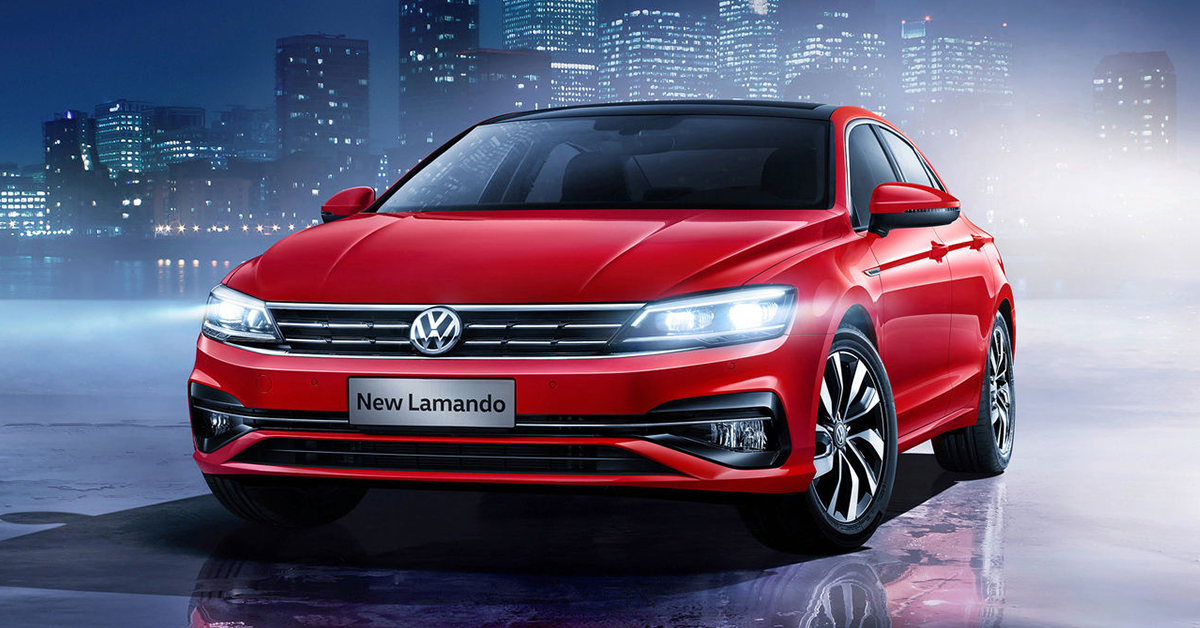
Official press image of the SAIC-Volkswagen Lamando (China). | © Volkswagen AG
The Volkswagen Lamando is the China-only coupé-styled saloon that Volkswagen showed as the New Midsize Coupé concept in Beijing in 2014 and has built with SAIC Volkswagen since November 2014. Here is the full Lamando story, from the concept and the first car to the 162 kW GTS, the longer Lamando L of 2022, the 2025 update and the first exports to Mexico.
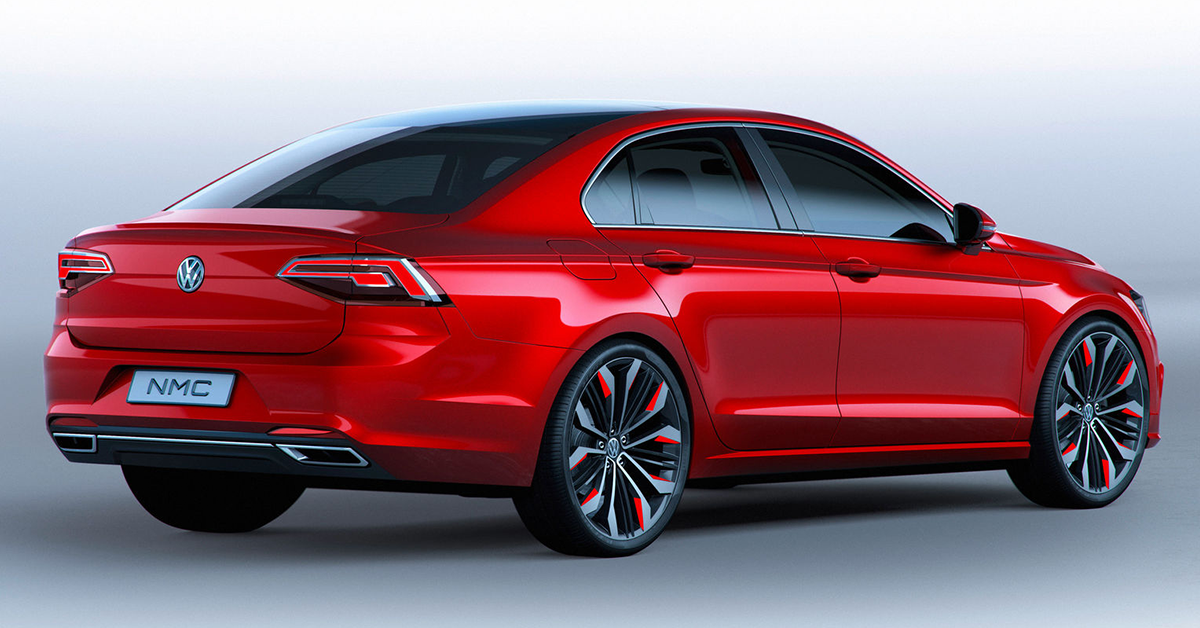
Official press image of the Volkswagen Midsize Coupé, four-door design concept. | © Volkswagen AG
The Volkswagen Lamando is a China-only compact saloon built by the SAIC Volkswagen joint venture, and it is one of the least known Volkswagens outside Asia. Volkswagen’s own market overview says it has been built in China by SAIC Volkswagen since November 2014, and describes it as a four-door notchback coupé with a wide body of 1.82 metres and a low roofline of 1.42 metres. The car is the answer to a simple question that Volkswagen asked in the early 2010s: what would a Jetta-sized car look like if it were styled the way the Passat CC was styled?
| Concept shown | Auto China 2014, Beijing (Volkswagen) |
| Production car shown | Chengdu Auto Show, August 2014 (reported) |
| Built since | November 2014 (Volkswagen) |
| Builder | SAIC Volkswagen, China only |
| Platform (first car) | MQB (Volkswagen) |
| Chinese name | Ling Du (reported) |
| First generation | 2014 to 2022 (reported) |
| Second generation | Lamando L, January 2022 (reported) |
| Designer (reported) | Marco Pavone |
| 2019 deliveries | More than 101,000 (Volkswagen) |
The Lamando did not appear from nowhere. Volkswagen showed a concept called the New Midsize Coupé at Auto China 2014 in Beijing, and the production car followed within months. A reference source says the Lamando debuted at the Chengdu Auto Show in August 2014 and was launched in China in November 2014. Its Chinese name is Ling Du, and the same source says it is meant to be the CC version of the Jetta, called the Sagitar in China, in the way that the CC was the low-slung version of the Passat. A US car-news site noted at the time that many people nicknamed it the Jetta CC.
The platform was the Group’s modular transverse matrix, known as MQB. Volkswagen’s market overview says the Lamando sits on the MQB platform, and a reference source adds that it was related to the Golf Mk7 and the Škoda Octavia Mk3. A car-history site says the Lamando slotted above the Lavida and Santana in the Shanghai range and set out to rival the Mercedes-Benz CLA. The Santana, the Passat-based car that put China on wheels, is covered in our Volkswagen Santana guide, and the Lamando is in many ways its far more stylish descendant.
The first generation ran from 2014 to 2022, according to a reference source, which also gives model years of 2015 to 2021 and names Marco Pavone as the designer. A second generation, called the Lamando L, was launched in January 2022 on the newer MQB Evo platform and was reworked again for the 2026 model year. Volkswagen’s own pages treat the Lamando as a single product line, so this guide follows the same approach, with the first car and the L covered in separate sections.
The Lamando is also a useful lesson in how Volkswagen builds cars for China. The company has several notchback saloons there, produced through the SAIC-Volkswagen and FAW-Volkswagen joint ventures and the Jetta sub-brand, and the Lamando is the most coupé-like of them. Volkswagen’s overview says a total of six individual models are offered in this key segment, and that it sold more than 1.6 million compact notchbacks in China in 2019. The Lamando was never the volume seller among them.
The article follows the Lamando through eight parts: the 2014 concept, the first car’s design and specifications, the engines and the GTS, its place in the Chinese market, the Lamando L of 2022, the 2025 update and the exports to Southeast Asia and Mexico. Where sources disagree, both figures are shown and marked as reported. For the larger car whose styling the Lamando borrowed, see the Volkswagen Arteon and Volkswagen Passat guides. The table lists the key dates.

Official press image of the Volkswagen Midsize Coupé, four-door design concept. | © Volkswagen AG
The Lamando’s story starts in April 2014. Volkswagen’s press release says the concept car made its world premiere at Auto China 2014 in Beijing, and that its design gave an initial look at how Volkswagen Design envisioned a sport sedan positioned below the Passat. The car was called the New Midsize Coupé, and the press release says it combined the worlds of saloons and sports cars. It was a four-door car with room for five people and a 500-litre boot, and the company described it as the first concept of its kind in this class.
| World premiere | Auto China 2014, Beijing (Volkswagen) |
| Length | 4,597 mm |
| Width | 1,838 mm |
| Height | 1,422 mm |
| Boot | 500 litres |
| Engine | 2.0 TSI, 162 kW (220 PS) |
| Gearbox | 7-speed DSG |
| Top speed | 244 km/h (estimate) |
| 0–100 km/h | 6.5 s (estimate) |
| Wheels and tyres | 20-inch, 245/40 |
The dimensions were distinctive. Volkswagen gives a length of 4,597 millimetres, a width of 1,838 millimetres and a height of 1,422 millimetres, and says the car was wider than the Passat but shorter than the Jetta. The press release also describes a low visual centre of gravity, short overhangs, muscular shoulders and a long bonnet. A US car-news site noted that the name might be the most misleading in concept car history, because the body was not as coupé-like as the name implied, though it was clearly sleeker than the Jetta.
The details were chosen to look sporty. Volkswagen says the concept rode on 20-inch multi-spoke alloy wheels with 245/40 low-profile tyres, with newly designed LED headlights, and that the rear spoiler was integrated into the boot lid with a dual-edge design. The press release says the paint was a special-effect red called Dragon Red, with the outer surfaces of the wheels carrying segments in the body colour. Inside, Volkswagen describes a driver-focused cabin with leather sports seats and Alcantara trim.
The technical data pointed to a quick car. The press release gives a 2.0-litre four-cylinder turbo petrol engine with direct injection producing 162 kilowatts, or 220 PS, a seven-speed DSG dual-clutch gearbox, a top speed of 244 kilometres per hour and a 0 to 100 km/h time of 6.5 seconds. Fuel consumption was estimated at 6.4 litres per 100 kilometres, and the drag coefficient was 0.299. Volkswagen says the data apply to models offered in Germany and were estimates as of March 2014. A teaser line in the same release says 224 km/h, which is a misprint, because the key facts and body text give 244.
The concept also served as a showcase for the platform. Volkswagen’s press release says the front end used the MQB layout, the controls came from MQB-A, the Golf version, and the axles and width followed MQB-B. It quotes the company’s head designer, Klaus Bischoff, whose team created the proportions. A US car-news site says Volkswagen described the concept as proof of how multifaceted the modular transverse matrix is, and of the models customers worldwide could expect over the next few years.
Production came quickly. A Chinese-car site reported shortly after the premiere that spy photographs showed a production version of the concept, to be built by the Shanghai-Volkswagen joint venture, and quoted a starting price of about 180,000 yuan, a figure that should be treated as reported. A US car-news site said the car was shown at Chengdu in August 2014 as the Lamando, and Volkswagen’s market overview confirms that production started in November 2014. The table summarises the concept’s main data.
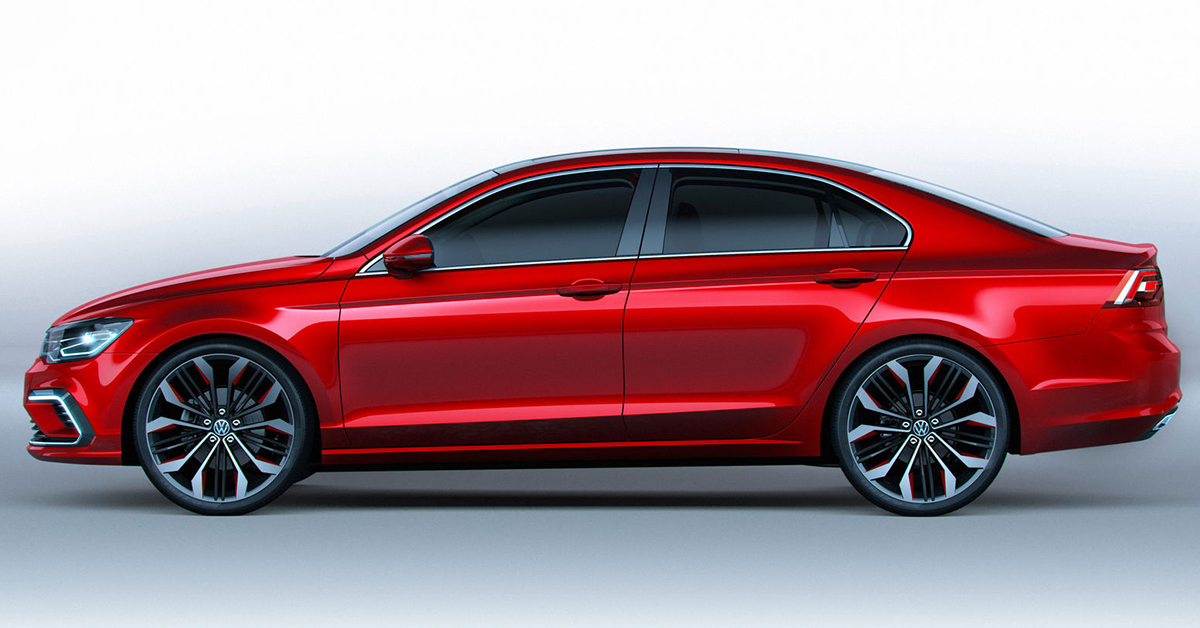
Official press image of the Volkswagen Midsize Coupé, four-door design concept. | © Volkswagen AG
The production Lamando kept the concept’s wide stance but was sized as a normal compact saloon. Volkswagen’s market overview gives a length of 4.60 metres, a wheelbase of 2.65 metres, a width of 1.82 metres and a height of 1.42 metres. A reference source gives more exact figures of 4,598 millimetres long, 1,826 millimetres wide and a 2,656-millimetre wheelbase, and a data site adds a height of 1,425 millimetres. These figures are close, and the small differences are shown as reported rather than official.
| Platform | MQB (Volkswagen) |
| Length | 4.60 m (Volkswagen), 4,598 mm (reported) |
| Width | 1.82 m (Volkswagen), 1,826 mm (reported) |
| Height | 1.42 m (Volkswagen), 1,425 mm (reported) |
| Wheelbase | 2.65 m (Volkswagen), 2,656 mm (reported) |
| Boot | 480 litres, 1,150 with seats folded (reported) |
| Front suspension | MacPherson struts (reported) |
| Rear suspension | Four-link (reported) |
| Fuel tank | 50 litres (reported) |
| Range position | Above Lavida and Santana (reported) |
Volkswagen describes the car as a four-door notchback coupé on the MQB platform. A reference source says the suspension used independent MacPherson struts at the front and an independent four-link arrangement at the rear. A data site gives a boot of 480 litres, growing to 1,150 litres with the rear seats folded, and a fuel tank of 50 litres. The numbers describe a practical, family-sized car with a sleeker roofline than usual.
The position in the range was deliberate. A car-history site says the Lamando was slotted above the Lavida and Santana, and Volkswagen’s overview places the 4.60-metre Lamando between the shorter Santana and Jetta VA3, both under 4.50 metres, and the longer Bora and Lavida at 4.66 to 4.67 metres. The comparison shows that the Lamando was longer than the cars at the entry level of the range, yet still shorter than the two largest.
A European car site, writing about the concept, noted the car was broader than the Passat at 1.83 metres and extremely low at 1.42 metres, and said the production car could be expected to use less powerful engines than the 220 PS turbo shown in Beijing. That prediction turned out to be right, as the next section shows. The same site called the Lamando a small CC for China, which is the shorthand most people used for the car, and which fits the reference source’s description of it as the CC version of the Sagitar.
The newsroom picture library carries a press photograph of the SAIC-Volkswagen Lamando with the note that this vehicle is not sold in Europe, and several photographs of the 2014 concept. The concept pictures show the 2014 show car whose proportions the production Lamando followed, and the press release describes the concept’s newly designed LED headlights and its dual-edge rear spoiler. The production car is a calmer, lower-cost interpretation of those ideas.
The size comparison with its siblings is instructive. Volkswagen’s overview gives the Lavida a length of 4.67 metres and a 2.68-metre wheelbase, the Bora 4.66 metres and 2.69 metres, and the Santana about 4.48 metres and 2.60 metres, while the Jetta VA3 measures 4.50 metres. It says the long-wheelbase Sagitar has a wheelbase of 2.73 metres compared with the US Jetta’s 2.69 metres. The Lamando’s 2.65-metre wheelbase is therefore shorter than the Bora, the Lavida and the Sagitar, so its roomy look comes from its width rather than from a long wheelbase. The production length of 4,598 millimetres is also almost identical to the 4,597 millimetres of the 2014 concept.
For readers comparing sources, the key point is that the Lamando has two generations with very different sizes. The first car was a compact saloon of about 4.6 metres. The Lamando L that followed in 2022 is a longer liftback of 4.78 metres on the newer MQB Evo platform, and the table in the Lamando L section gives its figures. The table below summarises the first car.

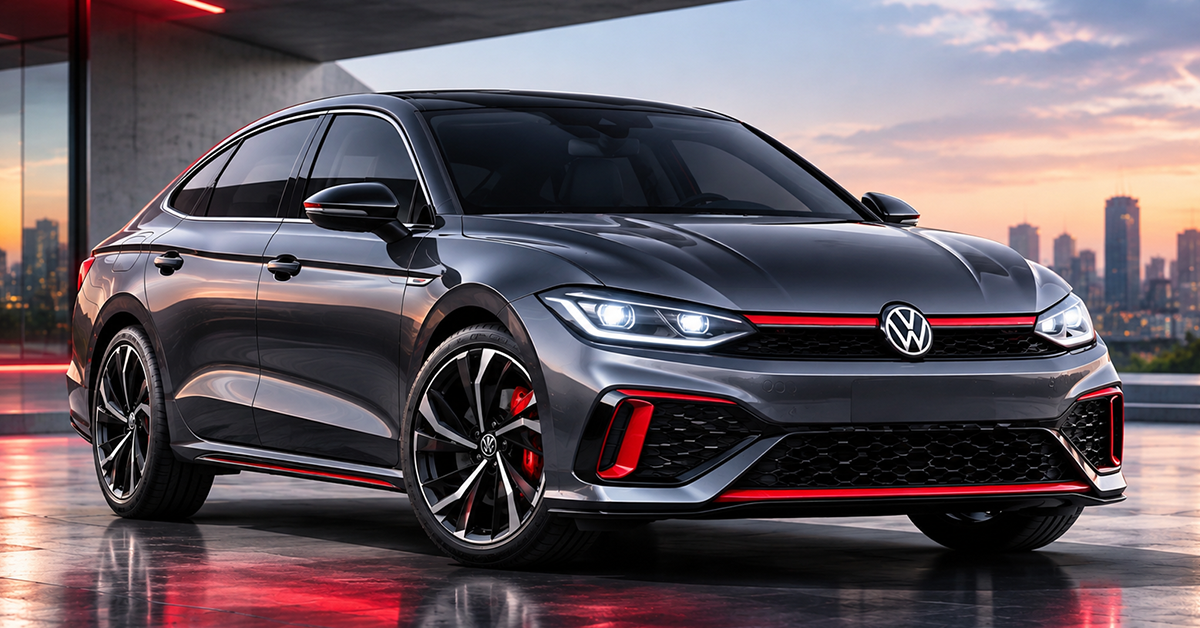
AI-generated concept illustration — Volkswagen Lamando GTS saloon, front three-quarter view. | Rev N Rise
The production Lamando used smaller engines than the concept. Volkswagen’s market overview says the car came with a 1.4-litre TSI four-cylinder in two outputs, 96 and 110 kilowatts, both with a DSG dual-clutch gearbox. Data sites label the versions by their Chinese engine names, 230TSI with 131 PS, 280TSI with 150 PS and 330TSI with 180 PS, and these labels are reported rather than official. A data site gives the later 280TSI a 0 to 100 km/h time of 8.5 seconds, which is moderate performance for a car with a sporty body.
| 1.4 TSI (low output) | 96 kW, DSG (Volkswagen) |
| 1.4 TSI (high output) | 110 kW, DSG (Volkswagen) |
| 230TSI (label) | 131 PS (reported) |
| 280TSI (label) | 150 PS, 250 Nm (reported) |
| 330TSI (label) | 180 PS (reported) |
| GTS engine | 2.0 TSI, 162 kW (Volkswagen) |
| GTS torque | 350 Nm (reported) |
| GTS launch | April 2016 (reported), on sale since 2016 (Volkswagen) |
| GTS gearbox | 7-speed wet-clutch DSG (reported) |
| Facelift (data site) | February 2019 to January 2022 |
The sporty version arrived in 2016. Volkswagen says that a sporty GTS version with a 2.0-litre TSI engine producing 162 kilowatts has been on the market since 2016. A reference source gives the same engine as the one from the Golf GTI, with 220 PS and 350 newton metres of torque, mated to a seven-speed wet-clutch DSG gearbox, and says the GTS trim was launched in April 2016 with cosmetic upgrades. A Chinese-car site that saw the first photographs said the car would debut at the Beijing show that month and added that the engine was the one used in the Chinese-built GTI with ten more horsepower.
A facelift followed. A data site gives the facelifted first-generation car a production start in February 2019 and an end in January 2022, with the 1.4-litre 280TSI at 150 PS and 250 newton metres, and the 230TSI at 131 PS. The 2019 update is not described in Volkswagen’s own pages, so details of it are limited, but the data suggest that the 1.4-litre engine was the bulk of the range. Sales volumes fell in those years, as the next section shows.
The GTS is the part of the range with the most interest for enthusiasts. A 162-kilowatt front-wheel-drive saloon with a seven-speed dual-clutch gearbox put the Lamando in a class of its own among Volkswagen’s Chinese saloons, and a car-history site places the car as a rival to the Mercedes-Benz CLA. A data site gives the Lamando GTS a 0 to 60 mph time of 6.6 seconds and a kerb weight of 1,475 kilograms, figures that match the concept’s promise of a quick car, though they are reported rather than official.
Gearboxes were simple. Volkswagen says the 1.4-litre cars used DSG, and a reference source says the GTS used the seven-speed wet-clutch unit, and the data sites list dual-clutch gearboxes for the versions they cover. A buyer looking at a used car should check which engine and which gearbox it has, because the Chinese engine names are not always printed on the car itself. The table lists the main engines and the sources for each figure.
The range also shows how Volkswagen thinks about China. The 1.4 TSI was the mainstream engine and the 2.0 TSI was the performance option. Volkswagen’s overview notes that the Lamando’s 101,000 deliveries in 2019 trailed the Sagitar, Bora and Lavida by a wide margin, which suggests that the sporty positioning appealed to a smaller group of buyers than the plain saloons did.

AI-generated concept illustration — Volkswagen Lamando saloon in a Chinese city street. | Rev N Rise
The Lamando competes in a very large market. Volkswagen’s 2020 market overview says the Volkswagen brand sold more than 1.6 million compact notchback saloons in China in 2019, with six models to choose from, and that compact notchbacks make up almost one third of the brand’s deliveries worldwide. European customers like hatchbacks such as the Golf, the overview says, while the world market is dominated by compact notchbacks, which explains why Volkswagen builds so many of them for China alone.
| Compact notchbacks sold in China, 2019 | More than 1.6 million (Volkswagen) |
| Models offered | Six (Volkswagen) |
| Lavida 2019 | 491,000 (Volkswagen) |
| Bora 2019 | 323,400 (Volkswagen) |
| Santana 2019 | About 245,000 (Volkswagen) |
| Lamando 2019 deliveries | More than 101,000 (Volkswagen) |
| Lamando production 2015 | 103,573 (reported) |
| Lamando production 2016 | 146,285 (reported) |
| Lamando production 2019 | 92,903 (reported) |
| Lamando production 2020 | 65,730 (reported) |
The overview gives sales figures for the other models in the segment. It says the Lavida was the best-selling model of all manufacturers in 2019 with 491,000 units, the Bora delivered 323,400, the Sagitar sold about 310,000 in the year the model changed and the Santana sold roughly 245,000. It says combined Jetta sales were over 145,000, and it says that more than 101,000 units of the Lamando were delivered in 2019. The Lamando therefore had the lowest volume of the six models, well behind the leaders, although more than 100,000 cars a year is still a large number.
A reference source gives annual production figures for the first generation. It lists 3,080 for 2014, 103,573 for 2015, 146,285 for 2016, 138,943 for 2017, 141,076 for 2018, 92,903 for 2019 and 65,730 for 2020. The 2019 figure of 92,903 is lower than Volkswagen’s own delivery figure of more than 101,000, which is possible because production and deliveries are different measures, though the sources do not explain the gap. The figures show a car that sold about 100,000 to 146,000 a year at its peak and then declined.
The decline matches what happened across the Chinese saloon market. A trade report from late 2021 says that customer preferences were gradually shifting away from notchback internal-combustion models toward SUVs and battery-electric cars, which is the reason Volkswagen gave for ending the Santana. The Lamando was part of the same segment, but the same trade report names a Jetta-based sedan called the Lamando among the models due to replace the ending cars, and the Lamando L followed in 2022.
Price positioning is harder to pin down. A Chinese-car site quoted a starting price of about 180,000 yuan in 2014, and later prices for the new Lamando L vary with promotions, so this guide does not give a list price for the first car. Readers who need current figures should check the official dealer pricing in China. Many Chinese prices are quoted as limited-time offers rather than list prices, which makes comparisons between sources unreliable.
The other models in the overview show how crowded the segment is. Volkswagen says the Jetta sub-brand was launched in 2019, that the Jetta VA3 measures 4.50 metres and is aimed at younger first-time buyers, and that the Bora also has an electric version, the e-Bora. For the Sagitar it says some 310,000 customers opted for the model in the year the model changed, of which more than 176,000 chose the new one. Against that background, a coupé-styled saloon that found over 100,000 buyers a year was holding a real niche.
In summary, the first Lamando was a stylish, mid-volume car that sold well for four years and then faded. It never became a high-volume nameplate like the Lavida or the Sagitar, but it gave Volkswagen a stylish saloon in a market that rewards looks. The table lists the 2019 figures from Volkswagen’s overview and the production numbers from the reference source.

AI-generated concept illustration — Volkswagen Lamando L liftback, front three-quarter view in a city setting. | Rev N Rise
The second generation arrived in January 2022 under a longer name. A Chinese-car site says the new Volkswagen Lamando L made its debut on 17 January 2022, built on the MQB Evo platform with a fully updated design, and a trade report from Australia says it was created in partnership with Volkswagen’s Chinese partner SAIC. The L is a different kind of car from the first Lamando, because the original was a notchback saloon while the new one is a five-door liftback, according to a Russian news site and a US car-news site that called it a completely different model.
| Launch | 17 January 2022 (reported) |
| Body | Five-door liftback (reported) |
| Platform | MQB Evo (reported) |
| Length | 4,784 mm |
| Width | 1,831 mm |
| Height | 1,469 mm |
| Wheelbase | 2,731 mm |
| Boot | 523 to 1,446 litres (reported) |
| Launch engine | 1.4 TSI, 150 PS, 250 Nm, 7-speed DSG (reported) |
| 0–100 km/h | About 8.5 s (reported) |
The Lamando L is bigger. A reference source gives a wheelbase of 2,731 millimetres, a length of 4,784 millimetres, a width of 1,831 millimetres and a height of 1,469 millimetres, and an Australian trade report says that makes it 500 millimetres longer, 42 millimetres wider and 13 millimetres taller than the Mk8 Golf. A European car site noted that, despite the larger footprint, the Lamando L remains smaller than the Arteon in all dimensions. A data site gives a boot of 523 litres, rising to 1,446 litres with the rear seats folded.
The platform changed too. A US car-news site says the regular saloon is based on the MQB platform, while its cooler cousin with frameless windows sits on the updated MQB Evo architecture introduced by the Group in 2019 for the latest Golf, Octavia, A3 and Leon. A Thai car site agrees that it uses MQB Evo, shared with the Golf Mk8 and the Audi A3 Mk4. The Lamando L therefore has much more in common with the current Golf than the first Lamando had with the Golf of its time.
Styling followed the Arteon. An Australian trade report says the car borrows styling cues from the Volkswagen Arteon, with a clamshell bonnet, frameless doors and coupé-style lines, and a Brazilian technology site notes the illuminated logos at the front and rear. A car-news site says an LED strip connects the headlights with the illuminated emblem, in line with the latest trend in new Volkswagens. A German car site observed that the new car had a face reminiscent of the ID.3.
The engine at launch was the 1.4-litre turbo petrol. Reports give it 150 PS and 250 newton metres of torque with a seven-speed DSG gearbox, and a car-news site gave a 0 to 100 km/h time of eight and a half seconds, which it described as not great but not terrible. A Brazilian site said a 2.0 TSI version also existed, while the US car-news site thought a more potent 2.0 TSI could follow later in the model’s life, so the early reports disagree about whether it was offered at launch. Volkswagen’s own pages carry no technical data for the L.
Because the Lamando L is China-only, it has had little coverage in Europe, but it matters for the story of the name. It moved the Lamando from a compact saloon with coupé styling to something closer to a junior Arteon, a car that sits between the Golf and the Passat in size. The table lists its main data, and the next section covers the 2025 update.
AI-generated concept illustration — Volkswagen Lamando L GTS, rear three-quarter view on a mountain road. | Rev N Rise
The Lamando L was reworked in 2025. A reference source says it received a facelift in 2025 for the 2026 model year, with refreshed front and rear designs, and that the update marked the return of the GTS performance variant. A trade news site says that on 29 August, at the Chengdu Motor Show 2025, SAIC Volkswagen launched the Lamando L, with three 1.5T and three GTS variants. The choice of the Chengdu show is a nice echo of 2014, when the original Lamando made its own debut there.
| Update launched | 29 August 2025, Chengdu Motor Show (reported) |
| Variants | Three 1.5T and three GTS (reported) |
| 1.5 TSI | EA211 EVO II, 160 PS, 118 kW, 250 Nm (reported) |
| GTS engine | EA888 2.0 TSI, 162 kW, 350 Nm (reported) |
| GTS gearbox | 7-speed DQ381 DSG (reported) |
| GTS 0–100 km/h | 6.98 s (reported) |
| Electrical architecture | MQB-EVO (reported) |
| Sensors | 15 radars, 5 cameras (reported) |
| Price range (list, reported) | 150,900 to 195,900 yuan |
| Promotional starting prices (reported) | 119,900 and 139,900 yuan |
The engines changed. A Russian car site and an automotive news site report that the old 1.4 TSI with 150 PS was replaced by a 1.5 TSI with 160 PS, and an automotive news site gives the same 160 PS or 118 kilowatts and 250 newton metres. A Chinese car site says the 1.5-litre unit is the EA211 EVO II. The GTS uses the EA888 2.0-litre turbo shared with the Golf GTI, with 162 kilowatts, or 220 PS, and 350 newton metres, and comes only with a seven-speed dual-clutch gearbox, according to the same automotive news site.
A reference source says the GTS engine has 350-bar high-pressure injection and gives a 0 to 100 km/h time of 6.98 seconds with the DQ381 seven-speed wet-clutch gearbox. That is about a second and a half quicker than the 1.4-litre car at launch, which gives the Lamando L GTS genuine performance in a car with a quiet saloon shape.
The technology list grew as well. A Chinese financial news site says the new car is built on the MQB-EVO electrical architecture and carries a perception system of 15 radars and 5 cameras, enabling driver assistance functions such as Front Assist and adaptive cruise control. A Russian car site says the interior swapped a single display for separate screens and that the GTS has black exterior trim and exposed round exhaust tips. The same Chinese report also says the car incorporates AI-based features, which the original Lamando did not have.
Prices are quoted in two ways, which is a common source of confusion. A trade news site gives a range of 150,900 to 195,900 yuan across the six variants, while a Chinese financial news site gives limited-time starting prices of 119,900 yuan for the 1.5T and 139,900 yuan for the GTS 2.0T. The first appears to be list pricing and the second a promotional price, but this is an inference, so both are shown as reported and neither should be treated as official.
The Chinese name of the car is worth knowing when reading local news. The financial news site that reported the launch calls the car the Lingdu L, which is the same Ling Du name that a reference source gives for the original, and it adds that SAIC Volkswagen also unveiled a Lingdu L GTS race car at the show. The reference source describes the update as a facelift for the 2026 model year, so cars sold from late 2025 are 2026 models, and anyone comparing used examples should check the model year rather than the calendar year of sale.
The 2025 update shows that Volkswagen still believes in the Lamando. At a time when its own overview and the trade press talk about Chinese buyers moving to SUVs and electric cars, a combustion-engined liftback was refreshed and given a performance version, and it was then offered to export markets. The table lists the main figures, and the final section covers the exports.

AI-generated concept illustration — Volkswagen Lamando L parked on a Mexican city street at dusk. | Rev N Rise
The Lamando was meant for China, but it has travelled. A reference source says it was exported to the Philippines from 2018 to 2022. A trade news site says SAIC Volkswagen’s export markets before Mexico included the Philippines, Vietnam and Uzbekistan across Southeast and Central Asia. The same reference source says sales of the Lamando in the Philippines were discontinued in September 2025 following the termination of a distributorship agreement between the importer and the Volkswagen Group.
| Philippines exports | 2018 to 2022 (reported) |
| Philippines sales ended | September 2025 (reported) |
| Other export markets | Philippines, Vietnam, Uzbekistan (reported) |
| Mexico | First batch shipped, 28 September (reported) |
| Mexico positioning | Sporty, practical sedan for younger buyers (reported) |
| Mexican specifications | Not disclosed (reported) |
| Sold in Europe | No (Volkswagen) |
| 2014 plan (reported) | Mexico-built version from 2016, not realised |
| First generation ended | 2022 (reported) |
| Status | Lamando L in production |
Mexico is the newest market. A trade news site reports that SAIC Volkswagen announced that the first batch of Lamando L sedans bound for Mexico had rolled off the assembly line and begun shipping, and describes it as the company’s first entry into the North American market. The report says SAIC Volkswagen is positioning the Lamando L as a sporty yet practical sedan for younger Mexican buyers, citing the country’s established sedan market and demand for more distinctive designs. It says specifications, pricing and sales targets for the Mexican version had not yet been disclosed.
A Latin American car site, writing about the plan, said Volkswagen would add a new sedan built in China to its Mexican range, with the size of a Jetta, and noted that in China the Lamando L offers two mechanical options, an entry-level 1.4 TSI with 150 horsepower and a more powerful one. That report is older than the 1.5 TSI update, so its engine details may not match the car that is actually shipped. The Mexican specification is therefore an open question, and this guide does not give figures for it.
There is some irony in the Mexican story. When the original car was previewed in 2014, an Australian car site reported that the new four-door coupé would first be produced for China before a more global model rolled out of the brand’s Mexico plant, likely from 2016, and a US site suggested it would arrive in America as a Jetta CC. Neither happened. Twelve years later, the car is arriving in Mexico from China instead, which shows how much Volkswagen’s relationship with its Chinese joint ventures has changed.
The car has also attracted attention through its name. The Lamando is not sold in Europe, and Volkswagen’s newsroom labels the press photograph of the SAIC-Volkswagen Lamando with a note that the vehicle is not sold in Europe. Enthusiasts who want a similar car in Europe have the Arteon, covered in our guide, and the Golf, whose platform family the Lamando shares. The Lamando is a useful reminder that some of Volkswagen’s most interesting cars are not available in the West.
Unlike many cars in this series, the Lamando has not ended. The first generation finished in 2022, the Lamando L continues, and the car is still gaining new markets. That makes it a living story, and this guide will need updating as Volkswagen releases more details about the Mexican version and the future of the range. The table summarises the export story, and the FAQ below answers the most common questions.