 Brands
Ford Capri — From the 1969 Coupe to the Electric Return
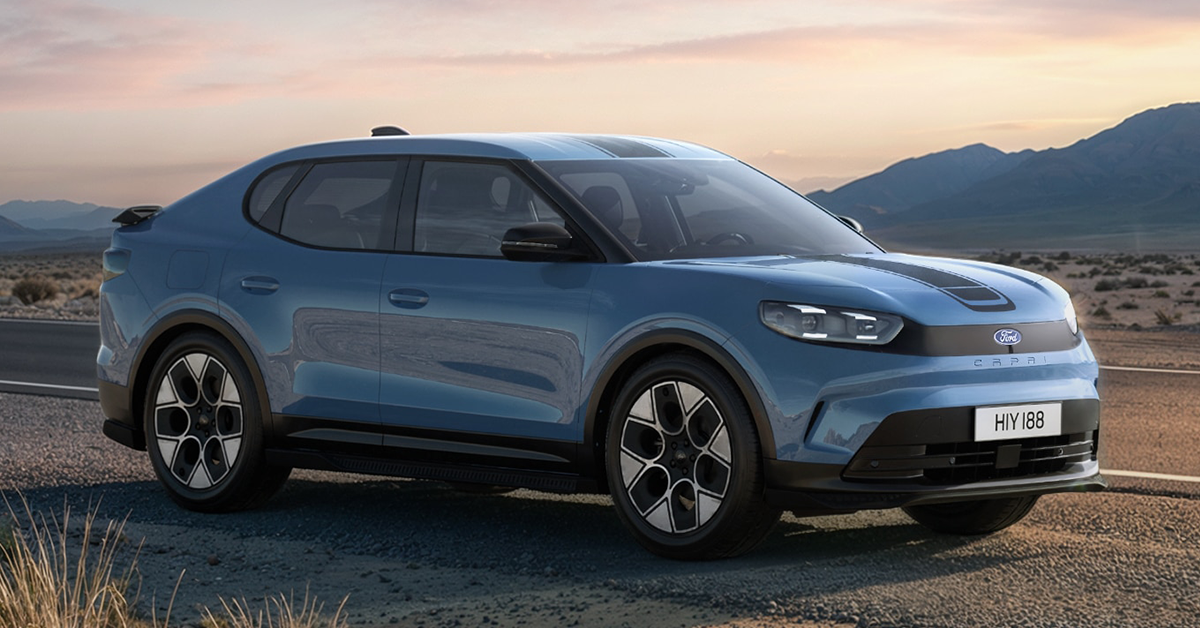
Official press image of the Ford Capri. | © Ford Motor Company
The Ford Capri from the 1969 sports coupe to the all-electric Capri: the Mk1, Mk2 and Mk3, the RS2600, RS3100 and Capri 280, the 2024 electric launch, range, boot space, prices where sources give them and the 2026 update.
The Ford Capri has been two very different cars. The first was a front-engined, rear-wheel-drive sports coupe built by Ford of Europe from 1969 to 1986, which Ford describes as the Mustang’s European cousin (Ford). The second is an all-electric coupe-style SUV that Ford revealed in July 2024 and builds in Cologne, Germany (Ford). The two share a name and a promise of style at a fair price, but they do not share a platform, a body style or a powertrain. This article covers both, and it keeps them apart so that the figures for one are never mixed into the other.
| Original Capri | Sports coupe, 1969 to 1986 (Ford) |
| Original debut | Brussels Motor Show (Ford) |
| Original total | More than 1.8 million (Ford) |
| Original builders | Halewood and Cologne (Ford) |
| Original slogan | “The car you always promised yourself” (Ford) |
| Electric Capri | Revealed July 2024 (Ford) |
| Electric plant | Cologne Electric Vehicle Center (Ford) |
| Electric top output | 340 PS (Ford) |
| Electric top range | Up to 627 km WLTP (Ford) |
| Sold in the US | No (reported) |
The original Capri was a big success. Ford says production ended in 1986 with more than 1.8 million built (Ford). A second Ford article says the original sold more than two million units over 18 years (Ford). A reported production history gives a precise total of 1,886,647 across all generations, with the last car leaving the Cologne line on December 19, 1986 (reported). We therefore describe the original as almost 1.9 million, and we show the two Ford wordings as a conflict, since they cannot both be exact.
Ford sold the original on a line that became famous. It was marketed as “the car you always promised yourself” (Ford). British and German engineers developed it together, and Ford says it was built at Halewood in the United Kingdom and at Cologne in Germany (Ford). A reported history adds that Saarlouis in Germany and Genk in Belgium also built Capris (reported). The first generation was shown at the Brussels Motor Show, and Ford says it sold about 400,000 in its first two years (Ford). The Capri’s story therefore runs from 1969 to the end of 1986.
The electric Capri is a modern reinterpretation. Ford calls it a sports coupe for the family and says it is how the Capri might have evolved had it stayed in continuous production (Ford). It is the second all-electric Ford built at the Cologne Electric Vehicle Center, alongside the Explorer, and Ford says the plant received a $2 billion investment (Ford). Ford lists up to 340 PS, 0 to 100 km/h in as little as 5.3 seconds and up to 627 km of WLTP range (Ford). Reports describe it as built on Volkswagen’s MEB electric platform (reported).
Ford’s launch prices were stated in euros and pounds. The Standard Range model started from 44,950 euros or 42,075 pounds in Germany and the United Kingdom, and the Extended Range rear-wheel-drive model from 51,950 euros or 48,075 pounds (Ford). In March 2026 Ford announced a new lithium iron phosphate battery for the Standard Range models, which raised range to up to 463 km (Ford). The electric Capri is sold in Europe, and a report says Ford has not confirmed sales outside it (reported). It is not sold in the United States.
Some limits apply. Ford’s European pages describe the electric Capri thoroughly, but the pages we read did not name its platform, so the MEB link is reported. The classic Capri is covered mostly by reference histories and period magazines, and we tag those figures (reported). We found no Ford production total for the electric model and no US price, since there is none. Ford sources used here include its media center, its heritage notes and its technical factsheet. For the wider Ford story, see the history and models pages linked below.
The first Capri arrived because Ford Europe wanted its own pony car. Ford says the car was released in 1969, five years after the Mustang, with a sleek European shape and compact dimensions (Ford). A reported history says the program, called Project Colt, was given the go-ahead in July 1966 and was launched three years later (reported). It was shown at the Brussels Motor Show in January 1969, and the Colt name was dropped for Capri because another maker already used it (reported). Production began at Halewood in November 1968, with sales from February 1969 (reported).
| Project approved | July 1966 (reported) |
| Shown | Brussels Motor Show, January 1969 (reported) |
| Production start | November 1968, Halewood (reported) |
| Platform | Mk2 Cortina (reported) |
| Designer | Philip T. Clark (reported) |
| Launch engines | 1300, 1600, 2000 (reported) |
| 3000 added | October 1969 (reported) |
| UK base price | 890 pounds (reported) |
| First two years | About 400,000 sold (Ford) |
| Peak year | 238,914 in 1970 (reported) |
The Capri was built from familiar parts. A reported history says it used the Mk2 Cortina’s floorpan, recalibrated suspension and four-cylinder engines, which kept costs down (reported). The Mustang, by comparison, was based on the Falcon (reported). The designer is listed as Philip T. Clark, who was also involved in the Mustang (reported). Ford says British and German engineers co-developed it, which was unusual because the two divisions had been run separately in the 1960s (Ford). Ford also says the prototype was shown across Europe three years before the Brussels debut (Ford).
The engine range was wide. A reported history says the launch cars came as 1300, 1600 and 2000 models, with the 3000 following in October 1969 (reported). In the UK, the Kent four-cylinders came in 1.3 and 1.6 litres, with a 2.0-litre Essex V4 above them, and the 3.0-litre Essex V6 on top (reported). Elsewhere in Europe, buyers could choose 1.3, 1.5 and 1.7-litre V4s and 2.0, 2.3 and 2.6-litre Cologne V6 engines (reported). The 2.0-litre V4 is listed at 90 bhp in one guide and 93 bhp in another (reported).
Performance climbed with each step. A used-car guide lists the Mk1 2000 GT at 90 bhp with 0 to 60 mph in 10.9 seconds and a top speed of 107 mph (reported). It lists the 3000 GT at 128 or 138 bhp with 8.9 seconds and 120 mph, and the 3000 GXL at 138 bhp with 8.6 seconds and 122 mph (reported). The base car was priced at 890 pounds in the UK at launch (reported). These are period figures from reference guides, and Ford’s own pages we read do not list them, so treat them as approximate.
Sales were strong, but the sources disagree on the pace. Ford says about 400,000 were sold in the first two years (Ford). Two other reports say almost half a million, or 500,000, in the same period (reported). One report says the millionth car came after four years and another says five years, and another says one million in 18 months, which cannot be right beside Ford’s 400,000 (reported). A reported figure puts annual output at an average of 213,000 for 1969 to 1974, with a 1970 peak of 238,914 (reported). Mk1 sales are given as 1.2 million (reported).
The dates for the end of the Mk1 differ by market. A reference gives Mk1 production as 1969 to 1974 in the UK and 1969 to 1973 in Germany (reported). Ford says Lincoln and Mercury also used the Capri name in North America (Ford), and a reference lists the Mk1 as also called the Mercury Capri (reported). A South African special, the Perana, used a 3.0-litre Essex engine and then a 302 cubic inch V8 (reported). Neither is the same car as the European Capri, and we do not cover them further. The Mk2 followed in 1974, as the next section shows.
The second generation made the Capri more practical. Ford says the second generation arrived in 1974 with a hatchback-style tailgate (Ford). A reported history says it was introduced at the Brussels Motor Show in February 1974 and replaced the Mk1’s separate boot with a three-door hatchback body (reported). Customer research had identified the separate boot as a practical shortcoming, according to the same history (reported). Split folding rear seats were added, and one magazine gives a boot of 630 litres, which is a period claim (reported).
| Capri II shown | February 1974 (reported) |
| Body change | Three-door hatchback (reported) |
| Mk2 boot | 630 litres, period claim (reported) |
| Mk3 start | 1977 or 1978 (reported) |
| 1300L engine | Pinto 1.3L, 54 bhp (reported) |
| 1600 GL engine | Pinto 1.6L, 72 bhp (reported) |
| 2.8 Injection | 1981 (reported) |
| 2.8i engine | Cologne V6, 2,792 cc, 160 bhp (reported) |
| LHD production ended | 1984 (reported) |
| Last car | December 19, 1986 (reported) |
Engines changed too. A reported history lists a 1300L with a 1.3-litre Pinto at 54 bhp, a 1600 GL at 72 bhp and a 3000 S or Ghia with the Essex V6 (reported). One table gives the 2000 GL/S as a Cologne V6 at 90 bhp, while another source says the Pinto 2.0-litre replaced the V4 (reported). A third source gives the Pinto 2.0 at 98 bhp (reported). The sources therefore disagree on the 2.0-litre engine, and we show both. The Essex V6 also received a redesigned intake to prevent carburettor icing (reported).
The Mk3 was a facelift of the same structure. A reported history says the project was called Carla and that the main differences were a re-profiled bonnet leading edge, ribbed rear light clusters and wraparound bumpers (reported). Ford says the 1978 update had a sleeker, more aggressive look, four round headlamps and a horizontal grille (Ford). The start date is given as 1977 in one guide and 1978 in others (reported). A reported history says the Mk3 was also built at Dagenham, Halewood, Genk, Cologne and Saarlouis at different times, which conflicts with Ford’s note that Halewood production ended in 1976 (reported).
Fuel injection arrived in 1981. A reported history says the 2.8 Injection came that year to replace the 3.0-litre Essex models and was developed by Ford’s Special Vehicle Operations (reported). Its Cologne V6 displaced 2,792 cc and made 160 bhp, with the Bosch K-Jetronic system (reported). A 1985 UK car is listed at 8.3 seconds for 0 to 60 mph (reported). Ford says the new 2.8-litre engine brought modern fuel injection to the Capri (Ford). It was the first regular Capri with injection since the RS2600, according to one reference (reported).
The final specification arrived in 1984. A reported history says the 2.8 Injection Special brought half-leather trim, a limited-slip differential, a five-speed gearbox and 13-inch seven-spoke RS alloy wheels without the RS logo (reported). A magazine says the car had a colour-coded grille and headlights (reported). Left-hand-drive production ended in 1984, and Capris were then built only for the UK and Ireland (reported). Buyers could choose a 1.6 or 2.0 Laser, the 2.8i Special and the Tickford Capri, according to one magazine (reported).
The Capri ended in December 1986. A reported history says the last car left the Cologne line on December 19, 1986, and Ford says production ended in 1986 with more than 1.8 million built (Ford). Another report says the car was planned to continue to October 1989, when the 2.8 engine and its gearbox were due to go out of production (reported). The Capri was not officially replaced, and a reference says the second-generation Probe effectively replaced it from 1994 (reported). Journalists called it a classic when it retired, according to Ford (Ford).
The Capri earned its sporting reputation on the track. Ford says the Capri RS2600 won the European Touring Car Championship in 1971 and 1972 (Ford). Ford adds that the production model brought fuel injection to European Fords (Ford). A reported history says the RS2600 was a homologation special with a 2,673 cc V6, Kugelfischer mechanical injection and about 148 bhp, built from 1970 to 1974 (reported). Another source says the Weslake-developed engine made about 150 bhp (reported). A reported total of 3,532 includes prototypes and homologation specials (reported).
| RS2600 racing | ETCC wins 1971 and 1972 (Ford) |
| RS2600 engine | 2,673 cc V6, mechanical injection (reported) |
| RS2600 output | About 148 to 150 bhp (reported) |
| RS2600 built | 3,532 including prototypes (reported) |
| RS3100 approved | September 25, 1973 (reported) |
| RS3100 engine | 3,098 cc Essex V6 (reported) |
| RS3100 built | Fewer than 250 (reported) |
| Zakspeed Capri | DRM title, 1981 (Ford) |
| Capri 280 built | 1,000 plus (Ford); 1,036 or 1,038 (reported) |
| Capri 280 colour | Brooklands Green (Ford) |
The RS3100 followed the RS2600. A reported history says Ford approved the right-hand-drive RS3100 on September 25, 1973, with an Essex V6 enlarged to 3,098 cc (reported). Touring car rules required 1,000 road cars, but fewer than 250 were made because of the 1973 oil crisis (reported). The RS3100 was built at Halewood and entered the European Touring Car Championship in 1974 (reported). One RS3100 sold for 74,250 pounds at auction in 2022, according to a magazine, which is a single sale and not a market price (reported). Ford says an RS3100 racer was based on the Capri (Ford).
Turbocharging reached the Capri in Germany. Ford says the turbocharged Zakspeed Capri won the DRM title in 1981 and inspired the Capri RS Turbo (Ford). In South Africa, a reported history says the Perana used the Essex V6 and then a V8, and that V8 Capris dominated local touring car racing (reported). A reference says the Capri entered motorsport through the European Touring Car Championship to boost its sporting credentials (reported). Ford’s own heritage note, on its Mustang-cousin story, lists only these wins, and we do not add other race results.
Special editions kept the range fresh. Ford says the 1975 Capri Special had gold pinstripes, gold-coloured wheels and seat trim with gold inserts (Ford). Series X kits, introduced in 1977, offered Rally Sport engines, suspension and wheels for customisation (Ford). A reported list also names Cabaret and Calypso limited editions with 1.6 and 2.0-litre engines (reported). Ghia versions with 2.0 and 3.0-litre engines sat at the top of the comfort range (reported). The Capri was therefore sold as a family of cars, from economy models to the 2.8 Injection and the race-bred RS cars.
The last special edition was the Capri 280. Ford says it had all-leather trim and that just over 1,000 were built, all in Brooklands Green (Ford). Reported counts are 1,036 in one history and 1,038 in two others, so the three numbers conflict slightly (reported). A reported history says Ford decided in September 1986 that an initial run of 500 was too small (reported). It was mechanically the same as the 2.8i Special, with the 2,792 cc, 160 bhp Cologne V6 and a Type-9 five-speed (reported). Reports say nearly half received a Turbo Technics conversion (reported).
The 280 also has a collector history. A magazine says the final car rolled off the line on December 19, 1986, and is part of Ford’s heritage collection (reported). A UK buying guide says the last example was not registered until 1989, which suggests slow sales at the end (reported). That guide calls the Brooklands model hastily assembled in one owner’s opinion, which we cite only as an opinion (reported). Production dates and registration dates are different things, so the 1986 build date and 1989 registration do not conflict. The next section covers the electric successor.
Ford revealed the electric Capri in July 2024. Ford’s page dates the reveal to July 11, 2024, in a livestream at a decommissioned power station in Wapping, London, co-hosted by Eric Cantona (Ford). A reported article says Ford introduced it on a Wednesday, which would be July 10 (reported). The dates therefore differ by a day, and we show both. Ford positions the model as how the Capri might have evolved had it stayed in continuous production (Ford). Ford also calls it a sports coupe for the family (Ford).
| Revealed | July 2024; July 11 (Ford), July 10 (reported) |
| Plant | Cologne Electric Vehicle Center (Ford) |
| Standard Range RWD | 125 kW (170 PS), 310 Nm, 52 kWh (Ford) |
| Extended Range RWD | 210 kW (286 PS), 545 Nm, 77 kWh (Ford) |
| Extended Range AWD | 250 kW (340 PS), 545 plus 134 Nm, 79 kWh (Ford) |
| 0 to 100 km/h | 8.7, 6.4 and 5.3 seconds (Ford) |
| Top speed | 160, 180 and 180 km/h (Ford) |
| WLTP headline range | 393, 627 and 592 km (Ford) |
| DC charging | 145, 135 and 185 kW (Ford) |
| First deliveries | October 14, 2024 (Ford) |
The body is not a traditional coupe. Reports call it a coupe-style SUV, and several describe it as the sleeker sister of the European Explorer (reported). A report says both are underpinned by Volkswagen’s MEB platform, with the Capri acting as Ford’s version of the ID.5 (reported). Ford’s pages that we read do not state the platform, so we give it as reported. Ford says the exterior is sleek and aerodynamic, and that the interior is minimalist and digital, with soft-touch materials and sculptured one-piece front seats (Ford).
Ford’s factsheet lists three powertrains. The Standard Range rear-wheel-drive model has a 52 kWh usable battery and 125 kW (170 PS) with 310 Nm (Ford). The Extended Range rear-wheel-drive model has 77 kWh, 210 kW (286 PS) and 545 Nm (Ford). The Extended Range all-wheel-drive model has 79 kWh, 250 kW (340 PS), 545 Nm at the rear and 134 Nm at the front (Ford). The three reach 100 km/h in 8.7, 6.4 and 5.3 seconds, and top speeds are 160, 180 and 180 km/h (Ford).
Range and charging figures come from the same factsheet. WLTP headline ranges are 393 km, 627 km and 592 km for the three variants, and Ford shows a second, lower figure for each, such as 598 km for the Extended Range rear-wheel-drive model, without labelling which trim it applies to (Ford). DC charging peaks at 145, 135 and 185 kW, and a 10 to 80 per cent charge takes about 25, 28 and 26 minutes (Ford). AC charging is 11 kW for all three (Ford). Ford’s July 2024 page said the rear-wheel-drive model could cover more than 620 km (Ford).
Launch prices are stated by Ford for two variants. The Standard Range starts at 44,950 euros or 42,075 pounds, and the Extended Range rear-wheel-drive at 51,950 euros or 48,075 pounds (Ford). A trade report lists the all-wheel-drive model at 55,950 euros, while another lists a Premium all-wheel-drive at 48,650 euros and labels the 627 km rear-wheel-drive car at 44,950 euros (reported). Those figures conflict with Ford’s pairing of 44,950 euros with the Standard Range, so we use Ford’s. Ford Ireland lists a Select 52 kWh from 45,798 euros with government subsidies (Ford).
Production is in Cologne. Ford says the Capri is the second all-electric Ford produced at the Cologne Electric Vehicle Center, built alongside the all-new Explorer (Ford). A reported article says series production started in September 2024 and that the plant is designed for 250,000 units a year across the two models (reported). Ford says the first Capri electric sports coupes left the plant for dealerships on October 14, 2024, the first Capri customer deliveries in almost four decades (Ford). The $2 billion plant investment is Ford’s figure (Ford).
Ford’s factsheet gives the electric Capri’s length as 4,634 mm, or 4,734 mm with a towbar (Ford). The width is 2,063 mm with mirrors, 1,946 mm with mirrors folded and 1,872 mm without mirrors (Ford). The height is 1,626 mm unladen and the wheelbase is 2,767 mm, with front and rear overhangs of 889 mm and 978 mm (Ford). Front and rear track are 1,581 mm and 1,571 mm, and ground clearance at maximum load is 135 mm for rear-wheel drive and 138 mm for all-wheel drive (Ford).
| Length | 4,634 mm (Ford) |
| Width | 2,063 mm with mirrors; 1,872 mm without (Ford) |
| Height | 1,626 mm (Ford) |
| Wheelbase | 2,767 mm (Ford) |
| Boot, five seats, to roof | 627 litres (Ford) |
| Boot, to seat-back | 572 litres (Ford) |
| Boot, two seats | 1,510 litres (Ford) |
| MegaConsole | 17 litres (Ford) |
| Kerb weight | 1,914 to 2,191 kg (Ford) |
| Braked towing | 1,000 or 1,200 kg (Ford) |
Luggage space is listed for several measures. In five-seat mode, the boot holds 627 litres laden to the roof, or 622 litres in one configuration, and 572 litres to the seat-back height (Ford). With two seats in use, it is 1,510 litres to the roof (Ford). Ford’s July 2024 page said up to 572 litres, and its October page said more than 570 litres, which match the seat-back measure and not the roof measure (Ford). The load opening is 637 mm high and 1,016 mm wide, and the loading length is 954 mm (Ford).
Weights vary by variant. Kerb weight is 1,914 to 1,930 kg for the Standard Range, 2,098 to 2,114 kg for the Extended Range rear-wheel-drive model and 2,175 to 2,191 kg for the all-wheel-drive model (Ford). Gross vehicle mass is 2,500, 2,685 and 2,745 kg (Ford). Maximum braked towing is 1,000 kg, 1,000 kg and 1,200 kg, and unbraked towing is 750 kg for all three (Ford). Nose load and roof load are both 75 kg (Ford). Ford adds that towing varies with cargo, configuration, accessories and passenger count (Ford).
Interior space and storage are described. First-row headroom is 1,008 mm, or 1,039 mm with the panorama roof, and first-row legroom is 1,135 mm (Ford). Second-row headroom is 972 mm, or 994 mm with the panorama roof, and legroom is 916 mm (Ford). A 17-litre MegaConsole sits beneath the front armrest, and Ford’s factsheet gives no front trunk capacity (Ford). The 14.6-inch SYNC Move screen slides up and down, and the car has a 5-inch digital instrument cluster, wireless Apple CarPlay and Android Auto and dual-zone climate control (Ford).
The factsheet lists Style, Select and Premium trims, while Ford’s launch pages named Capri and Capri Premium. Ford says all models have keyless entry and start, a massaging driver’s seat, heated front seats and a heated steering wheel (Ford). The Premium adds Dynamic Matrix LED headlights, a 10-speaker B&O sound system and 20-inch wheels (Ford). Ford says 55 per cent chose Premium, 59 per cent chose the 286 PS rear-wheel-drive model, and Vivid Yellow was the most popular of six colours at 24 per cent, a nod to the classic Capri’s Daytona yellow (Ford).
Safety and assistance are broad. Ford says every Capri has 12 ultrasonic sensors, five cameras and three radars, and that these systems supplement and do not replace driver attention (Ford). Standard assistance includes Blind Spot Information System, Cross Traffic Alert with Active Braking, Evasive Steering Assist and Intelligent Adaptive Cruise Control with Stop and Go (Ford). A Driver Assist Pack adds a head-up display, Active Park Assist, Lane Centring, Assisted Lane Change and a 360-degree camera (Ford). Standard wheels are 19-inch or 20-inch, with 21-inch wheels optional (Ford). Colours are Agate Black, Frozen White, Magnetic Grey, Vivid Yellow, Blue My Mind and Lucid Red (Ford).
The electric Capri was upgraded in early 2026. A report says Ford announced upgraded Explorer and Capri models in January 2026, now on an updated version of the underlying Volkswagen platform called MEB+ (reported). Another report says WLTP ranges rose by up to 70 km, giving the more aerodynamic Capri 464 km (reported). A separate report adds that both cars adopted a new Volkswagen motor, the APP350 (reported). Ford’s own March 2026 release gives 463 km for the Standard Range, which differs by one kilometre from that report (Ford).
| Upgrade reported | January 2026 (reported) |
| Platform update | MEB+ (reported) |
| Collection announced | March 12, 2026 (Ford) |
| New Standard Range power | 140 kW (190 PS), 350 Nm (Ford) |
| New 0 to 100 km/h | 8.0 seconds (Ford) |
| New Standard Range WLTP | Up to 463 km (Ford); 464 km (reported) |
| Extended Range RWD | Up to 627 km (Ford) |
| Collection paint | Tribute Blue (Ford) |
| Collection wheels | 21-inch alloys (Ford) |
| Reported start price | 42,400 euros (reported) |
Ford announced the changes on March 12, 2026, in Cologne. Capri Standard Range models receive a new lithium iron phosphate battery and an enhanced electric motor (Ford). The Standard Range now makes 140 kW (190 PS) and 350 Nm, reaches 100 km/h in 8.0 seconds and has up to 463 km of WLTP range, an increase of more than 17 per cent (Ford). The earlier Standard Range figures were 170 PS, 310 Nm, 8.7 seconds and 393 km (Ford). Ford does not state the new battery’s capacity or its charging speeds in that release (Ford).
The release also introduced a limited series. The Capri Collection has exclusive Tribute Blue paint, black body styling with deeper front and rear valances, side skirts and a rear spoiler, and new 21-inch alloy wheels (Ford). The interior is Black Onyx with Tribute Blue accents on the lower soundbar and seatbelts, a black and blue speckle effect on the dashboard and seats with a vertical stripe insert (Ford). Ford does not give a production number or a price (Ford). Ford says the Collection draws on the Capri’s motorsport and cult performance heritage (Ford).
Equipment changes apply across the range. Ford says one-pedal drive is standard on all Capri models and that the 14.6-inch SYNC Move screen now has Android-based software (Ford). New driver-assist features include Traffic Light Recognition, Reversing Assist, Trained Park Assist and Driver State Assist (Ford). Pro Power Onboard can deliver up to 2.3 kW from the drive battery to external devices, and it is not a charging feature (Ford). An optional Travel Pack adds dog guard provision, a front trunk insert and charge cable storage (Ford). The Extended Range rear-wheel-drive model keeps its 627 km figure (Ford).
Sales information is limited. Ford says about 200,000 consumers configured a Capri on its European website after the July 2024 unveiling, and it states that these were configurations and not orders (Ford). A report says Ford delivered 2,511 Capris through March 2025, against 3,611 for Volkswagen’s ID.5 (reported). It adds that production at Cologne was reduced after a slow start (reported). We found no Ford sales total for the electric Capri, and we do not estimate one. Ford’s wider European plans are covered on our Ford Europe page, linked below.
Prices after the update are reported. A report says the Capri with the new battery starts at 42,400 euros (reported). Ford did not state prices in its March 2026 release (Ford). Ford Ireland’s page lists a Select 52 kWh from 45,798 euros with government subsidies, which is a different figure again (Ford). Because prices change by market and incentive, we show the Ford figures and the report side by side. Check a local dealer for the current price.
The Capri was built as Europe’s answer to the Mustang. Ford says the Capri was released in 1969, five years after the Mustang, and that it has been called the Mustang’s European cousin (Ford). A reported history says the Capri was intended as the European equivalent of the Mustang and was built on Cortina mechanicals, while the Mustang used Falcon parts (reported). The Mustang remains in production as a coupe and convertible, while the electric Capri is an SUV, according to one report (reported). Our Mustang article covers the pony car in full.
| Mustang launched | 1964 (Ford) |
| Capri launched | 1969 (Ford) |
| Capri platform | Mk2 Cortina (reported) |
| Mustang platform | Falcon (reported) |
| Original Capri total | More than 1.8 million (Ford) |
| Original end | 1986 (Ford) |
| Not officially replaced | Probe effectively replaced it from 1994 (reported) |
| Electric Capri body | Coupe-style SUV (reported) |
| Original body | Fastback coupe, then hatchback (reported) |
| Used 2.0 and 2.8i price | 8,000 to 10,999 pounds (reported) |
Names matter with this car. Ford says Lincoln and Mercury also used the Capri name in North America (Ford), and the Mercury Capri is listed as another name for the Mk1 (reported). The South African Perana is also reported as a separate variant (reported). The electric Capri is a different car again, so a search for Capri parts or prices needs the right generation. We therefore refer to the classic Capri by Mk1, Mk2 and Mk3 and to the new car as the electric Capri. Ford’s own pages use Capri for both.
A buyer of a classic Capri should expect a project in some cases. A UK buying guide says the spares situation is becoming critical, with many parts scarce or unavailable, and that corrosion is the big enemy while the mechanicals are easy to fix (reported). It lists 2.0 and 2.8i cars in good condition at 8,000 to 10,999 pounds and low-mileage, low-owner cars at 11,000 to 19,999 pounds (reported). That is a snapshot from one guide, not a current value. Rare cars such as the RS3100 can sell for far more, as the 74,250-pound auction result shows (reported).
The classic Capri still has a following. A British magazine says Capri values were soaring and that fans continue to promise themselves one of these stylish icons (reported). Another says the Capri was loved, loathed and ridiculed (reported). The 2.8 Injection is the version most fans want, according to one review (reported). The 280 Brooklands is the last and most collectable, though one owner calls it hastily assembled, which is an opinion and not a fact (reported). Prices vary widely by condition and specification, so inspect any car in person.
A buyer of the electric Capri has a different checklist. Ford says its WLTP range figures are estimates and that real-world range varies with temperature, driving style, route, maintenance and battery age and condition (Ford). Ford says cargo and load capacity are limited by weight and weight distribution (Ford). The updated Standard Range has the LFP battery and a 463 km figure, while the Extended Range keeps 627 km (Ford). Check which battery and trim a particular car has, because the factsheet shows different figures for each (Ford).
For the wider picture, the electric Capri is one part of Ford’s European range. Our models page covers Ford’s cars and trucks, including the Mustang and its electric Mach-E namesake, and our Mustang article covers the car that inspired the first Capri. This article covers only the Capri nameplate. Ford has not announced a US launch for the electric Capri, and a report says it is expected to be sold only in Europe (reported). Check Ford’s European sites for your market before ordering.