 Brands
Ford Puma — From the 1997 Coupe to the Gen-E
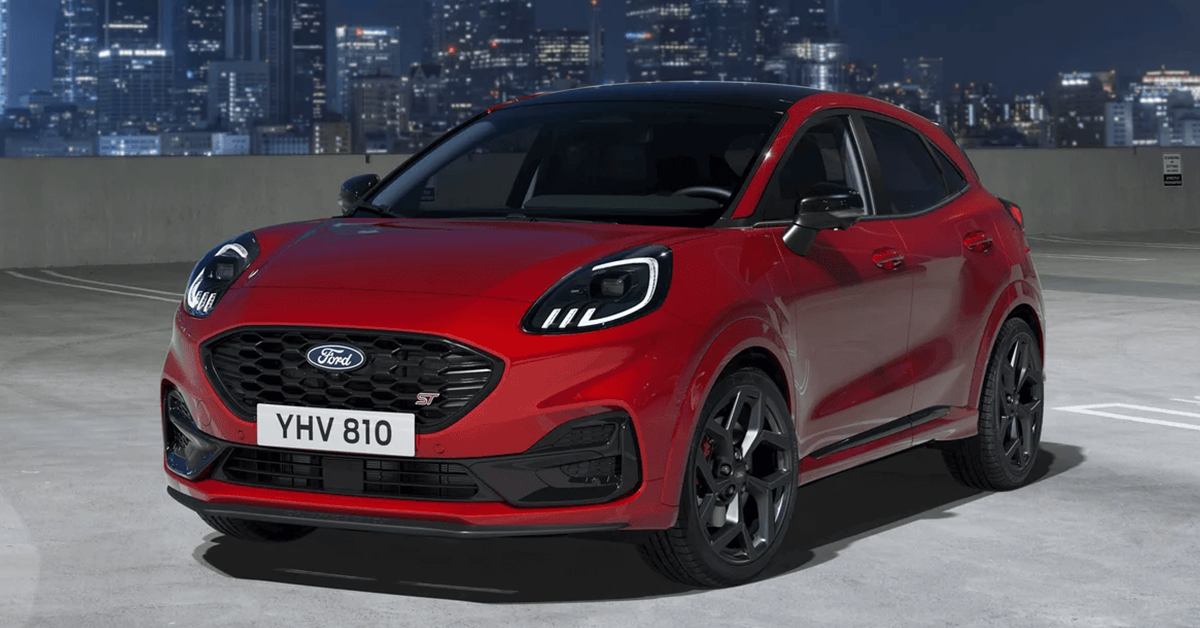
Official press image of the Ford Puma. | © Ford Motor Company
The Ford Puma from the 1997 sports coupe to today's compact crossover: the 2019 launch, the 2024 update, the ST Powershift, the electric Gen-E, boot space, prices where sources give them and sales in Europe and the UK.
The Ford Puma has been two very different cars. The first was a small three-door sports coupe built by Ford Europe from 1997, based on the Fiesta (reported). The second, which carries the name today, is a compact crossover that began production in October 2019 at Craiova in Romania (reported). This article covers both, but it is mostly about the crossover, which Ford calls its best-selling passenger vehicle in Europe in 2025 and the best-selling car of all in the UK in 2023, 2024 and 2025 (Ford). The Puma is a European model and is not sold in the United States.
| Today’s Puma | Compact crossover (Ford) |
| First Puma | Small sports coupe, from 1997 (reported) |
| Crossover production start | October 2019, Craiova, Romania (reported) |
| Built at | Ford Otosan Craiova Assembly Plant (Ford) |
| One millionth Puma | Celebrated May 2026 (Ford) |
| Hybrid engines | 1.0L EcoBoost Hybrid, 125 PS or 155 PS (Ford) |
| ST Powershift | 170 PS peak (Ford) |
| Puma Gen-E motor | 123.5 kW (168 PS), 290 Nm (Ford) |
| Boot, combustion | More than 450 litres (Ford) |
| Sold in the US | No |
Today’s Puma has two kinds of powertrain. Ford’s 2024 update lists a 1.0-litre EcoBoost Hybrid with 48-volt mild hybrid power, rated at 125 PS or 155 PS, plus a sporty Puma ST Powershift rated at 170 PS peak (Ford). The all-electric Puma Gen-E, revealed on December 3, 2024, uses a 43 kWh usable battery and a 123.5 kW (168 PS) front-mounted motor, according to Ford’s factsheet (Ford). A trade report gives the ST Powershift as 160 PS instead, so that figure is disputed (reported).
Practicality is the Puma’s selling point. Ford says the combustion Puma has an 80-litre MegaBox in the boot floor and more than 450 litres of boot space to the parcel shelf with five seats in use (Ford). The Puma Gen-E adds a 145-litre GigaBox, for up to 574 litres to the roof in five-seat mode, and a 43-litre front trunk (Ford). Ford says Puma Gen-E can charge from 10 to 80 per cent in approximately 23 minutes at up to 100 kW (Ford). Section six gives the sizes and section five covers the electric model.
Production has passed a milestone. Ford’s plant director at Craiova wrote in May 2026 that Ford had celebrated production of its one millionth Puma, which he called a significant milestone for the compact crossover (Ford). Ford builds the Puma and Puma Gen-E at Ford Otosan’s Craiova Assembly Plant in Romania, with the Gen-E’s electric drive units coming from Ford’s Halewood facility in the UK (Ford). A reported history says Ford invested 200 million euros in the plant for the Puma and that it employed 1,700 people (reported).
Sales are reported in more detail later. A reported history gives European sales of 118,180 in 2020, a peak of 159,704 in 2023 and 141,423 in 2025 (reported). In the UK, Ford says 55,488 Pumas were registered in 2025, 7,700 more than the next best-selling passenger vehicle (Ford). The Puma name also appears on Ford’s Rally1 hybrid rally car, which a reported history says has competed since 2022 (reported). The Puma sits in Ford’s European range below the Kuga, the model sold in North America as the Escape, which has its own article linked below.
Some limits apply. Ford’s European pages cover the 2024 update, the Gen-E and the 2026 editions well, but they do not describe the 2019 launch or the first Puma. Those parts come from reference histories and are tagged (reported). We found no Ford statement of the one millionth Puma’s build date, a Puma production total by year, or a US price, since the Puma is not sold in the US. Prices here are UK, Spanish and German figures from price lists, not Ford’s own. The history and models pages linked below cover the wider Ford range.
The first Puma was a small sports coupe based on the Fiesta. A reported history says the program began in 1993, when Ford’s then CEO Jac Nasser and small and medium vehicle design director Claude Lobo discussed a 2+2 coupe on a Fiesta chassis (reported). The first design, called the Lynx concept car, was unveiled at the Geneva Motor Show in 1996, and the production car was launched at the 1997 Geneva show (reported). Ford’s own pages we read do not cover the original Puma, so everything in this section is reported.
| Based on | Ford Fiesta (reported) |
| Concept | Lynx, Geneva 1996 (reported) |
| Production car shown | Geneva 1997 (reported) |
| Production | 1997 to 2001 or 2002 (reported) |
| Plant | Niehl, Cologne, Germany (reported) |
| Engines | 1.4, 1.6, 1.7 and Racing 1.7 (reported) |
| 1.7 output | About 123 to 125 hp (reported) |
| Racing Puma output | About 153 to 155 hp (reported) |
| Built | 133,000 (reported) |
| Length | 3,984 mm (reported) |
The dates are given differently by different sources. One history gives production as September 1997 to July 2002 (reported). Another says some were first registered in the UK as late as 2002, with production from 1997 to 2001 (reported). A used-car guide says the Puma was launched in 1.7-litre form in June 1997 and a 1.4-litre model followed in February 1998 (reported). We therefore describe it as built from 1997 to 2001 or 2002. It was built at Ford’s Niehl plant in Cologne, Germany, according to two references (reported).
The engines were four. The 1.4-litre made about 88 to 90 horsepower, the 1.6-litre about 102 to 104, and the 1.7-litre about 123 to 125, with the Racing Puma making about 153 to 155 (reported). A table in one review gives 88, 102, 123 and 153 horsepower, and another source gives 90, 103, 125 and 155 horsepower, so the sources round differently (reported). The 1.7 Zetec SE had variable camshaft timing and was developed with Yamaha, according to a review (reported). Ford’s March 1997 press release quoted 92 kW (125 horsepower) for it (reported).
Size and practicality were modest. A reference lists a length of 3,984 millimeters, a width of 1,837 millimeters, a height of 1,315 millimeters and a wheelbase of 2,446 millimeters (reported). It gives a kerb weight of 1,035 to 1,039 kilograms and a 5-speed manual transmission (reported). Ford’s 1997 press release, as quoted in a retrospective, claimed 725 liters of storage with the rear seat folded (reported). A used-car guide says the 1.7 reached 60 miles per hour in 8.8 seconds on the way to nearly 130 miles per hour (reported).
The Puma was cheap and popular. A reported history says the 1.7 launched in 1997 at 14,550 pounds, and that Ford sold 133,000 Pumas over five years (reported). A German report also says 133,000 first-generation Pumas were built (reported). The Racing Puma, developed by Ford Racing and converted by Tickford, was a limited run, and insiders suggested only about half of the planned 1,000 were sold (reported). A Thunder special edition was announced in late 2001 to mark the end of the model (reported).
The original Puma still has a following. A UK review calls it a performance bargain with a sweet chassis and a choice of engines, and says it made rival compact coupes feel under-developed (reported). The Puma name returned on a very different car in 2019, as the next section shows. The two have no shared platform or body style, which is why one reference history splits them into separate entries (reported). Used examples were listed in one review at about 3,000 pounds in excellent condition, which is a snapshot, not a current value (reported).
The new Puma was a different kind of car. A reported history says it was announced at Ford’s Go Further event in Amsterdam alongside the third-generation Kuga, with production and European sales beginning in 2019 (reported). Production started in October 2019 at Ford Romania’s Craiova plant, alongside the EcoSport, with Ford investing 200 million euros and employing 1,700 people (reported). It uses Ford’s global B-car platform, shared with the seventh-generation Fiesta (reported). The Kuga is the Escape’s European sister, and our Escape article is linked below.
| Launch event | Go Further, Amsterdam, with the Kuga (reported) |
| Production start | October 2019 (reported) |
| Plant investment | 200 million euros (reported) |
| Platform | Global B-car, shared with the Fiesta (reported) |
| 1.0L EcoBoost | 155 PS, 240 Nm (reported) |
| ST engine | 1.5L EcoBoost, 200 PS (reported) |
| ST Powershift | March 2023 (reported) or 2024 (Ford) |
| Flagship edition | Vivid Ruby Edition, December 2022 (reported) |
| Euro NCAP 2019 | Five stars (reported) |
| Europe sales, 2020 | 118,180 (reported) |
Reported engines were three. The 1.0-litre EcoBoost three-cylinder made 155 PS (114 kW) and 240 Nm, plus up to 50 Nm from the belt-driven starter, and a 48-volt, 0.48 kWh battery supported the mild hybrid version (reported). The sporty ST used a 1.5-litre EcoBoost three-cylinder with 200 PS (147 kW) (reported). A 1.5-litre EcoBlue diesel was also listed, though a German report says the diesel was gone from 2021 (reported). Transmissions were a 6-speed manual or a 7-speed dual-clutch automatic (reported).
The ST arrived in 2020. A reported history lists the 200 PS ST but gives no launch year, and says it was reviewed in late 2020 (reported). A later ST Powershift, with the 1.0-litre mild hybrid and an automatic transmission, is dated to March 2023 in the same history (reported). Ford’s own February 2024 release calls the Puma ST Powershift new, developed by Ford Performance with a special sports chassis, styling and specification (Ford). The two dates conflict, and we do not know whether Ford’s wording refers to the update rather than the launch.
Trims were arranged in steps. A reported history lists ST-Line X, Titanium, ST and a Vivid Ruby Edition as a flagship introduced in December 2022 (reported). A reported test in 2020 gave the boot as 456 litres, which matches the figure Ford later quoted for the outgoing model (reported). Ford’s 2024 release lists the outgoing model’s centre screen as 8 inches and its digital instrument cluster as 12.3 inches (Ford). The outgoing car also had fixed LED headlamps, according to Ford (Ford).
Awards and ratings are reported. A reported history says the Puma won a Car of the Year title from a UK new-car magazine in January 2020, a Small SUV of the Year award in January 2021 for the 1.0 hybrid Titanium, and a Sports SUV of the Year award in 2021 for the ST 200 Performance Pack (reported). Euro NCAP gave it five stars in 2019, with 94% for adults, 84% for children, 77% for pedestrians and 74% for safety assist (reported). The same history lists four stars in a 2022 retest, so the two ratings differ (reported).
Sales built quickly. A reported history gives European sales of 337 in 2019, 118,180 in 2020, 134,431 in 2021 and 136,956 in 2022, then 159,704 in 2023 (reported). In the UK it recorded 28,697 registrations in 2021, when it was the best-selling Ford and eighth overall, and was the fourth-best-selling car in 2022 (reported). It was the best-selling UK car in 2023, which Ford confirms (Ford). The same history lists Australian sales of 597 in 2020, 3,218 in 2021 and 2,408 in 2022 (reported).
Ford revealed the updated Puma on February 7, 2024, in Cologne, Germany, calling it an evolution of the UK’s best-selling car (Ford). The update simplified the engine range around Ford’s 1.0-litre EcoBoost Hybrid, which uses 48-volt mild hybrid power to save fuel or raise output to up to 155 PS (Ford). Ford lists a 125 PS version with a manual or Powershift automatic, a 155 PS version with Powershift, and the ST Powershift at 170 PS peak (Ford).
| Revealed | February 7, 2024, Cologne (Ford) |
| Engine family | 1.0L EcoBoost Hybrid, 48-volt (Ford) |
| Outputs | 125 PS, 155 PS; ST Powershift 170 PS peak (Ford) |
| 125 PS manual | 119 to 135 g/km CO2; 5.3 to 6.0 l/100 km (Ford) |
| 155 PS Powershift | 125 to 142 g/km CO2; 5.5 to 6.3 l/100 km (Ford) |
| ST Powershift | 135 to 146 g/km CO2; 6.0 to 6.5 l/100 km (Ford) |
| Instrument cluster | 12.8 inches (Ford) |
| Centre touchscreen | 12.0 inches (Ford) |
| Trims | Titanium, ST-Line, ST-Line X (Ford) |
| MegaBox | 80 litres (Ford) |
Ford gives fuel and emissions figures for each version. The 125 PS manual is listed at 119 to 135 grams per kilometre of CO2 and 5.3 to 6.0 litres per 100 kilometres on the WLTP cycle (Ford). The 125 PS Powershift is 127 to 143 grams and 5.6 to 6.3 litres, and the 155 PS Powershift is 125 to 142 grams and 5.5 to 6.3 litres (Ford). The ST Powershift is 135 to 146 grams and 6.0 to 6.5 litres, with a standard seven-speed automatic (Ford). Torque figures are not given on that page (Ford).
The ST’s output is disputed. Ford’s February 2024 release and its 2026 article both give 170 PS (Ford). A trade report says Ford originally quoted 170 PS but this has since been lowered by 10 PS, with torque of 200 Nm (reported). A Spanish price list names the version a 160 PS ST Powershift (reported). A reference history gives 170 hp in text and 168 hp in an infobox (reported). We show 170 PS as Ford’s figure and 160 PS as reported, and we cannot reconcile them.
The cabin changed the most. Ford fitted a 12.8-inch digital instrument cluster, up from 12.3 inches, and a 12.0-inch centre touchscreen, up from 8 inches (Ford). SYNC 4 has twice the computing power of the previous version, with wireless Apple CarPlay and Android Auto, wireless phone charging, Alexa Built-in and an optional 10-speaker B&O audio system (Ford). The 5G FordPass Connect modem replaced a 4G unit (Ford). Ford lists a sliding centre armrest and a flat-bottom two-spoke steering wheel (Ford). Ford adds that wireless phone charging may not work with every phone, and that the 360-degree camera only works below 10 km/h (Ford). Reverse Brake Assist and the Blind Spot Information System are listed for the new model (Ford). Ford describes the infotainment table’s centre screen as 12-inch, which rounds the 12.0-inch figure above (Ford).
Driver assistance and lighting grew. Ford lists optional Intelligent Adaptive Cruise Control with Stop and Go and Lane Centring, Predictive Speed Assist and a 360-degree surround-view camera that works below 10 km/h (Ford). Dynamic Matrix LED headlamps with Predictive Dynamic Bending Light and Glare-free High Beam were optional, and puddle lamps project the Puma logo (Ford). The trims were Titanium, ST-Line and ST-Line X, with ST described as a separate Powershift model and not a trim (Ford). There were six colours, with Cactus Grey new to the Puma (Ford).
Practicality was kept. Ford lists an 80-litre MegaBox in the boot floor, large enough for a small supermarket trolley, and says two sets of golf clubs fit upright (Ford). It says there are over 450 litres to the parcel shelf with five seats in use, although its comparison table prints 56 litres, which looks like a typo (Ford).
Ford revealed the all-electric Puma Gen-E on December 3, 2024, as the first zero-tailpipe Puma (Ford). Orders opened on December 3, 2024, with deliveries from spring 2025 (Ford). Ford builds it at Ford Otosan’s Craiova plant, with electric drive units from Halewood in the UK (Ford).
| Revealed | December 3, 2024 (Ford) |
| Motor | 123.5 kW (168 PS), 290 Nm (Ford) |
| Usable battery | 43 kWh (Ford) |
| 0 to 100 km/h | 8.0 seconds (Ford) |
| Top speed | 160 km/h (Ford) |
| WLTP range | Up to 376 km combined; 523 km city (Ford) |
| 2026 range | Up to 417 km (Ford) |
| DC charging | Up to 100 kW; 10 to 80 per cent in about 23 minutes (Ford) |
| Luggage | 574 litres to roof; 43-litre frunk (Ford) |
| Kerb weight | 1,563 kg (Ford) |
Ford’s factsheet gives the numbers. The front-mounted motor makes 123.5 kW (168 PS) and 290 Nm, and the usable battery is 43 kWh, with 0 to 100 km/h in 8.0 seconds and a top speed of 160 km/h (Ford). Electricity consumption is 13.1 kWh per 100 km for the Gen-E and 13.7 to 14.5 for the Premium (Ford). Ford says the battery is lithium-ion NMC and the same for both trims (Ford). A reference history gives a 46.0 kWh battery with 43.6 kWh usable and 166 hp, which conflicts slightly with Ford’s figures (reported).
Range and charging are set out by Ford. The Gen-E offers up to 376 km combined and 523 km city range on the WLTP cycle, while the Premium offers up to 364 km (or 347 km) combined and 506 km city (Ford). DC fast charging peaks at 100 kW, and a 10 to 80 per cent charge takes approximately 23 minutes, adding up to 124 km of range in 10 minutes (Ford). Ford did not give AC charging power in the factsheet (Ford). One fleet data listing gives a 53 kWh battery, which we cannot match to any Ford figure (reported).
The Gen-E has two trims. Standard equipment on the Puma Gen-E includes 17-inch alloy wheels, a 12.0-inch touchscreen with SYNC 4, a 12.8-inch digital instrument display, Alexa Built-in and Connected Navigation, wireless charging and a six-speaker audio system (Ford). The Premium adds 18-inch wheels, a ten-speaker B&O audio system with a soundbar, Dynamic Matrix LED headlights, keyless entry and a hands-free tailgate (Ford). Options include a panoramic roof, a Winter Pack and a Driver Assistance Pack (Ford). Colours include Electric Yellow and Digital Aqua Blue (Ford).
Weights and sizes are listed. Kerb weight is 1,563 kg for both trims, gross vehicle mass is 2,015 kg, and the maximum towable weight is 750 kg both braked and unbraked (Ford). The length is 4,214 mm, the width is 1,930 mm with mirrors and 1,805 mm without, the height is 1,555 mm and the wheelbase is 2,588 mm (Ford). The turning circle is 10.5 metres (Ford). The luggage space is 574 litres to the roof, 523 litres to the seat back, and 1,283 litres with two seats in use, plus a 43-litre frunk (Ford). Ford says the factsheet is preliminary.
Ford has promised an improved model. On November 17, 2025, Ford announced that the 2026 Puma Gen-E would offer over 400 km from a full charge on the WLTP cycle and over 550 km in the city, thanks to an optimised battery design (Ford). A later Ford article gives up to 417 km (Ford). Ford gave no new battery capacity, charging speed or price in the excerpts we read (Ford). A UK report gave the launch price as 29,995 pounds and said the first cars would arrive by spring 2025 (reported).
Ford’s Gen-E factsheet gives the electric model’s length as 4,214 mm and a wheelbase of 2,588 mm (Ford). A reference history gives the combustion crossover a length of 4,186 mm, a width of 1,805 mm, a height of 1,537 mm and the same 2,588 mm wheelbase (reported). The Gen-E is therefore 28 mm longer and 18 mm taller than those reported combustion figures, though the sources differ and we do not state a Ford combustion length (reported). The width without mirrors is 1,805 mm on both (Ford).
| Gen-E length | 4,214 mm (Ford) |
| Gen-E width | 1,930 mm with mirrors; 1,805 mm without (Ford) |
| Gen-E height | 1,555 mm (Ford) |
| Wheelbase | 2,588 mm (Ford) |
| Combustion boot | Over 450 litres (Ford) |
| MegaBox | 80 litres (Ford) |
| GigaBox | 145 litres (Ford) |
| Gen-E towing | 750 kg braked and unbraked (Ford) |
| Combustion towing | 1,100 kg braked in one review (reported) |
| Gen-E turning circle | 10.5 metres (Ford) |
Boot space is a Ford strength. Ford says the combustion Puma has over 450 litres to the parcel shelf with five seats in use, plus an 80-litre MegaBox (Ford). Ford’s table gives the outgoing model 456 litres (Ford). The Gen-E has up to 574 litres with its 145-litre GigaBox, and a 43-litre front trunk (Ford). The Gen-E’s 574 litres is a different measure from the combustion model’s boot, so the two are not a direct comparison (Ford). Ford adds that load capacity is limited by weight and weight distribution (Ford).
Efficiency varies by version. Ford’s 2026 article gives the Puma EcoBoost Hybrid at 119 to 146 grams per kilometre of CO2 and 5.3 to 6.5 litres per 100 kilometres, while another Ford article gives 120 to 143 grams and 5.3 to 6.3 litres for the 125 to 155 PS versions (Ford). The ST is listed at 135 to 146 grams and 5.9 to 6.5 litres in one Ford footnote and 6.0 to 6.5 litres in another (Ford). The ranges differ slightly by article, so we show the full range in the table.
Towing is modest. A UK review lists a maximum braked towing weight of 1,100 kg for the combustion Puma, with a detachable towbar as an option (reported). Ford’s Gen-E factsheet gives 750 kg both braked and unbraked (Ford). Reported 0 to 62 mph times run from 9.8 to 10.2 seconds for the 125 PS and 8.9 to 9.0 seconds for the 155 PS, with 7.4 seconds listed for the 170 PS ST (reported). Ford did not give those times for the combustion Puma in the pages we read.
Standard safety and assistance are listed for the Gen-E. Ford lists cruise control with Intelligent Speed Limiter, Driver Alert, Lane-Keeping Aid, Pre-Collision Assist, rear parking sensors, a rear-view camera, Speed Sign Recognition and Wrong Way Alert as standard (Ford). The Driver Assistance Pack adds Intelligent Adaptive Cruise Control with Stop and Go and Lane Centring, Predictive Speed Assist, Blind Spot Information System with Lane Change Warning, Cross Traffic Alert and a 360-degree camera (Ford). Euro NCAP’s ratings for the combustion Puma are given in the third section (reported).
Some limits apply. Ford’s factsheet for the Gen-E is marked preliminary and subject to change (Ford). We found no Ford fuel tank capacity, payload or kerb weight for the combustion Puma, and the 1,205 kg figure in a reference history is not Ford’s (reported). The Gen-E’s 1,563 kg kerb weight is Ford’s (Ford). For exact specifications of a particular Puma, use the owner’s manual or Ford’s European site for your market.
Ford’s pages did not list Puma prices in the excerpts we read, so these come from price lists in three markets (reported). A UK report says pricing for the revised Puma range starts at 26,350 pounds, or 29,995 pounds for the Gen-E, and that a 155 PS ST-Line X with the seven-speed automatic costs from 31,350 pounds before options (reported). A German catalogue lists the 1.0 EcoBoost Hybrid 125 PS ST-Line at 29,900 euros (reported). A Spanish list gives the 125 PS Titanium at 28,171 euros and the 160 PS ST Powershift at 39,709 euros (reported).
| UK range start | 26,350 pounds (reported) |
| Gen-E, UK | 29,995 pounds (reported) |
| Germany, 125 PS ST-Line | 29,900 euros (reported) |
| Spain, 125 PS Titanium | 28,171 euros (reported) |
| Spain, 160 PS ST Powershift | 39,709 euros (reported) |
| UK sales, 2025 | 55,488 (Ford) |
| Europe sales, 2023 | 159,704 (reported) |
| Europe sales, 2024 | 149,112 (reported) |
| Europe sales, 2025 | 141,423 (reported) |
| Best-selling UK car | 2023, 2024 and 2025 (Ford) |
The Spanish list gives more detail. It prices the 125 PS ST-Line at 29,200 euros, the 125 PS Titanium Powershift at 29,894 euros, the 125 PS ST-Line Powershift at 30,923 euros, the 125 PS ST-Line X at 31,880 euros and the same with Powershift at 33,602 euros (reported). The 155 PS ST-Line X Powershift is 34,220 euros (reported). A fleet data listing gives a Gen-E price of 26,245 pounds including a 2,500-pound plug-in car grant, which is not Ford’s figure (reported). Prices change by market and date, so check a local dealer.
Ford’s own sales claims are about rankings. Ford says Puma was its best-selling passenger vehicle in Europe in 2025 (Ford). It says Puma was the best-selling car of all in the UK in 2023, 2024 and 2025 (Ford). Ford’s UK release says 55,488 Pumas were registered in the UK in 2025, 7,700 more than the next best-selling passenger vehicle, and that Ford sold 118,998 passenger vehicles in the UK that year, up 8.22 per cent (Ford). Another report gives 55,487, one fewer, and says 48,340 were sold in 2024 (reported).
European totals are reported. A reference history gives 118,180 in 2020, 134,431 in 2021, 136,956 in 2022, 159,704 in 2023, 149,112 in 2024 and 141,423 in 2025 (reported). A report on 2025 places the Puma seventh among Europe’s best-selling crossovers on preliminary figures, behind the T-Roc, Tiguan and Yaris Cross (reported). Another report says the Puma was the best-selling mild-hybrid model in Europe in 2024 with 137,000 units, against 143,000 in 2023 (reported). That is a separate measure from the 149,112 total, since it counts only mild hybrids.
Monthly data show how the Puma moves. A report says 19,269 were registered in Europe in March 2025, up one per cent on March 2024, and 10,499 in January 2025, ranking 19th (reported). It also gives 10,278 for November 2024, which ranked 22nd and was 26 per cent fewer than a year earlier (reported). These monthly figures are from JATO Dynamics and reported by a third party, not Ford (reported). In the UK, the Puma ranked tenth in February 2025 with 1,466 units, according to SMMT data (reported).
Elsewhere sales were smaller. A reference history gives Australian sales of 597 in 2020, 3,218 in 2021 and 847 in 2024, South African sales of 368 in 2023 and 873 in 2024, and Turkish sales of 8,866 in 2024 (reported). The Puma Gen-E is eligible for the UK’s maximum 3,750-pound Electric Car Grant, according to one report, which is not Ford’s statement (reported). The Ford models page linked below covers the wider range, and the Puma is not sold in the United States.
BlueCruise has reached the Puma. On November 17, 2025, Ford said the Puma Gen-E is the first Puma offered with BlueCruise and Ford’s smallest vehicle with the system (Ford). BlueCruise came on 2026 model year Gen-E vehicles from spring 2026, only when equipped with the Driver Assistance Pack (Ford). Ford says it covers designated highways called Blue Zones, has been approved in 16 European markets, and that the driver’s eyes must stay on the road (Ford). It reported over 135,000 km of Blue Zones as of October 2025 (Ford).
| BlueCruise first offered | Puma Gen-E, 2026 model year (Ford) |
| BlueCruise approval | 16 European markets (Ford) |
| Blue Zones, October 2025 | Over 135,000 km (Ford) |
| Blue Zones, July 2026 | Over 139,000 km (Ford) |
| BlueCruise Edition | Puma and Puma Gen-E (Ford) |
| Gen-E Black Edition | Black roof, 18-inch wheels (Ford) |
| ST Edition | KW coilovers, 10 mm lower (Ford) |
| B&O audio | 650 W (Ford) |
| Connected Navigation trial | 12 months where eligible (Ford) |
| Rally1 | Hybrid rally car since 2022 (reported) |
Ford’s July 2026 article extended it. Ford says BlueCruise is offered on the Puma, which it calls the smallest vehicle in its European range, with over 139,000 km of Blue Zone motorways across Europe (Ford). Access is by one-time purchase or a monthly or annual plan (Ford). A BlueCruise Edition for the Puma and Puma Gen-E includes the one-time purchase, Vapor Blue paint and black-painted 18-inch wheels (Ford). The Blue Zone figure rose from 135,000 km to 139,000 km between Ford’s two articles, which is a difference in date, not a conflict.
Two new special editions went on order in July 2026. The Puma Gen-E Black Edition has optional Azura Blue paint with a black roof and mirror caps, Asphalt Black Matt 18-inch wheels, Candy Blue stitching and standard Dynamic Matrix LED headlights (Ford). The Puma ST Edition adds the Handling Pack with KW Automotive coilover suspension that lowers ride height by 10 mm, plus Azura Blue paint, a black roof, illuminated scuff plates and a sports steering wheel (Ford). Ford gave no prices or on-sale dates in the article (Ford).
Audio and connectivity are listed too. Ford says B&O Premium Audio with 650 W output is standard on the Puma ST Powershift, the BlueCruise Editions and the Puma Gen-E Premium, and optional on the ST-Line X (Ford). Premium Connectivity, with SYNC 4 streaming, games and Stingray Karaoke, is available on all Puma models, with a 90-day free trial where the vehicle qualifies (Ford). Connected Navigation is standard on BlueCruise Editions and available on other trims, with a 12-month free trial where the vehicle qualifies (Ford). Availability varies by market.
The Puma name also appears in rallying. A reported history says the Puma Rally1 is a hybrid rally car based on the road Puma, competing since 2022 and replacing the Fiesta WRC, and that it was revealed at Goodwood in 2021 (reported). We found no Ford page on the Rally1 in this research. It shares only the name and styling cues with the road car, since a rally car is a very different machine.
For buyers, the picture is clear. The Puma is available as an EcoBoost Hybrid, a sporty ST Powershift and an electric Gen-E, in a compact body with unusually large boot storage (Ford). Prices differ widely by market, so check a local dealer. The Puma is not sold in the United States, and Ford has not announced a US launch in the pages we read. The history and models pages linked above cover the rest of Ford’s range, and the Escape article covers the Kuga’s American counterpart, which has been discontinued.