 Brands
Ford Everest — From the 2003 Debut to Platinum and Tremor
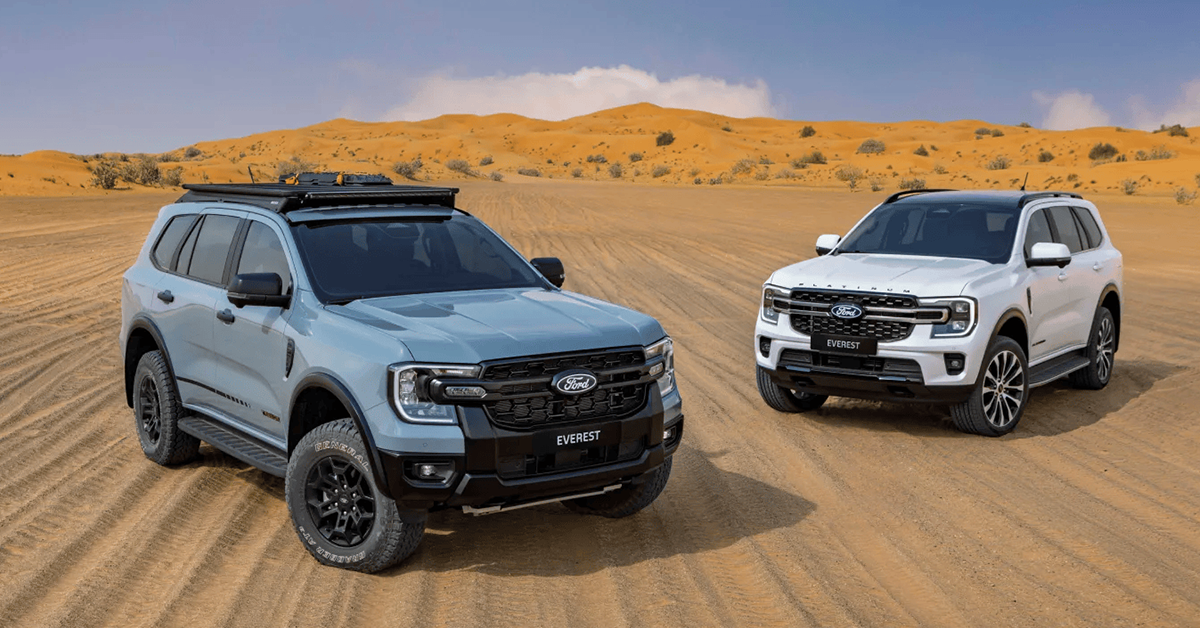
Official press image of the Ford Everest. | © Ford Motor Company
The Ford Everest from the 2003 debut and the Endeavour in India to the third generation: engines, towing, the Platinum, Wildtrak and Tremor, the 2026 lineup, prices where sources give them and sales in Australia and Asia.
The Ford Everest is a seven-seat, body-on-frame SUV that Ford builds in Thailand and sells in markets across Asia-Pacific, Africa and the Middle East. Ford says it sells the Everest in more than 110 markets and that every Everest is built at its AutoAlliance Thailand plant (Ford). It has had three generations since 2003, and a reported history says the first was designed specifically for Asian markets and is derived from the Ranger pickup (reported). In India the same SUV was sold as the Endeavour, a name that avoided a clash with a spice brand (reported).
| Body | Seven-seat SUV (Ford) |
| First shown | March 2003, Bangkok (reported) |
| Built at | AutoAlliance Thailand, Rayong (Ford) |
| Markets | More than 110 (Ford) |
| India name | Endeavour (reported) |
| Current generation | Third, revealed March 1, 2022 (Ford) |
| Top diesel | 3.0L V6, 184 kW, 600 Nm (Ford) |
| Max braked towing | 3,500 kg (Ford) |
| Transmission | 10-speed automatic (Ford) |
| Sold in the US | No (reported) |
The current Everest is the third generation, and Ford gave it a global debut on March 1, 2022, in Melbourne, Australia (Ford). Ford Australia’s media kit lists two diesel powertrains at launch, a new 3.0-litre V6 turbo-diesel and a proven 2.0-litre Bi-Turbo diesel, both with a 10-speed automatic (Ford). The V6 makes 184 kW and 600 Nm, and Ford rates the SUV for up to 3,500 kg of braked towing when properly equipped (Ford). Those figures come from Ford’s 2026 lineup article, which also lists the changes for the updated model (Ford).
The Everest is a different vehicle from the American Explorer and from the Bronco, both of which have their own articles on this site. Ford’s Everest pages that we read do not list the United States among its markets, and we found no US price or US launch plan, so we treat it as a vehicle for other markets. Its closest relative is the Ranger pickup, whose platform it shares, according to reports (reported). A reported history labels the platform T6 for both the second and third generations (reported).
The range has changed a great deal. Ford’s 2026 article says the new Everest Active replaces the Ambiente and Trend variants, and that Sport, Platinum and Wildtrak remain (Ford). Ford’s separate Tremor article describes the updated 2026 Everest Tremor as the most off-road capable factory-built Everest ever (Ford). Trim names also vary by country, with Titanium, Titanium Plus and Platinum used in some Asian markets (reported). We therefore describe the trims market by market where the sources allow, and we say so where they do not.
Sales have been strongest in Australia. A reported sales table gives 26,494 Everests in Australia in 2024 and 26,161 in 2025 (reported). Industry data say the 2025 total edged the Toyota Prado by 55 units, making it the top-selling large SUV in its segment for a second year (reported). Other markets are far smaller, with 13,056 in Vietnam and 7,110 in Thailand in 2025 in the same table (reported). Section seven covers sales and prices, and each figure there is tagged by source type.
Some limits apply. Ford’s newsroom covers the 2015 debut, the 2022 launch, the 2026 update, the Tremor and the Thailand plant, but it does not give a global production total or a full history of the first two generations. Those parts come from reference histories and are tagged (reported). We also found no Ford statement of boot capacity or fuel economy, so those are not given. Prices here are Australian and Thai listings, not US prices, and they change by market and date.
The first Everest arrived in 2003. A reported history says Ford unveiled it in March 2003 at the 24th Bangkok International Motor Show, although another listing gives January 2, 2003, and we show both (reported). It says development took about four years and roughly 100 million US dollars including manufacturing investment, led by chief platform engineer Masaki Makihara (reported). The first Everest was built at AutoAlliance Thailand in Rayong, with kits assembled in Vietnam and India (reported). Ford’s pages we read do not describe this launch.
| Unveiled | March 2003 or January 2, 2003 (reported) |
| Show | 24th Bangkok International Motor Show (reported) |
| Development | About four years, about 100 million US dollars (reported) |
| Ranger parts shared | About 60 per cent (reported) |
| Seats | Seven; 10 in Indonesia (reported) |
| Rear suspension | Live axle with leaf springs (reported) |
| Main plant | AutoAlliance Thailand, Rayong (reported) |
| Kit assembly | Vietnam and India (reported) |
| 2006 update | Ranger-style body panels, new fascia (reported) |
| Production years | 2003 to 2015 (reported) |
It was a Ranger-based SUV. A reported history says the first Everest shares about 60 per cent of its components with the Ranger, including the 2.5-litre intercooled turbo-diesel and the exterior styling up to the B-pillars (reported). It had a double-wishbone front suspension, a live rear axle with leaf springs and no lockable rear differential (reported). The layout was three rows and seven seats, and Indonesia also offered a 10-seat version with face-to-face third-row seats (reported). Another source describes the first car as derived from a Mazda-based Ranger (reported).
The engine list was broad. A reported history lists a 2.6-litre petrol four-cylinder, a 2.5-litre diesel, a 2.5-litre turbo-diesel and a 3.0-litre turbo-diesel, all four-cylinders, without power figures (reported). Transmissions were a 4-speed and a 5-speed automatic, with a manual option listed in one table (reported). The 5-speed automatic with a BorgWarner transfer case and shift-on-the-fly four-wheel drive arrived with the 2006 update, according to the same history (reported). We do not give power or torque for these early engines because the sources we found do not state them.
The first-generation car was refreshed several times. A reported history lists a January 2006 update that replaced the whole front and side body panels to match the redesigned Ranger, with a new fascia, transmission and improved engine (reported). It lists a May 2009 update with a rounder fascia, 18-inch alloys and new tail lamps, a September 2012 grille revision and an August 2013 final facelift with a new front bumper (reported). Photo captions on the same page call updates 2007, 2010 and 2014, so the sources disagree on the years (reported).
The generation numbering is not settled. The same history says the 2006 to 2015 model is sometimes called the second-generation Everest by Ford or by journalists, which conflicts with its own heading that starts the second generation in 2015 or 2016 (reported). We follow the common three-generation count, in which the original runs from 2003 to 2015, the T6-based car from 2015 to 2022 and the current car from 2022. Where a source uses another count, we say so. Production dates are given as 2003 to 2015 for the original (reported).
Sales in the early years were small. A reported table gives Indonesian sales between 392 and 1,870 a year from 2003 to 2010, and Indian sales of 3,003, 1,510 and 788 for 2011, 2012 and 2013 in the order the table lists them (reported). Those figures cover only some markets, and the table gives no global total (reported). Ford does not give a total either. The early Everest was therefore a regional product, which is why the second generation, shown in 2015, was developed with a wider market in mind.
India got the Everest as the Endeavour. A reported history says the name avoided a clash with an Indian spice brand and that the Endeavour launched on October 14, 2003 (reported). Another listing says it was introduced in India in 2003 (reported). Production and sales ended on September 9, 2021, when Ford closed its Indian plants, and attempts to continue production under a contract arrangement failed (reported). A second reference gives second-generation Indian production as 2016 to 2021 (reported). Ford’s pages we read do not cover the Endeavour.
| Endeavour launch | October 14, 2003 (reported) |
| Endeavour end | September 9, 2021 (reported) |
| Concept shown | Sydney, August 2013 (reported) |
| ASEAN debut | Bangkok, March 25 to April 5, 2015 (Ford) |
| 2015 engines | 3.2L five-cylinder and 2.2L four-cylinder diesel (Ford) |
| 2015 transmission | Six-speed automatic (Ford) |
| Thai 2.2L Titanium 4x2 | 1,269,000 baht (Ford) |
| Thai 3.2L Titanium+ 4x4 | 1,599,000 baht (Ford) |
| 2018 update | 2.0L bi-turbo diesel, 10-speed automatic (reported) |
| Production years | 2015 to 2022 (reported) |
The second generation was shown in stages. A reported history says a near-production concept appeared at a Ford event in Sydney in August 2013 and the production version was shown in November 2014 before a Guangzhou debut (reported). Ford’s own newsroom describes the ASEAN debut of the new Everest at the 36th Bangkok International Motor Show, which ran from March 25 to April 5, 2015 (Ford). The two accounts therefore describe different events, and we show both. Ford says development was led by its Asia Pacific design and product development teams (Ford).
Ford’s 2015 release gives the main specification. The new Everest had a seven-seat configuration, a 3.2-litre Duratorq five-cylinder TDCi diesel and a 2.2-litre four-cylinder TDCi diesel, with a six-speed automatic transmission (Ford). Ford did not state power, torque or towing figures in that release (Ford). It listed first-in-segment features for Thailand, including a Terrain Management System, a panoramic sunroof, third-row PowerFold seats, a power tailgate, Active Park Assist and a Blind Spot Information System with Cross Traffic Alert (Ford). Infotainment was SYNC 2 with an eight-inch touchscreen (Ford).
Ford also gave Thai launch prices in baht. The 2.2-litre Titanium 4x2 started at 1,269,000 baht, the 3.2-litre Titanium 4x4 at 1,459,000 baht and the 3.2-litre Titanium+ 4x4 at 1,599,000 baht (Ford). Bookings opened at Ford dealers in Thailand, with customer deliveries starting in the third quarter (Ford). Ford said both the Ranger and the Everest would be built at AutoAlliance Thailand for domestic sale and export across the region (Ford). The colours were Cool White, Black Mica Metallic, Aluminum Metallic, Sparkling Gold Metallic and Sunset Metallic (Ford).
The design and engineering changed. A reported history says the second generation had rounder proportions and was shorter than the first but wider and taller, with the wheelbase reduced from 2,860 mm to 2,850 mm (reported). It lists a 6-speed manual and 5-speed, 6-speed and 10-speed automatics across its life, and says development was led by Ford Australia under chief program engineer Todd Hoevener (reported). Production was spread across Thailand, China, South Africa, India and Cambodia in market-specific builds, according to the same page (reported). That list is reported, and Ford did not confirm it in the pages we read. The American Explorer, covered in our Explorer article linked below, is a different vehicle.
A 2018 update changed the range. A reported history says the May 2018 facelift added design tweaks, a new 2.0-litre bi-turbo diesel, a 10-speed automatic, standard autonomous emergency braking and a kick-activated power tailgate, with Titanium and Platinum trims mentioned (reported). A Thai update for the 2021 model year followed in late 2020 (reported). The French military also used a vehicle based on this Everest, the Arquus Trapper VT4, with the 4,000th unit announced on September 15, 2022 (reported). Production of the second generation is listed as 2015 to 2022 (reported).
The third-generation Everest debuted on March 1, 2022, in Melbourne, Australia (Ford). A reported history says it was developed by Ford Australia and shares its front-end components with the new Ranger (reported). Ford Thailand also showed it at the Bangkok International Motor Show in March 2022, and a report gives the Thai launch as March 21, 2022 (reported). Another report says the Australian launch was May 12, 2022, with Ambiente, Trend, Sport and Platinum variants (reported). The Everest won a major Australian car-of-the-year award in 2022, according to one history (reported).
| Global debut | March 1, 2022, Melbourne (Ford) |
| Thai launch | March 21, 2022 (reported) |
| Australian launch | May 12, 2022 (reported) |
| Launch engines | 3.0L V6 and 2.0L Bi-Turbo diesel (Ford) |
| Transmission | 10-speed automatic (Ford) |
| Track increase | 50 mm (Ford) |
| Wading depth | 800 mm (Ford) |
| Braked towing | 3,500 kg with Tow Pack (Ford) |
| Airbags | Nine (Ford) |
| Platinum wheels | 21-inch (Ford) |
Ford describes the launch lineup in its Australian media kit. It offered a new 3.0-litre V6 turbo-diesel and the 2.0-litre Bi-Turbo diesel, both with a 10-speed automatic (Ford). The V6 is exclusive to Platinum and available on Sport, and the four-wheel-drive models use a permanent system with an electronically controlled two-speed transfer case (Ford). Rear-wheel drive was offered only on Ambiente and Trend (Ford). Ford does not give kW or Nm in that kit, but launch reports give 184 kW and 600 Nm for the V6 and 154 kW and 500 Nm for the Bi-Turbo (reported).
The structure grew slightly. Ford says the track was increased by 50 mm and that the Everest can wade through water up to 800 mm at 7 km/h or less (Ford). A reported history says wheelbase and track are each about 50 mm longer than before, and a specification listing gives a 2,900 mm wheelbase (reported). Ford says braked towing is up to 3,500 kg with the optional Tow Pack, and roof rails carry 350 kg static and 100 kg dynamic load (Ford). A reported history adds that an electromechanical clutch pack replaces a conventional centre differential (reported).
The cabin moved upmarket. Ford says the Everest seats up to seven, with a 60:40 split second row and a 50:50 split third row in the seven-seat Platinum (Ford). The digital instrument panel is 8 inches on Ambiente, Trend and Sport and 12.4 inches on Platinum, and the centre touchscreen is 10.1 inches on Ambiente and 12 inches on Trend, Sport and Platinum (Ford). Wireless charging is fitted to all variants, and Platinum gets exterior zone lighting as standard (Ford). Heated and ventilated front seats are standard on Sport and Platinum and optional on Trend (Ford).
Safety and assistance were a focus. Ford lists nine airbags, a Blind Spot Information System that covers trailers up to 2.4 metres wide and 10 metres long, and lane-keeping with road-edge detection on rural roads between 65 and 110 km/h (Ford). Adaptive cruise control works from a minimum of 20 km/h, with Stop and Go from 0 km/h, and Reverse Brake Assist is active at 2 to 12 km/h (Ford). Matrix LED headlamps and Active Park Assist 2.0 were Platinum only at launch (Ford). Ford says these features supplement the driver and do not replace attention.
The rollout varied by market. A reported history lists launch dates of March 21, 2022 in Thailand, July 28, 2022 in the Philippines, July 1, 2022 in Vietnam, September 2022 in New Zealand and September 28, 2022 in South Africa (reported). It lists June 8, 2023 for Indonesia and October 10, 2023 for the Middle East, where grades are XLS, XLT and Limited with a 2.3-litre EcoBoost petrol (reported). It also says Australia dropped its two-wheel-drive variants in August 2025 under new vehicle efficiency rules (reported). Those dates are reported, and Ford’s pages we read do not confirm them.
The Everest’s engines now cover diesel and petrol. Ford’s 2026 lineup article lists a 3.0-litre V6 turbo-diesel making 184 kW at 3,250 rpm and 600 Nm from 1,750 to 2,250 rpm (Ford). It also lists a 2.0-litre single-turbo diesel making 125 kW at 3,500 rpm and 405 Nm from 1,750 to 2,500 rpm (Ford). A 10-speed automatic is now standard on all models, and an electronically controlled Advanced 4WD system is offered depending on market (Ford). Ford does not say which grade uses which diesel in that article.
| 3.0L V6 turbo-diesel | 184 kW at 3,250 rpm; 600 Nm (Ford) |
| 2.0L single-turbo diesel | 125 kW at 3,500 rpm; 405 Nm (Ford) |
| 2.0L Bi-Turbo diesel | 154 kW; 500 Nm (reported) |
| 2.3L EcoBoost petrol | 202 kW at 5,900 rpm; 420 Nm (Ford) |
| 2.7L V6 EcoBoost, Middle East Tremor | 231 kW; 542 Nm (Ford) |
| Transmission | 10-speed automatic, standard (Ford) |
| Max braked towing | 3,500 kg (Ford) |
| Unbraked towing | 750 kg (reported) |
| Platinum gross vehicle weight | 3,150 kg (reported) |
| Ranger plug-in hybrid battery | 11.8 kWh usable (Ford) |
The 2.0-litre Bi-Turbo is reported separately. Launch-era reports give it 154 kW and 500 Nm, which is 3 kW lower than the outgoing 2.0-litre but with the same torque (reported). Ford’s 2026 article lists a 2.0-litre single-turbo diesel at 125 kW and 405 Nm, which is a different output (Ford). The two may be different engines or different tunes, and we cannot tell from the pages we read. We therefore show both and attribute each. A reported review says the 2.0 diesel claims 7.2 litres per 100 km and the V6 claims 8.5 litres, with 9.5 litres in the Tremor (reported).
A petrol engine is offered in some markets. Ford’s 2026 article lists a 2.3-litre EcoBoost turbocharged petrol making 202 kW at 5,900 rpm and 420 Nm at 3,350 rpm with the 10-speed automatic, depending on market (Ford). Two reports give conflicting outputs for the same engine, 275 PS in China and 300 hp in Vietnam (reported). Ford’s 202 kW is about 275 PS, so the Chinese figure agrees with Ford and the Vietnamese one does not. The Middle East launched with the 2.3-litre petrol in October 2023, according to a reported history (reported).
The Middle East Tremor uses a different engine. Ford says it has a 2.7-litre V6 EcoBoost petrol making 231 kW and 542 Nm, while the Tremor in Australia, New Zealand and South Africa uses the 3.0-litre V6 diesel (Ford). Both are paired with a 10-speed automatic and full-time four-wheel drive (Ford). A reported history gives the 2.7-litre as 310 hp and 542 Nm, which matches Ford’s 231 kW (reported). A twin-turbo layout is listed in the same history, but Ford’s article does not state it (reported).
Towing is a strength. Ford says the Everest’s maximum braked towing is 3,500 kg, with the proper equipment and subject to cargo, configuration, accessories and passenger count (Ford). The Tremor retains 3,500 kg using a Genuine Ford tow pack, which may be optional at extra cost depending on the market (Ford). A specification listing gives the 2025 Platinum a braked capacity of 3,500 kg, an unbraked capacity of 750 kg, a gross vehicle weight of 3,150 kg and an unladen weight of 2,492 kg (reported). A second listing gives a gross vehicle weight of 3,000 to 3,150 kg across grades (reported).
Not every figure is available. Ford does not give acceleration times, top speed or fuel economy for the Everest in the pages we read. The fuel figures above are claims from a reported review, not Ford’s. We found no Everest plug-in hybrid or electric model. Reports say Ford Australia has not confirmed an Everest plug-in, and a May 2026 report says electric technology falls short of the Ranger and Everest buyers’ requirements (reported). Ford does sell a Ranger plug-in hybrid with a 2.3-litre EcoBoost, a 75 kW motor and an 11.8 kWh battery, but that is a different vehicle (Ford).
The Everest is sold in several trims, and they differ by market. In Australia, the launch lineup was Ambiente, Trend, Sport and Platinum, according to Ford’s media kit (Ford). Ford’s 2026 article says Everest Active now replaces Ambiente and Trend, and that Sport, Platinum and Wildtrak remain (Ford). A reported history lists Platinum in Australia, Malaysia and Thailand, Titanium in Indonesia, Malaysia and the Philippines, Platinum+ in Vietnam and Titanium+ in the Philippines and Thailand (reported). The same name can therefore mean different equipment in different countries.
| Australian launch trims | Ambiente, Trend, Sport, Platinum (Ford) |
| 2026 entry trim | Everest Active, replaces Ambiente and Trend (Ford) |
| Platinum wheels | 21-inch (Ford) |
| Platinum new paint | Acacia Green pearlescent (Ford) |
| Wildtrak return | 950 units or 1,000 units (reported) |
| Tremor added in Australia | August 2024 (reported) |
| Tremor ground clearance | 255 mm (Ford) |
| Tremor approach angle | 32 degrees (Ford) |
| Tremor departure angle | 26.8 degrees (Ford) |
| Tremor gross vehicle mass | 3,240 kg (Ford) |
The Platinum is the luxury model. Ford’s 2026 article lists a new Acacia Green pearlescent paint, a gloss black mesh grille with a Steel Armour Chrome centre bar, 21-inch Ebony Gloss Black wheels, dark chrome interior detailing and a new quilted seat design with Urban Grey stitching (Ford). At launch, Ford said Platinum was powered only by the 3.0-litre V6 with a 10-speed automatic and permanent four-wheel drive (Ford). It also had a 12.4-inch digital instrument panel, heated second-row seats and a heated steering wheel (Ford).
The Sport sits below it. Ford’s 2026 article describes a Sport interior with an Ebony Black and Medium Dark Grey instrument panel, Medium Dark Grey contrast stitching and a two-tone seat with a Medium Dark Grey upper insert (Ford). The Active has Ebony Black and Magnetite painted decorative elements on the steering wheel, door panels, instrument panel, screen surround and air registers (Ford). All models now have a 12-inch portrait touchscreen with SYNC 4A, an electronic park brake and an e-shifter (Ford). A 12.4-inch digital instrument display and Matrix LED headlamps are listed for the Wildtrak (Ford).
The Wildtrak has returned more than once. A reported 2025 price list shows a Wildtrak 4x4 V6 limited to 950 units, described as the reintroduction of the adventure-themed model for a limited time (reported). A reported history says the Wildtrak returned in April 2026 as a 1,000-unit limited edition with orange accents (reported). These may be two separate limited runs, and we cannot confirm that from the sources, so we show both counts. Ford’s 2026 article lists Wildtrak among the series but gives no unit number (Ford).
The Tremor is the off-road specialist. Ford’s June 2026 article lists Bilstein position-sensitive dampers, a lifted ride height, a wider 1,650 mm track, 17-inch alloys with General Grabber A/T tyres, a locking rear differential, a front steel bash plate and two front recovery hooks (Ford). It has seven drive modes, including Rock Crawl, which Ford says is exclusive to the Tremor in the Everest range (Ford). A reported history says the Tremor was added in Australia in August 2024 (reported). A reported test says the revised springs add 29 mm of ground clearance (reported).
Ford gives the Tremor’s off-road numbers. Running ground clearance is 255 mm, wading depth is 800 mm at a steady 7 km/h, the approach angle is 32 degrees, the departure angle is 26.8 degrees and the ramp breakover angle is 23.9 degrees (Ford). Gross vehicle mass is 3,240 kg, gross combined mass is 6,350 kg and payload is 760 kg for seven-seat variants (Ford). A reported comparison gives the standard MY23 Everest an approach angle of 30.4 degrees and a ramp angle of 22.2 degrees (reported). Ford says the Tremor is sold in Australia and is coming to South Africa and the Middle East (Ford). Readers who want to compare it with a smaller off-roader can read our Bronco article, linked below.
Ford detailed the updated 2026 Everest in May 2026. The article says Everest Active replaces the Ambiente and Trend, adds new exterior finishes in Ebony Gloss Black, Asphalt Black Matt and Steel Armour Chrome, and brings body-colour door mirrors and handles and Ebony Gloss Black roof rails (Ford). It lists a 12-inch portrait touchscreen with SYNC 4A as standard on all models, with a 360-degree camera, Zone Lighting and a Trailer Connection Alarm, depending on market (Ford). Ford says not all variants or features are available in all countries (Ford).
| 2026 entry trim | Everest Active (Ford) |
| Standard screen | 12-inch portrait SYNC 4A (Ford) |
| Tremor Pro Power Onboard | 400 W at 230 V (Ford) |
| Australia 2025 Platinum | A$81,200, A$82,390 or A$81,115 (reported) |
| Australia 2025 Tremor | A$76,590 or A$77,490 (reported) |
| Australia 2025 Sport V6 | A$74,640 or A$75,540 (reported) |
| Australia sales, 2024 | 26,494 (reported) |
| Australia sales, 2025 | 26,161 (reported) |
| Thailand sales, 2025 | 7,110 (reported) |
| Vietnam sales, 2025 | 13,056 (reported) |
The updated Tremor was detailed a month later. Ford says it has an 8-inch digital instrument cluster, a 12-inch portrait touchscreen with wireless Apple CarPlay and Android Auto, a wireless charging pad and Pro Power Onboard, which supplies 400 W at 230 V from a rear console inverter (Ford). The driver’s seat has 10-way power adjustment with memory, and both front seats are heated and ventilated (Ford). Seven seats are standard in Australia, New Zealand and South Africa, and Australian customers can delete the third row at no cost (Ford). Colours are Command Grey, Arctic White, Meteor Grey, Aluminium and Shadow Black (Ford).
Australian prices are reported, not Ford’s. A 2025 price list shows the Ambiente 4x2 Bi-Turbo at 54,240 Australian dollars, the Ambiente 4x4 at 59,240, the Sport 4x2 at 63,740, the Trend 4x4 at 67,040, the Sport 4x4 V6 at 74,640, the Tremor at 76,590, the Wildtrak at 76,950 and the Platinum at 81,200, before on-road costs (reported). Another listing for 2025 gives the Sport V6 at 75,540, the Tremor and Wildtrak at 77,490 and the Platinum at 82,390 (reported). A third gives the Platinum from 81,115 (reported). These differ by date.
Later listings show higher prices. A 2026 model listing gives the Active from 64,057, the Ambiente at 64,582, the Trend at 72,772, the Sport at 74,557, the Tremor and Wildtrak at 86,107 and the Platinum at 89,705 (reported). That list does not say whether prices include on-road costs, and the jump from 2025 may reflect a different basis, so we do not compare them. Ford’s 2026 article gives no prices (Ford). The Thai 2015 launch prices in section three are Ford’s own. Check a local dealer for current pricing in your market.
Sales are reported through industry data. The Everest sold 26,494 in Australia in 2024 and 26,161 in 2025, a 1.3 per cent fall, and it ranked fifth overall in 2025 (reported). It led the large SUV segment for a second year, ahead of the Toyota Prado by 55 units, 26,161 against 26,106 (reported). The same table gives Thailand at 12,037 in 2023, 8,128 in 2024 and 7,110 in 2025, and Vietnam at 13,056 in 2025 (reported). It gives the Philippines at 8,569 in 2023 and 8,538 in 2024 (reported). Ford’s own pages we read give no sales totals.
Some data are patchy. A report on August 2026 Australian sales says Ford’s two biggest names there suffered large declines, which it attributes in part to delayed Ranger deliveries and new Chinese competition (reported). We do not use month figures because they are volatile. A reported sales table also has blank cells for several markets and years, which reflect gaps in the data and not zero sales (reported). Ford’s wider range is covered on our models page, linked below. We found the Everest in no US lineup.
Ford publishes detail about how the Everest is made. It says every Everest is built at AutoAlliance Thailand, and that a new Everest leaves the line about every two minutes (Ford). Body production and assembly use 320 industrial robots and 25 collaborative robots, and each body has more than 3,600 spot welds (Ford). Before painting, each body is dipped in 10 chemical baths for corrosion protection, and more than 30 AI cameras monitor the trim, chassis and finish lines (Ford). Ford does not give an annual production total in that article.
| Plant | AutoAlliance Thailand (Ford) |
| Line rate | About one Everest every two minutes (Ford) |
| Robots | 320 industrial and 25 collaborative (Ford) |
| Spot welds per body | More than 3,600 (Ford) |
| Pre-paint baths | 10 chemical baths (Ford) |
| AI cameras on lines | More than 30 (Ford) |
| Water test | Five minutes per vehicle (Ford) |
| Plant solar power | Six megawatts (Ford) |
| Platinum wheelbase | 2,900 mm (reported) |
| Tremor gross combined mass | 6,350 kg (Ford) |
Quality checks are listed. Every vehicle must complete one full pass on the Squeak and Rattle Track and one on the Rough Road Track before it can ship (Ford). One vehicle per variant is pulled each day for an air leakage test and an alignment test, and each vehicle is sprayed with water for five minutes to simulate a severe rainstorm (Ford). Final audits use high-resolution cameras and AI algorithms to find defects such as decal, badge and colour problems (Ford). Ford says the plant partly runs on six megawatts of solar power, offsetting 4,600 tonnes of CO2 a year (Ford).
Safety ratings are reported. A reported history says the 2015 ANCAP assessment gave 15.38 of 16 for the frontal offset test, 16 of 16 for side impact and 2 of 2 for the pole test, with whiplash rated Good and pedestrian protection Adequate (reported). A later ANCAP result, aligned with Euro NCAP, lists adult occupant protection at 86 per cent, child occupant protection at 93 per cent, pedestrian protection at 74 per cent and safety assist at 86 per cent (reported). The page does not say which generation that later result covers, so check ANCAP directly.
Buyers should consider the vehicle’s size and weight. A specification listing gives a 2,900 mm wheelbase, an 11.8-metre turning circle and an unladen weight of 2,492 kg for the 2025 Platinum (reported). Ford’s Tremor article gives a gross combined mass of 6,350 kg (Ford). Those numbers mean the Everest is a heavy vehicle, so a tow setup should be checked against the specific model’s ratings. Ford says maximum towing varies with cargo, configuration, accessories and passenger count (Ford).
Ownership and equipment depend on the market. Ford’s Australian media kit lists online service booking and a loan vehicle during service at participating dealers, subject to availability (Ford). Warranty terms are not stated in the Ford pages we read, so we do not give them. Trim names, engines and available features differ across Asia-Pacific, Africa and the Middle East, as Ford’s own footnotes say (Ford). Always check the specification published for your country before ordering, since Ford says it publishes each country’s specifications before launch there (Ford).
For readers who want the wider Ford story, our history page covers the company and our models page covers the range. The Everest’s closest family relative is the Ranger, which this article mentions only for context. The Everest’s big rivals include the Toyota Prado, which a reported sales table shows just behind it in Australia in 2025 (reported). A reported article says the Everest also faces new Chinese competitors in Australia, including a hybrid-powered large SUV (reported). Ford has not announced a plug-in or electric Everest in the pages we read.
