 Brands
Ford EcoSport — From Brazil 2003 to the Last Build
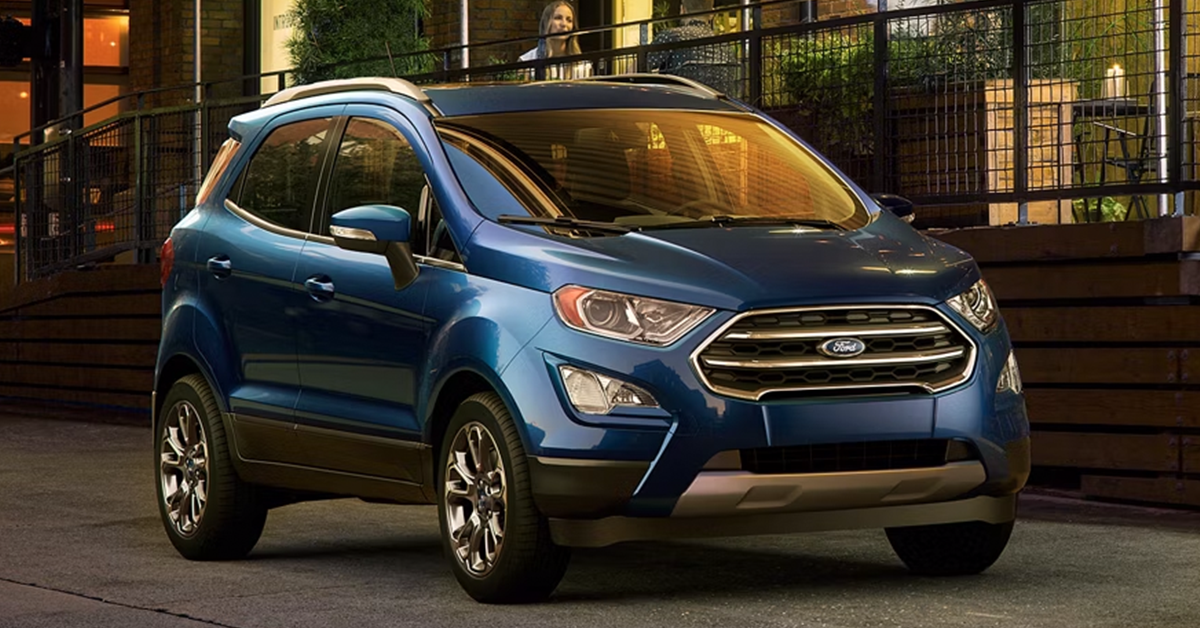
Official press image of the Ford EcoSport. | © Ford Motor Company
The Ford EcoSport from the Brazilian original of 2003 to the global second generation and the US model of 2018 to 2022: engines, trims by market, towing and cargo, prices where sources give them and how production ended.
The Ford EcoSport is a small, tall crossover that began in Brazil and later reached Europe, India and the United States. Ford’s own history timeline says it was launched in April 2003 and “created a new market segment” (Ford). It was built at Ford’s Camaçari plant in Bahia, Brazil (Ford). The second generation went global from 2012, and Ford presented the US version in February 2018 as the “first-ever EcoSport” (Ford). Production ended in 2022, according to a reported history, although one reference gives 2023 (reported).
| First launched | April 2003, Brazil (Ford) |
| First-generation plant | Camaçari, Bahia, Brazil (Ford) |
| Second generation | From 2012 (reported) |
| US debut | 2018, called first-ever EcoSport (Ford) |
| US final assembly | Chennai, India (Ford) |
| Europe plant | Craiova, Romania (Ford) |
| US engines | 1.0L EcoBoost, 123 hp; 2.0L, 166 hp (Ford) |
| Europe diesel | 1.5L EcoBlue, up to 125 PS (Ford) |
| Camaçari milestone | 700,000 by December 2011 (Ford) |
| Production ended | 2022 (reported) |
There were two generations. A reported history gives the first as the BV226, built from 2003 to 2012 in Brazil on the Ford B3 platform and related to the fifth-generation Fiesta (reported). It gives the second as the B515, built from 2012 to 2022 (reported). Reports describe the second generation as built on the Fiesta platform too, with the B3 platform named in one report and the sixth-generation Fiesta named in another (reported). We therefore describe both as Fiesta-based and show the platform naming as a conflict between sources.
The EcoSport was built in several countries. Ford’s 2019 US specification sheet lists final assembly at the Chennai plant in India (Ford), and its engines were made in Sanand, Gujarat (Ford). Ford says the European EcoSport was built at Craiova, Romania, after a 200 million euro investment (Ford). A reported history says the second generation was assembled in India, Thailand, Russia and Romania, and that Ford ended production in Vietnam in early 2022 (reported). The first generation came only from Brazil, according to the same history (reported).
Engines depended on the market. In the US, Ford lists a 1.0-litre EcoBoost three-cylinder making 123 hp and a 2.0-litre four-cylinder making 166 hp (Ford). In Europe, Ford lists a 1.0-litre EcoBoost in 100, 125 and 140 PS outputs and a 1.5-litre EcoBlue diesel up to 125 PS (Ford). In India, Ford lists a 1.0-litre EcoBoost at 125 PS, a 1.5-litre TDCi diesel at 100 PS and a 1.5-litre three-cylinder petrol at 123 PS (Ford). The Brazilian first generation used flex-fuel 1.6 and 2.0-litre engines (Ford).
The EcoSport was a volume seller in Brazil. Ford said in December 2011 that 700,000 had been produced at Camaçari, and that the EcoSport had 32.6 per cent of the compact SUV segment from January to October that year (Ford). In Europe, Ford said in 2017 that 150,000 had been sold since its 2014 introduction (Ford). For the US, a reported figure gives 60,544 sales in 2020 (reported). We found no Ford global production total, so we do not give one.
Some limits apply. Ford’s pages that we read cover the 2011 Brazilian timeline, the 2016 and 2017 European announcements, the 2018 India update and the 2019 US specification sheet, but not the second-generation launch in 2012 or the end of production in detail. Those parts come from reference histories and news reports, tagged (reported). The EcoSport is sometimes confused with the Puma, the Escape and the Bronco Sport, which have their own articles, and we keep them separate.
The first EcoSport was a Brazilian project. A Brazilian report says the idea began as a sketch on a restaurant napkin in 1996 by Ford’s then chief engineer Luc de Ferran, though the project only became real in 2002 at the Camaçari complex (reported). A US history says Ford spent 1.9 billion dollars in the region building the Camaçari plant (reported). Ford’s own timeline says the EcoSport was launched in April 2003 (Ford). A reported history says it was designed by the Ford Brazil Development Center under the code BV226 (reported).
| Launch | April 2003 (Ford) |
| Codename | BV226 (reported) |
| Platform | Ford B3, related to the fifth-generation Fiesta (reported) |
| 4WD added | 2004 (Ford) |
| First flex-fuel SUV | 2005, 1.6-litre (Ford) |
| Automatic added | 2007 (Ford) |
| Flex 2.0L engine | 2008 (Ford) |
| Three-year warranty | 2010 (Ford) |
| Production milestone | 700,000 units, December 2011 (Ford) |
| Production years | 2003 to 2012 (reported) |
Ford published a timeline of the first generation in December 2011. It says a four-wheel-drive version with intelligent all-wheel traction and distinct styling was added in 2004 (Ford). In 2005 the EcoSport became the first SUV with a flex-fuel engine, a 1.6-litre, and the FreeStyle version debuted as a limited edition before becoming a standard model that accounted for over 60 per cent of line sales (Ford). In 2006 it was first in its segment with an audio system offering iPod and USB connectivity, plus Bluetooth phone integration (Ford).
The timeline continues through 2011. Ford says the automatic EcoSport arrived in 2007 along with the first comprehensive body style change, and a flex 2.0-litre engine launched in 2008 (Ford). A battery saver that turns off interior lights after 10 minutes arrived in 2009 (Ford). In 2010 the styling and equipment were redesigned, including the panel, grille, headlights and hood emblem, and a three-year warranty was introduced (Ford). In 2011 the 2012 model year launched, with airbags and ABS standard on the FreeStyle 2.0 and optional on the FreeStyle 1.6 (Ford).
Ford’s 2011 release describes the car in detail. It lists flex 1.6 and 2.0-litre engines, manual or automatic transmissions, and 4x2 or four-wheel-drive traction, plus a 1.4-litre diesel model for export (Ford). It says water crossing is up to 45 centimetres and that the spare wheel is mounted on a rear swing gate that opens to the right (Ford). Standard equipment included hydraulic steering, air conditioning, electric windows and a leather steering wheel, and the FreeStyle trim added a roof rack, fog lights and 15-inch alloy wheels (Ford). Power figures were not given in the release (Ford).
Sales in Brazil were strong. Ford says the EcoSport had registered 32,915 units from January to October 2011 and held 32.6 per cent of the segment according to the national registry (Ford). The 700,000th unit came off the Camaçari line in December 2011 (Ford). A reported history says the EcoSport was one of the top 20 best-selling cars in Brazil (reported). In Mexico, the first-generation car arrived in late 2003 and sold about 15,000 units in 2004, against about 10,000 for the 2007 model year, then fell to 6,345 for the 2008 model year (reported).
The first generation was not sold in Europe or the US in this form. A reported history says Ford ended it in 2012 as the second generation took over, and that it was related to the fifth-generation Fiesta and the European Fusion (reported). A Brazilian journalist cited in a US guide says the first model was derived from a minivan-style Fiesta, while the second was based on the sixth-generation Fiesta and had a more pleasing style (reported). We do not use those style opinions as facts. The next section covers the second generation.
The second-generation EcoSport was shown first as a concept at the New Delhi Auto Expo on January 4, 2012, and launched in Brazil on July 14, 2012, according to a reported history (reported). It was developed in Brazil under Ford’s global product development process, which is part of how Ford described its One Ford approach (reported). A reported history says it launched in India, Brazil and China at once (reported). Ford’s own pages that we read do not cover the 2012 reveal, so the dates here are reported.
| Concept shown | New Delhi Auto Expo, January 4, 2012 (reported) |
| Brazil launch | July 14, 2012 (reported) |
| Codename | B515 (reported) |
| Europe introduction | 2014 (Ford) |
| Europe sales to 2017 | 150,000 (Ford) |
| Europe 2016 sales growth | 40 per cent (Ford) |
| 2015 European update | Improved styling and dynamics (Ford) |
| Europe length with spare | 4,273 mm (Ford) |
| Europe width, no mirrors | 1,765 mm (Ford) |
| Europe height | 1,650 mm (Ford) |
Ford described the EcoSport’s intended character in its Asia Pacific materials. Its page says the EcoSport offers a confident stance, a high driving position and robust character on top of the agility and fuel efficiency of a compact footprint (Ford). It lists a number of powertrains, including Ford’s 1.0-litre EcoBoost, and SYNC voice control (Ford). Ford says the EcoSport was designed to be a benchmark in fuel efficiency in its segment (Ford). Those are Ford’s own claims and not independent tests.
Europe received the second generation in 2014. Ford said in 2017 that 150,000 EcoSports had been sold in Europe since its 2014 introduction, and that sales grew 40 per cent the previous year (Ford). In July 2015, Ford announced an enhanced EcoSport for Europe with improved styling, dynamics and refinement (Ford). It was offered with a 1.0-litre EcoBoost petrol, a 1.5-litre petrol or a 1.5-litre TDCi diesel (Ford). A Winter Pack added a heated windscreen, heated mirrors and heated front seats, and the springs, dampers, rear torsion beam, stability programme and power steering were revised (Ford).
Ford published European dimensions for that car. The overall length is 4,273 mm including the rear-mounted spare wheel and 4,017 mm without it, according to Ford’s specification sheet (Ford). The overall width is 2,057 mm with mirrors, 1,847 mm with folded mirrors and 1,765 mm without mirrors, and the unladen height is 1,650 mm (Ford). The sheet lists a 1.0-litre EcoBoost 125 PS, a 1.5-litre Ti-VCT at 110 PS and a 1.5-litre TDCi at 90 PS (Ford). The 4,017 mm figure is as printed, and we did not check it against another source.
The cabin and features grew over the period. Ford’s 2017 European release says the boot-mounted spare wheel option remained available on the updated car (Ford). A reported US guide says the second-generation EcoSport was developed in Brazil and based on the sixth-generation Fiesta (reported). Ford’s own pages do not name competitors, so we do not rank it against rivals.
The Brazilian market became crowded. A reported US guide says the second generation did well in its home market until Honda introduced a rival, and that a redesigned model regained leadership a year later (reported). Reports also say Ford ended passenger car production in Thailand in 2018 and announced plant closures in Brazil and India by early 2021 (reported). Those closures shaped the EcoSport’s later years, which sections six and seven cover. The India section next covers the Chennai-built car in detail, including the 2018 update that Ford India published in May of that year.
India was the EcoSport’s biggest manufacturing base. A reported press item says Ford planned to invest 142 million dollars at its Chennai facility in Tamil Nadu to roll out the global compact SUV (reported). It also says the EcoSport was launched in India at a starting price of 5.59 lakh rupees, ex-showroom Delhi (reported). Ford India’s own pages we read do not give the launch date, so we do not state one. A fan site says the Chennai plant began production in 1999 and had a capacity of 150,000 cars on a two-shift basis (reported).
| Chennai plant | Began production in 1999 (reported) |
| Sanand | Engine and vehicle plant, Gujarat (Ford) |
| India launch price | 5.59 lakh rupees ex-showroom (reported) |
| Black Edition | May 12, 2016 (Ford) |
| 2018 S petrol | 1.0L EcoBoost, 125 PS, 170 Nm (Ford) |
| 2018 S diesel | 1.5L TDCi, 100 PS (Ford) |
| Signature Edition petrol | 1.5L, 123 PS (Ford) |
| Airbags, S | Six (Ford) |
| Service interval | 10,000 km (Ford) |
| Exit from India announced | September 2021 (reported) |
Ford India updated the car in 2016. Ford’s Indian newsroom lists a Black Edition introduced on May 12, 2016, and a new top-of-the-line Titanium+ petrol variant with a manual transmission (Ford). A reported item says the 2016 model year brought more power to the 1.5-litre TDCi diesel, by nine horsepower (reported). The page does not give the output in the excerpt we read. The EcoSport was among India’s best-selling compact SUVs until newer rivals arrived, according to a reported comparison (reported).
The May 2018 update added the EcoSport S and Signature Edition. Ford India’s release lists the S with a 1.0-litre EcoBoost making 125 PS and 170 Nm at 18.1 km per litre, and a 1.5-litre TDCi diesel making 100 PS at 23 km per litre (Ford). The Signature Edition, an option pack on the Titanium, used a 1.5-litre three-cylinder petrol making 123 PS at 17 km per litre (Ford). Ford said the EcoSport S had a new six-speed manual transmission and that the lineup also had an all-new six-speed automatic with paddle shifters (Ford).
Prices and equipment were also listed. The Signature Edition started at 10.40 lakh rupees for the petrol and 10.99 lakh for the diesel, and the EcoSport S at 11.37 lakh and 11.89 lakh, introductory prices as Ford listed them (Ford). Both had a power slide sunroof that Ford called the fun roof, and the S had six airbags, while dual front airbags and ABS were standard across the lineup (Ford). Ford said it was the only compact SUV offering up to six airbags (Ford). The S had smoked HID headlamps, 17-inch smoke alloys, orange seat accents and an 8-inch SYNC 3 touchscreen (Ford).
Ford listed more details for the range. It said all EcoSports had Apple CarPlay and Android Auto, cruise control, hill launch assist, fold-flat rear seats and 27 cabin storage compartments, with a 10,000 km service interval (Ford). There were seven colours, including Lightning Blue, Race Red and Absolute Black (Ford). The page does not say whether the prices are ex-showroom, though Indian convention suggests so. We therefore show the prices as Ford listed them and do not convert them. Ford India’s integrated plant is in Chennai, with another facility at Sanand, Gujarat (Ford).
Exports became the plant’s purpose in later years. A reported item says Ford even started building left-hand-drive EcoSports in Chennai for North America from 2018 and exporting to Argentina after Brazilian closures (reported). A reported report says Ford announced in September 2021 that it would exit the Indian market and that vehicle and engine manufacturing at Chennai would stop by the second quarter of 2022 (reported). The EcoSport’s end in India is covered in section seven. Ford India said it would continue to provide service, parts and warranty support, according to a report (reported).
Ford chose Romania for European production. On March 22, 2016, Ford confirmed it was investing up to 200 million euros to build the EcoSport at its Craiova Assembly Plant, with production starting in the autumn of 2017 (Ford). Craiova would supply EcoSport for all Ford’s European markets except Russia (Ford). Ford said that since taking over the facility in 2008 it had invested more than 1 billion euros there (Ford). Ford said production of the new EcoSport started in Craiova on October 12, 2017, to meet growing European demand (Ford).
| Craiova investment | Up to 200 million euros (Ford) |
| Investment announced | March 22, 2016 (Ford) |
| European production start | October 12, 2017 (Ford) |
| 2017 reveal | September 5, 2017, Cologne (Ford) |
| New diesel | 1.5L EcoBlue, up to 125 PS, 300 Nm (Ford) |
| Claimed diesel economy | 4.5 l/100 km, 119 g/km CO2 (Ford) |
| All-wheel drive | Intelligent AWD, first on EcoSport (Ford) |
| 1.0L EcoBoost outputs | 140, 125 and 100 PS (Ford) |
| Sporty trim | ST-Line, first time (Ford) |
| Boot, lowered floor | 334 litres (Ford) |
Ford revealed the updated European EcoSport on September 5, 2017, in Cologne. Its headline changes were the new 1.5-litre EcoBlue diesel, Intelligent All Wheel Drive and, for the first time, an ST-Line version (Ford). The EcoBlue made up to 125 PS and 300 Nm with a six-speed manual and claimed 4.5 litres per 100 km and 119 g/km of CO2 (Ford). Intelligent All Wheel Drive can shift torque up to 50:50 between the axles in under 20 milliseconds (Ford). A 100 PS 1.5-litre TDCi with front-wheel drive was also offered at launch (Ford).
The petrol range was the 1.0-litre EcoBoost. Ford listed 140 PS, 125 PS and, from mid-2018, 100 PS outputs with a six-speed manual, and a 125 PS version with a six-speed automatic with paddle shifters (Ford). A 125 PS front-wheel-drive EcoBlue with a new low-friction six-speed manual followed in mid-2018, with lower CO2 (Ford). Ford’s release did not list a 1.5-litre petrol engine, which had been offered in 2015 (Ford). The sources therefore show the petrol range changing between the 2015 and 2017 announcements.
The ST-Line was the sporty trim. Ford lists Ford Performance-inspired bumpers and side skirts, black roof rails and headlight bezels, 17-inch Dark Tarnish alloys and ST-Line badging on the outside (Ford). The interior had a flat-bottomed leather steering wheel, partial leather seats with recycled-polyester suede inserts and red stitching, and stainless steel sports pedals (Ford). Other wheels were 17 and 18-inch alloys in four finishes, and the boot-mounted spare wheel option remained available (Ford). The ST-Line was available on the EcoSport for the first time (Ford).
Technology and safety were upgraded. Ford fitted a floating 8-inch touchscreen with SYNC 3 and Apple CarPlay and Android Auto compatibility, with a 6.5-inch screen optional, a 4.2-inch colour display and a 4.2-inch digital instrument cluster (Ford). A ten-speaker B&O PLAY system with a boot-mounted subwoofer was offered (Ford). Cruise Control with Adjustable Speed Limiter and a rear view camera were new to the EcoSport, and Blind Spot Information System was optional (Ford). Standard equipment included Roll Stability Control and a perimeter alarm, with driver and passenger airbags, a driver knee airbag, side airbags and curtain airbags (Ford).
Practicality details came from the same release. A height-adjustable boot floor can conceal storage or lower to give 334 litres of luggage capacity (Ford). There was a folding, sliding armrest with storage, a heated steering wheel, seven interior lighting colours and 12 exterior colours, including Lightning Blue, Ruby Red and Tiger Eye (Ford). A contrasting extended roof colour option was offered (Ford). Ford said the EcoSport would sit alongside the Edge and Kuga, and that a Fiesta Active crossover would follow in Europe the next year (Ford). Our Escape article covers the Kuga’s American counterpart.
The EcoSport reached the United States late. A reported guide says Ford introduced it at the 2016 Los Angeles Auto Show as a restyled mid-cycle refresh of the second generation, already on sale elsewhere, without mentioning its Brazilian roots (reported). Ford’s own February 8, 2018 advisory describes the launch of an entirely new Expedition and the first-ever EcoSport, after a record year of SUV sales in North America in 2017 (Ford). A reported report says the US car went on sale in the last weeks of 2017 and came from Chennai, India (reported).
| US trims | S, SE, SES, Titanium (Ford) |
| US 1.0L EcoBoost | 123 hp, 125 lb-ft (Ford) |
| US 2.0L | 166 hp, 149 lb-ft (Ford) |
| Transmission | Six-speed SelectShift automatic (Ford) |
| EPA, 1.0L | 27 city, 29 highway, 28 combined (Ford) |
| EPA, 2.0L | 23 city, 29 highway, 25 combined (Ford) |
| Length | 161.3 inches (Ford) |
| Cargo behind second row | 20.9 cubic feet (Ford) |
| Towing | 1,400 lb (1.0L); 2,000 lb (2.0L) (Ford) |
| 2018 starting price | $19,995 (reported) |
Ford’s 2019 specification sheet gives the US lineup. Trims were S, SE, SES and Titanium, built on a unibody structure with final assembly at the Chennai plant (Ford). The 1.0-litre EcoBoost three-cylinder made 123 hp at 6,000 rpm and 125 lb-ft, with front-wheel drive, and the 2.0-litre four-cylinder made 166 hp and 149 lb-ft with Intelligent Four-Wheel Drive (Ford). Both used a six-speed SelectShift automatic with Auto Start-Stop (Ford). The EPA ratings were 27 city, 29 highway and 28 combined for the 1.0 and 23, 29 and 25 for the 2.0 (Ford).
Dimensions and capacity were small. The wheelbase is 99.2 inches, the length 161.3 inches, the width 69.5 inches excluding mirrors and the height 64.8 inches (Ford). Cargo space is 50 cubic feet behind the first row and 20.9 cubic feet behind the second (Ford). Towing is 1,400 pounds for the 1.0 and 2,000 pounds for the 2.0, and curb weight is 3,021 and 3,300 pounds (Ford). Ford lists a 13.8-gallon fuel tank in the 2019 sheet and 13.6 gallons in its 2018 vehicle guide, which is a conflict in Ford’s own figures (Ford).
Equipment was straightforward. Ford lists 16-inch wheels on the S and SE and 17-inch wheels on the SES and Titanium (Ford). Driver aids included hill start assist, a reverse sensing system and a blind spot information system, with AdvanceTrac and Roll Stability Control (Ford). A 2018 Ford article says the EcoSport had a moveable cargo floor board with three positions and flip-and-fold second-row seats, and measured 161.3 inches long (Ford). Ford called it the most compact SUV in North America in that article (Ford). That is Ford’s claim for its segment and we did not verify it.
Reported prices for the 2018 model were from about 19,995 dollars for the S front-wheel drive to 27,330 dollars for the Titanium four-wheel drive (reported). Others were 21,590 for the S 4WD, 23,000 for the SE front-wheel drive, 24,500 for the SE 4WD, 25,880 for the Titanium front-wheel drive and 26,880 for the SES (reported). For 2022, a report said Ford made the 2.0-litre standard, which also made every EcoSport an all-wheel-drive model, with an S priced at 23,235 dollars including destination (reported). Those are US dollar list prices for particular years.
Sales were modest. A reported figure gives 60,544 US sales in 2020, down 6.4 per cent from 2019 (reported). Another report says only 26,304 were delivered in the first half of 2021, which made it Ford’s lowest-selling SUV apart from the Mustang Mach-E (reported). In September 2021, a Ford spokesperson said the EcoSport would be sold in North America only through the second half of 2022 (reported). Our Bronco Sport article covers the larger Ford SUV that sat above the EcoSport in the US, and the Maverick took over as the lowest-priced Ford, according to a report (reported).
The end began in India. A reported report says Ford announced on September 9, 2021, that it would stop vehicle and engine manufacturing in Chennai by the second quarter of 2022 and end production at Sanand by the fourth quarter of 2021 (reported). The report says Ford had accumulated operating losses of more than 2 billion dollars over the last decade (reported). Ford said it would continue to build the EcoSport at Craiova for Europe (reported). Ford confirmed to the press that the EcoSport would not be sold in the US or Canada after Indian production ended (reported).
| India exit announced | September 9, 2021 (reported) |
| Brazil plant closures announced | January 11, 2021 (reported) |
| Camaçari closed | By June 2021 (reported) |
| Last Indian EcoSport | Mid-2022 (reported) |
| Final Chennai batch | About 1,500 units (reported) |
| Vietnam production | Ended early 2022 (reported) |
| Craiova production ended | 2022; December 2022 (reported) |
| US sales end | Second half of 2022 (reported) |
| EcoSport Active, South Africa | June 2022 (reported) |
| Run, per reference | 2003 to 2022; one lists 2023 (reported) |
Brazil had already closed. A reported history says Ford announced on January 11, 2021, that it would shutter three production plants in Brazil as part of cost-saving measures (reported). A Brazilian report says Argentina had been receiving the EcoSport from India since June 2021, when the Camaçari plant was closed (reported). The EcoSport was the car the Camaçari plant was first built to produce, according to the same report (reported). Ford’s December 2011 release says 700,000 had been produced there by then (Ford).
The last Indian EcoSport came in mid-2022. A report says production was originally slated to end in May but a strike at the Chennai plant extended the timeline by a couple of months, and Ford planned to build 1,500 more EcoSports before closing (reported). Another report says the last unit rolled off the Chennai line, ending Ford’s manufacturing in India, and that production had been planned to finish in June 2022 (reported). A reference history says Ford ended EcoSport production in India in late 2021, which conflicts with those reports of mid-2022, so we show both (reported).
Europe followed. Ford said in 2021 it would continue to build the EcoSport at Craiova (reported). A South African report says Ford in Europe confirmed in March 2022 that production at the Romanian factory would end, while a May 2024 report says the EcoSport was phased out of Craiova in December 2022 (reported). The same South African report says the Romanian-built EcoSport Active was added to the South African range in June 2022 (reported). Ford also transferred ownership of the Craiova plant to Ford Otosan, according to a report (reported), and our Puma article covers the car now built there.
The end of the EcoSport left gaps. A May 2024 report says the end of production left a significant void in Ford’s lineup in South America and Europe, and that South America got larger SUVs such as the Territory and Bronco Sport while Europe did not get a direct replacement (reported). The same report says Ford was considering a new EcoSport for Europe, built in Valencia, which Ford had not confirmed in the pages we read (reported). Our Territory article covers the China-built SUV that Ford sold in Latin America as a replacement.
The final dates therefore differ by market. In the US, sales were to continue through the second half of 2022 (reported). In India, the last car was built around mid-2022 (reported). In Europe, production ended in 2022 (reported). Brazil’s production ended in 2021 (reported). A reference history gives the model’s whole run as 2003 to 2022, although another mirror lists 2023 (reported). We use 2022 as the end of the EcoSport’s production and note that sales continued in some markets after that, from stock.
The EcoSport’s specifications differ by market, so a buyer should start with the market of the car. In the US, Ford lists a 1.0-litre EcoBoost at 123 hp and a 2.0-litre at 166 hp with a six-speed automatic (Ford). In Europe, Ford lists a 1.0-litre EcoBoost at 100, 125 and 140 PS and a 1.5-litre EcoBlue at up to 125 PS (Ford). In India, it lists a 1.0-litre EcoBoost at 125 PS and 1.5-litre engines at 100 and 123 PS (Ford). The Brazilian first generation used flex-fuel 1.6 and 2.0-litre engines (Ford).
| US engines | 1.0L EcoBoost, 123 hp; 2.0L, 166 hp (Ford) |
| Europe engines | 1.0L EcoBoost 100 to 140 PS; 1.5L EcoBlue to 125 PS (Ford) |
| India engines | 1.0L EcoBoost 125 PS; 1.5L 100 and 123 PS (Ford) |
| Brazil first-generation engines | Flex 1.6 and 2.0L (Ford) |
| US trims | S, SE, SES, Titanium (Ford) |
| Europe sporty trim | ST-Line (Ford) |
| Brazil trim | FreeStyle (Ford) |
| US cargo, behind second row | 20.9 cubic feet (Ford) |
| Europe boot, lowered floor | 334 litres (Ford) |
| US towing | 1,400 or 2,000 lb (Ford) |
Trims differ as well. The US range was S, SE, SES and Titanium (Ford). The European range included Titanium and the new ST-Line, and an Active trim existed in some markets, with South Africa receiving the Romanian-built EcoSport Active in June 2022 (Ford, reported). India had Trend, Titanium and Titanium+ trims plus the S and Signature Edition in 2018 (Ford). Brazil had a FreeStyle trim that accounted for more than 60 per cent of line sales (Ford). The names are therefore not interchangeable between countries.
Practicality was the EcoSport’s strong point in the US, and it is mostly Ford’s own claim. Ford lists 50 cubic feet behind the first row and 20.9 cubic feet behind the second, with a three-position cargo floor (Ford). In Europe, the lowered boot floor gives 334 litres (Ford). Ford’s Brazilian release lists a cooled compartment in the dashboard and storage under the passenger seat large enough for a laptop (Ford), and its Indian release lists 27 cabin storage compartments (Ford). The rear-mounted spare wheel and swing gate are a signature of the design (Ford).
Towing and capability are modest. Ford lists 1,400 pounds for the US 1.0-litre and 2,000 pounds for the 2.0-litre (Ford). Ford’s European sheet lists a rear torsion beam suspension on the 2015 car and Intelligent All Wheel Drive on the 2017 diesel (Ford). The Brazilian first generation could wade through water up to 45 centimetres (Ford). The EcoSport is a small crossover and not an off-roader, so these figures suit light use. Buyers needing capability should look at the Bronco Sport instead, which our article covers.
Used buyers should check the market of origin. A US EcoSport was built in India, a European one in Romania and a Latin American one in Brazil or, later, India, according to Ford and reports (Ford, reported). Parts and service networks have shrunk in some countries after the closures, and a report says Ford India said it would continue to provide service, parts and warranty for its vehicles (reported). Ford’s US reliability and warranty terms are not in the pages we read. A pre-purchase inspection and a vehicle history check are sensible for any used EcoSport.
For the wider Ford story, our models page covers the current range. The EcoSport’s role in Europe passed to the Puma, which our Puma article covers, and in Latin America to the Territory, which has its own article (reported). The Escape, which our Escape article covers, was the larger US crossover. Ford has not announced a new EcoSport in the pages we read, and a May 2024 report of a possible revival for Europe is unconfirmed (reported). The EcoSport remains a useful, if aging, small SUV in the used market.