 Brands
Ford Escort — History, Models and Why It Ended
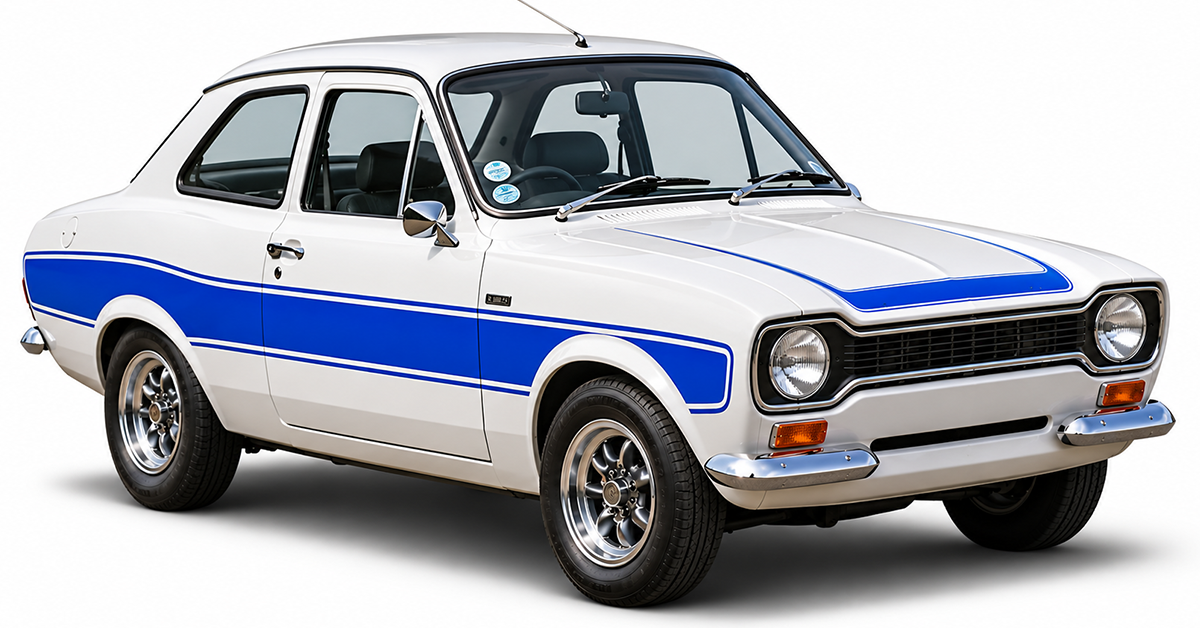
AI-generated concept illustration — Ford Escort. | Rev N Rise
The Ford Escort in two forms: the European Escort from the 1968 Mk1 and Mexico rally cars to the RS Cosworth and the 2000 end, and the North American Escort and ZX2, with sales, engines and what is known.
The name Ford Escort covers two separate car lines, and this article keeps them apart. The European Escort was a small family car built by Ford of Europe from 1968, and a reference history gives its end as 2000 in one place and 2004 in another (reported). The North American Escort was a compact sold for the 1981 to 2003 model years, according to a reference history, and it shared the name and the “world car” idea with the European car (reported).
| European Escort | 1968 to 2000 or 2004 (reported) |
| North American Escort | 1981 to 2003 model years (reported) |
| European generations | Six, on three platforms (reported) |
| Rear-wheel drive | Mk1 and Mk2, 1968 to 1980 (reported) |
| Front-wheel drive | Mk3 onward, from 1980 (reported) |
| UK sales chart | Topped for 32 years (reported) |
| First generation built | About 2.14 million (reported) |
| Front-drive Escorts sold | More than 8 million since 1980 (reported) |
| European successor | Ford Focus (reported) |
| North American successor | Ford Focus (reported) |
The European Escort is usually described as six generations on three platforms. A reference history lists the rear-wheel-drive Mk1 and Mk2 of 1968 to 1980, the front-wheel-drive Mk3 and Mk4 of 1980 to 1992, and the final Mk5 and Mk6 of 1990 to 2002 (reported). A UK motoring site says the Escort topped the UK sales chart for 32 years until it was replaced by the Ford Focus (reported). We found no Ford-owned page for that claim, so we treat it as reported.
The Escort is remembered for motorsport as well as sales. A trade site says that from the original Twin Cam of 1968 to the final Escort RS Cosworth of 1996 there was always at least one high-performance flagship in the range (reported). The same site says sporting success was key to the Escort’s image (reported). We describe the main performance models in their own section, and we do not list every special edition, because the sources we read disagree on several of them.
Totals are given only for some cars. A German motoring magazine says the first generation reached roughly 2.14 million cars, then the most successful European Ford to that date (reported). A German car-listing site says Ford had sold more than eight million front-drive hatchback Escorts worldwide since 1980 (reported). We found no reliable total for the whole nameplate, and we do not add the two figures together, because they cover different periods and cars.
Some names need care. The Ford Orion was a related saloon, the Mercury Tracer shared the North American car’s platform, and the Ford Laser was the Australasian cousin (reported). We mention them only where they explain the Escort’s story. The Ford Fiesta and the Ford Focus are separate models with their own histories, and the Focus is covered here only as the Escort’s successor. We treat the Escort sold in China from 2014 as a separate car and give it a short note.
Some limits apply to this article. We found no Ford-owned page for the Escort in the sources we could read, so every claim is tagged as reported, and we say so wherever a figure matters. We give no current used-car values, because prices vary widely with condition and market. We also do not claim that Ford plans to revive the name in Europe or America. Our wider Ford history article gives the company context, and the sections below take the Escort in order. Where two sources disagree, we show both values and say what kind of source each is, so you can judge them yourself.
The Escort replaced the Anglia in Britain. A reference history says production began at Halewood in England during the closing months of 1967, and for left-hand-drive markets in September 1968 at Saarlouis in Germany (reported). A motoring site says the 1968 Escort was the first integrated European Ford, assembled to a common design in Cologne and Halewood (reported). A different source says Ford Germany built the car in Genk in Belgium and later in Saarlouis (reported).
| Launch | January 1968 (reported) |
| Replaced | Ford Anglia in the UK (reported) |
| First plants | Halewood, then Saarlouis (reported) |
| Drive | Rear-wheel (reported) |
| Gearbox | Four-speed manual or three-speed automatic (reported) |
| Launch trims | De Luxe, Super, Super 1300, GT (reported) |
| 100,000th car | Five months after launch (reported) |
| Mk1 production | About 2.14 million (reported) |
| Production span | January 1968 to November 1974 (reported) |
| Nickname | Dog bone, from the grille (reported) |
The Mk1 was simple by design. A classic-car site says it was not technically or conceptually advanced in any way, but its impact on the European and British market was prompt, deep and long lasting (reported). A reference history says it had conventional rear-wheel drive and a four-speed manual gearbox or a three-speed automatic (reported). A UK motoring site says four versions were offered at launch: De Luxe, Super, Super 1300cc and GT (reported).
Sales took off quickly. A German motoring site says the 100,000th Escort was built at Halewood only five months after launch (reported). A German magazine says the first generation reached about 2.14 million cars (reported). A UK classic-car site says the Mk1 was built in Dagenham, Halewood, Saarlouis, Cork, Nazareth, Homebush, Seaview, Taipei and Genk (reported). We found no Ford figure for the split between plants, and we do not estimate one.
The styling was distinctive. A classic-car site says the Mk1 launched with an American-inspired Coke-bottle design and a dog-bone-shaped front grille (reported). A Czech motoring site says the car was nicknamed the dog bone, and it explains the name by that grille shape (reported). A German magazine uses the same nickname, Hundeknochen (reported). These are descriptions from the sources, and we found no Ford page that explains how the styling was chosen.
The Mk1 was also built outside Europe. A reference history lists assembly in Australia, New Zealand, Israel and Taiwan, in some cases from kits (reported). A UK classic-car site describes an eight-year production life (reported), while a reference history and a German magazine give January 1968 to November 1974 for the Mk1 in Europe (reported). Those two spans differ a little, so we carry both.
Value and survival are mentioned by one source. A UK classic-car site says there are possibly more Mk1 Escorts in existence today than actually left the Halewood and Saarlouis plants (reported). We could not check that claim, and we found no registry figure, so please treat it as a remark and not a fact. We also found no Ford price list for the 1968 range, and we do not quote launch prices for the base cars. The sporting versions are covered in the next section. We also found no Ford figure for how many Mk1 cars were sold in each market, and the sources we read gave production totals for only some plants, so we do not give a market-by-market split. Dates and numbers in older sources can also differ by a few months or a few thousand cars, and we have not tried to reconcile them.
The Twin Cam came first. A UK motoring site says Ford revealed the Escort Twin Cam in January 1968, just weeks after the base car, to compete in Group 2 rallying (reported). A classic-car site says it used the Lotus-Ford Twin Cam engine from the Elan and Lotus Cortina, built at Halewood with a list price of £1,162.78 (reported). A magazine says the first 25 cars were largely hand-built at Boreham for racing and rally teams (reported).
| Twin Cam revealed | January 1968 (reported) |
| Twin Cam engine | Lotus-Ford 1,558cc (reported) |
| Twin Cam road power | 105 bhp (reported) |
| Twin Cam race power | Up to 200 bhp (reported) |
| Twin Cam list price | £1,162.78 (reported) |
| White Twin Cams built | 1,263, 1968 to 1970 (reported) |
| RS1600 introduced | 1970, Cosworth BDA 16-valve (reported) |
| Rallye Sport dealers | 66 in the UK by year end (reported) |
| Mexico introduced | November 1970 (reported) |
| Mexico engine | 1.6-litre Kent, 86 bhp (reported) |
Power figures for the Twin Cam vary by use. A classic-car site says the 1,558cc engine gave 105 bhp in road trim and up to 200 bhp when tuned for racing (reported). A second site says a 16-valve race version produced over 200 hp (reported). A Czech site says 1,263 white two-door Twin Cams were built from 1968 to 1970 at Halewood and Boreham (reported). We found no Ford page for these figures, so we tag them all as reported.
The Twin Cam won early. A UK motoring site says Roger Clark, Tony Chappell and Barry Lee drove it to four race wins at Croft in February 1968 (reported). A second site says Roger Clark’s victory in the 1968 Circuit of Ireland Rally helped establish its reputation (reported). A motoring site says Frank Gardner drove a 16-valve car to win the 1968 British Saloon Car Championship, taking all but two of eleven races (reported). We give no later results.
The RS1600 replaced the Twin Cam. A classic-car site says it arrived in 1970 as the hottest model in the range, using the Cosworth-built BDA 16-valve engine, a close relative of the chain-drive FVA Formula 3 engine (reported). A UK motoring site says Ford set up a network of Rallye Sport dealers, 66 of them in the UK by the end of the year (reported). Another site says the RS1600 helped launch the career of rally driver Hannu Mikkola (reported).
The Mexico was the road car for everyone. A UK classic-car site says Hannu Mikkola and Gunnar Palm won the 1970 London to Mexico World Cup Rally in a modified 1,850cc Escort, and that Ford introduced the Escort Mexico in November 1970 as a tribute model (reported). It describes an 86 bhp 1.6-litre Kent crossflow engine and lower suspension, built by the Advanced Vehicle Operations centre (reported). A separate site says the Mexico was a more everyman version of the high-maintenance RS1600 (reported).
The Escort kept winning. A classic-car site says eight back-to-back RAC Rally victories are part of its record (reported). We do not list individual results beyond those the sources state, and we did not find a Ford page that confirms the dealer-network or the sales figures for the Mexico or RS1600. The RS2000 also existed in the Mk1 range, but the sources we read give little detail, so we give no specification for it, and we make no claim about how many were built. Prices, power outputs and production counts for these cars come from classic-car and motoring sites, not from Ford, and period road tests often quoted slightly different figures, so a buyer who needs exact numbers should check the factory documents for the individual car.
The Mk2 carried the formula on. A classic-car site says production of the Mk2 ended in Britain in August 1980, with other countries following soon after (reported). The same site says that, as with its predecessor, the Mk2 had a successful rallying career (reported). A reference history lists the Mk1 and Mk2 together as the original rear-wheel-drive platform of 1968 to 1980 (reported). The sources we read give few specifications for the Mk2, so we give none.
| Mk2 production in Britain | Ended August 1980 (reported) |
| Mk3 launch | September 1980 (reported) |
| Mk3 code name | Erika (reported) |
| Layout change | Front-wheel drive, transverse engine (reported) |
| Engine family | CVH (reported) |
| Reported development cost | Five billion marks (reported) |
| First front-drive motorsport Escort | RS1600i (reported) |
| RS Turbo | 1985 (reported) |
| Facelift | Early 1986 (reported) |
| Rival named | Volkswagen Golf (reported) |
The Mk3 was a clean break. A motoring-magazine feature says Ford gave its bestseller a radical makeover with the launch of the Mk3 in September 1980, because the Mk2 faced stiff competition from a new wave of hatchbacks, including the Fiesta (reported). A trade site says the Mk3 underwent a seismic change to front-wheel drive and a compact, transversely mounted engine (reported). A UK classic-car site calls it Ford of Europe’s second-ever front-drive vehicle, code-named Erika (reported).
The cost was reported as very large. A German motoring site says the Mk3 development cost five billion marks, a sum no manufacturer had previously spent on a new car (reported). It says the car introduced the transversely mounted CVH engines with hemispherical combustion chambers (reported). We found no Ford figure for the development budget, and we do not convert the amount to present-day money, because the currency basis is unclear.
Opinions on the change differ. A UK motoring site says that for purists the Mk3 represented the beginning of the end for the Escort, but that to Ford’s credit it was the right car at the right time, able to hold its own against the Volkswagen Golf and other front-drive rivals (reported). A UK classic-car site says the Mk3 marked the beginning of the end of the Escort’s motorsport glamour years (reported). Those are writers’ views, not Ford statements.
Performance models continued. A motoring site says the RS1600i was the first front-wheel-drive Escort developed for motorsport, produced in limited numbers to meet homologation rules (reported). A trade site says an RS Turbo arrived in 1985 and the Mk3 was facelifted in early 1986 (reported). The XR3 and XR3i were the sporty road versions, according to a UK motoring site (reported). We found no Ford page that gives their output, so we give no horsepower for them.
A trade site says the Mk3 was heralded as a world car, with Ford announcing it would be made in North America and South America too (reported). We cover the American car in its own sections, since it differed from the European one. Ford’s own pages we could read do not describe the Mk3’s launch, and we found no sales figure for it alone, so we give no total, and we do not compare it with the Mk2 for volume. We also found no Ford statement on how many XR3i or RS Turbo cars were built, and the sources we read gave no figures, so we leave the counts out and ask readers not to repeat unsourced totals. Those details are also missing for the Mk2.
The next big change came in 1990. A reference history says the fifth generation was launched in September 1990 and made until 1998 (reported). A trade site calls the 1990 car the Mark IV, and says its European launch was one of the most embarrassing and flawed in Ford’s history, though it taught Ford lessons (reported). The numbering conflicts, so we use Mk5 for the 1990 car, and we note that UK enthusiasts often call the facelift the Mk5b (reported).
| Fifth generation launch | September 1990 (reported) |
| Fifth generation end | 1998 (reported) |
| 1990 launch verdict | Flawed, per one trade site (reported) |
| RS Cosworth years | 1992 to 1996 (reported) |
| RS Cosworth engine | Turbo 2.0-litre Cosworth 16-valve (reported) |
| RS Cosworth drive | Four-wheel drive (reported) |
| RS Cosworth road cars | About 2,500 (reported) |
| RS Cosworth rally win | 1994 Monte Carlo Rally (reported) |
| Facelift nickname | Mk5b (reported) |
| Successor | Ford Focus, from 1998 (reported) |
The RS Cosworth was the performance flagship. A trade site says it ran from 1992 to 1996 (reported). A UK car-news site says it used a shortened version of the Sierra Cosworth chassis to underpin the Escort’s rally revival, and that the Mk5 RS Cosworth won the 1994 Monte Carlo Rally (reported). A hobby-site history says the car used a turbocharged 2.0-litre Cosworth 16-valve engine with four-wheel drive (reported). We found no Ford page for its power figure.
Its looks were unmistakable. A kit-car guide says its most memorable feature was an outrageous whale-tail tailgate spoiler (reported). A hobby-site history says that about 2,500 road cars were sold, and two sources give that figure, which is the number needed for homologation (reported). A German listing site says Formula One used the RS Cosworth as a safety car, and that a limited Michael Schumacher edition followed his first world title (reported). We have not checked either claim.
Other sporty Escorts ran out. A German listing site says the XR3i and RS2000 also ended before the Focus took over in 1998 (reported). It says niche models such as the RS Cosworth and XR3i impressed sports fans but did not help registration statistics (reported). We found no sales figure for the XR3i or RS2000 in the later cars, and we give no total for either.
A facelifted car followed. A UK motoring site says the later cars were sometimes called Mk6 and Mk7 in error, and that UK enthusiasts generally agree to call the facelifted car the Mk5b (reported). A specs site says production continued from 1995 to 2000 for the latest generation, which it describes as a heavy modernisation of the previous model (reported). The reference history gives the Mk5 and Mk6 as covering 1990 to 2002 (reported). We cannot reconcile those date ranges.
Quality and buying notes are thin. A German listing site says the 1990s cars were criticised for looks that did not change enough, and that the Focus brought the visual revolution the Escort lacked (reported). We found no Ford reliability data for these cars, and we do not make a quality claim. A buyer should check the build plate, service history and proof of any RS or limited-edition claim, especially for the Cosworth, because replicas and conversions are common in listings. We also found no Ford statement on how many Mk5 and Mk6 cars were built in total, and the sources we read gave no figure, so we leave the total out. A buyer who needs the number should ask an owners’ club, because registries often hold better records than magazines do.
The Focus replaced the Escort in Europe. A reference history gives the successor as the Ford Focus, and a trade site says demand for the Escort began to decline in 1998 as the Focus appeared (reported). A UK motoring site says that after 32 years at the top the Escort was replaced by the Focus (reported). We found no Ford statement about the decision, and we do not offer a reason beyond the sources’ own remarks.
| All production moved to | Halewood, 1998 (reported) |
| European production stopped | July 2000 (reported) |
| Alternative end year | 2004 (reported) |
| Successor | Ford Focus (reported) |
| Escort van ended | 2002 (reported) |
| Van successor | Ford Transit Connect (reported) |
| China restart | 2014 (reported) |
| China sales 2015 | 214,362 (reported) |
| China sales 2016 | 296,867 (reported) |
| China sales 2018 | 150,360 (reported) |
The end was a run-out. A trade site says all European Escort production was moved to Halewood in 1998, that the Escort was on extended run-out, and that production finally stopped in July 2000 (reported). A reference history gives 2000 as the end year in one place and 2004 in another (reported). A specs site says the Focus was released in 1998 and the Escort was phased out gradually (reported). We carry both end years and do not choose between them.
The van lasted longer. A car-history site says the panel-van version ended production in 2002 in favour of the Ford Transit Connect (reported). A reference history lists the Transit Connect as the Escort van’s successor (reported). Ford’s own pages we could read do not mention the van’s last day, so we give only the year, and we do not claim a production total for it, because we found none.
A Chinese Escort appeared later. A specs site says production resumed in China in 2014, and that the model sold well (reported). A sales database lists 3,710 in 2014, 214,362 in 2015, 296,867 in 2016, 285,029 in 2017 and 150,360 in 2018 (reported). The specs site says the model was the fifth best-selling car in the world, but we could not confirm that, so we leave the ranking out. It is a separate car from the European Escort, and we do not cover its specifications.
Many readers want to know why the Escort ended. The sources we read give several remarks: the Focus replaced it, the 1990s cars did not change enough, and demand fell as the Focus appeared (reported). Those are writers’ opinions, and Ford’s own pages do not give a reason. We therefore describe the end as a model replacement, not as a failure, and we do not compare its final sales with its peak, since no source gave both.
A few limits remain. We found no Ford figure for the last Escort built, no confirmed last-car ceremony and no total for the European car across all generations. The last-car date of July 2000 is from one trade site. For the exact day, please check a Ford of Europe or Halewood source. A reader who needs a full production total should use a registry kept by an owners’ club, because magazine totals can differ from factory records. We also found no Ford statement on how many European Escorts were built in total over all generations, so we give no grand total. For the last year in particular we found no figure at all, and a figure for the final month would need a Ford of Europe source we could not reach.
The American Escort was a different car under the same name. A reference history says it was introduced in 1980 for the 1981 model year, and was the first front-wheel-drive Ford developed and sold in North America (reported). It says it was the direct successor of the Ford Pinto and Mercury Bobcat, and largely replaced the European-imported Ford Fiesta as the smallest Ford (reported). It describes it as the first Ford world car, developed alongside Ford of Europe (reported).
| Introduced | 1980, for the 1981 model year (reported) |
| First generation | 1981 to 1990 model years (reported) |
| Predecessor | Ford Pinto (reported) |
| Layout | Front-wheel drive (reported) |
| Mercury twin | Lynx, 1981 to 1987 (reported) |
| First-generation trims | L, GL, GLX, SS (reported) |
| Main plant | Wayne, Michigan (reported) |
| Rank in the 1980s | Best-selling US car after 1982 (reported) |
| 1985 US sales | 420,690 (reported) |
| 1986 US sales | 402,181 (reported) |
The Escort sold in large numbers. A reference history says that after 1982 the model line became the best-selling car in the United States, a position it held during most of the 1980s (reported). A sales database lists 420,690 US sales for 1985 and 402,181 for 1986 (reported). We could not check those against Ford’s own sales reports, and we found no Ford figure for the earlier years, so we give no sales numbers for 1981 to 1984 or 1987 to 1990.
There was a Mercury twin. A reference history says the first generation was sold as the Mercury Lynx from 1981 to 1987 (reported). It says the first Escort used a transverse-mounted engine and was marketed in L, GL, GLX and SS trims, alongside an unnamed base trim (reported). To show its world-car status Ford designed an Escort badge for the front fender, according to the same source (reported). We found no Ford page that confirms the badge or the trims.
Production was spread across several plants. A reference history says the Escort was built at Wayne Stamping and Assembly in Wayne, Michigan throughout, and that the first generation was also built at plants in Edison, New Jersey and Milpitas, California (reported). A Detroit-history site says the car helped keep the Michigan lines busy (reported). We found no Ford figure for the plant split, and we do not estimate one.
The American car was changed from the European car. A local-history site says Ford’s Detroit teams made significant changes to adapt it to American tastes and regulations, and that its performance did not match its looks in the early years (reported). We found no Ford page that lists those changes, and we do not repeat the claims about individual engines. The first generation lasted from the 1981 to the 1990 model year, according to a reference history (reported).
Some performance versions existed. A reference history lists the SS trim in the first generation (reported), but the sources we read give no output figure for it, and we give none. We also found no reliable fuel-economy figure for the first-generation car, so we make no mileage claim. A buyer of a first-generation car should check the trim from the build plate, since listings often mislabel the sporty versions. The later generations and the ZX2 are covered next. We also found no Ford figure for the total number of American Escorts built, and the one sales table we saw covers only some years, so we do not add it up or call it a lifetime total.
The second generation ran from 1991 to 1996. A reference history says it was produced from April 1990 and sold for the 1991 to 1996 model years, built at Wayne, Michigan and Hermosillo, Mexico (reported). It says the second generation was also sold as the Mercury Tracer, and as the Ford Laser in Asia and Oceania (reported). We found no Ford page for it, and we give no output figures for the engines.
| Second generation | 1991 to 1996 model years (reported) |
| Second-generation plants | Wayne, Michigan; Hermosillo, Mexico (reported) |
| Mercury twin | Tracer (reported) |
| Third generation | 1997 to 2002 (reported) |
| ZX2 | 1997 or 1998 launch, to 2003 (reported) |
| ZX2 engine, 2003 | 2.0 Zetec, 130 hp, 127 lb-ft (reported) |
| ZX2 S/R | About 110 sold, 1999 (reported) |
| Sedan production ended | After the 2002 model year (reported) |
| US sales 2001 | 90,503 (reported) |
| US sales 2002 | 51,857 (reported) |
The third generation was a redesign. A reference history says that for 1997 the sedan was extensively redesigned and the Escort ZX2 two-door was introduced, while the Tracer continued separately (reported). A summary site says the ZX2 launched for the 1998 model year and replaced the Probe, which conflicts with 1997, so we carry both (reported). A car-history site says the hatchback was dropped and a 2.0-litre engine was used, with a five-speed manual or four-speed automatic (reported).
The ZX2 outlived the Escort name. A car-history site says that for 2003 the car was known only as the Ford ZX2, and that it was facelifted with a new grille and standard 15-inch aluminium wheels and a rear spoiler (reported). It lists a 2.0-litre Zetec four-cylinder with 130 horsepower and 127 lb-ft (reported). A summary site says the ZX2 was discontinued after a single model year as the ZX2 (reported). We found no Ford page for the power figures.
A rare performance model existed. A news site says the ZX2 S/R debuted at the 1999 SEMA Import Auto Salon and was developed by Ford Racing and the Small Vehicle Center together (reported). It says only roughly 110 examples were sold for the 1999 model year (reported). We could not confirm that figure, and we found no Ford page about the car, so please treat it as approximate. We give no performance numbers.
The sedan ended quietly. A reference history says that after the 2000 model year the four-door Escort moved primarily to fleet sales, and production ended after the 2002 model year (reported). A sales database lists 90,503 US sales in 2001, 51,857 in 2002, 25,473 in 2003 and 1,210 in 2004 (reported). The 2003 and 2004 figures presumably include the ZX2, but the source does not say. The Focus was the successor, with the model year given as 1999, 2000 or later in different sources (reported).
For the current Ford range, our Ford models page shows what the company sells today. We found no Ford statement about reviving the Escort name in America or Europe, and we make no claim about one. Collectors should join the relevant owners’ club, because parts and trims differ between the European and American cars, and a European part may not fit an American car. Where a listing mixes the two, treat it with caution, and ask for the build plate. We found no Ford figure for the lifetime total of American Escorts, and the sales figures above are US figures only, so they do not cover other countries. The 2003 and 2004 values are also very small, which fits a model in run-out, but the source does not explain them.
