 Brands
Ford Falcon — History, Models and Why It Ended
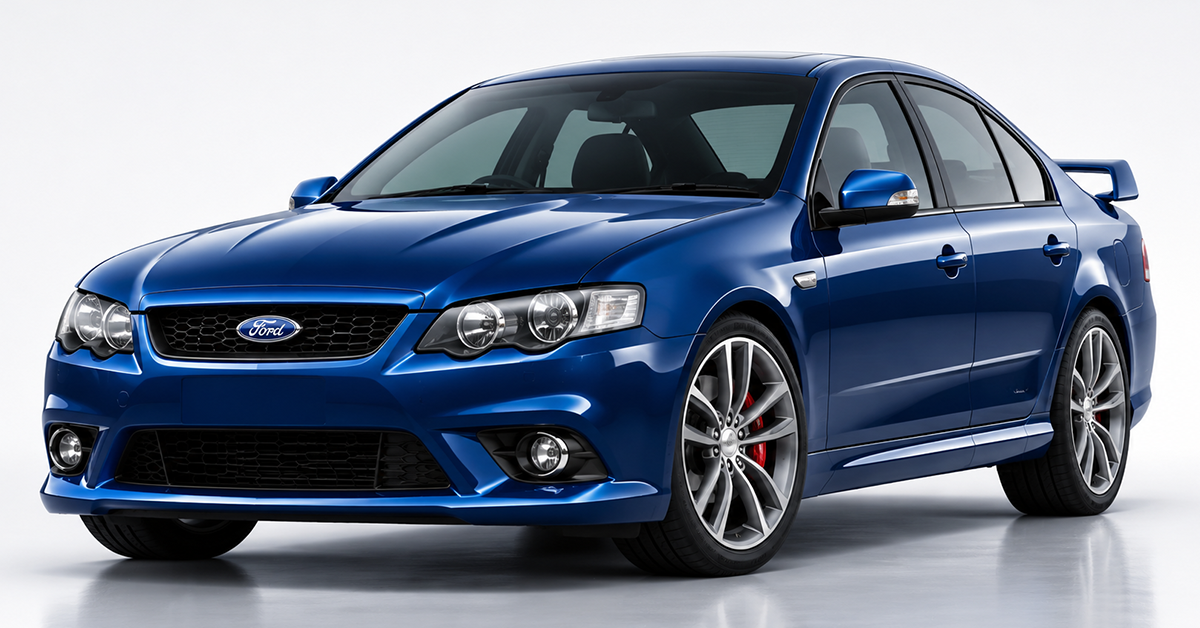
AI-generated concept illustration — Ford Falcon. | Rev N Rise
The Ford Falcon in three forms: the 1960 US compact behind the Mustang, the Australian Falcon built until 2016 and the Argentine Falcon built until 1991, with sales, engines and what is known.
The name Ford Falcon covers three different car lines, and this article keeps them apart. The first is the North American compact, sold for the 1960 to 1970 model years (reported). The second is the Australian Falcon, built from 1960 to 2016, and the third is the Argentine Falcon, built from 1962 to 1991 (reported). They share a starting point, but after the early 1970s the Australian car was developed locally while the Argentine car carried on from the early design.
| North American Falcon | 1960 to 1970 model years (reported) |
| Australian Falcon | 1960 to 2016 (reported) |
| Argentine Falcon | 1962 to 1991 (reported) |
| US compact rank | First by a Big Three maker (reported) |
| US replacement | Ford Maverick (reported) |
| Australian generations | Seven, over 56 years (reported) |
| Last Australian car | October 7, 2016 (reported) |
| Australian sedans and wagons | 3,005,880 (reported) |
| Australian utes and vans | 572,809 (reported) |
| Argentine total built | 494,209, 494,029 or 490,000+ (reported) |
In North America the Falcon was the first compact car marketed by a Big Three maker, according to a reference history, and it was preceded only by the Rambler American (reported). The same history says its sales success, together with slow sales of the rear-engined Corvair, led General Motors to bring out the Chevy II (reported). We found no Ford-owned page for the Falcon in the sources we could read, so every claim in this article is tagged as reported, and we say so wherever a figure matters.
The Australian car is the long-lived one. A reference history says that from the XA series of 1972 onward each Falcon was designed, developed and built in Australia (reported). An Australian motoring site calls the Falcon the longest-running vehicle name in Australian motoring history and the oldest surviving car nameplate in Ford’s history to that point (reported). The same site says production ran for 56 years and seven generations, ending at Broadmeadows on October 7, 2016 (reported).
Totals differ by market and by source. An Australian motoring site gives 3,005,880 Falcon sedans and wagons and 572,809 utes and vans (reported), which adds to about 3.58 million, and the same site elsewhere says more than 3.5 million (reported). A different report gives 3.5 million units (reported). For Argentina, three sources give 494,209, 494,029 and more than 490,000 (reported). We carry the conflicting values and do not pick one, because we cannot check factory records.
A few names need care. The Mercury Comet was based on the 1960 Falcon, and the Maverick replaced the Falcon in North America, while the Mustang used many Falcon parts (reported). Each of those is its own model, so we mention them only where they explain the Falcon’s story. We do not give a Mustang or Maverick history here. Likewise, we treat the Fairlane and LTD built in Australia on the Falcon platform as separate lines, which we do not cover.
Some limits apply to this article. We give no current used-car values, because prices vary widely with condition and market, and we found no Ford figure for them. We also do not claim that Ford plans a new Falcon, since none of the sources we read says so. Our wider Ford history article gives the company context, and the sections below take the Falcon in order, from the 1959 American launch to the last Australian car in 2016 and the Argentine car in 1991. Where two sources disagree, we show both values and say what kind of source each is, so you can judge them yourself, and we do not average them or choose the more convenient one.
The Falcon was introduced on September 2, 1959, according to a classic-car history, which calls it the crowning achievement of Ford president Robert McNamara, who soon left to serve in the Kennedy administration (reported). Another history says the project was started and sponsored by McNamara, who commissioned a team to create what by American standards of the time would be a small car (reported). A model history says it was the smallest car Ford had sold in the US since the 1930s (reported).
| Introduced | September 2, 1959 (reported) |
| Project sponsor | Robert McNamara (reported) |
| Sales chief at the time | Lee Iacocca (reported) |
| Engine choice | Six-cylinder, not the four wanted (reported) |
| 1960 base price | $1,974 (reported) |
| Original body styles | Two- and four-door sedans, wagons (reported) |
| Ranchero | Moved to Falcon platform for 1960 (reported) |
| Comet launch | March 1960 (reported) |
| Canadian Frontenac | 1960 only, then Comet (reported) |
| Rival response | Chevy II (reported) |
Accounts of the car’s purpose differ in emphasis. A heritage magazine says McNamara sketched the specification for a new car during a church service in the late 1950s, producing a practical, reasonable compact (reported). A car-collecting site says he wanted a car like the Volkswagen Beetle, small and compact (reported). These are retellings, and we found no Ford document that confirms either anecdote, so we present them as stories rather than as settled facts.
The design was a plain one by intent. A collector magazine says that unlike the Corvair, the Falcon was simply engineered and, unlike the Valiant, it had conventional styling (reported). A used-car site says Ford approved a six-cylinder engine instead of the four-cylinder that McNamara wanted (reported). A 1960 base price of $1,974 is also reported (reported). We found no Ford price list, so we treat that price as approximate, and we do not convert it to present-day money.
There was internal friction. A heritage magazine says the other Ford bosses disliked the car, none more than Lee Iacocca, the company’s sales chief (reported). A model-history site describes the Falcon as the flash point of a conflict between two management philosophies, those of Iacocca and McNamara (reported). A collector magazine says Iacocca made the car more appealing, with better-trimmed models (reported). Those are historians’ summaries, and we found no Ford statement that describes the dispute.
Other accounts say the idea was older. A hobby site says Ford’s Mercury division was first recommended to produce the company’s first compact (reported). A reference history says Edsel Ford first used the name Falcon for a more luxurious Ford he designed in 1935 (reported). A heritage article says the Comet, originally intended for the defunct Edsel brand and based on the 1960 Falcon, launched in March 1960 (reported). None of this is from a Ford page.
The Falcon also spread beyond the Ford brand. A reference history says the 1960 Frontenac was a rebadged Falcon for Canada, with its own grille, tail lights and red maple-leaf badges, and that it was replaced by the Comet for 1961 (reported). It says the Frontenac took 5 per cent of Ford’s Canadian output (reported). We do not know how many were built, because the sources we read give no total, and we leave the figure out. Ford’s own pages we could read do not cover the 1959 launch in detail, so the launch date and the first-year story are also reported only, and a reader who needs them exactly should check a period brochure or press release.
The first-year figure is where sources disagree. A collector magazine and an auto review both give first-year production or sales of 435,676 (reported). A heritage magazine says Ford sold some 400,000 in the first year and took 22,000 orders on the first day (reported), and another site says nearly half a million (reported). One auto-enthusiast listing gave only 146,000, which does not match any of the others, so we do not use it. We carry 435,676 and about 400,000.
| 1960 sales, source one | 435,676 (reported) |
| 1960 sales, source two | About 400,000 (reported) |
| First-day orders | 22,000 (reported) |
| 1961 sales | 474,191 (reported) |
| One million mark | Passed in 1962 (reported) |
| Club Wagon | 1962, Econoline-based van (reported) |
| Four-speed manual | 1962 (reported) |
| First V8 | 260 cu in, 164 hp, 1963 (reported) |
| Futura Sprint | First true performance version (reported) |
| 1963 table total | 266,518 (reported) |
The Falcon outsold its rivals. A collector magazine says the first-year total was more than the Corvair and the Valiant combined (reported). An auto review gives 474,191 for 1961 and says the one million mark was passed in 1962 (reported), and a hobby site says over a million were sold in the first two years (reported). Those counts use different definitions, such as sales or production, and we do not know which applies, so we state them only as reported.
The line widened quickly. A reference history says the Ranchero car-based pickup came onto the Falcon platform for 1960, and that a Falcon Club Wagon, an eight-passenger Econoline-based van, followed in 1962 (reported). A hobby site says the four-speed manual arrived for 1962 and the roofline changed to a more Thunderbird-like design (reported). We found no Ford page that confirms these dates, and we do not claim Ford’s own sales split for the van.
Trim levels climbed. A history site says the Falcon moved up from its budget beginnings as Ford tried to wring more profit from the line (reported). By 1963 there was a four-door Futura, a Deluxe wagon and a convertible, and a Futura Sprint was described as the first true performance version (reported). A muscle-car site lists 266,518 as the 1963 total for one table of models (reported), but it is not clear whether that table covers the whole range.
The first V8 came in 1963. A muscle-car site says the line got a 164-horsepower 260-cubic-inch small-block that year (reported). A hobby site says the Sprint came with the 260 V8, bucket seats, a tachometer and a deluxe trim package, and could be ordered with a four-speed manual (reported). A second site says the Sprint was entered in the Monte Carlo Rally (reported). We found no Ford page for the output, so we tag the horsepower figure as reported.
Wagons and sedans remained the core. We found no Ford figure that splits sales by body style for 1960 to 1963, and the sources we read give only partial lists. A buyer who wants a particular body style should check the build data on the car itself. We also found no reliable fuel-economy figure for the early six-cylinder car in any source, so we make no mileage claim. We also found no Ford figure for how many Futura, Sprint or wagon models were built each year, and the single table we saw may not cover the whole range, so we do not total the body styles or compare their sales with one another.
The Mustang came from the Falcon. A hobby site says many Falcon design elements and chassis pieces were used to build the original 1964½ Mustang, and that it was Lee Iacocca’s idea to develop a new car on the Falcon chassis (reported). A reference history says the first-generation Falcon Sprint cars were the basis for the 1964½ Mustang, and that the two are nearly mechanically identical (reported). That is a historian’s description, and we found no Ford page that says it.
| Mustang debut | Late in the 1964 model year (reported) |
| Mustang basis | Falcon chassis parts (reported) |
| Idea credited to | Lee Iacocca (reported) |
| Second generation | 1964 to 1965 (reported) |
| 1965 Sprint hardtops | Fewer than 3,000 (reported) |
| 1965 Sprint convertibles | Fewer than 500 (reported) |
| Redesign | 1966 (reported) |
| Maverick introduced | April 17, 1969 (reported) |
| Falcon retired | After a shortened 1970 model year (reported) |
| 1970 half-year Falcon | Torino-based (reported) |
The Mustang then hurt the Falcon. A hobby site says Falcon Sprint production fell off sharply in 1965 because the Mustang had taken its market niche, with fewer than 3,000 Sprint hardtops and fewer than 500 Sprint convertibles built (reported). It calls 1965 the last year for the Falcon Sprint (reported). A car-news site says the Mustang made the Falcon Sprint possible and then killed it (reported). Those are summaries of the same trend and not Ford statements.
The Falcon was redesigned twice. A reference history lists a first generation from 1960 to 1963 and a second from 1964 to 1965 (reported). The 1965 Falcon is said to have offered the two-barrel version of the 289 V8 used in the Mustang (reported). A reference history says the Falcon was redesigned again in 1966 but could not meet the coming US safety and emissions rules, while its sales had been decimated by the Mustang (reported). We give no sales figure for 1966 to 1969, because the sources we read gave none that we could check, and we do not estimate one from the trend they describe.
The Maverick took over. A reference history says Ford introduced the Maverick on April 17, 1969 as a 1970 model on the Falcon’s rear-wheel-drive platform (reported). Another says the Falcon was retired after a shortened 1970 model year, and that Ford introduced a 1970½ Falcon for the second half of the year (reported). A hobby site says that model was based on the Torino and arrived in January 1971 (reported), which conflicts with the 1970 date, so we carry both.
The Falcon platform lived on elsewhere. A reference history says the platform continued in Argentina through 1991, where it was sold as a Falcon, and the Mustang and Mercury Cougar also used it (reported). A hobby site says the dies for the 1963½ Falcon went to Argentina in July 1963 (reported). We treat that as reported only. It is why the Argentine car looks like an early American Falcon, and we return to it in the last section.
The Falcon’s end in America was quiet. A hobby site says the Falcon marque continued as a successful Ford product for many years elsewhere (reported), which matches the Australian and Argentine stories. Ford’s own pages we could read do not discuss the American end of the Falcon, so we give no Ford statement about its reasons. The explanations here, the Mustang, new rules and the Maverick, are historians’ views and we have not tested them. We also found no Ford figure for the final-year Falcon sales or output, so we give none.
The Falcon reached Australia in September 1960 as the XK. A motoring site says it was the first Australian-manufactured car not designed with local roads in mind, and that it proved fragile (reported). A reference history says Ford’s Australian sales were faltering in the 1950s because of the popularity of the Holden, which had no effective competitor (reported). The same history says Ford chose the Falcon in part because it had more experience building North American cars (reported).
| XK | September 1960 to July 1962, 68,453 (reported) |
| XL | August 1962 to January 1964, 75,653 (reported) |
| XM | 1964 to 1965, 47,103 (reported) |
| XP | March 1965 to August 1966, 69,561 (reported) |
| XR | September 1966 to March 1968, 88,786 (reported) |
| XT | March 1968 to June 1969, 74,392 (reported) |
| XW | June 1969 to October 1970, 93,129 (reported) |
| XY | October 1970 to May 1972, 100,474 (reported) |
| First Australian V8 Falcon | XR, 4.7-litre Windsor, 150 kW (reported) |
| XP honour | Named a national car of the year, 1965 (reported) |
The early production figures are on a motoring site. It gives 68,453 for the XK, 75,653 for the XL and 47,103 for the XM (reported). It says the XL was the first Australian car with seat-belt mounting points, and the XM was the first Australian-designed body (reported). Those figures are the site’s own table, and we found no Ford Australia page that lists them. The same site says the XK sold as a compact in Australia.
The XP was a turning point. A motoring site says the XP was named the national car of the year for 1965, and a second site says it was the first Australian-manufactured car to win that award, largely because it was such a huge improvement over the original model (reported). The XP is credited with 69,561 built from September 1964 to August 1966 (reported). We do not name the award organiser, because the sources we read give the award only in summary form.
The XR of 1966 brought a V8. A motoring guide says the XR was largely based on the US car, and was the first Falcon in Australia to carry a V8, a 150 kW 4.7-litre Windsor engine (reported). A motoring site says it had Mustang-bred styling and that the XR GT launched in April 1967 (reported). It gives 88,786 built (reported). We found no Ford page on the engine, so the output is as reported and may differ from a factory rating.
The GT and GTHO cars came next. A motoring site says the XT GT had the largest engine available in Australia, and that a Ford team placed in the 1968 London to Sydney Marathon (reported). It says the XW added GTHO models, with the XW GTHO Phase II taking first and second at Bathurst, and the XY brought a Phase III (reported). The XW is credited with 93,129 and the XY with 100,474 built (reported). Other race results are outside our scope.
A few early firsts are claimed. A motoring site says the XY brought Australia’s first production four-wheel-drive utility, with 432 built (reported). We found no Ford statement that confirms that. We also found no reliable price list for the 1960s cars, and we do not give one. For exact specifications, an owners’ club or the build plate on the car is the better guide, because the same model code can cover several engines and trims. Two cars with the same code can also differ in trim and equipment, and the early production figures above are for whole model codes, not for any one version.
The XA of 1972 is often called the first truly Australian Falcon. A reference history says it was the first Falcon designed, with help from Ford’s US headquarters, and manufactured in Australia (reported). A motoring site says it was designed in Dearborn by three Ford Australia designers, Jack Telnack, Brian Rossi and Allan Jackson (reported). A motoring feature says the answer depends on how first and Australian are defined, but concludes that the XA deserves the title (reported). The XA is credited with 129,473 built (reported).
| XA | 1972 to 1973, 129,473 (reported) |
| XA designers | Telnack, Rossi, Jackson (reported) |
| XB | 1973 to 1976, 211,981 (reported) |
| XC | 1976 to 1979, 171,080 (reported) |
| XD | 1979 to 1982, 200,849 (reported) |
| Top-selling car in Australia | 1977 (reported) |
| Last V8 of that era | November 25, 1982 (reported) |
| V8 returned | 1991, XR8 (reported) |
| EA engine | 3.9-litre overhead-cam six (reported) |
| XF 25th Anniversary | 2,000 built (reported) |
The reasons for a local design were practical. A motoring site says Ford Australia had to design the XA itself because the US Falcon it had been based on was dropped from the US Ford lineup, and the Falcon was its top-selling model (reported). A hobby site says the XA hardtop resembled the 1971 to 1973 Mustang hardtop (reported). Engines for the XA are listed as a 3.28-litre six, a 4.1-litre six, a 4.95-litre V8 and a 7.75-litre V8 (reported), which we have not verified.
Sales peaked in the middle of the decade. A motoring site says the XB sold 211,981, the highest volume in its table, and that in 1977 the Falcon became Australia’s top-selling car (reported). It gives 171,080 for the XC, which was the last hardtop, and 200,849 for the XD (reported). It says 1982 was the first time Ford reached market leadership in Australia (reported). We found no Ford page for those claims, so please treat them as secondary.
The V8 disappeared for a decade. A motoring site says the last V8 Falcon of that era was built on November 25, 1982 (reported), and a motoring guide says V8s were absent from 1983 until the XR8 returned with the EB in 1991 (reported). The same guide says the XE gained a Watts linkage at the rear and an electronically injected 4.1-litre six arrived in 1983 (reported). Those details are as reported, and we give no output figures for that engine.
The 1980s and 1990s brought a run of firsts. A motoring site says the EA was the first fully Australian-designed Falcon, with a new 3.9-litre overhead-cam engine (reported). It says the EAII brought the first four-speed and the first electronically controlled automatic in Australia, and the EBII was the first mainstream Australian sedan with standard ABS (reported). It says the EF gave a standard driver airbag (reported). We found no Ford page that makes any of these claims.
Performance and special models appear throughout. A motoring site says the XF 25th Anniversary edition was limited to 2,000 and that the XC Cobra was limited to 400 numbered cars (reported). The sixth-generation AU followed in 1998 and is covered below. We do not list every special edition, and a collector should confirm a car’s status from its build plate and documents, because limited-edition claims are often repeated in listings without proof. We found no Ford Australia page that lists total special-edition numbers, and the 2,000 and 400 figures above are from a single motoring site, so please check them against another source.
The sixth generation arrived in 1998. A motoring site says the AU brought a new shape and independent rear suspension, and the AUII became the first Australian-built car with standard dual airbags (reported). It says the BA of 2002 followed a $500 million program with new engines, independent rear suspension and electronic throttle control (reported). The AU is credited with 130,451 built and the BA with 199,303 (reported). We found no Ford page that gives these figures.
| Sixth generation | AU, from 1998 (reported) |
| BA program | $500 million (reported) |
| FG safety rating | Five-star ANCAP (reported) |
| Final model | FG X, late 2014 (reported) |
| FG X engines | 4.0 six, 2.0 EcoBoost, 5.0 V8 (reported) |
| XR6 Turbo | 270 kW, 533 Nm (reported) |
| FG X built | 11,570 (reported) |
| Closure announced | May 2013 (reported) |
| Last Falcon built | October 7, 2016, 9:36am (reported) |
| Jobs lost, Broadmeadows | 600 (reported) |
The late cars were more advanced. A motoring site says the BAII added a six-speed manual for the XR6 Turbo and XR8, and the BF added a six-speed automatic and stability control (reported). It says the FG of 2008 was the first Australian-built car with a five-star ANCAP safety rating and added a supercharged FPV GT V8 (reported). The FG is credited with 144,587 built and the FGII with 46,727 (reported). These are as reported and unverified.
The final model was the FG X. A motoring site says it launched in late 2014 with an updated face and major overhauls, and that engines included a 4.0-litre inline six, a 2.0-litre turbo four called EcoBoost and a 5.0-litre V8 in the XR8 (reported). It says the XR6 Turbo is rated at 270 kW and 533 Nm from its 3,984 cc engine (reported). The FG X is credited with only 11,570 built, the lowest in its table (reported).
The end was announced in advance. A motoring site says Ford Australia announced in May 2013 that it would stop local manufacturing in October 2016 (reported). A news site says Ford later confirmed October 7, 2016 as the last day for the Falcon and Territory (reported). Another report said that the last day was chosen based on a solid year of production, with no down days scheduled (reported). Ford’s own pages we could read do not repeat those statements, so we tag them as reported. A buyer or researcher who needs exact announcement wording should look for the original Ford Australia statements, which we did not find in the sources we could read.
The last Falcon was built on October 7, 2016. A magazine says the 3,005,880th Falcon sedan or wagon left the Broadmeadows line at 9:36am that day (reported). A reference history says the final car was a blue XR6, and a motoring site says Ford had confirmed that a Falcon and not a Territory would be the last car off the line (reported). Ford Australia’s president Graeme Whickman is quoted calling it an emotional day, and the Falcon a cultural icon in Australia (reported).
The job and plant figures are reported. A news report says 600 employees lost their jobs at Broadmeadows (reported). A motoring site says the Falcon ute ended earlier, on July 29, 2016, with a white XR6 after more than 55 years and almost half a million sales (reported). A reference history says the Geelong engine plant built its last Australian six and V8 on September 26, 2016 (reported). Reports describe Ford’s history in Australia as 88, 90 or 91 years, and we carry all three.
Argentina built its own Falcon. A reference history says local production began in 1962 with complete knock-down kits imported from the US and assembled at Ford’s factory in La Boca, after two US Falcons were imported for testing in 1961 (reported). It says production was later at General Pacheco and that the car reached about 98 per cent local parts by the end (reported). Another source says the Falcon was the first Ford four-door sedan fully produced in Argentina from 1963 (reported).
| Argentine production | 1962 to 1991 (reported) |
| Start | 1962, kits assembled at La Boca (reported) |
| Plant | General Pacheco (reported) |
| Autolatina years | 1987 to 1991 (reported) |
| Optional four-cylinder | 2.3-litre, 1982 to 1983 (reported) |
| Local parts at the end | About 98 per cent (reported) |
| Last car | September 10, 1991 (reported) |
| Total, source one | 494,209 (reported) |
| Total, source two | 494,029 (reported) |
| Total, source three | More than 490,000 (reported) |
The Argentine car stayed in production for nearly 30 years. A classic-car site says that in 1962 it appeared solely as a four-door sedan with a 170 or 187 cubic-inch six, and that an optional 2.3-litre four of Taunus origin was briefly available in 1982 and 1983 (reported). The same site says sales receded from 1985 and that production ended on September 10, 1991 (reported). A Spanish-language report gives the same date and says the last unit left General Pacheco (reported).
Totals and years differ. An Argentine report says Ford Motor Argentina built the Falcon from 1962 to 1986, and that in 1987 to 1991 it was under Autolatina, the joint venture of Ford and Volkswagen (reported). Production totals are 494,209 in a reference history, 494,029 on a classic-car site and more than 490,000 elsewhere (reported). A production table shows 35,595 for 1973 and 4,684 for 1962 (reported), but we could not read the full table.
The Argentine Falcon has a complicated cultural history. A reference history and a news report link the car to clandestine operations during the Dirty War (reported). We state only that these are reported accounts, and we do not give detail. The same history says Falcons are still raced in the Turismo Carretera stock-car series (reported). We found no Ford statement on either point, and we make no comment beyond the reports. The Argentine totals above also depend on whether pickups were counted, which the production table we saw marks with an asterisk, so please check that point before quoting any total. We found no Ford Argentina page that gives yearly figures, and the table we could read was partial.
A buyer should check the market. In North America, the Sprint and the V8 versions were the performance cars, according to the sources we read (reported). In Australia, motoring sites single out the GT and GTHO versions for their race results (reported). We found no Ford price list for any of them, and values vary widely, so we give none. Ask for the build plate, service history and proof of any limited-edition claim.
For the current Ford range, our Ford models page shows what the company sells today. We found no statement from Ford about reviving the Falcon in any market, and we make no claim about one. Collectors should join the relevant owners’ club in the US, Australia or Argentina, because parts, trims and engines differ between the three Falcon lines, and we found no Ford source on parts supply for any of them. Where a listing mixes the three, treat it with caution, since a US Falcon part may not fit an Australian car.
