 Brands
Ford Sierra — Models, Cosworth Versions and Replacement
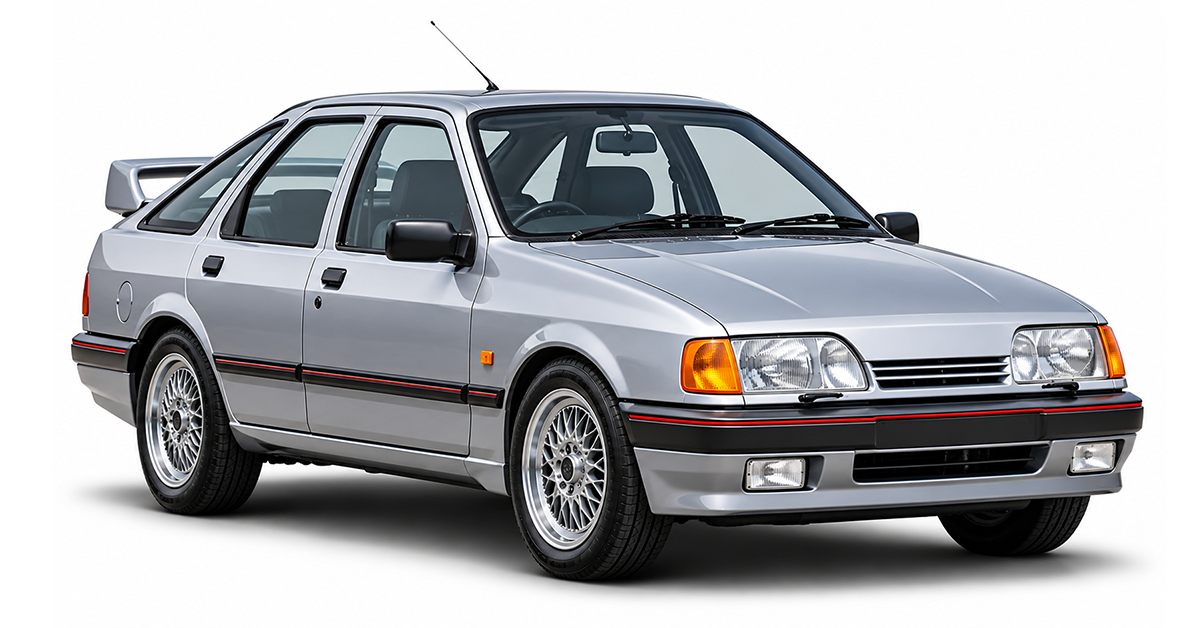
AI-generated concept illustration — Ford Sierra. | Rev N Rise
The Ford Sierra from the 1982 aerodynamic launch through the XR4i, Sapphire, RS Cosworth and RS500 to the Mondeo replacement in 1993, with engines, production figures and what is known.
The Ford Sierra was a mid-size family car built by Ford of Europe from 1982 to 1993, according to several reference histories (reported). It replaced the Cortina in Britain and the Taunus on the Continent, and it was itself replaced by the Mondeo (reported). A reference history lists it as a hatchback and estate at launch, with a four-door saloon added in 1987 (reported). We found no Ford-owned page for the Sierra, so every claim here is tagged as reported.
| Built | 1982 to 1993 (reported) |
| Replaced | Cortina and Taunus (reported) |
| Replaced by | Ford Mondeo (reported) |
| Designers credited | Bahnsen, Lutz, le Quément (reported) |
| Project code name | Toni (reported) |
| Total built, German source | About 2.7 million (reported) |
| Total built, French source | 2,750,000 (reported) |
| Second generation built | 974,400, 1987 to 1994 (reported) |
| North American version | Merkur XR4Ti, 1985 to 1989 (reported) |
| Saloon added | 1987 (reported) |
The Sierra is remembered for its shape and for its fast versions. A reference history credits the design to Uwe Bahnsen, Robert Lutz and Patrick le Quément, and says it was noted for aerodynamic styling (reported). The sporting versions included the XR4i, the XR4x4, the Sierra RS Cosworth and the RS500, plus the Sapphire Cosworth saloon (reported). We cover each in its own section, and we keep them separate from the Escort RS Cosworth, which was a different car.
Production totals are approximate. A German motoring site says about 2.7 million Sierras were built in eleven years (reported), a Dutch classic-car site says approximately 2.7 million (reported), and a French reference page gives 2,750,000 (reported). A data site gives 974,400 for the second generation from 1987 to 1994 (reported). We carry the totals as they are given, because we found no factory figure and cannot check any of them.
The Sierra was built in several countries. A reference history lists assembly in Genk in Belgium, Dagenham in England, Cologne in Germany, Cork in Ireland, Pretoria and Port Elizabeth in South Africa, Lower Hutt in New Zealand, Pacheco in Argentina and Valencia in Venezuela (reported). A second history says the car was also sold as the Merkur XR4Ti in North America from 1985 to 1989 (reported). The sources do not agree on every plant, so we do not give a production split.
Generation labels also differ. One reference history lists the Mk I as 1982 to 1986, the Mk II as 1987 to 1990 and a Mk III as 1990 to 1993 (reported). Another lists the Mk II as 1987 to 1989 and a facelifted Mk II as 1990 to 1993 (reported). A third describes only a launch car and a 1987 facelift (reported). We therefore use years instead of Mk numbers wherever possible, and we say Mk II only for the post-1987 range.
Some limits apply to this article. We give no current used-car values, because prices vary widely with condition, and we found no Ford figure for them. We also do not claim that Ford plans a new Sierra, since none of the sources we read says so. Our wider Ford history article gives the company context, and the sections below take the Sierra from the 1982 launch to the 1993 end. Where two sources disagree, we show both values and say what kind of source each is. We also found no Ford figure for sales by year, and we do not repeat unsourced claims about market share or about how the car compared with its rivals, because the sources we read gave none.
The Sierra was developed as the Cortina and Taunus replacement. A reference history says the outgoing Cortina and Taunus was a 12-year-old design by 1982, and that it was a reskinned version of the 1970 car with few major mechanical changes (reported). A classic-car review says the Sierra, known as Project Toni, was the joint Cortina and Taunus replacement (reported). A 1982 magazine says more than 10 million of the older cars had been built since 1962 (reported). We found no Ford page for these claims.
| Replaced | Cortina Mk 5 and Taunus (reported) |
| Cortina and Taunus built | More than 10 million since 1962 (reported) |
| Project name | Toni (reported) |
| Sales began | October 15, 1982, per one source (reported) |
| Unveiled | September 22, 1982, per another (reported) |
| Drag coefficient, source one | 0.34 (reported) |
| Drag coefficient, source two | 0.28 (reported) |
| Old Cortina and Taunus | About 0.45 (reported) |
| Launch layout | Front engine, rear-wheel drive (reported) |
| Early sales | Well below expectations (reported) |
The launch date depends on the source. A reference history says the Sierra debuted at the 1982 British International Motor Show in Birmingham, then at the Paris show, and that sales began on October 15, 1982 (reported). A data page says it was first unveiled on September 22, 1982 (reported). An owners’ club document says Ford unveiled it at the Frankfurt show in September 1982 (reported). Another page says it was released on October 13, 1982 (reported). We carry all of these as reported.
The shape was the headline. A data page says its aerodynamic styling was ahead of its time and that it broke the 0.30 drag barrier with a figure of 0.28 (reported). A reference history gives a drag coefficient of 0.34 for the car and compares it with the old Cortina and Taunus at about 0.45 (reported). These values conflict, probably because they describe different versions, and we do not say which version each applies to. Ford’s own pages we could read do not give the figure.
Buyers were divided. A reference history says the aerodynamic styling and the initial absence of a saloon alienated many conservative buyers, including company-car drivers (reported). A UK classic-car site says journalists praised it but sales were far behind where they needed to be, partly because Ford dealers had stockpiled Cortinas before the launch (reported). A classic-car magazine says early sales fell well below expectations, helped little by heavy discounts on remaining Cortina stock (reported).
Opinions on its legacy differ. A US car-history site says the Sierra altered the trajectory of car design (reported). A UK classic-car review says the styling was so advanced that it still looks modern, while the running gear and engines did not live up to expectation (reported). A hobby site says the Sierra’s aerodynamic styling would later be seen in North America’s Ford Taurus (reported). Our Ford Taurus article covers that car, and we make no claim about how directly the two were related.
The launch cars used older mechanicals. A classic-car review says engines were carried over from the Cortina, and that the rear-wheel-drive layout was kept so servicing stayed simple and fleet managers stayed on board (reported). A reference history says the Sierra had a front-engine, rear-wheel-drive layout for most of its life (reported). We found no Ford statement on why the layout was kept, and we give the classic-car review’s explanation as a view, not a confirmed reason. We also found no Ford page that confirms the launch dates, the design credits or the name’s origin, so a reader who needs them exactly should check a period press release.
The big change came in 1987. A reference history says the most notable changes came in early 1987, with a major facelift and the addition of a four-door saloon, known in the UK as the Sapphire (reported). A classic-car review says that by the time of the 1987 facelift the Sierra was selling strongly enough to remain in production for more than a decade (reported). A data page says the facelift made the car more mainstream as other cars followed its aerodynamic route (reported).
| Facelift | Early 1987 (reported) |
| Saloon added | 1987 (reported) |
| UK saloon name | Sapphire (reported) |
| South African saloon name | Sapphire, 1990 to 1993 (reported) |
| Saloon grille | Black, right-hand-drive markets (reported) |
| Three-door in UK | Dropped 1984 or 1987, sources differ (reported) |
| Body-coloured bumpers | From 1991 (reported) |
| Added trims | Solar, GT, Azur (reported) |
| 1988 engine change | New twin-cam 2.0, 120 hp (reported) |
| Sold alongside | Hatchback and estate (reported) |
The saloon was added because buyers wanted one. A hobby site says Ford found customers were more attached to the idea of a saloon than expected, so it produced one in 1987 (reported). A summary page says the four-door was sold alongside the hatchback and estate until the Sierra was replaced by the Mondeo in early 1993 (reported). In the UK the saloon was called the Sapphire, with a traditional black grille, according to a kit-car guide (reported).
Names differed by market. A data page says the range was sold as Sierra, Sierra Sapphire, Ford Sapphire and Ford P100 (reported). A reference history says the saloon was the Sapphire in South Africa from 1990 to 1993 (reported). A kit-car guide says the saloon’s black grille appeared only in right-hand-drive markets, and that the grille later appeared on other models in Europe (reported). We found no Ford page that lists the markets.
The three-door car had a complicated story. A hobby site says the remodelled three-door was never offered in the UK after it was withdrawn in 1984, but that production of the three-door continued in Europe after the 1987 facelift (reported). A kit-car guide says the three-door Sierra was dropped in the UK in 1987 (reported). Those dates conflict, so we carry both and do not state which is right, because we found no Ford source.
Trim names changed over time. A Dutch classic-car site says that in 1991 the range gained body-coloured bumpers, and that a Solar version and a sporty GT version, available only with a fuel-injected 2.0-litre engine, were launched (reported). It also says a new version called the Azur was introduced (reported). It says the 2.0-litre engine was replaced in 1988 by a new twin-cam 2.0-litre with 120 horsepower (reported). We have not checked these against factory material.
A few limits apply. We found no Ford figure for sales of the Sapphire alone, and no figure for how many saloons were built. We also found no price list for the 1987 range, and we do not convert any historic prices to present-day money. A buyer should check a car’s trim, engine and body from its build plate, because several trims were repeated across years, and listings often use the Sapphire name for any four-door Sierra. We found no Ford page that lists every change made in the 1987 facelift, so we do not list them, and we give no claim about reliability. The sources we read also disagree on when some trims were introduced, so we avoid giving a trim timeline, and a reader who needs one should check a period brochure.
The Sierra range used a wide set of engines. A reference history says engines carried over from the Cortina at launch, and that a V6 followed (reported). A data page lists four- and six-cylinder petrol engines of 1.6, 1.8, 2.0, 2.9 and 3.0 litres for the second generation, in both single- and double-overhead-cam form (reported). A reference history says the earlier V6 was replaced in 1989 by the more efficient 2.9i fuel-injected V6 (reported). We found no Ford page that lists all the engines and outputs.
| Launch engines | Carried over from Cortina (reported) |
| V6 replaced | 2.9i fuel-injected V6, 1989 (reported) |
| XR4i V6 power | 150 bhp (reported) |
| XR4i built | A little over 25,000 (reported) |
| XR4i production halted | 1985 (reported) |
| XR4 top speed | 130 mph (reported) |
| Performance names after 1985 | XR4x4 and Cosworth (reported) |
| North American version | Merkur XR4Ti, 1985 to 1989 (reported) |
| Turbo at launch | Considered unnecessary (reported) |
| Second-generation capacities | 1.6, 1.8, 2.0, 2.9, 3.0 litre (reported) |
The XR4i was the first performance Sierra. A reference history lists the XR4i among the sporting models (reported). An owners’ club document says the XR4i’s V6 generated a respectable 150 bhp, that a little over 25,000 were built at Genk, and that production was halted in 1985 (reported). An enthusiast site says the XR4 had a top speed of 130 mph (reported). Those are secondary figures, and we found no Ford page for them.
The XR4x4 followed. The same owners’ club document says that the XR4x4 and the Sierra Cosworth were then left to carry the Sierra performance name (reported). A reference history lists a four-wheel-drive Sierra among the range (reported). We found no reliable output or production figure for the XR4x4 in the sources we read, so we give none, and we do not claim the four-wheel-drive cars sold in large numbers.
North America got the Merkur XR4Ti. Two reference histories say the car was sold in North America from 1985 to 1989 as the Merkur XR4Ti (reported). We did not find a Ford page about the Merkur brand, and we do not give US sales or power figures, because the sources we read give none that we could check. A separate Merkur article would be the place for them.
A turbo version was not offered at first. A classic-car site says that at launch Ford considered that the Sierra’s aerodynamic efficiency made a turbo version unnecessary, though that changed in 1986 with the Cosworth (reported). The same site says a diesel option existed with a Peugeot-built engine of about 67 horsepower in normally aspirated form (reported). We have not confirmed the capacity of that diesel, and we give no further detail about it.
Engine claims should be checked car by car. A data page lists engine families, but a given car could have been built with different units over the years, and the model-year changes were many (reported). Ford’s own pages we could read do not list outputs by year, and we found no consolidated factory table. A buyer who needs an exact figure should check the car’s build plate and an owners’ club, because magazine and site figures can differ from the rated figures. We also found no Ford figure for the total number of Sierras built with each engine, and the sources we read give none, so we make no claim about which engine was the most popular, and we leave out the diesel’s details, since the sources we read did not agree on them.
The RS Cosworth was built for racing. A reference history says the Sierra RS Cosworth was a high-performance version built from 1986 to 1992 at Genk in Belgium (reported). A data page says it was first displayed in 1985 and rolled out of Genk in July 1986, wearing a huge single-plane rear wing (reported). A Ford PR figure named Walter Hayes is credited with guiding the project through senior management (reported). We found no Ford page for these details.
| RS Cosworth built | 1986 to 1992 (reported) |
| First shown | Geneva or Frankfurt, 1985 (reported) |
| Production began | July 1986 (reported) |
| Built at | Genk, Belgium (reported) |
| Total built, one source | 5,545 (reported) |
| Homologation requirement | 5,000 cars (reported) |
| RS500 conversions | 500, by Tickford (reported) |
| RS500 homologated | August 1987 (reported) |
| RS500 power | 224 bhp or 260 PS (reported) |
| Gearboxes | Borg-Warner T5, later MT75 4x4 (reported) |
Accounts of the 1985 debut differ. One reference history says the car was first shown at the Geneva Motor Show in March 1985 (reported). A supercar site says the prototype debuted at Frankfurt in September 1985 (reported). A data page says it was displayed at Geneva in 1985 (reported). We carry both venues and do not decide between them. The sources agree that production began in July 1986, later than the planned September 1985 delivery date mentioned by one history (reported).
The engine was a turbocharged 2.0-litre. A supercar site says Ford asked Cosworth to develop a turbocharged version of the Sierra’s two-litre inline four (reported). A classic-car site says the unit was Cosworth’s twin-cam, built on the Pinto block (reported). A reference history lists a Borg-Warner T5 five-speed manual for 1986 to 1989 and a Ferguson four-wheel-drive MT75 gearbox for 1990 to 1992 (reported). We found no Ford page that gives the standard car’s power.
Production numbers conflict. A reference history says 5,545 were built in total, of which 500 went to Tickford for conversion to the RS500 (reported). A supercar site gives 5,545 between July 1986 and July 1987, with final assembly at Boreham (reported). A supercar-nostalgia page says production ran from July 1986 until January 1987, and that all 5,000 needed for homologation sold quickly (reported). We carry the 5,000 and 5,545 figures and both date spans.
The RS500 was the evolution model. A data page says Ford created it in March 1987 and assigned Aston Martin Tickford to convert 500 road cars, with homologation in August 1987 (reported). A magazine says Ford set aside 500 of the last 1986 cars from Genk for the work, in a contract worth more than half a million pounds (reported). A classic-car magazine lists 224 bhp at 6,000 rpm and 204 lb-ft at 4,500 rpm for the RS500 (reported). Another source says the declared power was 260 PS (reported).
Racing results are also reported. A supercar site says Andy Rouse drove an RS Cosworth to the 1986 British Touring Car Championship title (reported). We could not confirm that date, and we give no other results. A reader who needs exact racing records should use a motorsport database. We also found no Ford page that confirms the number of RS500s that were sold, so we use 500 as the reported conversion count. The power figures above are also reported, and rated and measured outputs can differ, so please do not treat them as exact. We also give no lap times or race results, because the sources we read gave few and we could not check them.
The Cosworth became a saloon. A classic-car site says Ford broadened the appeal in 1988 with the four-door Sapphire RS Cosworth, which gained a four-wheel-drive option in 1990 using an MT75 gearbox (reported). A car-profile site says the saloon used the same 204 hp Cosworth engine as the three-door car, but lost its spectacular aerodynamic kit and boy-racer image, aiming to be a performance executive car (reported). We found no Ford page for the power figure.
| Sapphire RS Cosworth | Four-door, from 1988 (reported) |
| 4x4 option | From 1990, MT75 gearbox (reported) |
| Saloon engine | 204 hp Cosworth four (reported) |
| Surplus engines used | 1988 to 1990 (reported) |
| 4x4 time to 60 mph | 6.6 seconds (reported) |
| Curb weight, 1990 to 1992 | 1,305 kg (reported) |
| Curb weight, 1988 to 1989 | 1,206 kg (reported) |
| Rally successor | Escort RS Cosworth (reported) |
| World Championship wins | None for the 4x4 Sapphire (reported) |
| National championships | Successful (reported) |
There was a reason for the saloon. A supercar-nostalgia page says surplus engines from the first run were later used up in the saloon-bodied Sapphire Cosworth between 1988 and 1990 (reported). A classic-car magazine says the Group A rules needed only 5,000 cars, and the rest of the engines would go into the four-door Sapphire, with enough left for the Escort RS Cosworth (reported). Those are accounts of Ford’s plan and not Ford statements.
The 4x4 changed the car. A motoring site says the 4x4 Sapphire was slower to 60 mph at 6.6 seconds despite its extra power and potential for traction (reported). A reference history lists a different curb weight for the later cars, 1,305 kg for 1990 to 1992 against about 1,206 kg for the 1988 to 1989 cars (reported). We found no Ford page for the weight or the time, so please treat them as approximate.
The 4x4 also fed the rally car. A motoring site says the 4x4 Sapphire formed the basis of Ford’s more successful rally car, the Escort RS Cosworth (reported). A UK classic-car site says a shortened version of its chassis underpinned the Escort’s rally revival (reported). Another source says the 4x4 Sapphire never won a World Championship event but was successful in national championships (reported). We cover the Escort in a separate article and give no Escort figures here.
Ownership was affected by crime. A motoring site says that in the 1990s, when car crime and joyriding were at a record high, insurance premiums on fast Fords were monumental (reported). We found no Ford statement about this, and no insurer or police figure, so we give none. Buyers of any Cosworth should check the car’s history for conversions and for signs of theft damage, and should ask for proof of any claimed originality, since replicas of the RS Cosworth are common.
Some limits remain. We found no reliable production figure for the Sapphire Cosworth or for the 4x4, and the sources we read do not agree on how many were built, so we give none. We also found no Ford price list for the saloon or the 4x4. The three-door RS Cosworth and the RS500 are covered in the previous section. Where a listing mixes the three-door, the Sapphire and the 4x4, please check the VIN and the build plate before relying on it. We also found no Ford statement about how many Sapphire Cosworths were sold in each market, so we make no claim about their share of the Cosworth total, and we do not compare them with the three-door car.
The Sierra was sold in many markets. A reference history lists assembly in South Africa, New Zealand, Argentina and Venezuela, with Venezuela given as 1985 to 1994 (reported). A second source says Venezuelan assembly ran from 1985 to 1993 (reported). A kit-car guide says that in South Africa the local range featured both the hatchback and the wagon (reported). We found no Ford figure for production in any of those markets.
| Venezuela assembly | 1985 to 1993 or 1994 (reported) |
| Argentina assembly | Pacheco (reported) |
| South Africa assembly | Port Elizabeth and Pretoria (reported) |
| New Zealand assembly | Lower Hutt (reported) |
| Telstar replaced Sierra | New Zealand and South Africa (reported) |
| Telstar replaced by | Mondeo, 1998 in South Africa (reported) |
| North American name | Merkur XR4Ti (reported) |
| North American years | 1985 to 1989 (reported) |
| XR4i built at Genk | A little over 25,000 (reported) |
| South African saloon | Sapphire, 1990 to 1993 (reported) |
The Sierra’s successor differed outside Europe. A kit-car guide says that in New Zealand and South Africa it was initially replaced by the Telstar, which it describes as badge engineering of Mazda’s car (reported). It says the Telstar was less successful in South Africa than in other markets and was replaced by the Mondeo in 1998 (reported). It says the Telstar replaced the Sierra in South Africa in 1993 (reported). We found no Ford page for any of this.
The North American car carried a different name. A reference history says the Merkur XR4Ti was sold in North America from 1985 to 1989 (reported). An owners’ club document says only a little over 25,000 Sierra XR4i were produced at Genk, with production halted in 1985, and it links the car to the Merkur line (reported). The sources we read give no sales total for the Merkur XR4Ti, so we give none.
Not every claim about the Sapphire name is consistent. A reference history says the saloon was the Ford Sapphire in South Africa from 1990 to 1993 (reported), while a data page says the name Sapphire applied to the saloon in the UK and in South Africa (reported). Those are compatible, but they give different years, so we carry both. A buyer in either market should check the car’s badge against its build plate, because badges were also changed on later cars.
Argentina and Venezuela are thinly documented. The reference history lists Pacheco in Argentina and Valencia in Venezuela as assembly points (reported). A second page says Sierras were also assembled in Argentina, Venezuela, South Africa and New Zealand (reported). We found no model-year or output detail for those cars, and we make no claim about which versions they received. Readers in those markets should use local owners’ clubs, which will know more than we could verify.
A broad limit applies. The Sierra was a European car first, and the sources we read describe the other markets only briefly. We therefore give no sales table outside Europe, and we do not say how the car was received there. We also found no Ford page about the Telstar, so the Telstar remarks above come from a single kit-car guide and should be checked against another source before they are quoted. The same applies to the Venezuelan dates, which are given as 1993 in one source and 1994 in another, and to the plant list, which does not match between sources. We also found no figure for how many Sierras were assembled from kits in any market, so we make no claim about it, and we do not say how many were imported instead. If you hold local production or sales records, they would be the best source. The next section covers the 1993 end.
The Mondeo replaced the Sierra in Europe. A reference history says the Sierra was replaced by the Mondeo in March 1993, although stocks lasted for about two years afterwards (reported). A reference history on the Mondeo says the first-generation Mondeo was introduced in November 1992, with sales beginning in March 1993 (reported). It describes the Mondeo as a world car whose design and marketing were shared between Dearborn and Europe (reported). Our Ford Mondeo article covers that car.
| Mondeo shown | November 1992 (reported) |
| Mondeo sales began | March 1993 (reported) |
| Sierra replaced | March 1993 (reported) |
| Sierra stocks lasted | About two years more (reported) |
| Second generation span | 1987 to 1994, per one source (reported) |
| Total built | About 2.7 million (reported) |
| RS500 appeal | Lasting, per one magazine (reported) |
| RS500 vs RS Cosworth | Can cost the same (reported) |
| Ford price list | None found (reported) |
| Ford statement on last car | None found (reported) |
The Sierra stayed on the road. A reference history says it remained a popular second-hand buy and a common sight on British roads until well beyond the year 2000 (reported). A Dutch classic-car site says approximately 2.7 million Sierras were built, and that the Mondeo took its place (reported). A 2009 trade piece says Ford was a decade late in righting its engineering wrongs with the front-drive Mondeo, but that the Sierra still has a place in history (reported).
We found no Ford statement about the final Sierra. The sources we read give 1993 as the end year, with a data page giving 1987 to 1994 for the second generation (reported). A reference history says the Sierra was replaced in March 1993 (reported). A hobby page says the Sierra was replaced by the Escort Cosworth in 1993 in motorsport (reported), which is about the rally role and not the family car. We therefore give no last-car date.
Buying a Sierra needs care. A magazine says the RS500’s lasting appeal means it can cost the same as an excellent standard RS Cosworth (reported). We found no Ford price list, and values vary widely with condition and originality, so we give no figures. A buyer should check the build plate, the service history and the body for corrosion, and should treat any listing of a rare version as unverified until the paperwork is seen.
Check the version before you buy. The three-door and Sapphire Cosworths, the XR4i, the XR4x4 and ordinary family cars all share the name, and sources disagree on several dates, so we cannot give a single guide to engines or trims. An owners’ club can help with parts and with checking authenticity. We found no Ford page on parts supply for the Sierra, and we make no claim about how easy parts are to find, nor about how reliable any version is.
For the current Ford range, our Ford models page shows what the company sells today. We found no statement from Ford about reviving the Sierra name, and we make no claim about one. We also give no sales table, no total beyond the reported 2.7 million and no insurance guide. The sections above give the history in order, and wherever sources conflict we have shown both values, so that you can decide which to trust before you quote any figure. Dates in particular vary between sources by a few months, and we have not tried to reconcile them. We also give no insurance, running-cost or fuel-economy guide, because we found no Ford figure for any of them.
