 Brands
Ford Transit Custom — Diesel, PHEV, EV Range and Payload
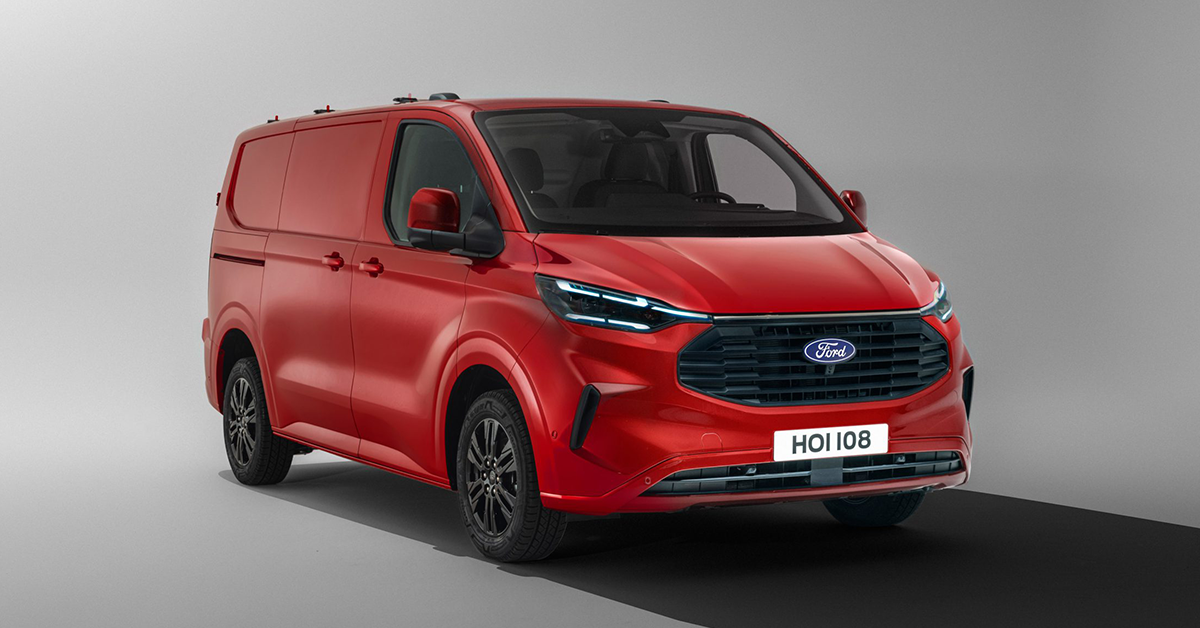
Official press image of the Ford Transit Custom. | © Ford Motor Company
The Ford Transit Custom from its 2012 debut to the all-new 2023 van, covering the EcoBlue diesel, the plug-in hybrid, the E-Transit Custom, payload, towing, charging, trims and UK sales, showing what Ford says and what is only reported.
Transit Custom is Ford’s one-tonne van in Europe. Ford’s 2026 pages list it as a van, a Kombi, a double-cab-in-van and a MultiCab, and Ford sells a passenger version called the Tourneo Custom (Ford). Ford’s 2023 launch release calls it Europe’s best-selling van (Ford). Ford’s U.S. pages we read cover the full-size Transit, which is a different van, so this article uses Ford’s European pages. Our Transit article covers the full-size U.S. van and the E-Transit.
| Body styles | Van, Kombi, Double-cab-in-van, MultiCab (Ford) |
| Passenger version | Tourneo Custom (Ford) |
| Launch of all-new van | October 9, 2023, Munich (Ford) |
| Diesel engine | 2.0L EcoBlue, 110/136/150/170 PS (Ford) |
| Plug-in hybrid | 2.5L petrol, 232 PS (Ford) |
| Electric motors | 100 kW or 160 kW at launch (Ford) |
| Net payload, diesel | Up to 1,350 kg (Ford) |
| Net payload, PHEV | Up to 1,181 kg (Ford) |
| Net payload, electric | Up to 1,011 kg at launch (Ford) |
| UK best-seller | 11 consecutive years (Ford) |
Ford’s media page says the all-new Transit Custom was announced in Munich on October 9, 2023, and was available to order across Europe (Ford). Deliveries of the diesel models were scheduled to start in the fourth quarter of 2023, and the all-electric E-Transit Custom was planned for summer 2024 (Ford). The same page says the range uses multiple powertrains, including a new plug-in hybrid and an intelligent all-wheel-drive system that is new to the Transit Custom (Ford).
Three powertrain families make up the range. Ford’s 2023 fact sheet lists a 2.0-litre EcoBlue diesel in 110, 136, 150 and 170 PS outputs, a plug-in hybrid with a 2.5-litre petrol engine and 232 PS, and an electric version with a 100 kW or 160 kW motor (Ford). Ford says the diesel can be ordered in front-wheel drive or all-wheel drive, and that the plug-in hybrid and the electric van are front-wheel drive and rear-wheel drive respectively (Ford).
Payload is the next headline number. Ford’s 2023 fact sheet gives net payload of up to 1,350 kg for the diesel, up to 1,181 kg for the plug-in hybrid and up to 1,011 kg for the electric van (Ford). Ford’s 2026 pages give the E-Transit Custom up to one tonne of payload and a maximum towing capacity of 2,300 kg (Ford). Ford’s footnote says horsepower, torque, payload and towing are independent and may not be achieved at the same time (Ford).
Sales are the other headline. Ford says the Transit Custom has been the UK’s best-selling van for 11 consecutive years, and that at times it has outsold every other model of vehicle in the UK, including cars (Ford). Ford’s April 2025 anniversary release says the Transit nameplate sold more than 96,000 vehicles in the UK in 2024, more than a quarter of the light commercial vehicle sector (Ford). A report of official UK data gives 49,774 Transit Custom registrations in 2025 (reported).
We kept the scope tight. We found no Ford price for the Transit Custom in the pages we read, no Ford torque figure for the EcoBlue diesel, and no Ford 0 to 62 mph time. We found no Ford statement of how many Transit Customs are built each year. Where Ford’s own pages disagree with each other, we show both values and say which page each one comes from. We give no claim about reliability, resale value or running costs beyond what Ford states. We also give no claim about how many of each powertrain Ford sells, because the pages we read do not say.
Ford’s July 2012 release, which we read on an archive mirror, says the first all-new Transit Custom and Tourneo Custom rolled off the assembly line on July 23, 2012 at Kocaeli in Turkey (Ford). A German trade report gives July 24, 2012 for the same event, so the day is a conflict between sources (reported). The release says Ford Otosan’s Kocaeli plant had been the home of Transit production since 2001 and had built more than 2,250,000 vehicles for export to more than 70 countries (Ford).
| First van off the line | July 23, 2012, Kocaeli (Ford); July 24 (reported) |
| On sale | Late 2012 (Ford) |
| Ford Europe CV share, Jan-Jul 2017 | 13.3% (Ford) |
| Updated van deliveries | Early 2018 (Ford) |
| 185 PS EcoBlue and mild hybrid | Announced September 2018 (Ford) |
| First PHEV in 1-tonne segment | September 23, 2019 (Ford) |
| PHEV battery warranty, 2019 | 8 years or 160,000 km (Ford) |
| Next-gen range confirmed | March 16, 2021 (Ford) |
| All-new van launched | October 9, 2023, Munich (Ford) |
| E-Transit Custom deliveries | Summer 2024 (Ford) |
Ford’s UK media page says the Transit Custom was introduced in late 2012 and was the first of the all-new Transit line-up to go on sale, later joined by the Transit Courier, Transit Connect and Transit (Ford). Ford’s 2017 release says Ford was Europe’s number one selling commercial vehicle brand, with a 13.3 per cent share in the first seven months of 2017, led by the two-tonne Transit and the one-tonne Transit Custom (Ford). Our Ford history article covers the company around these vans.
A second Custom arrived around 2018. Ford’s 2017 release says a new Transit Custom would enter production later that year for customer delivery in early 2018, with a plug-in hybrid following in 2019 (Ford). Ford’s September 2018 release says the range gained a 185 PS EcoBlue variant and a segment-first mild hybrid option, and that the plug-in hybrid would enter volume production in the second half of 2019 (Ford). The 2019 hybrid used a 1.0-litre EcoBoost petrol engine as a range extender with a zero-emission range targeted above 50 km (Ford).
Ford’s September 23, 2019 release says Ford was the first manufacturer to deliver plug-in hybrid technology for zero-emission driving to the one-tonne van segment, with the Transit Custom Plug-In Hybrid (Ford). It says the battery pack was covered by a standard eight-year or 160,000 km warranty (Ford). Ford’s March 2021 release then confirmed that the next-generation Transit Custom range would include an all-electric model alongside plug-in hybrid, mild hybrid and conventional engines, built by Ford Otosan in Kocaeli (Ford).
Ford’s November 2023 release says the all-new Transit Custom is built with the Tourneo Custom at Ford Otosan’s Yeniköy Assembly Plant, which it calls a first-of-its-kind multistorey facility (Ford). Ford’s 2021 release names Kocaeli as the home of the range, and reports say Yeniköy builds the Courier while the Custom is built at another Kocaeli plant, so the plant name conflicts between sources (reported). The same Ford release says the E-Transit Custom and E-Tourneo Custom would reach customers from summer 2024 (Ford).
Ford’s own generation labels do not give a clean count. Ford called the 2018 van a “new generation” and the 2023 van “all-new” (Ford). Reports call the 2023 van the second generation, and one report calls it the fifth-generation Transit Custom (reported). We give no generation count of our own. We also found no Ford statement of how many first-generation vans were built, so we give none.
The EcoBlue diesel is the volume engine. Ford’s 2023 fact sheet lists a 2.0-litre diesel in 110, 136, 150 and 170 PS outputs, with a six-speed manual or an eight-speed automatic and front-wheel drive or all-wheel drive (Ford). Reports say the automatic is offered on the 136 and 170 PS versions, and a Dutch-language report gives a towing capacity of up to 2,800 kg for those versions (reported). Ford’s media page for the van gives no EcoBlue outputs, so we take the outputs from the fact sheet (Ford).
| EcoBlue outputs | 110, 136, 150, 170 PS (Ford) |
| Gearbox | 6-speed manual or 8-speed automatic (Ford) |
| Drive | Front-wheel or all-wheel drive (Ford) |
| CO2, WLTP | 178 to 296 g/km (Ford) |
| Fuel use, WLTP | 6.8 to 11.3 l/100 km (Ford) |
| Net payload | Up to 1,350 kg (Ford) |
| Load volume | 5.8 to 6.8 m3 (Ford); 5.8 to 9.0 m3 (reported) |
| Length, L1 and L2 | 5,050 mm and 5,450 mm (Ford) |
| Wheelbase, L1 and L2 | 3,100 mm and 3,500 mm (Ford) |
| Turning circle, L1 and L2 | 10.9 m and 12.1 m (Ford) |
Ford’s fact sheet footnote gives homologated diesel emissions of 178 to 296 g/km of CO2 and fuel efficiency of 6.8 to 11.3 litres per 100 km on the WLTP cycle (Ford). A Swedish-language release says the new diesels cut CO2 emissions by up to almost six per cent against the previous model (reported). We found no Ford torque figure for the diesel on the pages we read, so we give none. A report of the launch also lists an optional mechanical limited-slip differential (reported).
Load figures differ between sources. Ford’s fact sheet gives a load volume of 5.8 to 6.8 cubic metres and a net payload of up to 1,350 kg for the diesel (Ford). A reprint of Ford’s launch release gives load volumes of 5.8 to 9.0 cubic metres, with payload up to 1,350 kg and a maximum load length of 3,450 mm using the load-through feature under the passenger seats (reported). Ford South Africa’s release gives 5.8 cubic metres at the standard roof height, payload up to 1,269 kg and a 3,050 mm load length (Ford).
The 1,269 kg figure appears again in Australia. A report on Ford Australia’s range gives 1,269 kg on the short wheelbase, 1,223 kg on the long wheelbase and a braked towing capacity of 2,500 kg (reported). Those are market-specific figures, so they do not contradict Ford’s 1,350 kg European figure, but we show them because readers in each market will see different numbers. A magazine road test says the standard-wheelbase, standard-roof van has 5.8 cubic metres and 1,350 kg (reported).
Ford’s 2026 tech spec sheet gives dimensions for the electric and plug-in hybrid vans, which share the body. Overall length is 5,050 mm on the L1 and 5,450 mm on the L2, wheelbase is 3,100 mm and 3,500 mm, and overall height is 1,959 to 2,040 mm (Ford). Width is 2,032 mm without mirrors and 2,275 mm with them, ground clearance is 140 mm, and the turning circle is 10.9 metres on the L1 and 12.1 metres on the L2 (Ford).
The sheet also gives door and load sizes. The side door aperture is 1,030 mm wide and 1,301 mm high, the rear door aperture is 1,400 mm wide and 1,314 mm high, and the maximum load height is 1,433 mm (Ford). Load volume is 5.8 and 6.8 cubic metres for the van, 3.8 and 4.7 for the MultiCab and 3.3 and 4.3 for the double-cab-in-van, on the L1 and L2 (Ford). We found no Ford 0 to 62 mph time and no Ford diesel kerb weight, so we give none.
The plug-in hybrid has two lives. The 2019 version used a 1.0-litre EcoBoost petrol range extender, and Ford targeted a zero-emission range above 50 km (Ford). The 2023 version uses a 2.5-litre petrol engine, which Ford’s fact sheet rates at a maximum of 232 PS, with front-wheel drive, a continuously variable transmission, an 11.8 kWh battery and a net payload of up to 1,181 kg (Ford). A review says the engine and motor are shared with Ford’s Kuga SUV (reported).
| 2019 PHEV engine | 1.0L EcoBoost range extender (Ford) |
| 2023 PHEV engine | 2.5L petrol, 2,488 cc, 4-cylinder (Ford) |
| System output | 232 PS (Ford); 233 PS (Ford) |
| Torque, engine and motor | 180 Nm and 320 Nm (Ford) |
| Battery | 11.8 kWh usable, 96 cells (Ford) |
| Electric range | Up to 55 or 56 km WLTP (Ford) |
| AC charging | 3.6 kW, 10-100% in about 3.9 h (Ford) |
| Fuel tank | 63 litres (Ford) |
| Max net payload | Up to 1,181 kg (Ford) |
| Towing, sample van | 2,000 kg (Ford) |
Ford’s 2026 tech spec sheet gives more detail. The engine is a 2,488 cc four-cylinder with a 13.0 to 1 compression ratio, paired with a Ford-developed power-split CVT, and the total output is listed as 233 PS (Ford). The petrol engine makes 180 Nm and the electric motor 320 Nm (Ford). The battery has 96 NMC lithium-ion cells with 11.8 kWh usable, and the fuel tank holds 63 litres (Ford). The 232 PS and 233 PS figures conflict, so we show both.
Electric range also varies. Ford’s March 2025 release says up to 56 km of pure-electric driving, with a footnote range of 44 to 56 km on the WLTP cycle (Ford). Ford’s 2023 fact sheet gives 48 to 55 km, and the 2026 tech spec says up to 55 km (Ford). The March 2025 release gives CO2 of 35 to 46 g/km and fuel use of 1.6 to 2.0 litres per 100 km, while the 2026 sheet gives 86 to 112 g/km and 3.8 to 4.9 litres per 100 km for the Euro 6e-bis WLTP standard (Ford). The 2026 sheet gives UK figures of 36 to 52 g/km and 1.6 to 2.3 litres per 100 km (Ford).
Charging and modes are simple. Ford’s sheet says a 3.6 kW AC charger takes the battery from 10 to 100 per cent in about 3.9 hours, and that there is no DC fast charging for the plug-in hybrid (Ford). The drive modes are EV Now, EV Later, EV Auto and EV Charge, and the service interval is two years or 40,000 km (Ford). Pro Power Onboard, an optional 2.3 kW outlet, is listed in the plug-in hybrid column of the sheet (Ford).
The sample vehicle on the sheet is a Limited MultiCab L2H1. It has a kerb weight of 2,245 kg, a gross payload of 980 kg, a gross vehicle mass of 3,225 kg and a maximum towing weight of 2,000 kg (Ford). Ford lists 52 km of electric range, 4.1 litres per 100 km and 94 g/km for it (Ford). The 980 kg figure is a configuration result, not a conflict with the 1,181 kg maximum, because the body and equipment differ (Ford).
Ford’s January 2026 release says Ford Pro was the top-selling brand in Europe’s overall electrified commercial vehicle segment in 2025, with particularly strong sales of plug-in hybrids including the Transit Custom and the Ranger (Ford). A report says Ford cut the Australian price of each plug-in hybrid variant by A$3,900 for 2027 (reported). We found no Ford count of Transit Custom plug-in hybrids sold, and we give no claim about the share of Custom sales that are hybrid.
Ford revealed the E-Transit Custom in May 2022. Ford’s release, which we read on an archive mirror, targeted a range of up to 380 km, 125 kW fast charging, towing of 2,000 kg and payload of up to 1,100 kg, from a 400-volt, 74 kWh usable battery (Ford). It says the 82 Ah pouch cells are shared with the Ford F-150 Lightning (Ford). Our F-150 Lightning article covers that truck, and this section stays on the electric van.
| Reveal | May 2022 (Ford) |
| 2022 target battery and range | 74 kWh, up to 380 km (Ford) |
| Launch battery | 64 kWh usable (Ford) |
| Launch range | Up to 337 km (Ford) |
| 2026 battery | 71 kWh usable (Ford) |
| 2026 range, RWD | Up to 373 km WLTP (Ford) |
| 2026 range, AWD | 342 km or 348 km (Ford) |
| Sample range, Limited L1H1 | 325 km (Ford) |
| Service interval | 2 years, unlimited km (Ford) |
| UK page range | 163 to 204 miles (Ford) |
The production van changed those numbers. Ford’s 2023 fact sheet gives a 64 kWh battery, a 100 kW or 160 kW rear-wheel-drive motor with a single-speed automatic, and payload of up to 1,011 kg (Ford). Ford’s media page gives up to 337 km of driving range, two-year unlimited-distance service intervals, payload up to 1,011 kg and 2,300 kg of towing (Ford). So the 2022 targets and the production figures differ on battery, range, payload and towing, and we show both sets.
A battery upgrade followed. Ford’s 2025 articles say the usable capacity rises from 64 kWh to 71 kWh for vehicles built from early 2026, and that range rises to up to 373 km on the WLTP cycle for the rear-wheel-drive 2026 model, a more than 10 per cent improvement (Ford). Ford’s what’s-new page gives up to 342 km for the all-wheel-drive 2026 model, while the 2026 tech spec sheet gives up to 348 km, so the AWD range conflicts (Ford).
The sample vehicles on Ford’s sheet show how configuration changes range. The Limited van L1H1 with 100 kW is listed at 325 km, the Sport van L1H1 with 160 kW at 316 km, and the Trail AWD van 320 L1H1 with 160 kW at 315 km (Ford). The 373 km headline is therefore a best case for a particular rear-wheel-drive configuration, not a figure for every van (Ford). Ford’s footnote says real range depends on temperature, driving style, route, maintenance and battery age and condition (Ford).
Ford’s UK page still lists older numbers. It shows a targeted range of 163 to 204 miles and a maximum gross payload of 1,088 kg for the L1H1 electric van (Ford). Ford’s 373 km converts to about 232 miles by our arithmetic, so the UK page and the 2026 European figures do not match, and we cannot say which one a UK buyer should use (our calculation). A report also gives 1,088 kg as the best payload for the lower-powered Trend (reported).
Ford’s 2024 launch article says Ford Pro anticipates lower operating costs than an equivalent diesel van (Ford). For the larger E-Transit it says servicing costs could be as much as 40 per cent lower, and that figure is not a Transit Custom number (Ford). We found no Ford energy-consumption figure in kWh per 100 km for the E-Transit Custom, and no Ford ownership-cost figure in euros or pounds, so we give none. We also found no Ford statement of how the 74 kWh target battery became a 64 kWh pack, and we do not guess at the reason.
Ford’s what’s-new page gives the charging figures. At 125 kW, a 10 to 80 per cent DC charge takes about 29 minutes, a 10-minute saving, and about 111 km of range is added in 10 minutes (Ford). Ford says over-the-air updates for vans already on the road cut the 10 to 80 per cent charge to about 25 minutes, a 14-minute saving (Ford). The 2026 tech spec sheet lists AC charging at 11 kW in about 4 hours 40 minutes and at 7.4 kW in about 6 hours 42 minutes for 10 to 80 per cent (Ford).
| DC charging, 10 to 80% | About 29 min at 125 kW (Ford) |
| DC charging after OTA update | About 25 min (Ford) |
| Range added in 10 minutes | About 111 km (Ford) |
| AC 11 kW, 10 to 80% | About 4 h 40 min (Ford) |
| AC 7.4 kW, 10 to 80% | About 6 h 42 min (Ford) |
| AWD drive units | 100, 160 or 210 kW (Ford) |
| Torque, RWD | 415 Nm (Ford) |
| Torque, AWD | 435, 617, 630 Nm (Ford) |
| Towing, max | 2,300 kg (Ford) |
| Gross payload, Limited L1H1 | 1,038 kg (Ford) |
Ford’s page says optional all-wheel drive adds an independent front electric drive unit with outputs of 100 kW, 160 kW or 210 kW, with the 210 kW unit only on the Sport and MS-RT (Ford). Each unit can deliver full power independently, and the 210 kW version has 630 Nm of total motor torque from standstill, which Ford says is over 50 per cent more than the rear-wheel-drive van (Ford). Ford says wheel slip is monitored up to 50 times per second, with real-time torque adjustments (Ford).
The torque numbers on Ford’s tech spec sheet are 415 Nm for the rear-wheel-drive van and 435, 617 and 630 Nm for the all-wheel-drive versions, listed as motors combined (Ford). Power options are 100, 160 and 210 kW (Ford). By our arithmetic, 630 Nm is about 52 per cent above 415 Nm, which matches Ford’s “over 50 per cent” wording (our calculation). Ford’s page also says regenerative braking force is roughly 50 per cent higher at lower speeds, and the AWD drive modes are Normal, Eco, Sport, Slippery and Trail (Ford).
Payload and towing carry wording that needs care. Ford’s 2026 pages say the E-Transit Custom offers up to one tonne of payload and a maximum towing capacity of 2,300 kg (Ford). The sheet then lists a gross payload of 1,038 kg for the Limited L1H1 and 1,024 kg for the Sport L1H1, both above one tonne, and 857 kg for the Trail AWD L1H1 (Ford). All three have a gross vehicle mass of 3,225 kg and a towing weight of 2,300 kg (Ford). So “up to one tonne” is rounded wording on Ford’s page.
Ford’s footnotes say payload varies with accessories and configuration, that the doorjamb label shows each vehicle’s capacity, and that towing varies with cargo, accessories and the number of passengers (Ford). The footnotes also say horsepower, torque, payload and towing may not be achieved simultaneously (Ford). The 2022 reveal promised a Pro Power Onboard feature for the electric van, but the 2026 tech spec sheet lists Pro Power Onboard as not available for the electric versions and as an optional 2.3 kW outlet for the plug-in hybrid (Ford).
We keep the limits plain. We found no Ford figure for DC charging at higher than 125 kW for the Transit Custom, no Ford figure for the heat pump or winter range, and no Ford price. We also found no Ford statement of what the Trail mode does to range. Ford’s 2024 launch article describes the electric van as built for small and medium businesses, and we give no claim about which trade it suits best (Ford).
Ford lists four body styles for the electric van: a van, a Kombi, a double-cab-in-van and a MultiCab (Ford). The electric series are Trend, Limited, Trail, Sport and MS-RT (Ford). Ford’s 2026 sheet lists the wheels by series. The Trend has 16-inch steel wheels, the Limited has 16-inch alloys, the Sport has 17-inch directional-spoke alloys with 19-inch machined alloys optional, and the MS-RT has 19-inch multi-spoke alloys (Ford).
| Body styles | Van, Kombi, Double-cab-in-van, MultiCab (Ford) |
| Electric series | Trend, Limited, Trail, Sport, MS-RT (Ford) |
| Trend wheels | 16-inch steel (Ford) |
| Limited wheels | 16-inch alloy (Ford) |
| Sport wheels | 17-inch alloy, 19-inch optional (Ford) |
| MS-RT wheels | 19-inch multi-spoke alloy (Ford) |
| Tourneo capacity | Up to nine occupants (Ford) |
| E-Tourneo range, RWD and AWD | 341 km and 315 km (Ford) |
| Connectivity | 5G modem, over-the-air updates (Ford) |
| Downtime saved, Europe 2025 | More than 994,000 days (Ford) |
Ford’s launch page lists the digital features. They include a tilting steering wheel, Delivery Assist and Exit Warning, which Ford calls segment firsts, plus an Upfit Integration System for digitised conversions, a Mobile Office option and the MultiCab body style, which Ford calls class-unique (Ford). Standard 5G connectivity with over-the-air updates and full integration with the Ford Pro software and services platform are also listed (Ford). A report adds a 13-inch SYNC 4 touchscreen (reported).
The Tourneo Custom is the passenger version. Ford’s November 2023 release says it is built in the same plant as the van and is a multi-activity vehicle with flexible accommodation for up to nine occupants (Ford). Ford’s 2026 page lists a new E-Tourneo Custom for 2026 with optional all-wheel drive using 160 kW or 210 kW drive units, a 71 kWh battery and over-the-air charging updates for existing models (Ford). The range is up to 341 km in rear-wheel drive and up to 315 km in AWD (Ford).
The van also has a partner. Reports say the Ford and Volkswagen alliance means the next Volkswagen Transporter is based on the Transit Custom platform, and that Volkswagen’s one-tonne van is built in Kocaeli (reported). One report says Ford planned to invest about two billion euros in Ford Otosan’s Kocaeli facilities to raise vehicle and battery production (reported). Ford’s own pages we read do not mention the Volkswagen partnership on the Transit Custom product page (Ford).
Servicing and uptime are part of the pitch. Ford says the FORDLiive uptime system saved customers more than 994,000 days of downtime in Europe in 2025, up from the 822,000 additional days of availability it reported for 2024 (Ford). Ford’s sheet lists a two-year unlimited-distance service interval for the electric van and two years or 40,000 km for the plug-in hybrid (Ford). We found no Ford service-interval figure for the diesel on the pages we read, so we give none.
We found no Ford crash-test statement for the 2023 van, no Ford statement of seat counts for the Kombi in the pages we read, and no Ford fuel-economy figure for the Kombi. A review says the van has a five-star Euro NCAP rating, but we did not read the test result itself, so we do not state it as fact (reported). We also give no claim about how the Transit Custom compares with rival vans, because the Ford pages we read do not compare them. Ford’s pages also give no price for any series or wheel option, so we cannot say what the Sport or MS-RT adds over the Trend, and we do not infer it.
Ford’s European 60-year article says the Transit or Transit Custom has been the UK’s best-selling van for 59 years, and the Transit Custom alone for 11 consecutive years (Ford). It says Transit and Transit Custom sales in Europe grew 52 per cent from 2014 to 2024, and that almost one in five one-tonne and two-tonne vans sold in Europe in 2024 was a Transit or Transit Custom (Ford). Ford’s January 2026 article says Ford Pro was Europe’s leading commercial vehicle brand for an 11th consecutive year in 2025, with a record share of over 17 per cent (Ford).
| UK best-seller, Custom | 11 consecutive years (Ford) |
| UK best-seller, Transit or Custom | 59 years (Ford) |
| Europe sales growth, 2014 to 2024 | Up 52%, Transit and Custom (Ford) |
| Ford Pro Europe, 2025 | 11th year as leader, over 17% share (Ford) |
| UK Custom registrations, 2025 | 49,774 (reported) |
| UK Custom, July 2026 | 5,756 (Ford) |
| UK electric chart, July 2026 | 1,271 units, 26.9% share, Ford (Ford) |
| Germany Ford Pro, 2025 | 93,673 registrations, record (Ford) |
| Germany Custom, 2025 | 27,193 registrations (Ford) |
| Australia Trend SWB, 2024 | A$55,990 before on-road costs (reported) |
UK registrations are well documented. A report of official UK data gives 49,774 Transit Custom registrations for 2025, making it the second-best-selling vehicle overall behind the Ford Puma (reported). The same report says the electric version had 19.8 per cent of UK electric van registrations (reported). Reports for 2026 give 23,000 registrations in the first half and 30,463 through August, against 15,026 for the larger Transit (reported). Ford says 5,756 Transit Customs were registered in July 2026 (Ford).
Ford’s UK July 2026 article says Ford topped the all-electric commercial vehicle chart that month with 1,271 units registered, a 26.9 per cent segment share (Ford). Ford’s German release says Ford Pro registered 93,673 vehicles in Germany in 2025, a record and 15,218 more than in 2024, and that the Transit Custom, including the electric version, led with 27,193 registrations (Ford). Reports differ on when the Custom became the UK’s best-selling vehicle range overall, giving 2021 in one place and 2022 in another (reported).
Production is centred on Turkey. Ford’s 2012 release, read on an archive mirror, says Ford Otosan is owned jointly by Ford and Koç Holdings (Ford). Ford’s 2023 release names the Yeniköy plant for the new Custom, and its 2021 release names Kocaeli, while reports place the Courier at Yeniköy (reported). A Ford Pro article says Ford builds Transits across a network of facilities from Europe to the United States and China (Ford). We found no Ford figure for annual Custom output.
Prices are not given on the Ford pages we read, so prices here are reported. A report on Ford Australia’s 2024 range gives the Trend short wheelbase at A$55,990, the Trend long wheelbase at A$56,990, the Sport short wheelbase at A$59,990 and the Sport double cab at A$62,990 before on-road costs (reported). Another report says the 2027 plug-in hybrid prices fall to A$63,990 for the Trend long wheelbase and A$66,390 for the Sport short wheelbase, and the electric prices to A$73,990 and A$76,390 (reported).
Readers comparing the Transit Custom with Ford’s wider range can use our Ford models page. We found no Ford price for Britain, Germany or Ireland on the pages we read, and we do not convert the Australian prices into other currencies, because exchange rates and local taxes would make the result misleading. We give no claim about discounts, finance offers or residual values, and we keep sales figures labelled by country because Ford’s UK, German and Europe-wide numbers cover different markets.
