 Brands
Volkswagen Corrado — History, G60, VR6 and Specs
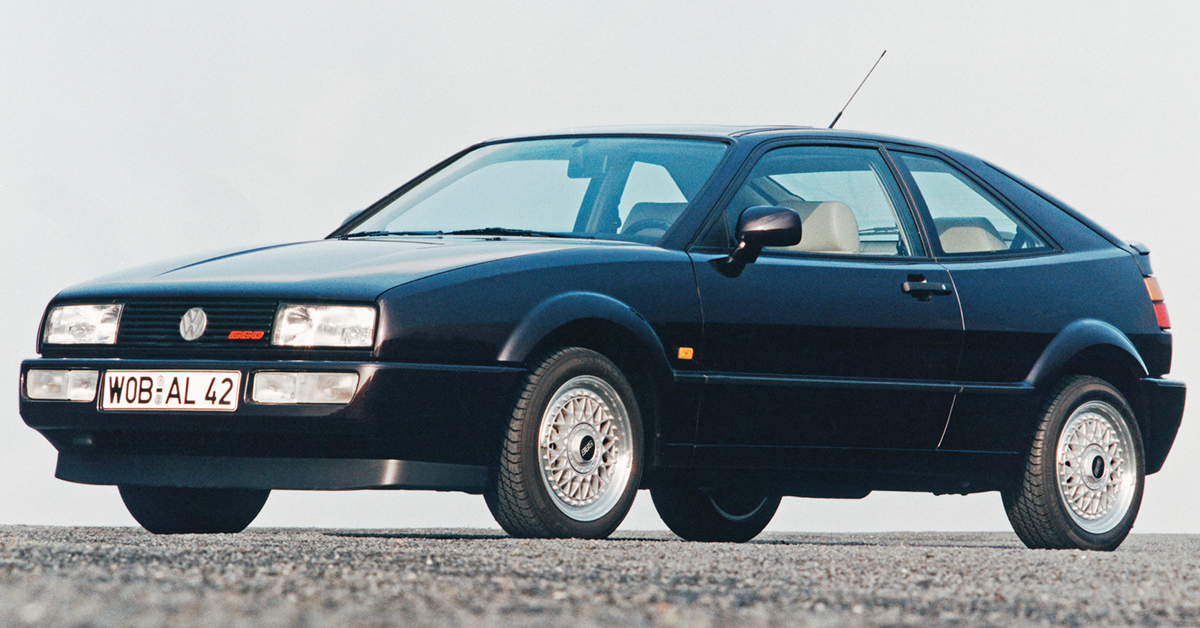
Official press image of the Volkswagen Corrado. | © Volkswagen AG
The Volkswagen Corrado is the supercharged, spoiler-equipped sports coupé that Volkswagen presented in August 1988 and built at Karmann in Osnabrück until July 1995, with about 98,000 cars made. Here is the full Corrado story, from the abandoned Scirocco III plan to the G60, the VR6, the American SLC and the prototypes that never reached the showroom.

Official press image of the Volkswagen Corrado (1988). | © Volkswagen AG
The Volkswagen Corrado is a three-door, front-wheel-drive 2+2 sports coupé that Volkswagen presented in August 1988 and built until 1995. It was assembled by Karmann in Osnabrück, the same coachbuilder that made the Karmann Ghia and the first two Sciroccos, and it was based on the Golf II. Volkswagen’s own history page gives it the factory code Type 53i and the label “first purebred sports car”, and says the car was positioned above the Scirocco II rather than replacing it. Volkswagen’s figures put total production at about 98,000 cars by 1995, although other sources give slightly different totals, as the last section explains.
| Factory code | Type 53i (Volkswagen) |
| Development begins | 1981, internal code EA 494 (reported) |
| Decision to keep the Scirocco II | 1984 |
| Presented | August 1988 (Volkswagen) |
| Plant | Karmann, Osnabrück |
| Platform | Golf II |
| 2.0 16V and 2.9 VR6 added | 1991 |
| 2.0 8V added, G60 dropped | 1993 |
| Production ended | 6 July 1995 |
| Total built | 97,535 (Volkswagen Classic), about 98,000 (chronology), 97,521 (reference) |
The Corrado began life as the next Scirocco. Volkswagen says the car was initially planned as the successor to the Scirocco II, a project known as the Scirocco III, and that it was improved so much on the basis of the Golf II that it outgrew the Scirocco class. A classic-car article says development started in 1981 under the internal code EA 494, around the time the Scirocco II was launched, and that early drafts by the designer Herbert Schäfer were ready by mid-1982. The same article says Volkswagen’s financial problems stalled the project and that the planned coupé risked costing more than the Scirocco it was meant to undercut. A UK classic-car timeline adds that the original proposal was a shooting-brake estate in the style of the Lancia HPE.
The aim had been a cheaper, more compact car, but according to one source the new coupé ended up only about 20 millimetres shorter than the Scirocco, and the modified engine range made a lower price impossible. In 1984 the plan changed. Volkswagen’s page says that the decision was made to keep building the Scirocco II, and that the model now called Corrado would be positioned higher in the range with an engine to match. The same classic-car article says a smaller, Polo-based coupé was also considered, and that the plan was dropped in favour of four more production years for the Scirocco II and a new sports car. The name comes from the Spanish verb “correr”, meaning to run, and replaced the internal project name Taifun, the German word for typhoon.
Dates for the launch differ slightly by source. Volkswagen’s newsroom says the Corrado was presented in August 1988, its history page says autumn 1988, a reference source says production began on 1 September 1988, and a French database lists the world premiere in August 1988, the Paris Motor Show in October 1988 and sales from November 1988. At launch the car used a supercharged 1.8-litre engine called the G60, with 118 kilowatts, or 160 PS, according to Volkswagen. A UK classic-car timeline gives the G60’s UK price as 19,000 pounds, a figure that should be treated as reported.
The range changed in several steps. Volkswagen says a 2.0-litre 16-valve engine with 136 PS and a 2.9-litre six-cylinder engine joined the G60 in 1991, and that a 2.0-litre 8-valve engine with 115 PS arrived in 1993 as the G60 was discontinued. Production ended on 6 July 1995. The Scirocco II was sold alongside the Corrado until 1992, so for four years Volkswagen sold two coupés built by the same factory. A reference source says the Corrado reached a production total of 97,521 cars, while Volkswagen’s Classic page gives 97,535 and its chronology gives about 98,000.
This guide covers the Corrado in eight parts: the design and active spoiler, the G60, the four-cylinder 16V and 2.0 engines, the VR6, the American and export markets, the updates and prototypes, and the end of production. Where sources disagree, both figures are shown and marked as reported. For the car it was meant to replace, see our guide to the Volkswagen Scirocco, and for the platform it shared, see the Golf guide. The table lists the key dates.

Official press image of the Volkswagen Corrado (1990). | © Volkswagen AG
The Corrado was designed in-house at Volkswagen, which made it a break from the Scirocco, whose shape was drawn by Giorgetto Giugiaro. A reference source credits the design to Herbert Schäfer, and a US classic-car magazine describes it as an in-house job by Schäfer’s team, built by Karmann. A classic-car article describes the look as typical of Volkswagen at the time, with clean edges, rectangular headlights and a slightly raised waistline, and a UK review notes that the car is closely related to the Golf II in its styling and that its dashboard came from the Passat. The result was a wedge-shaped, flush-glazed coupé that has aged well.
| Length | 4,048 mm |
| Width | 1,690 mm |
| Height | 1,318 mm |
| Wheelbase | 2,470 mm |
| Layout | Front engine, transverse, front-wheel drive |
| Boot | 300 litres at launch, 235 litres from 1992 (reported) |
| Fuel tank | 55 litres, 70 litres from 1991 |
| Spoiler (Europe) | Extends at 120 km/h (Volkswagen) |
| Spoiler (US) | 75 km/h, about 45 mph (reported) |
| Designer | Herbert Schäfer and team (reported) |
Volkswagen’s figures give the dimensions. The newsroom vehicle data lists a length of 4,048 millimetres, a width of 1,690 millimetres, a height of 1,318 millimetres and a wheelbase of 2,470 millimetres, with the engine mounted at the front, transversely, and drive to the front wheels throughout the production run. Other sources differ in small ways, giving a length of 4,049 or 4,050 millimetres, a width of 1,674, 1,689 or 1,796 millimetres and a height of 1,310 millimetres, so the table shows Volkswagen’s own figures. A reference source gives a kerb weight of 1,210 to 1,274 kilograms, and a buying guide gives 1,240 kilograms for the VR6.
The Corrado was a 2+2. Volkswagen says the boot held 300 litres at launch, and a classic-car article says that for the 1992 model year the boot fell from 300 to 235 litres while the fuel tank grew from 55 to 70 litres. Volkswagen confirms the larger tank for 1991. The mechanical parts were drawn from across the group, and the classic-car article lists components from the Golf II, the Golf III, the Passat B3 and the Passat B4. This sharing helped keep costs in check, but it also meant the Corrado did not feel like a clean-sheet sports car.
The feature everyone remembers is the rear spoiler. Volkswagen’s history page says it extended automatically, at 120 km/h in Germany, to improve road holding at high speed, and notes that it resembles the spoiler of the Porsche Carrera 964, which extends at 80 km/h. A classic-car article describes it as a first for the brand, placed below the rear window, rising at 120 km/h in Europe and 75 km/h in the United States and lying flat again at low speed. A US classic-car magazine gives the American figure as 45 mph, which is about 72 km/h, and says it retracted below 12 mph. One reference source gives 100 km/h for Europe, which conflicts with Volkswagen, so the table uses Volkswagen’s figure.
Equipment was generous. A classic-car article lists a green-tinted windscreen and glazing, ABS, height-adjustable sports seats, power steering, fog lights and electrically adjustable, heated, body-coloured mirrors as standard, with metallic paint, leather and a sunroof as options. That ABS claim should be read with care, because a UK buying guide says ABS became standard in 1992, and a US magazine says ABS cost 835 dollars as an option on the 1990 American car. The US magazine adds that the power windows could be closed from outside the car when it was stopped, a small party trick that Volkswagen used in its marketing.
The Corrado also made claims about aerodynamics. US advertising for the car, as described in a collection of period press material, quoted a drag coefficient of 0.32, which should be treated as a manufacturer claim rather than a measured figure. Together, the body, spoiler and equipment made the Corrado a different kind of car from the Scirocco, even if the underlying engineering was familiar. The table lists the main design and body figures.
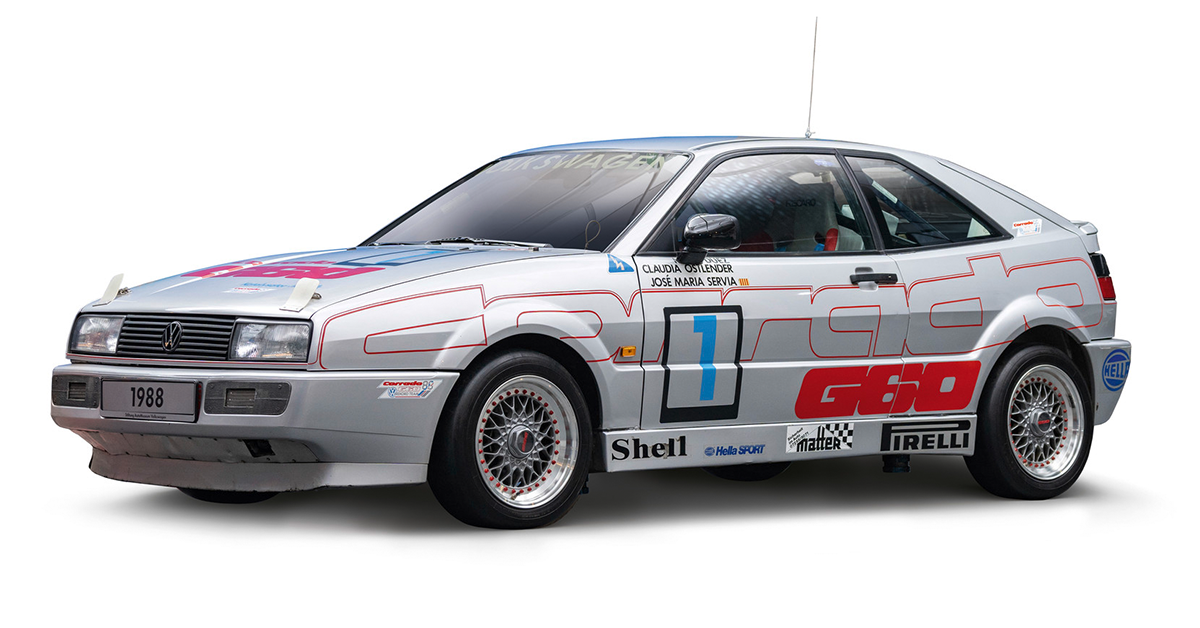
Official press image of the Volkswagen Corrado G60. | © Volkswagen AG
The G60 was the engine that defined the early Corrado. Volkswagen’s newsroom describes it as a new engine with a scroll-type supercharger, called the G-Lader, and gives its output as 118 kilowatts, or 160 PS. The engine was a 1.8-litre, 8-valve four-cylinder with a capacity of 1,781 cc. A UK review quotes 158 brake horsepower, and a US classic-car magazine gives 158 horsepower and 166 pound-feet of torque, which are the same output expressed in different units. A German magazine gives the torque as 225 newton metres, and one reference source lists it at 4,000 rpm.
| Engine | 1.8 L, 1,781 cc, 8-valve, G-Lader supercharger |
| Power | 118 kW (160 PS), Volkswagen |
| Torque | About 225 Nm (reported) |
| 0–100 km/h | 8.5 s (reported) |
| Top speed | 225 km/h (reported) |
| Production (Volkswagen) | 1988 to 1993 |
| Replaced by | 2.0 8V, 115 PS, in 1993 |
| G60 “Record” car | 1987, record breaker in 1988 (Volkswagen archive) |
| 16V G60 prototype | 154 kW (210 PS), 1989, never built in series |
| Weak point (reported) | Five-speed gearbox |
The name comes from the supercharger’s shape. A reference source says the G60 is named for the G-Lader, a scroll-type supercharger whose interior resembles the letter G, and a classic-car article says the name refers to the G-shaped casing. The supercharger was driven by a belt from the engine, according to a German magazine, which means it worked all the time rather than waiting for exhaust pressure like a turbocharger. Volkswagen’s argument, as reported in period advertising, was that the engine produced more power at lower revs without the lag of turbocharging.
The supercharger did not appear from nowhere. A US classic-car magazine traces it to Volkswagen’s late-1970s G-Lader programme, proven on a 1.3-litre Polo G40 that reportedly ran at 130 mph for 24 hours, and says a G60 set six class records at the Ehra-Lessien test track. Volkswagen’s image archive lists a Corrado G60 “Record” from 1987 as a record breaker in 1988, though the page gives no further detail. A classic-car article adds that the G-Lader debuted in the Polo G40 before it powered the Corrado.
Performance figures vary with the source. A Spanish magazine table lists the G60 at 8.5 seconds from 0 to 100 km/h with a top speed of 225 km/h, and a German magazine gives the same 8.5 seconds. A UK review gives 7.8 seconds for 0 to 60 mph and 140 mph, while the US magazine says Volkswagen claimed 7.5 seconds to 60 mph, which it said beat the Porsche 944. The 0 to 60 mph and 0 to 100 km/h times are not directly comparable, and the claims were made by the manufacturer, so the table marks them as reported.
The G60 was built from 1988 to 1993, according to Volkswagen’s vehicle data. A French database lists European, American, Canadian and Japanese sales, with US availability from 1989 to 1991 for the manual car and from 1990 to 1991 for the automatic, while a reference source says the G60 disappeared from the North American market after 1992 and the European market in 1993. The 1993 end matches Volkswagen’s statement that the 2.0-litre 8-valve engine replaced the G60 in that year. A US magazine says the five-speed gearbox was the G60’s weakest point, because it was inferior to the Golf GTI’s.
Volkswagen also built a more extreme version that never reached the showroom. The newsroom shows a prototype Corrado 16V G60 from 1989, which combined the G-Lader supercharger with four-valve technology and produced 154 kilowatts, or 210 PS. The car is part of Volkswagen Classic’s collection, and a US magazine says a 16-valve G60 was planned but cancelled. For many enthusiasts the G60 remains the purest Corrado, and the table summarises its main figures.

Official press image of the Volkswagen Corrado 16V. | © Volkswagen AG
Not every Corrado had a supercharger. Alongside the G60, Volkswagen built naturally aspirated four-cylinder versions that were cheaper and are often forgotten. A reference source says the car debuted with two engines, a 1.8-litre 16-valve with 136 PS and the G60, and a UK classic-car review lists the 16V as the base model, calling it the best version of the car and the cheapest to buy. A UK buying guide dates the arrival of the 16-valve car to May 1989, which conflicts with the launch date given by the review, so it is safest to say it arrived in 1988 or 1989 depending on the market.
| 1.8 G60 (Volkswagen) | 1988 to 1993 |
| 2.0 16V (Volkswagen) | 1991 to 1994, 136 PS |
| 2.0 8V (Volkswagen) | 1993 to 1995, 115 PS |
| 1.8 16V (reference) | 136 PS, 1988 or 1989 depending on source |
| 1.8 16V performance | 9.1 s, 210 km/h (reported) |
| 2.0 16V performance | 9.3 s, 210 km/h (reported) |
| 2.0 8V performance | 10.6 s, 200 km/h (reported) |
| 2.0 16V engine origin | Golf III GTI (reported) |
| Timing drive (four-cylinder) | Belt, change every five years or 40,000 miles (buying guide) |
| Export markets | 1.8, 1.8 16V or 2.8 VR6 (reported) |
Volkswagen’s own sources tell the story differently. The newsroom vehicle data lists four variants: the 1.8 G60 from 1988 to 1993, the 2.0 16V from 1991 to 1994, the 2.9 VR6 from 1991 to 1995 and the 2.0 from 1993 to 1995. It does not list a 1.8 16V. Volkswagen’s history page says that in 1991 a 2.0-litre 16-valve four-cylinder with 136 PS joined the G60, and a German motoring site says the 16-valve engine came from the Golf III GTI. A classic-car article adds that export markets received a 1.8, a 1.8 16V or a 2.8 VR6, which suggests the 1.8 16V was sold in some markets only.
The numbers are modest next to the G60. A Spanish magazine table gives the 1.8 16V a 0 to 100 km/h time of 9.1 seconds and a top speed of 210 km/h, and the 2.0 16V 9.3 seconds and 210 km/h, both with 136 PS. The same table gives the 2.0-litre 8-valve car, with 115 PS, 10.6 seconds and 200 km/h. These are slower than the G60’s 8.5 seconds and 225 km/h, but the four-cylinder cars were lighter and cheaper to run, and the 16-valve engines revved more freely than the supercharged unit.
The 2.0-litre 8-valve engine arrived in 1993 as a cheaper entry point. Volkswagen’s history page says it joined the range that year, rated at 115 PS, and that the G60 was discontinued. A classic-car article says the 2.0-litre engine replaced the G60 from 1993 to 1995. A reference source says a 2.0-litre 8-valve car with 117 PS was produced in Europe in 1995, which is the same engine described in different units. For buyers it is the least powerful Corrado, but it carried the same body, spoiler and equipment.
For used buyers, the four-cylinder cars have different strengths. A UK buying guide says that non-VR6 engines use a timing belt that should be changed every five years or 40,000 miles, and notes that the VR6 uses a chain. It lists the sills, wheelarches, front valance, bonnet underside and rear spring plate areas as places to check for corrosion, and says that corrosion is generally less severe than on many contemporaries. The same guide says that originality is increasingly valued, and that modified cars with lowered suspension and aftermarket wheels are common.
A UK review gives the Corrado 16V five stars out of five and calls it the best mid-sized coupé of its era, which shows how well the basic car was regarded even without the headline engines. The four-cylinder Corrado is also the version most likely to be found in the lower price range of the used market. The table lists the four-cylinder engines, with Volkswagen’s production periods and reported performance.

Official press image of the Volkswagen Corrado VR6. | © Volkswagen AG
The VR6 turned the Corrado from a clever coupé into a car that people still seek out. Volkswagen’s history page says that in 1991 a 2.9-litre six-cylinder engine joined the range, with a standard electronic limited-slip differential, called EDS, and that the new engine required an extended, redesigned front end. Volkswagen’s newsroom describes the VR6 as another milestone in Volkswagen powertrain history, available first with 128 kilowatts, or 174 PS, and then with 140 kilowatts, or 190 PS, in the coupé assembled by Karmann in Osnabrück.
| Introduced | 1991 in Germany (Volkswagen); later in other markets (reported) |
| Layout | Narrow-angle V6, 15 degrees, shared head |
| Capacity (Europe) | 2.9 L, 2,861 cc |
| Power (Europe) | 140 kW (190 PS) at 5,800 rpm |
| Torque (Europe) | 245 Nm at 4,200 rpm (reported) |
| 0–100 km/h | 6.9 s manual (reported) |
| Top speed | 233 km/h manual (reported) |
| Early output | 128 kW (174 PS), Volkswagen |
| North America | 2.8 L, about 174 to 178 hp, sold as Corrado SLC |
| Differential | EDS electronic limited-slip, standard (Volkswagen) |
The engine’s layout was unusual. A UK buying guide describes it as a narrow-angle V6 with a 15-degree angle and a shared cylinder head, and a French database also lists a 15-degree V arrangement. A reference source says this design let engineers fit six cylinders into roughly the same space as four. The 2.9-litre engine had a capacity of 2,861 cc and produced 190 PS at 5,800 rpm and 245 newton metres at 4,200 rpm, according to a reference source, which also gives a top speed of 233 km/h and a 0 to 100 km/h time of 6.9 seconds for the manual car.
There were two capacities. The 2.9-litre engine, listed at 2,861 cc, was sold in Europe, while a 2.8-litre version of about 2,792 cc was sold in North America and some other export markets, with 174 to 178 horsepower depending on the source. Volkswagen’s 174 PS figure for the initial VR6 matches the output other sources give for the 2.8-litre export engine. A reference source gives the 2.8 a top speed of 225 to 230 km/h and a 0 to 100 km/h time of 6.8 to 7.2 seconds.
Dates for the VR6 are a source of confusion. Volkswagen and a German motoring site say 1991, and the newsroom lists the 2.9 VR6 from 1991 to 1995. A UK buying guide says the VR6 was introduced in September 1992, and a reference source says the American version was announced in October 1991 but arrived during the 1992 calendar year. The likely explanation is that the VR6 reached Germany in 1991 and other markets later, which is how the table presents it.
In the United States and Canada the VR6 was called the Corrado SLC, short for Sport Luxury Coupé, and a reference source says 3,500 were brought in for 1992, with 1,500 leftover G60 cars sold after the SLC arrived. A French database lists the SLC in the United States from 1991 to 1994 and a Canadian VR6 from 1992 to 1995. A UK buying guide says VR6 cars were assembled by Karmann, which it links to slightly better build quality.
The VR6 is not trouble-free. A UK buying guide says its timing chain can rattle if the guides or tensioners are worn, usually at around 80,000 miles, and that replacement can be expensive. A UK review describes the VR6 as somewhat troublesome but calls it a modern classic in high demand, and says a clutch judder is often caused by an off-centre release bearing. The last VR6 variant was the Storm, covered in the updates section. The table summarises the VR6 figures.

Official press image of the Volkswagen Corrado SLC. | © Volkswagen AG
The Corrado was an international car. Volkswagen’s history page says cars were exported within Europe and also to the United States and Canada, some with different engines, and a French database lists sales in Germany, the United Kingdom, France, Italy, Spain, Belgium, the Netherlands, Austria, Switzerland, Sweden, the United States, Canada and Japan. Export versions differed in power, equipment and even the speed at which the spoiler rose, which makes it hard to quote one figure for every market.
| Markets (reported) | Europe, United States, Canada, Japan |
| US competitors (reported) | Toyota Celica, Eagle Talon TSI |
| US VR6 name | Corrado SLC (Sport Luxury Coupé) |
| US VR6 first year | 1992, about 3,500 cars (reported) |
| US last model year | 1994 (reported) |
| Canada VR6 | 1992 to 1995 (reported) |
| US sales (reported) | 1,393 in 1989, 5,650 in 1990 |
| ABS option, US 1990 | 835 dollars (reported) |
| UK G60 launch price | 19,000 pounds (reported) |
| UK VR6 Storm | 500 built, 1995, UK only (reported) |
In the United States the Corrado arrived with the G60. A US classic-car magazine says the front-wheel-drive coupé competed with the Toyota Celica and the Eagle Talon TSI, and that Volkswagen’s marketing compared it with the Porsche 944 and an all-wheel-drive 911. The 1990 American car came with most features as standard, and leather upholstery, a power sunroof and ABS were extra, with ABS priced at 835 dollars. A collection of period material says a US advertising campaign promoted the Corrado as a model of innovation, citing more power at low revs without turbo lag, and lists air conditioning, a leather steering wheel, power windows and mirrors, cruise control, central locking, fog lights and the speed-activated spoiler as standard on the American car. It prices the sunroof at 695 dollars and leather at 710 dollars as options.
American sales were modest. A US sales database lists 1,393 Corrados sold in 1989 and 5,650 in 1990, and a reference source says the G60 left the American line-up after 1992. The VR6 arrived as the Corrado SLC, with 3,500 cars brought in for 1992 according to a reference source, and 1994 was the last model year in the United States. These sales figures come from secondary sources and should be treated as reported, but they show the Corrado was always a niche car in America.
Canadian advertising took a different line. A US classic-car magazine says Volkswagen’s Canadian advertisements stressed Karmann’s coachwork and craftsmanship, calling hand work a technological breakthrough. A French database lists the Canadian VR6 from 1992 to 1995, which is one year longer than in the United States. The American and Canadian cars used the 2.8-litre VR6, while Europe received the 2.9-litre version.
In the United Kingdom, a UK timeline puts the G60 at 19,000 pounds at launch, and a UK classic-car review says the Corrado 16V was the base model. The UK also received the last Corrado, the VR6 Storm, a limited edition from 1995 that was sold only there. A UK buying guide says the Storm came with leather upholstery, heated seats and distinctive alloy wheels, and a reference source says only 500 were produced, 250 in Classic Green and 250 in Mystic Blue.
Japan also received the car, according to the French database, with the G60 and the 2.9 VR6 listed there. For buyers outside Europe today, the differences matter, because parts, engines and equipment vary by market. The table summarises the main markets, with the sources marked where figures come from outside Volkswagen, and the same caution applies to any US sales or model-year figure quoted for these cars.

Official press image of the Volkswagen Corrado Cabriolet study. | © Volkswagen AG
Volkswagen updated the Corrado several times during its seven years. The biggest change came in 1991, when, according to Volkswagen, the 2.0-litre 16-valve and the 2.9-litre VR6 were added, the fuel tank grew from 55 to 70 litres in all models and an optional automatic transmission became available. A classic-car article says the changes for the 1992 model year included a taller bonnet, wider front wings, a revised front bumper and grille and a modified front crossmember to fit the larger six-cylinder engine, while the boot shrank from 300 to 235 litres.
| 1991 | 2.0 16V and 2.9 VR6 added, tank 70 L, automatic optional |
| 1992 model year | Taller bonnet, wider wings, revised front end (reported) |
| August 1992 | New console, door panels, gauges (Volkswagen) |
| 1993 | 2.0 8V added, G60 dropped |
| 1994 (reported) | Airbags available from August 1994 |
| 1995 | Front airbags available in final year (Volkswagen) |
| 1989 prototype | Corrado 16V G60, 154 kW (210 PS) |
| 1993 study | Corrado Cabriolet, 115 PS, never built |
| Cabriolet studies | Two: one by Karmann, one in-house (Volkswagen) |
| Final edition | VR6 Storm, 500 built, UK only (reported) |
Volkswagen’s history page says that in August 1992 the interior was revised, with a new centre console and door panels, a push button replacing the toggle switch and redesigned gauges with red needles and a Corrado logo in the rev counter. The split rear seat became standard only in VR6 models. The 1993 update added the 2.0-litre 8-valve engine, and a French database says driver and passenger airbags became available in August 1994. Volkswagen’s newsroom confirms that the coupé was available with front airbags in its final year.
The most interesting prototype was the Corrado 16V G60. Volkswagen’s image archive describes it as an exclusive combination of G-Lader supercharger and four-valve technology, with 154 kilowatts, or 210 PS, from 1989. A reference source says Volkswagen Motorsport produced it, and that although the 16-valve engine combined with the original supercharger was appreciated by enthusiasts, the model never entered series production. Volkswagen showed the car at the Techno Classica in 2017 and at the Bremen Classic Motorshow in 2018, which is why it is well documented in the company’s archive.
There was also a convertible. Volkswagen’s archive shows a Corrado Cabriolet study from 1993, powered by a four-cylinder engine of 1,984 cc and 115 PS with a top speed of 200 km/h. The archive text says two studies were made: a Corrado roadster developed by Karmann, which also built the coupé, and a second created in Volkswagen’s own design department, with a manually operated roof for two occupants that sinks fully into the body while keeping the full boot volume. Its rear spoiler was static rather than automatic. The convertible was discussed but never built.
A classic-car article says at least two cars were converted at Karmann into convertibles to suggest a possible second body style, and that the version stayed in the prototype stage. The Corrado never got an open version. Collectors prize the prototypes that survive, and the 16V G60 is now part of Volkswagen Classic’s collection in Germany.
The final production variant was the VR6 Storm, a UK-only limited edition from 1995. A UK classic-car review says it recalled the Mk1 Scirocco, and a reference source gives 500 as the production run. Together these updates show Volkswagen continually refining the car, even as sales declined. Volkswagen still uses a Corrado G60 16V at classic events, and its archive shows the car at the 2018 Sachsen Classic, in the steep-wall special stage at Meerane, so the prototype is not only a museum piece. The table lists the main changes by year.
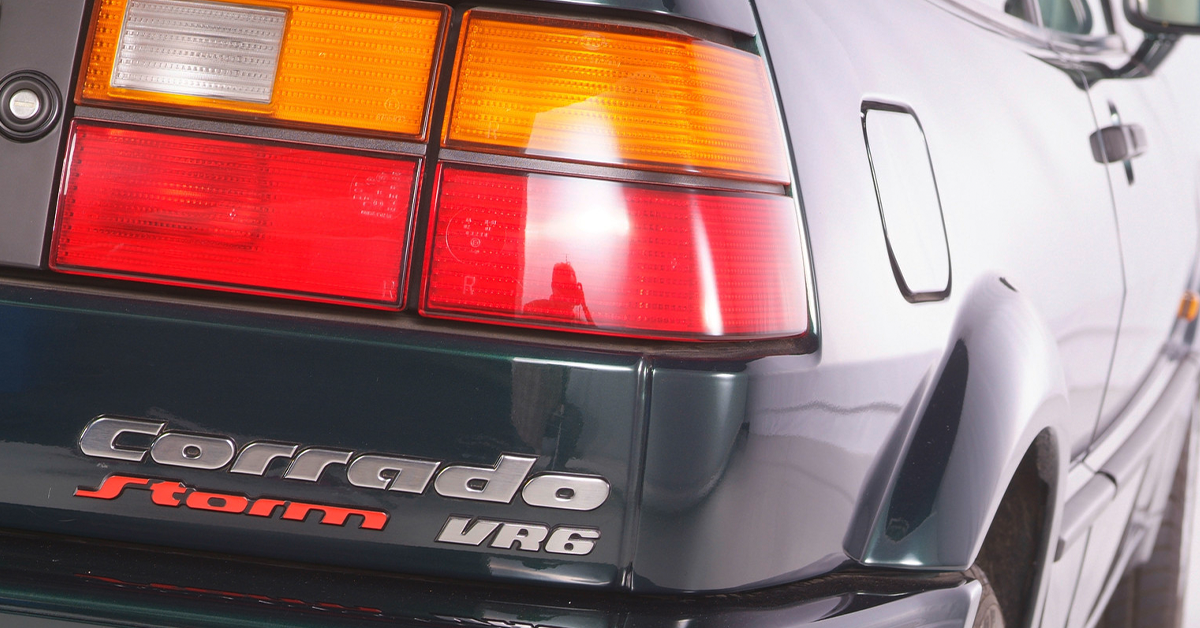
Official press image of the Volkswagen Corrado VR6 (1995). | © Volkswagen AG
Volkswagen’s history page says production of the Corrado ended on 6 July 1995 after 98,000 units. The newsroom’s image archive adds that the last left-hand-drive Corrado, a VR6, rolled off the line at Karmann on 6 July 1995. A French news report describes it as finished in a classic pearl green, and a German magazine gives October 1995 for the last car, while other sources say June or July 1995, so the last cars may have been built or registered at different times. Volkswagen’s own date is the one this guide uses. Volkswagen’s newsroom adds that the coupé was available with front airbags in its final year, so late cars differ from early ones in equipment as well as in engines.
| Production ended | 6 July 1995 (Volkswagen) |
| Last left-hand-drive car | VR6, 6 July 1995 (Volkswagen archive) |
| Total (Volkswagen Classic) | 97,535 |
| Total (Volkswagen chronology) | About 98,000 |
| Total (reference) | 97,521 |
| Best years (reported) | 1989 and 1990 |
| 1989 production (reported) | 24,389 |
| Scirocco II ended | 1992 |
| Revived coupé | Scirocco III, 2008 |
| 30th birthday | Bremen Classic Motorshow, 2018 |
The production figures disagree by a few units. Volkswagen’s Classic page gives 97,535, its chronology gives about 98,000, and a reference source, the German magazine and several others give 97,521. A French database lists 102,544 or 97,521 depending on whether 70 pre-series cars built in 1987 are counted, and gives annual production of 3,276 in 1988 and 24,389 in 1989, while another source gives 3,206 for 1988. A German magazine says 1989 and 1990 were the best years, with demand falling afterwards.
Volkswagen’s pages do not say why the Corrado ended. A reference source says it was perceived as too expensive and that its modest sales did not match the praise it received, and a sales database says its relatively high price compared with other Volkswagens may have limited sales. A German magazine says that after the good years of 1989 and 1990, Volkswagen had to think for a long time about how it saw a sports car. These are interpretations rather than Volkswagen statements, so they are attributed rather than stated as fact.
There was no direct successor. A German magazine says Volkswagen picked up the sporty-coupé tradition again only after a long gap with the current Scirocco, which Volkswagen presented in 2008. A sales database calls the revived Scirocco a spiritual successor to the Corrado. The Scirocco II had already ended in 1992, so between 1995 and 2008 Volkswagen sold no sporty coupé of this kind.
The Corrado has since become a classic. Volkswagen celebrated its 30th birthday at the Bremen Classic Motorshow in 2018, where it showed the 210 PS prototype and the last left-hand-drive VR6. A classic-car article says the Corrado has moved through the lower used-car price range and is now a sought-after young classic, and that the first cars had reached the official classic age of 30. A German motoring site calls it the only true sports car Volkswagen produced in series, a view that is an opinion rather than a fact.
For buyers, the VR6 and the G60 are the cars most enthusiasts want. A UK buying guide says that originality is increasingly valued, especially for the VR6, and that corrosion is generally less severe than on many contemporaries. It also warns that timing chains and sunroof mechanisms can be expensive to repair. Prices vary widely by condition, so check current listings rather than relying on any figure printed here. The table summarises the end of production.