 Brands
Volkswagen ID.7 — History, Range, Tourer and GTX
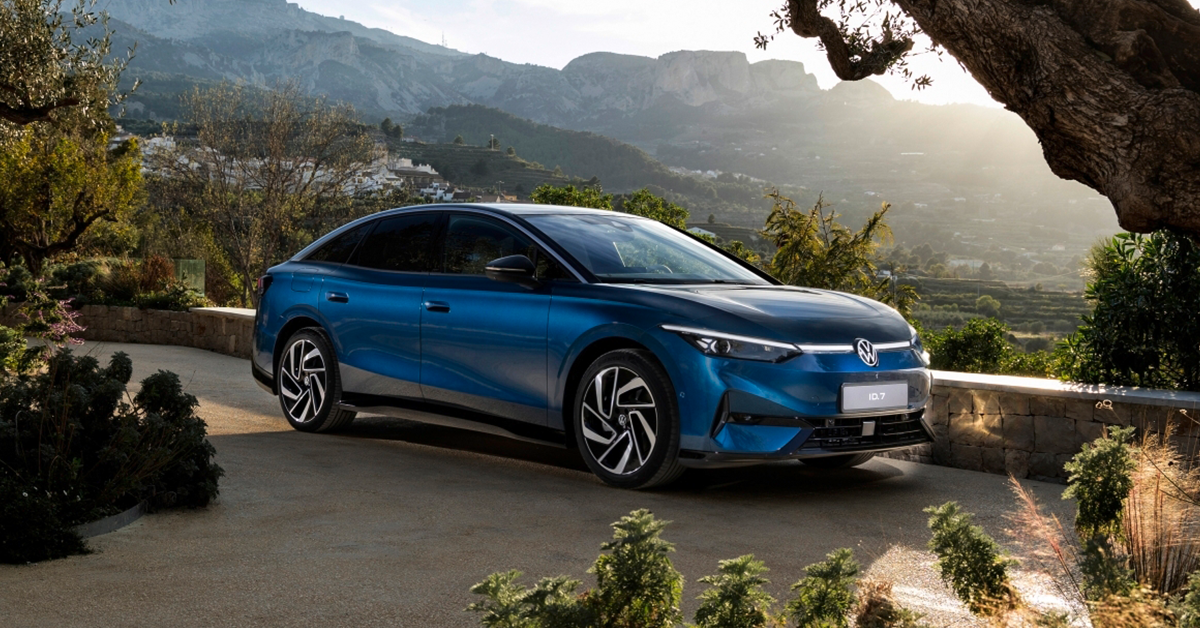
Official press image of the Volkswagen ID.7 fastback saloon. | © Volkswagen AG
The Volkswagen ID.7 is the electric flagship of the ID. family, a fastback saloon with a long-range estate called the ID.7 Tourer and a sporty GTX. Here is the full ID.7 story, from the ID. VIZZION concept and the April 2023 premiere to the 77 and 86 kWh batteries, the Nardò range record, Emden production and its sales results in Europe.
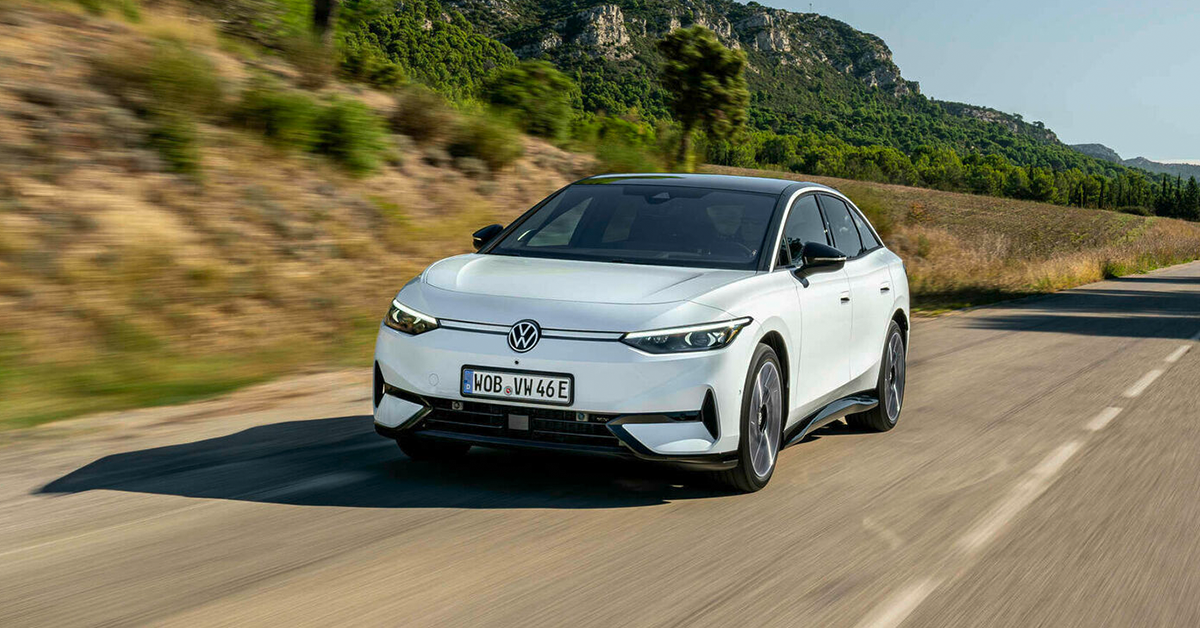
Official press image of the Volkswagen ID.7 fastback saloon on the road. | © Volkswagen AG
The Volkswagen ID.7 is the all-electric flagship of the ID. family: a fastback saloon in the upper mid-size class, joined in 2024 by an estate called the ID.7 Tourer. Volkswagen’s own newsroom calls it the largest ID. model to date. It sits on the MEB platform, is built in Emden, Germany, and was designed for long-distance driving, with a drag coefficient of 0.23 for the saloon. This guide follows the car from its first concept in 2018 to its sales results in 2025 and 2026.
| First concept | I.D. VIZZION, Geneva, 6 March 2018 (Volkswagen) |
| Concept launch plan | 2022 (Volkswagen) |
| CES appearance | 3 January 2023, camouflage (Volkswagen) |
| World premiere | 17 April 2023 (Volkswagen) |
| Premiere location | Wolfsburg dateline (Volkswagen); Berlin and Shanghai (reported) |
| Symbolic production start | 21 August 2023, Emden (reported) |
| Pre-sales opened | 24 August 2023 (Volkswagen) |
| Launch price | 56,995 euros, ID.7 Pro, Germany (Volkswagen) |
| Launch range | Up to 621 km WLTP (Volkswagen) |
| Platform | MEB (Volkswagen) |
The idea of an electric Volkswagen saloon is older than the ID.7 itself. Volkswagen’s Media Information No. 71/2018 introduced the I.D. VIZZION, a concept car that had its world premiere at the Geneva show on 6 March 2018. It was presented as the top model of the future ID. range, with a launch planned for 2022. The plan slipped, but the direction held: a large electric saloon at the head of the family.
The road to the production car then ran through three public steps. Volkswagen showed the ID.7 in a digital camouflage look at CES in Las Vegas on 3 January 2023, in Media Information No. 2/2023. The world premiere followed on 17 April 2023, in release No. 69/2023 with a Wolfsburg dateline. Volkswagen labelled the car on show a near-production concept that had not yet gone on sale. A reference site reports a simultaneous premiere in Berlin and Shanghai, which is a different account of the location (reported).
Volkswagen titled the April 2023 release “World premiere for the efficiency champion: Volkswagen ID.7 with a range of up to 700 km (WLTP)”. Thomas Schäfer, CEO of Volkswagen Passenger Cars, called it the new flagship model. The release quotes a length of almost five metres, a drag coefficient of about 0.23 and a new 210 kilowatt (286 PS) motor. Volkswagen said it would launch in autumn 2023 in Europe and China, with North America planned for 2024.
Production and orders came next. Volkswagen held a symbolic production start in Emden on Monday 21 August 2023, although a trade site reported that small numbers had been built since June (reported). Pre-sales opened on 24 August 2023 in Media Information No. 125/2023, with the ID.7 Pro at 56,995 euros and a range of up to 621 kilometres WLTP. The Tourer, the sporty GTX and the long-range Pro S all followed in 2024, and each has its own section below.
A note on sources. Dates, dimensions and ranges come from Volkswagen press releases and newsroom pages wherever possible. Where only a trade outlet gives a figure, it is labelled “reported”. Range numbers are WLTP and come with footnotes: Volkswagen states that its headline figures are determined on the most range-favourable equipment variant. Real-world range depends on speed, temperature, wheels and driving style, so treat every figure here as a comparison tool rather than a promise.
Why does the ID.7 matter to Volkswagen? It is the car that carried the ID. family out of the compact-SUV segment. The ID.3 is a hatchback and the ID.4 and ID.5 are SUVs, while the ID.7 is a saloon that Volkswagen’s newsroom aims at frequent private and business drivers. Volkswagen lists five key points for it: the upper mid-size class, a new high-efficiency drive, a new cockpit, premium-class climate and seat comfort, and a range that was set to expand from 2024 with GTX and Tourer versions.

Official press image of the Volkswagen show car ID. SPACE VIZZION. | © Volkswagen AG
The ID.7 has three concept ancestors, and each one explains a part of the finished car. The first is the I.D. VIZZION of 2018, a saloon concept that Volkswagen introduced in Geneva on 6 March 2018 in Media Information No. 71/2018. Newsroom images show Herbert Diess, then chairman of the Volkswagen Passenger Cars brand, presenting it with Frank Welsch and Klaus Bischoff. It was positioned as the top model of the planned ID. family, with a launch pencilled in for 2022.
| Saloon concept | I.D. VIZZION, 6 March 2018 (Volkswagen) |
| Estate concept | ID. SPACE VIZZION, image dated 20 November 2019 (Volkswagen) |
| Concept shown at LA | Reported for November 2019 (reported) |
| Aero concept | ID. AERO, June 2022 (reported) |
| Premiere vehicle | Near-production concept car (Volkswagen) |
| Motor type | APP550, developed in Kassel (Volkswagen) |
| Motor output | 210 kW (286 PS) (Volkswagen) |
| Drag coefficient | 0.23 saloon, 0.25 estate (Volkswagen) |
| Length and wheelbase | 4,961 mm and 2,971 mm (Volkswagen) |
| Platform | MEB (Volkswagen) |
The second is the ID. SPACE VIZZION, an estate concept. A newsroom image of the show car is dated 20 November 2019, which fits a reported debut at the Los Angeles show that month (reported). The concept described a long, low estate and a full-width light bar at the front. Volkswagen’s own caption notes air entering through a horizontal bar-shaped opening between the headlights, from where it flows over the low bonnet. The idea of an electric estate eventually became the ID.7 Tourer.
The third is the ID. AERO, which was reported as shown in June 2022 and as a preview of the ID.7 (reported). I could not find a Volkswagen newsroom page for the ID. AERO in the sources used here, so treat that link as a trade report. What can be checked is the production car’s own focus on aerodynamics. Volkswagen’s newsroom gives the ID.7 saloon a drag coefficient of 0.23, and the Pro S press kit gives 0.25 for the estate.
Efficiency was the theme from the start. The April 2023 release called the car the “efficiency champion” and put the motor at the centre of the story. Volkswagen’s release says the new 210 kilowatt motor is the most powerful and highest-torque electric drive motor in a Volkswagen ID. model so far, and that this power variant is used with either battery size. The motor was developed with Volkswagen Group Components in Kassel and carries the type name APP550.
Platform matters too. The ID.7 uses the MEB, Volkswagen’s Modular Electric Drive Matrix, which also underpins the ID.3, ID.4 and ID.5. Our ID.3 guide covers how the platform started. The ID.7 stretches it: Volkswagen gives a length of 4,961 millimetres and a wheelbase of 2,971 millimetres,. The ID.4 and ID.5 guides show how the same architecture was used for SUVs and a coupé.
Volkswagen also tied the ID.7 to its wider plan. At the 2023 premiere, the company said the ID.7 was one of ten new electric models it would launch by 2026, and that an entry-level model under 25,000 euros was planned. Later newsroom text updated that to eleven new electric models by 2027. The change in that number shows how product plans move.
One detail from the VIZZION story is worth keeping in mind. The newsroom images of the 2018 Geneva presentation list it only as a concept car. The ID.7 that reached customers in 2023 is a very different, driver-focused car. It keeps the idea of a large electric saloon, but drops the show-car promise. This is common with concepts, and it is why this guide separates what Volkswagen showed from what it sold.
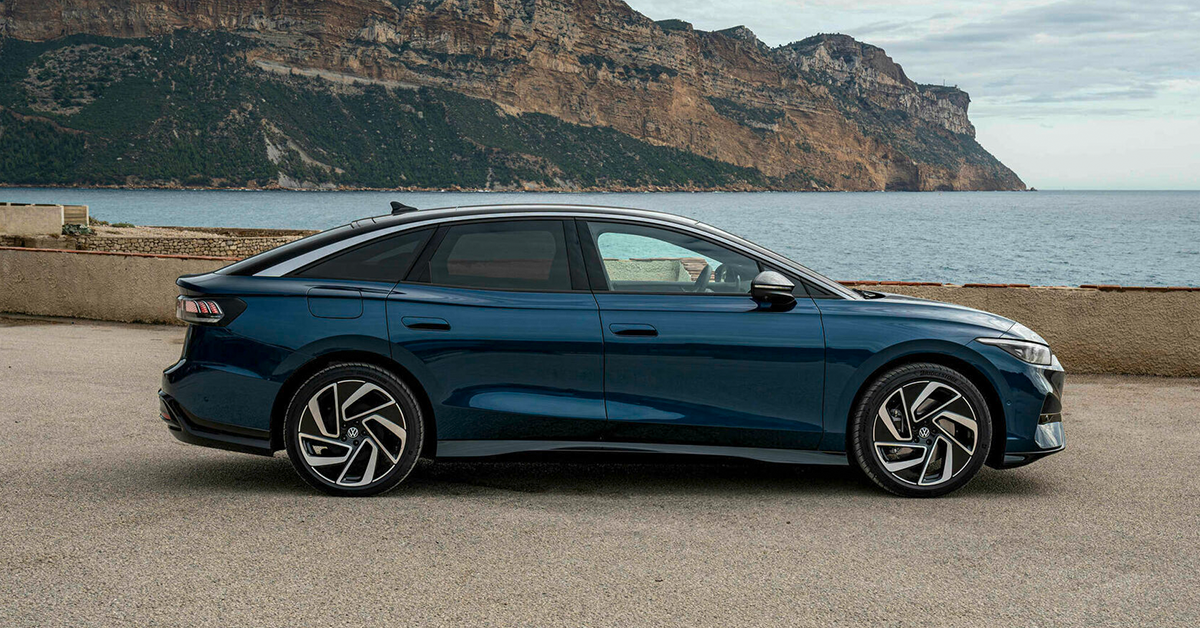
Official press image of the Volkswagen ID.7 fastback saloon in side view. | © Volkswagen AG
The ID.7 is a fastback saloon, and its size puts it in the same class as the Passat. Volkswagen’s newsroom gives a length of 4,961 millimetres, a wheelbase of 2,971 millimetres, a width of 1,862 millimetres (2,141 millimetres with mirrors) and a height of 1,536 millimetres. A trade site quotes 2,966 and 1,538 millimetres for the last two figures (reported), so use the Volkswagen numbers when they matter. The turning circle is about 10.9 metres, according to the Pro S press kit.
| Body | Fastback saloon, estate called Tourer (Volkswagen) |
| Length | 4,961 mm (Volkswagen) |
| Width | 1,862 mm, 2,141 mm with mirrors (Volkswagen) |
| Height | 1,536 mm (Volkswagen) |
| Wheelbase | 2,971 mm (Volkswagen) |
| Boot, saloon | 532 l, up to 1,586 l (Volkswagen) |
| Boot, Tourer | 605 l, up to 1,714 l (Volkswagen) |
| Drag coefficient | 0.23 saloon, 0.25 Tourer (Volkswagen) |
| Kerb weight, Pro S | 2,230 kg saloon, 2,239 kg Tourer (Volkswagen) |
| Towing | 1,200 kg braked, 750 kg unbraked (Volkswagen) |
Space is one of its selling points. The newsroom lists a boot of up to 532 litres in the saloon, or up to 1,586 litres loaded to the roof. The estate offers up to 605 litres with five occupants and up to 1,714 litres. Headroom is 1,030 millimetres at the front and 961 millimetres at the rear, according to Volkswagen, with slightly less under the panoramic roof. Braked towing is 1,200 kilograms at an 8 per cent gradient, with 750 kilograms unbraked and a drawbar load of 75 kilograms.
The cockpit was reworked. Volkswagen’s newsroom describes a free-standing 38-centimetre (15-inch) touchscreen as standard, with illuminated touch sliders for temperature and volume beneath it. An augmented-reality head-up display is standard on all versions. The page also describes automatically controlled air vents with electronic actuators, and optional ergoActive seats with a pressure-point massage function. The Tourer page adds the IDA voice assistant with ChatGPT integration. At the premiere, Volkswagen also listed an optional 700 watt Harman Kardon system with 14 speakers.
Driver assistance and software are part of the pitch. The April 2023 release mentioned Travel Assist with swarm data and a parking memory function working over a distance of up to 50 metres. The press kit also says that AirConsole, a games platform, comes with ID. Software 4.0. Volkswagen’s March 2026 release, Media Information No. 23/2026, announced a digital product upgrade for the ID.4, ID.5 and ID.7. I could read only its title, so details of that update are not covered here.
The running gear is conventional. The Pro S press kit lists a MacPherson front axle and a five-link rear axle, with 19-inch Hudson wheels as standard and 19-inch Bergen or 20-inch Montreal wheels as options. The rear-wheel-drive Pro S weighs 2,230 kilograms as a saloon and 2,239 kilograms as an estate, according to Volkswagen. The GTX adds 20-inch Skagen wheels, a honeycomb grille, a diffuser and illuminated Volkswagen logos at the front and rear.
One more point on the design: the Tourer. Volkswagen gives it the same length of 4,961 millimetres as the saloon. Its drag coefficient is 0.25, slightly higher than the saloon’s 0.23, which is the usual price of a longer roofline. The Pro S figures of 709 kilometres for the saloon and 690 for the estate show the gap in range. A short table of the key specifications is above, and the range section below covers the batteries.
Volkswagen also gave the ID.7 a premium-class comfort pitch. The newsroom lists seat ventilation and massage functions on the Tourer, a glass roof that a trade site says can be switched between clear and opaque at the touch of a button (reported), and the electronically controlled air vents mentioned above. The launch Pro also came with the augmented-reality head-up display and the Discover Pro Max navigation system as standard, according to the August 2023 pre-sales release.
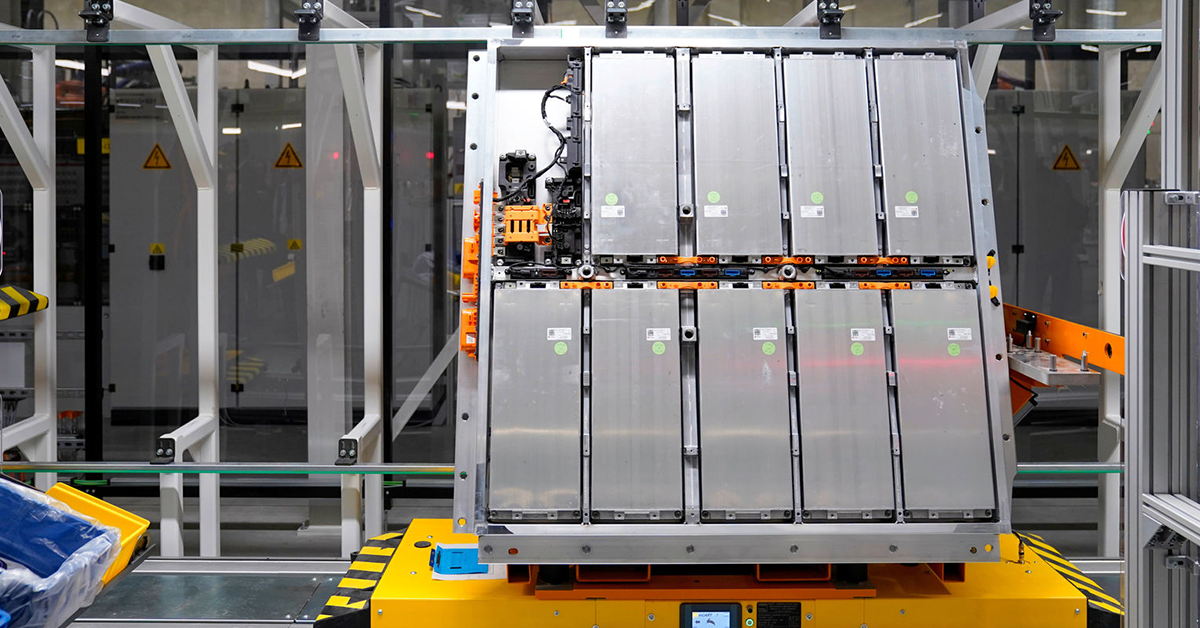
Official press image of the MEB battery system in production at the Volkswagen Group Components plant in Brunswick. | © Volkswagen AG
The ID.7 has been sold with two battery sizes. The launch ID.7 Pro uses a 77 kilowatt-hour net battery and, according to Volkswagen, reaches up to 621 kilometres WLTP. A trade report gives the gross capacity as 82 kilowatt-hours and the module count as 12 (reported). The later Pro S, GTX and Tourer Pro S use an 86 kilowatt-hour net battery with 91 kilowatt-hours gross, and Volkswagen’s Pro S press kit says it has 13 modules.
| Pro battery | 77 kWh net (Volkswagen) |
| Pro S, GTX battery | 86 kWh net, 91 kWh gross, 13 modules (Volkswagen) |
| Pro range | Up to 621 km WLTP at launch (Volkswagen) |
| Pro S range | Up to 709 km saloon, 690 km Tourer (Volkswagen) |
| GTX range | Up to 595 km saloon, 584 km Tourer (Volkswagen) |
| Pro, Pro S motor | 210 kW (286 PS), 545 Nm (Volkswagen) |
| GTX output | 250 kW (340 PS), 4MOTION (Volkswagen) |
| Pro S 0 to 100 km/h | 6.6 s saloon, 6.7 s Tourer (Volkswagen) |
| DC charging | Up to 200 kW on 86 kWh; 175 kW on 77 kWh (reported) |
| 10 to 80 per cent | 26 minutes at best, GTX (Volkswagen) |
Motor output depends on the version. The Pro and Pro S have one rear motor, the APP550, with 210 kilowatts (286 PS) and 545 newton-metres of torque, according to the Pro S press kit. It gives 0 to 100 kilometres per hour in 6.6 seconds for the saloon and 6.7 for the estate, with a limited top speed of 180 kilometres per hour. The GTX adds a front motor for 4MOTION all-wheel drive and 250 kilowatts (340 PS). Volkswagen quotes 5.4 seconds for the GTX saloon and 5.5 for the GTX Tourer.
Range figures are where the sources disagree most. At launch, Volkswagen said the Pro reaches up to 621 kilometres, while the premiere release had spoken of up to 700 kilometres for the larger battery. The Pro S raised the saloon figure to 709 kilometres and the Tourer Pro S to 690 kilometres. The Tourer premiere release in February 2024 had said up to 685 kilometres for the top estate. The Tourer Pro, in the August 2025 release, is up to 606 kilometres.
One footnote needs attention. The Pro S press kit says the 709 and 690 kilometre figures were determined on the most range-favourable Tourer Pro variant with a 77 kilowatt-hour battery. That wording reads oddly next to an 86 kilowatt-hour car, and it is the source’s own text, so check the current footnote before quoting. The consumption ranges in the press kit are 16.2 to 13.6 kWh per 100 km for the Pro S and 16.6 to 14.0 for the Tourer Pro S. The GTX is 18.4 to 16.2, and the GTX Tourer 18.8 to 16.6.
Charging has also moved. At the premiere, a trade source gave 170 kilowatts for the 77 kilowatt-hour battery, while later Volkswagen material gives 175 kilowatts (reported). The 86 kilowatt-hour battery charges at up to 200 kilowatts DC. Volkswagen’s June 2024 release says the GTX battery charges from 10 to 80 per cent in 26 minutes at its quickest. The Pro S press kit says ten minutes of DC charging adds about 244 kilometres for the saloon and 236 for the estate. Alternating current charging is up to 11 kilowatts.
A practical summary follows. For long motorway trips, the Pro S is the efficiency choice, with the longest figures and the 200 kilowatt charge rate. The GTX trades about a hundred kilometres of range for much stronger acceleration. The 77 kilowatt-hour Pro and Tourer Pro suit buyers who drive shorter distances and want a lower price. Volkswagen’s April 2023 release also noted that the new motor works with either battery, which is why the choice is mostly about size and price rather than technology.

Official press image of the handover of the 1.5 millionth ID. model at the Emden plant, August 2025. | © Volkswagen AG
The European ID.7 is built in Emden, a port city in Lower Saxony. Volkswagen’s newsroom says the Emden plant builds the ID.7 saloon, the ID.7 Tourer and the ID.4 together. The August 2025 release says Emden is one of three Volkswagen plants that build only electric vehicles, alongside Zwickau and the Gläserne Manufaktur in Dresden. It adds that the group invested more than one billion euros to convert Emden into an all-electric site.
| European plant | Emden, Germany (Volkswagen) |
| Built alongside | ID.7 Tourer and ID.4 (Volkswagen) |
| Plant type | Electric vehicles only (Volkswagen) |
| Conversion investment | Over 1 billion euros (Volkswagen) |
| Symbolic start | Monday 21 August 2023 (Volkswagen) |
| Small-scale builds | Since June 2023 (reported) |
| Planned daily output | About 300 cars (reported) |
| China versions | ID.7 S (SAIC VW), ID.7 Vizzion (FAW-VW) (reported) |
| Line cut, Emden | May 2026, two lines to one (reported) |
| Extra shifts planned | At least two, September 2026 (reported) |
The production start was staged. Volkswagen held a symbolic start of series production on Monday 21 August 2023, and Schäfer said the launch was a further milestone on the way to the brand’s electric future. Guests included Gunnar Kilian, Daniela Cavallo and Lower Saxony officials, according to a trade report. The same report says the car had been built in small numbers since June, which is why the date shifted from the one first planned (reported).
Orders followed within days. The 24 August 2023 release opened pre-sales for the ID.7 Pro in Germany. A French trade site reported that about 300 cars a day were expected from the line over time (reported), and a German site said delivery times could stretch into the second quarter of 2024 depending on equipment. The Tourer was later added to the same lines, and the GTX and Pro S versions joined in the second half of 2024.
Volkswagen’s plan also named North America. The April 2023 release said the Emden-built car would serve Europe and North America. That never came to pass: Volkswagen delayed the North American launch on 22 May 2024 and then cancelled it in January 2025. The details are in the status section below. The cancellation is covered in the status section below.
China has its own versions. A reference site reports that SAIC Volkswagen sells an ID.7 S and FAW-Volkswagen an ID.7 Vizzion (reported), and a German site said the Vizzion was reserved for Chinese customers. I could not find a Volkswagen release that confirms the Chinese production details, so treat that line as reported. Volkswagen’s own China brand page, with facts as of May 2026, does not list the ID.7 among the models it describes, which suggests the car is not a focus there.
Emden has changed since. A trade report said Volkswagen cut Emden and Zwickau from two lines to one each in May 2026 to reduce overcapacity. In September 2026, another report said at least two extra shifts for the ID.7 were planned in Emden because demand for electric cars was rising (reported). The same report said the new Tiguan would soon be built there, replacing the ID.4. That makes the ID.7 the car the plant is leaning on, which fits its sales results in Europe.
A few numbers put Emden in context. The August 2025 release says Volkswagen delivered its 1.5 millionth all-electric ID. model in Emden, and that the Minister President of Lower Saxony, Olaf Lies, handed over the key with board members Martin Sander and Kai Grünitz. Lies said his official car as the state’s economics minister had been an ID.7 built in Emden. The newsroom image of the handover is shown above, and it is the best official picture of the plant in the sources used here.

Official press image of the Volkswagen ID.7 Tourer Pro S. | © Volkswagen AG
The ID.7 Tourer is the estate version, and Volkswagen calls it its first all-electric estate. Its world premiere was on 19 February 2024. In the release, Imelda Labbé, a member of the Volkswagen brand board for sales, marketing and aftersales, called it “a perfect estate model, especially for families and long-distance drivers”. Volkswagen said it is built in Emden with the saloon and the ID.4, and that pre-sales would begin across Europe in the first quarter of 2024.
| Tourer premiere | 19 February 2024 (Volkswagen) |
| Estate position | First all-electric Volkswagen estate (Volkswagen) |
| Boot | 605 l with five occupants, up to 1,714 l (Volkswagen) |
| Drag coefficient | 0.25 (Volkswagen) |
| Tourer Pro range | Up to 606 km WLTP (Volkswagen) |
| Tourer Pro S range | Up to 690 km WLTP (Volkswagen) |
| GTX Tourer | 250 kW, 0 to 100 km/h in 5.5 s, up to 584 km (Volkswagen) |
| 1.5 millionth ID. | ID.7 Tourer Pro, 15 August 2025 (Volkswagen) |
| Nardò result | 941 km on one charge, Pro S (Volkswagen) |
| Nardò consumption | 9.2 kWh per 100 km (Volkswagen) |
The Tourer is the same length as the saloon, 4,961 millimetres, and its boot is its argument. Volkswagen gives up to 605 litres with five occupants and up to 1,714 litres loaded to the roof. For comparison, the saloon’s equivalent figures are 532 and 1,586 litres. The Tourer’s drag coefficient is 0.25, against 0.23 for the saloon, according to the Pro S press kit. The Tourer also appears in newsroom images as the Tourer Pro S, numbers 82735 to 82738.
Versions followed the saloon’s pattern. The Tourer Pro uses the 77 kilowatt-hour battery. The Tourer Pro S arrived in 2024 with the 86 kilowatt-hour battery and 210 kilowatts, and Volkswagen quotes 690 kilometres WLTP for it. The GTX Tourer has 250 kilowatts and four-wheel drive, and Volkswagen calls it the most powerful Volkswagen estate ever built. In Volkswagen’s June 2024 release it reaches 100 kilometres per hour in 5.5 seconds and its range is up to 584 kilometres.
Sales have been strong. The August 2025 milestone release says the ID.7 Tourer was the electric vehicle with the highest number of registrations in Germany in the first half of 2025. The 1.5 millionth all-electric ID. vehicle, handed over in Emden on 15 August 2025, was a black ID.7 Tourer Pro for a customer from Vechta. Volkswagen gave its range as up to 606 kilometres, with consumption of 16.8 to 14.5 kWh per 100 km. A German trade site also reported that the estate outsold the saloon (reported).
Range records have supported the pitch. Volkswagen’s release of 15 January 2025 says an ID.7 Pro S with the standard technology package, a 210 kilowatt motor and the 86 kilowatt-hour net battery covered 941 kilometres on a single charge. That is 232 kilometres, or 32.7 per cent, more than the 709 kilometre WLTP figure, and consumption was 9.2 kWh per 100 km. The release does not give the date of the drive or the average speed, so the result is a record of efficiency and not a guide to normal motorway use.
A second run is listed on the newsroom page for the ID.7 Tourer. A press headline says the ID.7 Pro S covered 794 kilometres on one charge with Volkswagen Team Switzerland, led by Felix Egolf, a long-distance expert. I read only the headline and the first sentence, so I give it here without further numbers. Both results show the same thing: with careful driving, the 86 kilowatt-hour car can go well beyond its published range, which is the main reason the Pro S has become the car to look at for long trips.

Official press image of the Volkswagen ID.7 Tourer Pro S, ID.7 Pro S, ID.7 GTX and ID.7 GTX Tourer. | © Volkswagen AG
Volkswagen widened the ID.7 line on 4 June 2024 with a release titled “New ID.7 models: extremely dynamic GTX and a WLTP range of up to 709 kilometres with the ID.7 Pro S”. It introduced four versions, all with the 86 kilowatt-hour battery: the ID.7 GTX, the ID.7 GTX Tourer, the ID.7 Pro S and the ID.7 Tourer Pro S. Pre-sales in Germany began on 6 June 2024, and the newsroom lists the cars’ images from August 2024.
| Release date | 4 June 2024 (Volkswagen) |
| Pre-sales start | 6 June 2024, Germany (Volkswagen) |
| New versions | GTX, GTX Tourer, Pro S, Tourer Pro S (Volkswagen) |
| GTX output | 250 kW (340 PS), 4MOTION (Volkswagen) |
| GTX 0 to 100 km/h | 5.4 s saloon, 5.5 s Tourer (Volkswagen) |
| GTX range | 595 km saloon, 584 km Tourer (Volkswagen) |
| GTX price | 63,155 euros, Tourer 63,955 euros (Volkswagen) |
| Pro S price | 58,985 euros, Tourer 59,785 euros (Volkswagen) |
| MY27 software | ID. Software 6, 5G (reported) |
| Digital upgrade | Announced 12 March 2026 (Volkswagen) |
The GTX is the sporty one. It has 250 kilowatts (340 PS) from two motors and electric all-wheel drive, which Volkswagen calls 4MOTION. The release gives 5.4 seconds from 0 to 100 kilometres per hour for the saloon and 5.5 for the Tourer. A trade source quotes 560 newton-metres (reported). The GTX range is up to 595 kilometres for the saloon and 584 kilometres for the Tourer, while a trade report gave 585 for the Tourer (reported). Charging is up to 200 kilowatts.
Looks distinguish it. The newsroom describes a GTX bumper with a gloss-black honeycomb air intake, an illuminated Volkswagen logo at the front and red at the rear, and 3D LED tail lights with a dynamic indicator. At the rear, a honeycomb element spans nearly the full width of the bumper. The wheels are the 20-inch Skagen design. Inside, the GTX gets a customised interior. Volkswagen also launched the ID.3 GTX and ID. Buzz GTX in the same 2024 campaign.
Prices in the June 2024 release, for Germany with VAT, are 63,155 euros for the GTX and 63,955 euros for the GTX Tourer. The Pro S starts at 58,985 euros and the Tourer Pro S at 59,785 euros. A trade report gave 63,995 euros for the GTX Tourer, which differs from Volkswagen’s figure by 40 euros (reported). The launch Pro was 56,995 euros in August 2023, so the Pro S added roughly two thousand euros for the bigger battery and longer range.
Updates have continued. A reported model-year 2026 change gave the Tourer Pro S a range of up to 685 kilometres, and a reported MY27 ID.7 Tourer GTX was listed from March 2026 (reported). A Finnish importer price list dated 12 June 2026 describes a renewed ID.7 Tourer for model year 2027, with ID. Software 6, updated infotainment and 5G online connectivity (reported). That list shows the GTX Tourer at 59,990 euros including 25.5 per cent VAT, but those are Finnish prices and not comparable with German ones.
Volkswagen’s March 2026 release also announced a digital upgrade for the ID.7, alongside the ID.3 Neo, the successor to the ID.3. A later trade report claimed discounts of up to 28.2 per cent in September 2026 (reported), which should be read as a market signal and not an official price. Buyers should check the current German or local configurator. The ID.7 has been repriced, rebadged and re-specified several times since 2023, and every figure in this guide has a date for that reason.
A word on how to read the Pro S and GTX choice. The Pro S is rear-wheel drive with 210 kilowatts and is built for maximum efficiency, according to the press kit. The GTX has two motors and uses more energy: Volkswagen’s consumption range for the GTX is 18.4 to 16.2 kWh per 100 km, against 16.2 to 13.6 for the Pro S. Those numbers explain the range gap between them even though both use the same 86 kilowatt-hour battery and the same 200 kilowatt charging limit.

Official press image of the Volkswagen ID.7 GTX and ID.7 GTX Tourer. | © Volkswagen AG
How is the ID.7 doing? In Europe it has become Volkswagen’s best-selling electric model. Volkswagen’s January 2026 release says the ID.7 was the new best-selling model of the ID. family, with around 35,000 units delivered in Germany in 2025, a rise of 132.0 per cent. Across Europe, customers ordered 76,600 units, up 133.9 per cent. A trade report said it was the best-selling electric car in Germany in 2025, and eight of the top ten were Volkswagen Group cars.
| 2025 Germany deliveries | About 35,000, up 132.0 per cent (Volkswagen) |
| 2025 Europe orders | 76,600, up 133.9 per cent (Volkswagen) |
| H1 2026 group list | 29,500 units, with Tourer (reported) |
| Jan to Sep 2026 group list | 47,500 units, with Tourer (reported) |
| German Car of the Year | 2024, Premium category and overall (Volkswagen) |
| North America delay | 22 May 2024 (reported) |
| North America cancelled | January 2025 (reported) |
| Named successor | None in sources used (Volkswagen) |
| Plant | Emden, with the ID. Tiguan to follow (reported) |
| Discounts reported | Up to 28.2 per cent, September 2026 (reported) |
The 2026 figures are lower in the group tables, but the model remains among the group’s best sellers. Volkswagen’s first-half 2026 list put the ID.7, including the Tourer, at 29,500 units, according to a trade site (reported). The nine-month list put it at 47,500, behind the ID.3 and ID.4/ID.5 among Volkswagen-brand models (reported). The group’s European order book for electric vehicles rose by more than 50 per cent in the first half of 2026, according to Volkswagen Group.
North America is the part of the story that did not happen. Volkswagen had planned a launch in 2024. On 22 May 2024 it announced a delay, citing market-driven choices, and no new date was given. In January 2025 reports said the car was cancelled for the United States and Canada, with Volkswagen blaming the challenging EV climate, according to trade reports. The ID.7 had been expected to replace both the Passat and Arteon in the United States, which is why the cancellation mattered to American readers.
Awards are part of the picture. Volkswagen’s newsroom says an international jury named the ID.7 German Car of the Year 2024, and that it won the Premium category and the overall title. That result matters because it came from journalists who drove the car against its rivals.
What comes next is partly known. Volkswagen announced a digital product upgrade for the ID.7 in March 2026, and a reported MY27 package adds ID. Software 6 and 5G (reported). The ID.7 has no named successor in the sources I used. The company’s new ID. Tiguan, which premiered on 9 October 2026 and replaces the ID.4 and ID.5, will share Emden with the ID.7, and a reported plan adds extra shifts for the ID.7 there. Our ID.4 guide covers that SUV.
For enthusiasts, the ID.7 is the car that moved Volkswagen’s electric range from compact SUVs to a proper long-distance flagship. It follows a line that includes the Phaeton and the Arteon, and the Passat that it echoes in size. A short buying checklist follows. Confirm the battery size, because 77 and 86 kilowatt-hours are very different cars. Check which software version it runs. Compare Pro S and GTX range against your own routes. And check the current local price, because discounts have been large.
Competition is the last piece. The ID.7 sells against saloons and estates from Germany, France and Asia, but the sources used here do not give a market-share table for its segment, so I do not rank it against rivals. What the figures do show is that Volkswagen’s own list of best-selling electric models for the first nine months of 2026 places the ID.7, with 47,500 units, among the group’s top six (reported). That is a strong result for a car in the upper mid-size class.