 Brands
Best Classic Toyota Cars With History and Buying Tips
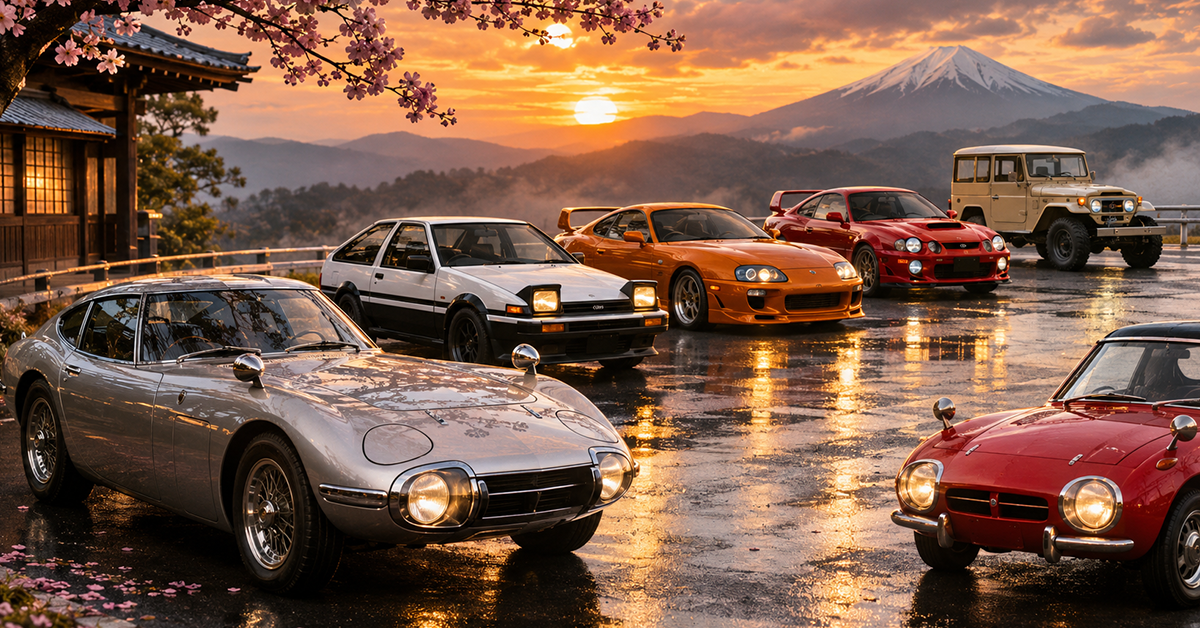
AI-generated concept illustration — classic Toyota cars. | Rev N Rise
Before Toyota was known for hybrids, it built some of the most loved cars in Japanese history: a hand-finished grand tourer that starred opposite James Bond, a featherweight roadster nicknamed the Yota-Hachi, a rear-drive Corolla that became a drift legend, a twin-turbo Supra and a rugged Land Cruiser that went everywhere. Here is what makes each classic Toyota special, and what to know before you buy one.
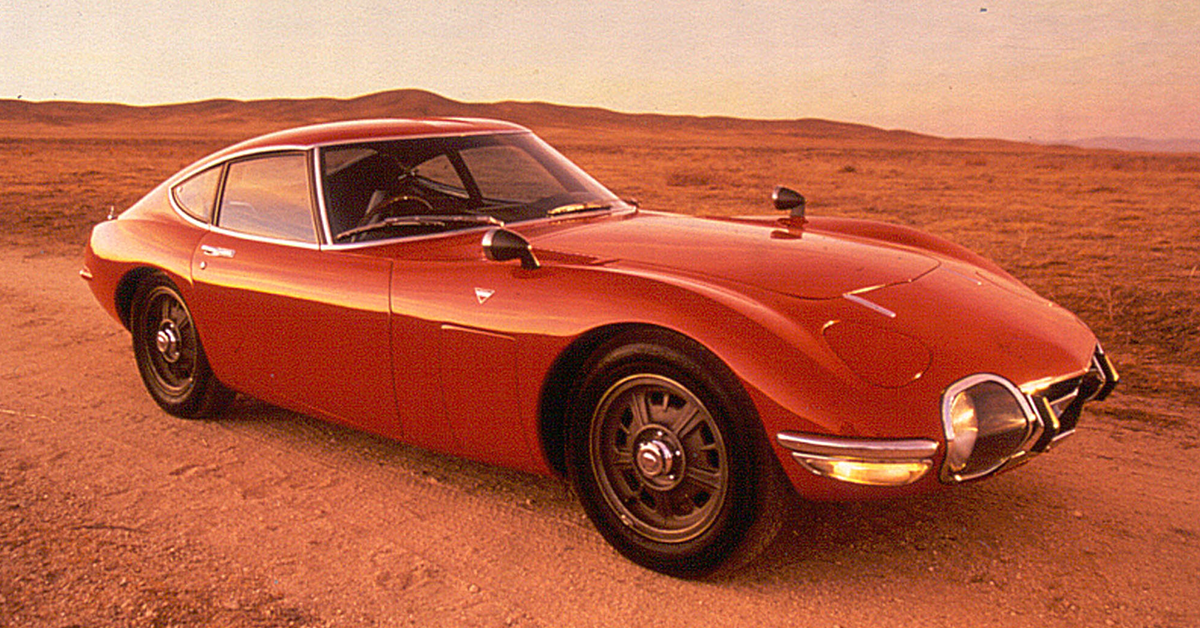
Official press image of the Toyota 2000GT. | © Toyota Motor Corporation
The Toyota 2000GT is the car that changed how the world saw Japanese manufacturers. When the prototype was completed in August 1965 and the car reached Japanese showrooms in May 1967, Japan was known for small, economical machines, and nobody expected a low, long-nosed, hand-finished grand tourer that could stand beside European exotics. Production ended in 1970, and only 351 cars were built in total, with sources putting the number sold to customers at somewhere between about 320 and 337 depending on how the special-purpose cars are counted. That tiny number is the first reason it is now regarded as the most important classic Toyota ever made.
| Years built | 1967 to 1970 (prototype 1965) |
| Total built | 351 |
| Engine | 2.0-litre DOHC straight-six (3M) |
| Power | 150 bhp |
| Top speed | About 136 mph |
| 0 to 62 mph | About 8.6 seconds |
| Chassis | MF10, X-shaped backbone frame, aluminium body |
The car was not built on Toyota's normal production lines. Toyota developed it with Yamaha Motor Co., which built the first prototype under contract and then handled production in small batches, finishing each car by hand. The aluminium two-seat coupe body was designed in-house by Satoru Nozaki, and it sits on an X-shaped backbone frame. The result is a car barely taller than a modern sports coupe's door line, with a long bonnet, a short tail and a shape that still looks modern more than half a century later.
Under the bonnet is a 2.0-litre DOHC straight-six, known as the 3M, derived from the single-overhead-camshaft engine used in the Toyota Crown. In 2000GT form it produced 150 bhp, which gave a top speed of around 136 mph and a 0 to 62 mph time of roughly 8.6 seconds, figures that were very serious for the late 1960s. The chassis code is MF10, and the car featured four-wheel independent suspension, magnesium alloy wheels and a rosewood dashboard, a level of detail that was closer to a boutique coachbuilder than to a mass manufacturer.
The 2000GT also proved itself where it mattered. At the 1966 Yatabe speed trials, a 2000GT tuned by what was then Tosco, the forerunner of Toyota's Toyota Racing Development tuning arm, averaged 128.76 mph over 72 hours and set three world records and 13 international records. At the 1967 Fuji 24-hour race, two 2000GTs finished first and second, ahead of a Toyota Sports 800 in third. These results showed that the car was not just beautiful but genuinely durable, a message Toyota badly wanted to send to export markets.
Its fame outside Japan came from the cinema. Two prototypes were converted into open-top versions for the 1967 James Bond film You Only Live Twice, reportedly because the standard car's interior was considered too small for the film's tall lead actor. That appearance made the 2000GT a global celebrity almost overnight, even though the production roadster was never sold. A 1969 update brought smaller fixed driving lights, and buyers could also specify air conditioning and a three-speed automatic, which shows how much Toyota was thinking about customers beyond Japan.
Today the 2000GT is the blue-chip of Japanese classics, and examples that reach public auction regularly sell for high six-figure or seven-figure sums, and a 2013 sale of 1.16 million dollars was then a record for an Asian-built car. Only a handful change hands in any given year, so values depend heavily on originality, documentation and history. It was never a commercial success, since hand-building a few hundred cars could not pay for itself, but that was never the point. The 2000GT proved that Toyota could build a world-class sports car, and the lineage that runs through the Celica, the Supra and the GR models today began with this beautiful, impractical, unforgettable coupe.
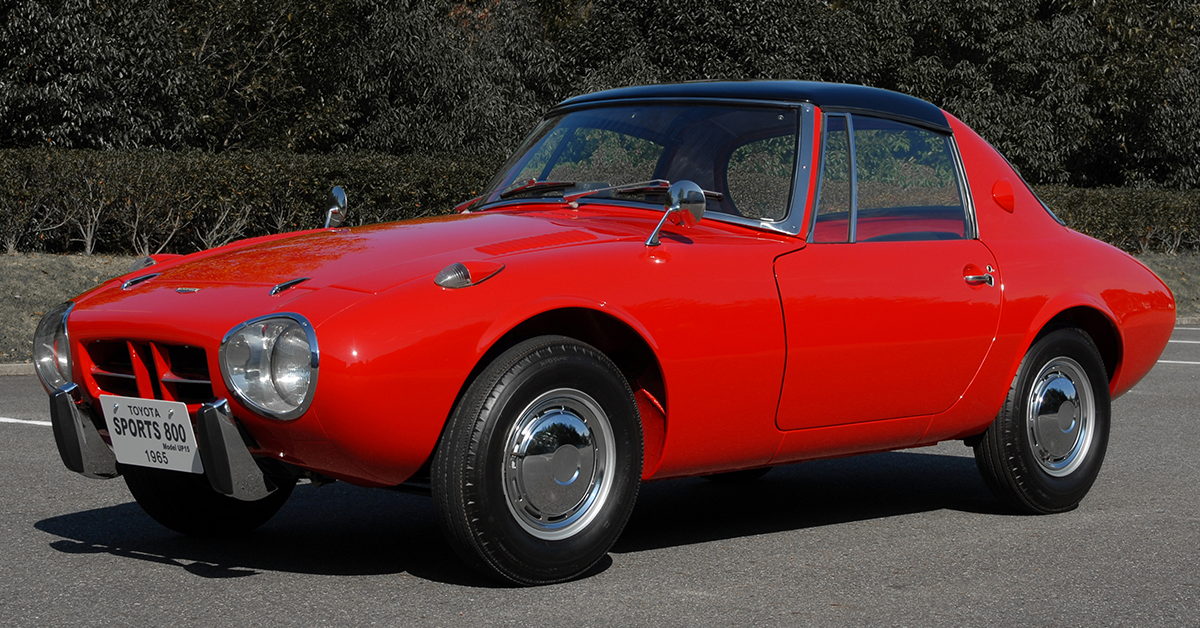
Official press image of the Toyota Sports 800. | © Toyota Motor Corporation
If the 2000GT was Toyota's dream car, the Sports 800 was its people's sports car. Nicknamed the Yota-Hachi, short for Toyota 8, it is regarded as Toyota's first production sports car, and it is one of the most charming small classics from the 1960s. It was shown at the 1962 Tokyo Motor Show as the Publica Sports prototype and went on sale in April 1965. Production ran until October 1969, with roughly 3,131 cars built over those few years, and only a small fraction of them are believed to survive.
| Years built | 1965 to 1969 |
| Total built | About 3,131 |
| Engine | 790 cc air-cooled flat twin (2U-B) |
| Power | About 44 hp (33 kW) |
| Top speed | About 160 km/h (100 mph) |
| Weight | 580 kg (about 1,279 lb) |
| Fuel use (Toyota quoted) | As low as 3.8 litres per 100 km |
The idea was the opposite of the 2000GT. Instead of power and luxury, the Sports 800 was about lightness and efficiency. The curb weight was just 580 kg, or about 1,279 lb, which is lighter than many modern city cars by a very wide margin. The styling was by Shozo Sato, with engineering by Tatsuo Hasegawa, and the little coupe had a smooth, rounded shape that gave it a low drag figure. It remains a masterclass in how to get performance by removing weight rather than adding horsepower.
The engine is the most unusual part of the story. It is a 790 cc air-cooled horizontally opposed twin, coded 2U-B, producing about 44 hp, or 33 kW. That sounds modest, but in a car that light it was enough for a top speed of around 160 km/h, about 100 mph, on a race track. Toyota also quoted fuel consumption as low as 3.8 litres per 100 km, which made the car both thrilling and remarkably frugal, a combination that is rare in any era and almost unheard of in a sports car of the 1960s.
The Sports 800 was also one of the first production cars to have a lift-out aluminium targa-style roof panel, which could be stored in the boot. That feature predated the famous Porsche Targa, and it gave the car a convertible feel without the weight and flex of a folding soft top. Together with its low seating position and tight, communicative handling, the roof panel made the car feel far more special than its small engine suggested, and it is one of the reasons enthusiasts remain so fond of the design today.
Motorsport helped build the car's reputation. It was popular in Japanese domestic racing for its reliability and fuel efficiency, because a light car with a small engine could finish long races without stressing its components. At the 1967 Fuji 24-hour race a Sports 800 finished third overall, behind two Toyota 2000GTs, an impressive result for a machine with less than a third of their power. Toyota also experimented with the concept later, showing a Sports 800 gas-turbine hybrid concept at a Tokyo Motor Show in the late 1970s.
For collectors the Sports 800 offers something the 2000GT cannot, which is accessibility. Prices are a small fraction of the 2000GT's, although good cars are scarce outside Japan and parts need to be sourced carefully. It makes a wonderful first Japanese classic for an enthusiast who values driving feel over outright speed. Its spirit lives on in the modern GR86 and in Toyota's recent small sports car concepts, because the Yota-Hachi showed that a light, affordable, rear-driven fun car could be a part of Toyota's identity from the very beginning.
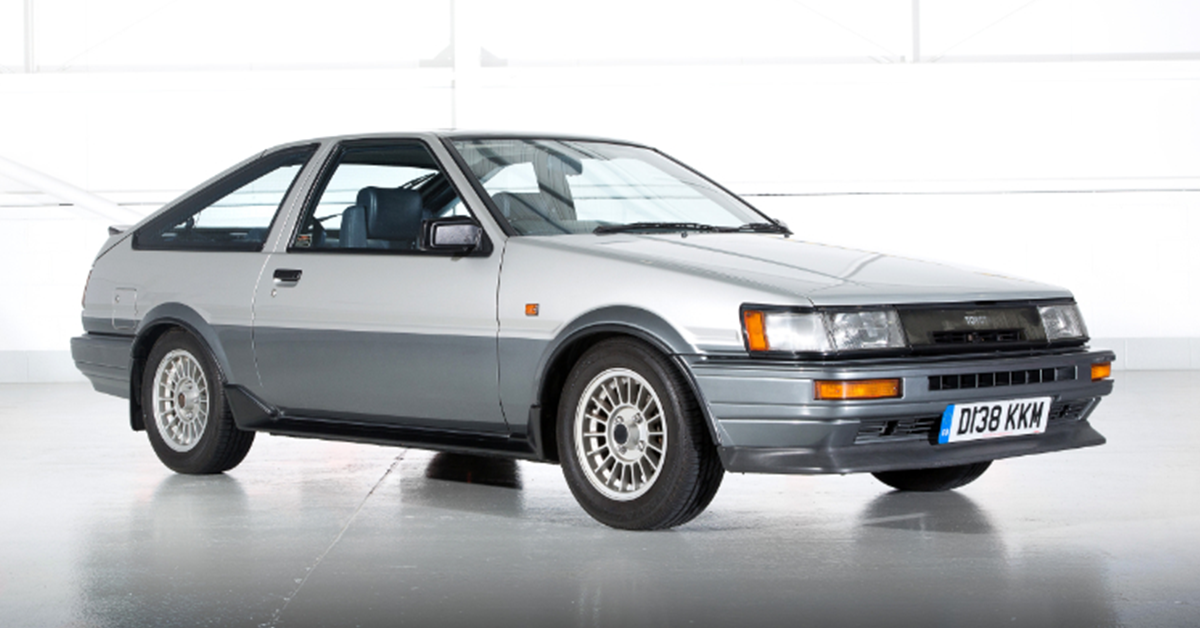
Official press image of the Toyota AE86 Corolla Levin. | © Toyota Motor Corporation
Few Toyotas have a fan base as devoted as the AE86. Sold as the Corolla Levin and the Sprinter Trueno in Japan and simply as the Corolla GT-S, GT or Sprinter in other markets, it was built from May 1983 to July 1987 and is the last rear-wheel-drive Corolla. An estimated 360,000 or more were produced, which is a large number for a car that is now treasured, but most were used hard, modified or simply worn out, and clean, unmodified examples are now increasingly hard to find.
| Years built | May 1983 to July 1987 |
| Production | Estimated 360,000 or more |
| Engine | 1.6-litre DOHC 4A-GE (cheaper models 4A-C) |
| Power | 130 PS Japan, 124 PS Europe, about 112 hp North America |
| Drive | Rear-wheel drive |
| Weight | About 900 to 1,065 kg |
| Body | Coupe and three-door hatchback |
The name comes from the chassis code, AE86, and the cars come in coupe and three-door hatchback forms. Both the Levin and the Trueno share the same basic body, although the Levin has fixed headlights and the Trueno has pop-up units. The car was not extreme or expensive, and in standard form it was a practical, light and simple front-engined, rear-drive coupe with a near 50/50 weight balance. That balance, together with its low weight, is what gave it such a lively and forgiving character on the road.
The key to the car is the engine. The sporting versions used the 1.6-litre DOHC 4A-GE, a high-revving four-cylinder with a Yamaha-developed cylinder head that was celebrated for its responsiveness. In Japan it was rated at 130 PS and 149 N m, in Europe at 124 PS, and in North America it was rated at about 112 hp. Cheaper models used the single-cam 4A-C, which made roughly 70 to 74 hp. Weight ranged from about 900 to 1,065 kg, and the lightest GT versions were right at the bottom of that range.
In motorsport the AE86 was a surprisingly successful car. It won the 1986 European Touring Car Championship manufacturers' title, Chris Hodgetts won the British Touring Car Championship in 1986 and 1987 in one, and Kaoru Hoshino took the 1985 All-Japan Touring Car Championship class title. Privateer teams also raced AE86s in World Rally Championship events from 1984, with a best result of third overall at the 1989 Rallye Cote d'Ivoire. For a small, cheap coupe, that is a very strong competition record.
The car's cultural impact is even larger. Rear-wheel drive and light weight made the AE86 a natural drifting car, and Keiichi Tsuchiya, the driver nicknamed the Drift King, helped popularise the sport in Japan while driving one. Later, the manga and anime series Initial D, which ran from 1995 to 2013, made the car a worldwide icon through its hero, Takumi Fujiwara, who uses an AE86 for tofu deliveries and mountain-pass racing. Many enthusiasts around the world first learned about the car through that story, and demand has been climbing ever since.
That popularity is both the best and the worst thing about owning one today. Values have risen sharply, rust and accident damage are common, and the market is full of heavily modified or lookalike cars with swapped engines and rebuilt shells, so documentation matters. Parts support has improved, since Toyota's heritage parts programme has remade selected components for the car. The AE86 also gave its name to the modern GR86 and the earlier Toyota 86, whose model names are a direct tribute to the original car, which shows how important it remains to Toyota itself.
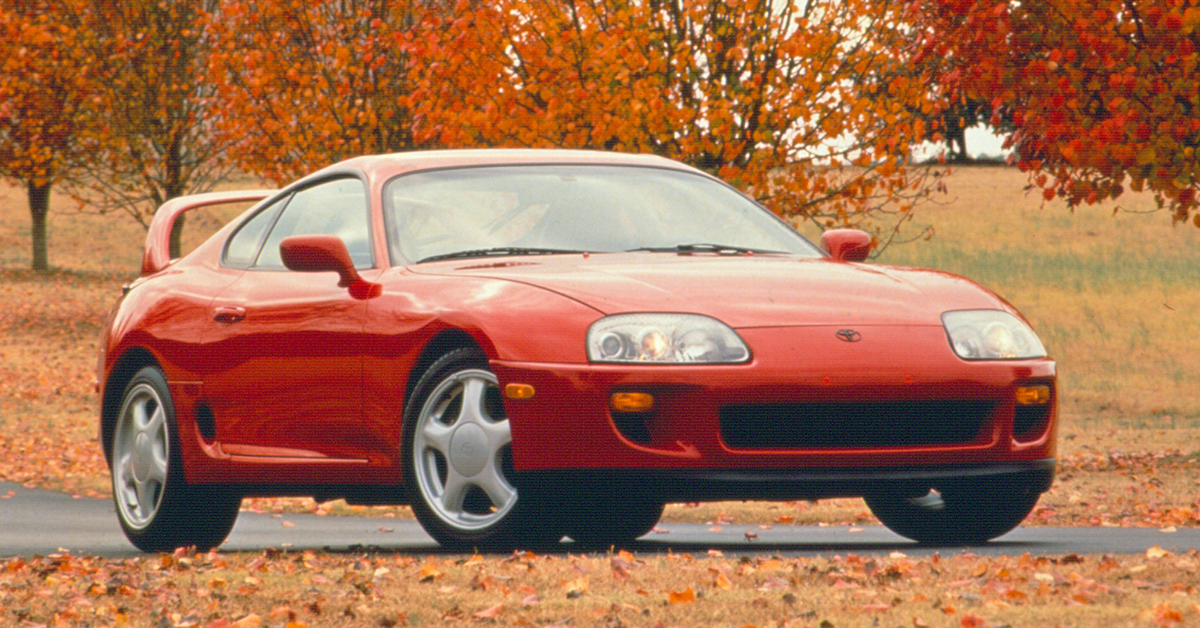
Official press image of the Toyota Supra A80. | © Toyota Motor Corporation
The fourth-generation Supra, known by its chassis code A80 or JZA80, is the best known of all classic Toyotas. It was launched on 24 May 1993 and built until 2002, and it was a three-door, four-seat, rear-wheel-drive coupe with an optional removable roof panel. It arrived at the peak of Japan's performance-car boom, alongside rivals such as the Nissan Skyline GT-R and the Mazda RX-7, and it matched them with a smooth, strong and remarkably durable engine that remains legendary today.
| Years built | 1993 to 2002 |
| Engine (turbo) | 3.0-litre sequential twin-turbo 2JZ-GTE |
| Power (turbo) | 280 PS Japan, about 320 hp US |
| Engine (non-turbo) | 2JZ-GE, 225 PS |
| Torque (turbo, Japan) | About 431 to 451 N m |
| Transmissions | Five-speed or six-speed manual, four-speed automatic |
| Drive | Rear-wheel drive |
That engine is the 3.0-litre inline-six known as the 2JZ. In naturally aspirated 2JZ-GE form, used in the SZ and SZ-R grades, it produced 225 PS. The headline version was the sequential twin-turbocharged 2JZ-GTE, used in the RZ, GZ and RZ-S grades, which was rated at 280 PS in Japan, with around 431 to 451 N m of torque depending on the year. US-market turbo cars were rated at about 320 horsepower, and the first Japanese cars were deliberately held to the industry's informal 280 PS limit. The cast-iron block is famous for withstanding far higher power with the right upgrades, which is a large part of the car's reputation.
The transmissions matter as much as the engine. The SZ was offered with a five-speed manual or a four-speed automatic, and the SZ-R with a five-speed manual at launch and a six-speed manual from April 1996. The RZ turbo launched with a six-speed manual developed with Getrag, with an automatic as an alternative, while the GZ was automatic only. Cars with the six-speed manual are generally the most sought after, and a manual twin-turbo car with the original paint and documentation sits at the top of the market.
Toyota also paid attention to safety and equipment. Airbags were optional at launch, and ABS and both front airbags became standard in April 1996. The optional aluminium removable roof gave the car a targa-style character, though roof leaks on ageing turbo cars are a known problem. The styling, with its long bonnet, short tail and the large rear wing on some versions, is instantly recognisable, and the shape was reinforced by the car's appearance in the 2001 film The Fast and the Furious, which introduced the Supra to a global audience.
That fame has pushed prices very high. Asking prices on one large Japanese-import marketplace currently sit around a median of roughly 56,000 US dollars across more than 130 listings, with a range from a few hundred dollars for non-running project cars to almost 180,000 dollars for the best examples, although those are asking prices and not final sale prices. Very good manual twin-turbo cars have sold for far more at auction. The enormous spread shows how important condition, originality and provenance are when you buy a Supra.
If you are considering one, there is a short checklist. Modifications are extremely common, so check workmanship and records carefully. Watch for leaking valve seals and roof leaks, listen for driveline whine under power, and check that the grade, engine and gearbox match the build year, since an SZ-R is naturally aspirated and not a turbo. Importers should also note that eligibility for the United States generally follows a 25-year rule from the build date, which means 2002 builds become eligible in 2027. The A80 remains the benchmark that every modern Supra is measured against.
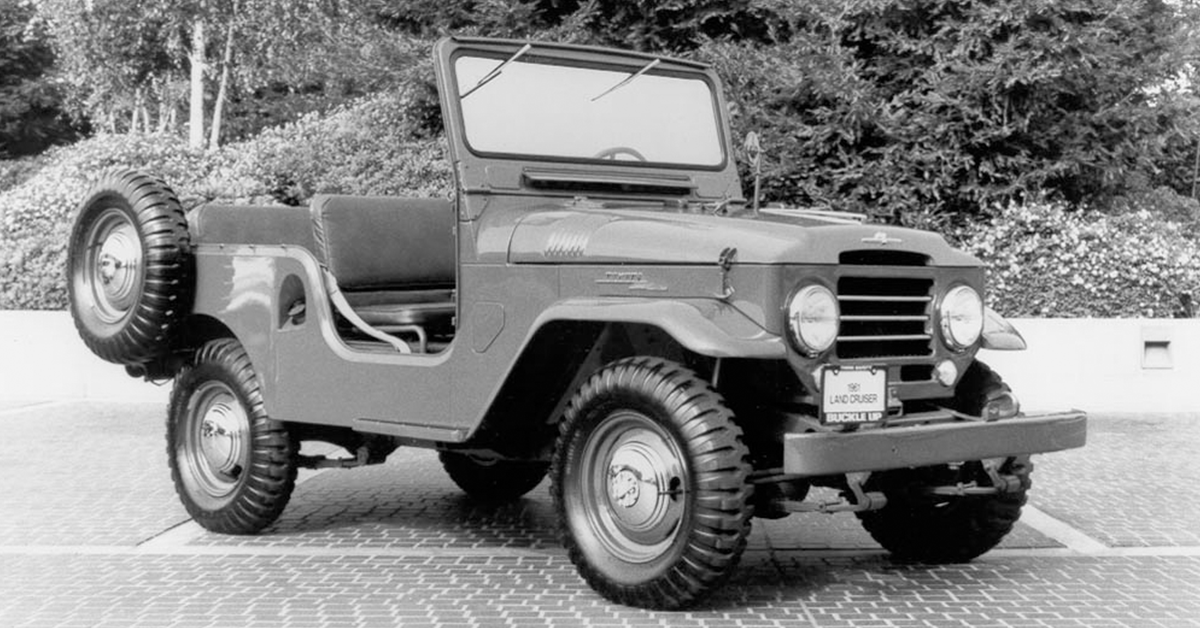
Official press image of the Toyota Land Cruiser FJ40. | © Toyota Motor Corporation
Not every classic Toyota is a sports car. The Land Cruiser 40 Series, usually called the J40 or FJ40, is one of the most respected classic off-roaders ever made, and it is the model that built Toyota's reputation for toughness in dozens of countries. It went on sale in Japan in August 1960. In most markets, including Japan, production ended in 1984 when the 70 Series took over, although in Brazil a derivative called the Bandeirante carried on until 2001.
| Years built | 1960 to 1984 (Bandeirante in Brazil to 2001) |
| Launch engine | 3,878 cc inline-six F, 125 PS |
| Later engines | 3.0-litre B diesel (1974), 4.2-litre 2F petrol (1975) |
| Gearbox | Three-speed manual, two-speed transfer case |
| FJ40 wheelbase | 2,285 mm |
| FJ40 weight | About 1,480 kg |
| Chassis | Ladder frame, solid axles |
The FJ40 name tells you what is under the bonnet. The F refers to the engine family and the J to the Land Cruiser line, and the launch engine was the F, a 3,878 cc inline-six petrol unit rated at 125 PS at 3,600 rpm. A 3.0-litre four-cylinder B diesel was added in 1974, a 4.2-litre 2F petrol engine replaced the F in 1975 in most markets outside Japan, and other diesel engines were fitted in different markets. The F engine was a heavy, low-revving unit with plenty of torque, and it was matched to a three-speed column-shift manual gearbox with a dashboard-operated two-speed transfer case.
The 40 Series was always more than one vehicle. The FJ40 short-wheelbase utility had a 2,285 mm wheelbase and weighed about 1,480 kg, while the longer FJ43 had a 2,430 mm wheelbase and the FJ45 light van had a 2,650 mm wheelbase. A longer pickup or cab-chassis was added in 1963 for export markets only, and the separate FJ55 station wagon arrived in July 1967 to replace the four-door van. That variety allowed Toyota to sell the same basic design as a farm tool, a family wagon and an expedition vehicle.
The reason the FJ40 became a classic is its simplicity. It has a ladder frame, solid axles at both ends, leaf springs and very little electronics, which makes it easy to repair almost anywhere in the world. Owners have crossed deserts, mountains and jungles in them, and the vehicles served as work trucks for governments, mining firms and aid agencies. In the United States the FJ40 became a cult favourite from the 1970s onward, and open-top versions with removable roofs are now among the most desirable of all classic Toyota 4x4s.
Values have risen steadily, and well-restored examples in the United States now command prices that once seemed impossible for a utility vehicle. The condition of the frame and body is critical, since rust is the great enemy of these vehicles, particularly in the floors, the rear body section and around the windscreen. Many cars have been restored, modified or fitted with different engines, so originality is a major factor in value. A well-documented, rust-free car with matching numbers is the one to look for, and a thorough inspection is essential.
One of the best things about owning an FJ40 today is the support available. Toyota announced in 2021 that it would reproduce engine, driveline and exhaust parts for the series through its heritage parts programme, and a large aftermarket exists around the world. The vehicle also remains a useful reminder of where today's Land Cruiser began. The latest Land Cruiser 250 and 300 models are far more advanced, but the FJ40's ideas of durability, repairability and go-anywhere confidence are still the foundation of the entire Land Cruiser name.
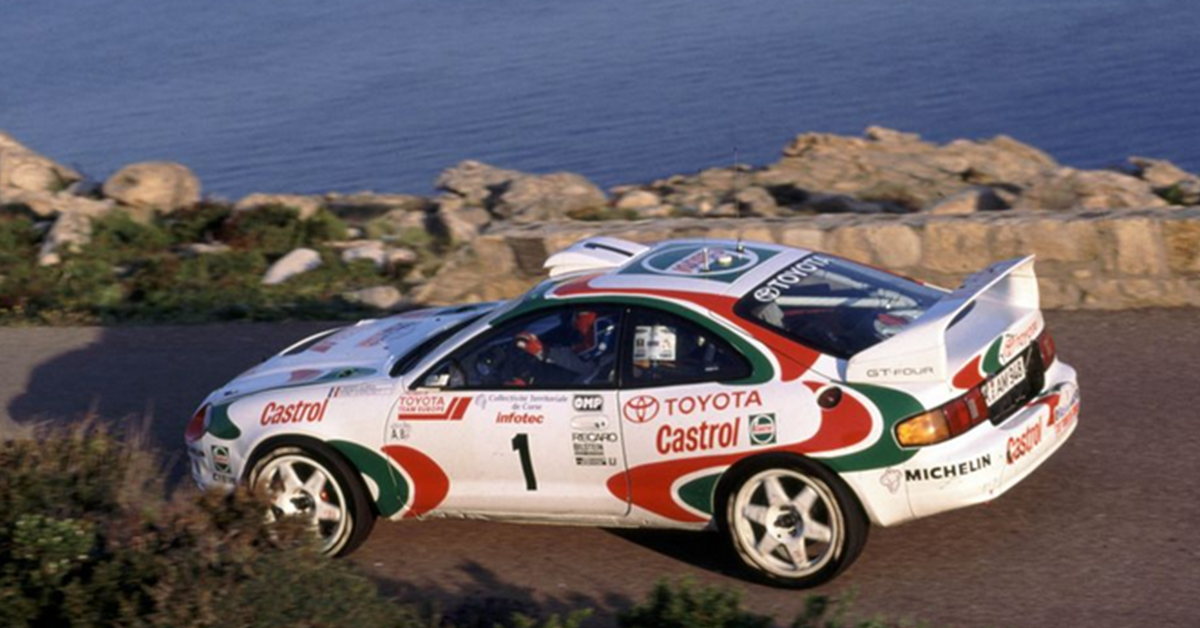
Official press image of the Toyota Celica GT-Four ST205. | © Toyota Motor Corporation
The Celica GT-Four ST205 is the last and wildest of the rally-bred Celicas, and it is a favourite among collectors of 1990s Japanese performance cars. It was built from 1994 to 1999, launching in Japan in February 1994 with other markets following in mid-1994, and production ended in June 1999. It was the road-going basis for Toyota's 1995 World Rally Championship car, and it carried a more aggressive look than the models before it, with wider arches, a larger rear wing and a distinctive front end.
| Years built | 1994 to June 1999 |
| Engine | 2.0-litre turbo 3S-GTE |
| Power | 252 hp Japan, 239 hp export |
| Torque | About 224 lb ft |
| Drive | All-wheel drive, five-speed E154 manual |
| Weight | About 1,390 kg |
| Homologation run | 2,500 road cars, all built in 1994 |
Under the bonnet is a 2.0-litre turbocharged four-cylinder 3S-GTE, in its third generation, producing 252 hp in Japanese-market form and 239 hp for export, with about 224 lb ft of torque. Power goes to all four wheels through a five-speed E154 manual gearbox, and the car weighs about 1,390 kg. The all-wheel-drive layout and turbocharged engine were direct descendants of the earlier GT-Four cars that had carried Toyota to world titles, including those won by Carlos Sainz, Juha Kankkunen and Didier Auriol.
The ST205's most unusual feature is its production history. To homologate the rally car under Group A rules, Toyota built 2,500 road cars, all produced in 1994. About 2,100 of them stayed in Japan, around 300 went to Europe, 77 went to Australia and five went to New Zealand. The Australian cars were sold as the GT-Four Group A Rallye. That low production figure and the car's direct link to a factory rally programme are the main reasons the ST205 is considered rare and collectable today.
The competition story is dramatic. The ST205 made its debut at Rally Australia in 1994, and Didier Auriol won the 1995 Tour de Corse, which turned out to be the car's only WRC victory. Then, at Rally Catalunya in 1995, FIA scrutineers found a turbocharger with unauthorised modifications. As a result, Toyota and its drivers lost championship points, and the team was banned from the World Rally Championship for twelve months. It was one of the biggest scandals in the sport's history, and it ended the ST205's career at the top level far too early.
For buyers, a few details matter. VINs follow the format ST205-#######, starting at ST205-0001001, and the genuine homologation cars were among the first 5,000 built, so a car claiming WRC specification with a much higher number deserves suspicion. The timing belt should be replaced about every 100,000 km or four to five years, together with the tensioner, idler, pulleys and water pump. Oil should be changed around every 14,000 km using quality synthetic oil, and a healthy engine idles at around 650 to 750 rpm with compression of roughly 160 to 170 psi.
Other checks include rust in the sills, wheel arches, underbody and boot, since Japanese-market cars were usually not undersealed, and the condition of the Superstrut front suspension, including the figure-8 camber control links. Stock engines are generally considered safe to around 300 hp, so be cautious of heavily tuned cars, and ask for full service history. A good ST205 is a genuine piece of rally history that you can drive every day, and it is a fascinating counterpart to the current GR Yaris, which carries the same family spirit forward.
Toyota has a reputation for building cars that last, and that reputation carries over into the classic market, where a well-kept Toyota is often easier and cheaper to live with than a European rival of the same age. That does not mean buying one is simple. Prices for the headline models have climbed quickly, genuine cars are increasingly hard to find, and the gap between a carefully maintained example and a neglected one can be enormous. A few principles apply to every model in this guide, from the Sports 800 to the Supra A80.
Start with rust and structure, because these are the problems that cost the most to fix. Toyotas of the 1960s to 1990s were built with thin steel and limited rust protection, and water finds its way into sills, floors, arches and bulkheads. Look underneath, check panel gaps for signs of accident repair, and be wary of fresh paint that hides filler. Mechanical parts are generally robust, so a rusty car with a good engine is usually a worse buy than a mechanically tired car with a solid shell.
Next, check authenticity. Popular models such as the AE86 and the Supra A80 are widely copied, modified or rebuilt, and a car that looks like an RZ or a GT-S may be a cheaper grade dressed up with parts. Compare the chassis number, engine code and gearbox with the original catalogue specification for the year, and ask for service records, import papers and photographs of any restoration. A documented history is worth real money, and it is the best protection you have against buying a car with a hidden past.
Parts and support deserve attention before you buy, not after. Toyota's GR Heritage Parts programme has remade selected discontinued components for several classics, including the Supra A70 and A80, the AE86 and the 40 Series Land Cruiser, which is a major advantage over many rivals. Specialist clubs, forums and independent workshops add a great deal of knowledge, particularly for cars such as the 2000GT, where body panels and trim are extremely hard to find. Always ask what is realistic before committing to a project car.
Importing is another consideration. Many of the cars in this guide were sold only in Japan or in a limited number of markets, and rules for bringing them into other countries vary. In the United States a car generally has to be 25 years old to be imported without meeting modern standards, a rule that is the reason the Supra A80 market is still opening up. Other countries have their own age limits and approval requirements, so check the current rules, and budget for shipping, duties and compliance before you bid on a car overseas.
Finally, think about how you want to use the car. A 2000GT is an investment to be preserved and shown, an FJ40 is a tool that is happy to work, and an AE86 or an ST205 is a driver's car that rewards regular use but punishes neglect. Insurance specialists offer agreed-value policies for classics, and keeping a car dry, serviced and gently exercised preserves more value than any restoration. Buy the best example you can afford, and the car will repay you in enjoyment and, quite possibly, in resale value.