 Brands
Ford Kuga — From the 2008 Debut to BlueCruise
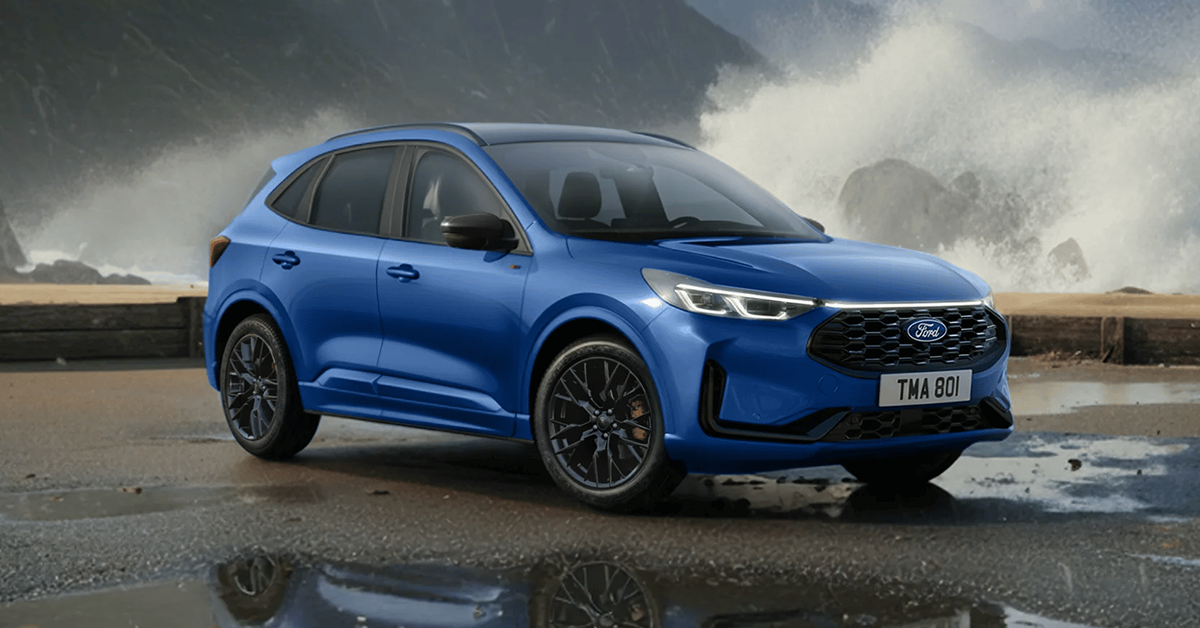
Official press image of the Ford Kuga. | © Ford Motor Company
The Ford Kuga from the 2008 European original to the 2019 third generation on the C2 platform, with mild, full and plug-in hybrids, the 2024 update and BlueCruise in 2026: engines, electric range, towing, trims and sales.
The Ford Kuga is a compact crossover SUV that Ford has built mainly for Europe since 2008. Ford describes the current car as the third generation of its mid-size SUV for customers in Europe since the nameplate was introduced in 2008 (Ford). Ford also says it has sold more than 1 million Kugas in Europe since 2008, a figure given when the third generation arrived (Ford). A reference history lists production from 2008 to the present, with the Ford Escape named as the same car in North America from 2012 (reported).
| First launched | 2008, Europe (Ford) |
| First-generation plant | Saarlouis, Germany (reported) |
| Second generation | From 2012 (reported) |
| Third generation | Revealed April 2, 2019 (Ford) |
| Current plant | Valencia, Spain (Ford) |
| Platform, third generation | Ford C2 architecture (Ford) |
| Europe sales since 2008 | More than 1 million, at 2019 (Ford) |
| Best-selling PHEV in Europe | 2021 and 2022 (Ford) |
| Powertrains | Petrol, diesel, hybrid, PHEV (Ford) |
| Name meaning, some languages | Plague (reported) |
The three generations are easy to tell apart. A reference history gives the first as the C394, built from February 2008 at Saarlouis, Germany (reported). It gives the second as the C520 from 2012, and the third as the C482 from 2019 (reported). Ford’s own 2019 release says the third Kuga was the first SUV based on its global C2 architecture, with 10 per cent more torsional stiffness and up to 90 kg less weight (Ford). One reference gives the first generation’s end as 2012 and another as 2013, so we show both (reported).
The Kuga is best known today for its electrified range. Ford said at the 2019 reveal that it was the most electrified Ford ever and the first to offer mild-hybrid, full-hybrid and plug-in hybrid powertrains (Ford). Ford’s January 2024 article says the Kuga Plug-In Hybrid was Europe’s bestselling plug-in hybrid in 2021 and 2022, citing JATO Dynamics and IHS Markit data, and was on track for 2023 (Ford). Those claims cover Ford of Europe’s 20 traditional markets, according to the same article (Ford).
Where it is built matters for readers. Ford says the current Kuga is built at its Valencia plant in Spain (Ford). The first generation came from Saarlouis in Germany, according to a reference history (reported). A used-car guide agrees that the first Kuga was built at Saarlouis specifically for the European market (reported). Ford’s March 2026 reference page lists the current series as Titanium, ST-Line, ST-Line X, Active X and a BlueCruise Edition (Ford).
The name has a footnote. A reference history says Kuga means plague in Bosnian, Croatian, Serbian and Slovenian, and that sales are reportedly lower in that region because of the name (reported). We found no Ford statement on this, so we treat it as a reported claim only. We also do not give a global production total, because we found no Ford figure for one, only the European sales figures quoted in later sections.
Some limits apply to the article. Ford’s own pages that we could read cover the 2019 reveal, the 2019 and 2024 specification sheets, the 2023 and 2024 updates and the March 2026 BlueCruise update. They do not cover the 2008 launch or the 2012 second generation in detail, so those sections lean on reference histories and are tagged (reported). Our wider Ford history article gives the company context, and we keep the Kuga separate from the Escape, which has its own article. The sections below follow the generations in order, then the hybrids, the sales and the latest updates.
The first Kuga was built for Europe. A reference history lists it as the C394, produced from February 2008 at the Saarlouis plant in Germany (reported). A used-car guide says it was built there specifically for the European market (reported). Ford’s 2024 article confirms that the original Kuga launched in 2008 (Ford). The first generation therefore predates Ford’s later hybrid line-up, and Ford’s own pages that we could read give no technical detail for it.
| Model code | C394 (reported) |
| Production start | February 2008 (reported) |
| Production end | 2012 or 2013 (reported) |
| Plant | Saarlouis, Germany (reported) |
| Diesel | 2.0L Duratorq, 138 hp (reported) |
| Gearboxes | Six-speed manual or automatic (reported) |
| 2008 Euro NCAP, adults | 33 points (reported) |
| Europe sales, 2008 | 26,761 (reported) |
| Europe sales, 2010 | 72,878 (reported) |
| Europe sales, 2012 | 62,951 (reported) |
Engines were mainly diesel. A sales reference says the first Kuga used a 2.0-litre Duratorq diesel making 138 horsepower and 236 lb-ft, with a six-speed manual or six-speed automatic (reported). Another reference says some trims had a 2.5-litre five-cylinder turbo petrol (reported). We could not check either against a Ford source, so we do not state outputs in PS. A platform reference says the car was built on the Ford C1 platform shared with the Focus, though the sources differ (reported).
The first Kuga was close to being a North American car. A reference history says a local broadcaster reported in July 2008 that Ford was reconsidering bringing the Kuga to North America (reported). It says news leaked in October 2009 that Ford would build the Kuga at its Louisville plant, possibly as the 2012 Escape (reported). Ford then announced on June 23, 2010 that it would end the second-generation Escape in 2011 in anticipation of the Kuga’s North American launch as the next Escape (reported).
A hybrid was also discussed. A reference history says Ford announced in May 2010 that it would build unspecified hybrids at its Valencia plant and would likely offer a hybrid option of the Kuga (reported). It says the Kuga Hybrid would have been Ford’s first hybrid sold in Europe, although Ford had by then sold over 100,000 Escape Hybrids and Mercury Mariner Hybrids in the United States since 2004 (reported). We found no Ford page confirming that a first-generation Kuga Hybrid went on sale, so we do not claim one did.
Safety and sales gave a mixed picture. A reference lists a Euro NCAP result for a 2008 Kuga 2.0 diesel in Trend trim of 33 points for adult occupants, 38 for child occupants and 20 for pedestrians (reported). Euro NCAP scoring has changed since 2008, so those numbers should not be compared with modern cars. A sales reference lists 26,761 European registrations in 2008, then 64,773 in 2009 and 72,878 in 2010 (reported). Those are data-site figures and not Ford figures.
The first generation ended in the early 2010s. A reference history gives its production as February 2008 to 2013, while a platform guide and a topic page give 2008 to 2012, which is a conflict we carry (reported). Sales fell to 68,604 in 2011 and 62,951 in 2012 as the second generation approached (reported). Ford’s own pages we read do not describe the changeover. The next section covers the second generation, which Ford developed under its global strategy. Readers who want exact first-generation specifications should consult an owner’s manual or a period road test, because we found no primary source we could cite.
The second Kuga arrived in 2012 and ran until 2019. A reference history lists it as the C520, and a used-car guide gives 2012 to 2019 (reported). A Japanese export guide says it was released in 2012 as a 2013 model and was cheaper, bigger and offered more technology than the first (reported). Ford’s own pages that we could read do not cover the 2012 launch, so these dates are reported. A cars guide calls it long-lived and still popular after eight years on sale (reported).
| Model code | C520 (reported) |
| Production | 2012 to 2019 (reported) |
| Model year | Sold from 2012 as a 2013 model (reported) |
| Escape link | Same car as the third-generation Escape (reported) |
| European assembly | Valencia, Spain (reported) |
| Trims | Titanium, Titanium X, ST-Line X (reported) |
| Engines | Turbo petrol and diesel (reported) |
| Europe sales, 2013 | 160,658 (reported) |
| Europe sales, 2017 | 243,906, the table peak (reported) |
| Europe sales, 2019 | 170,533 (reported) |
This generation tied the Kuga to the American Escape. A reference history lists the Escape as the same car from 2012, and a repair site says the second-generation Kuga was virtually identical to the third-generation Escape (reported). Our Ford Escape article covers the American side of that pairing. A reference says the second-generation Kuga was primarily developed in Europe, with European assembly at Valencia (reported). The pairing followed Ford’s One Ford strategy, according to an Austrian guide (reported).
Trims were broadened. The Austrian guide lists Titanium, Titanium X and ST-Line X for the second generation (reported). It says a plug-in hybrid with a 14.4 kWh battery was offered for the first time and was at times Europe’s best-selling plug-in hybrid (reported). We could not confirm that against a Ford page, and Ford’s own materials credit the third-generation Kuga as the first to offer mild, full and plug-in hybrid powertrains (Ford). We therefore treat the second-generation plug-in claim as reported only.
Engines were petrol and diesel. A used-car guide says the second generation had a choice of turbo petrol and diesel engines (reported). We found no Ford specification sheet for the second generation, so we give no outputs. Readers comparing used cars should check each car’s own documents. An Austrian guide also reports poor build quality and high oil loss in some cars, but that is a single reported complaint, and we do not treat it as established (reported).
Sales grew strongly. A data site lists 160,658 European registrations in 2013 and 222,443 in 2014 (reported). It lists 237,658 in 2015, 234,516 in 2016 and 243,906 in 2017, the highest year in that table (reported). The figures then fell to 184,408 in 2018 and 170,533 in 2019 (reported). The 2013 jump matches the first full year of the second generation, though the source does not say so, and these are not Ford-published figures.
Ford’s later releases give context. Ford said in 2019 that more than 1 million Kugas had been sold in Europe since 2008 (Ford). A reference history lists China, Russia and the United States among the second generation’s markets, the last under the Escape name (reported). The second generation was replaced in 2019 by a car on the new C2 architecture. The following section covers that third generation and its April 2019 reveal. Because Ford’s own pages are thin for the 2012 to 2019 years, readers should treat the sales and trim details above as reported background and not as Ford-confirmed specifications for any particular car.
Ford revealed the third-generation Kuga on April 2, 2019. Its release called the car sculpted and electrified, and the first Ford to offer mild-hybrid, plug-in and full-hybrid powertrains (Ford). It said the Kuga was the most electrified Ford ever (Ford). The release gave an anticipated plug-in hybrid electric range of more than 50 km, a fuel efficiency of 1.2 litres per 100 km and 29 g/km of CO2 (Ford). Those were anticipated figures at the time, and later sections give the homologated ones.
| Reveal date | April 2, 2019 (Ford) |
| Platform | C2 architecture, first SUV on it (Ford) |
| Weight saving | Up to 90 kg (Ford) |
| Torsional stiffness | 10 per cent more (Ford) |
| Top diesel, 2019 | 2.0L EcoBlue, 190 PS, 8-speed auto, AWD (Ford) |
| Entry diesel, 2019 | 1.5L EcoBlue, 120 PS (Ford) |
| Mild hybrid, 2019 | 2.0L EcoBlue Hybrid, 150 PS (Ford) |
| PHEV, 2019 | 2.5L petrol, 225 PS (Ford) |
| PHEV range, 2019 | 56 km WLTP; 72 km NEDC (Ford) |
| Turning circle | 11.1 m (Ford) |
The C2 architecture was the technical change. Ford said the Kuga was the first SUV based on its global C2 architecture, with 10 per cent more torsional stiffness and up to 90 kg of weight reduction compared with the outgoing car (Ford). A reference history says the new car was longer and wider with a more generous wheelbase (reported). A used-car guide gives the third generation’s model code as C482 (reported). Ford’s 2019 specification sheet lists a turning circle of 11.1 metres (Ford).
Ford’s 2019 specification sheet lists the original line-up. A 2.0-litre EcoBlue diesel made 190 PS with an eight-speed automatic and all-wheel drive, and a 1.5-litre EcoBlue made 120 PS (Ford). A 2.0-litre EcoBlue Hybrid made 150 PS with a six-speed manual, and the 2.5-litre petrol plug-in hybrid made 225 PS (Ford). The sheet lists a plug-in hybrid top speed of 200 km/h and a 0 to 100 km/h time of 9.2 seconds, against 194 km/h and 9.6 seconds for the 150 PS hybrid (Ford). The diesels were Euro 6 (Ford).
The plug-in hybrid’s range was given in two ways. Ford’s sheet lists 72 km on the older NEDC cycle and an equivalent all-electric range of 56 km on the WLTP cycle (Ford). At the September 2019 Frankfurt show, Ford said the Kuga could drive up to 55 km on electric power alone (Ford). A November 2020 German release says it could drive up to 56 km purely electrically (Ford). The differences come from test cycles and from when each release was written, not from separate cars.
Space and convenience were highlighted. A Malaysian news item reporting on the Ford release says the new Kuga had best-in-class rear legroom of 1,035 mm and a remote release for the second row of seats (reported). Ford’s 2024 article says the sliding rear seats increase rear legroom to over 1 metre or add up to 150 litres of boot space (Ford). We could not read the 2019 release in full, so we do not give 2019 boot volumes. We also avoid ranking it against rivals.
Electrification expanded after launch. Ford’s November 2020 release says the Kuga came with 1.5 or 2.0-litre engines and a 2.0-litre EcoBlue Hybrid with 48-volt mild-hybrid technology, and that a full hybrid based on the 2.5-litre Duratec petrol engine was now orderable (Ford). It says Ford planned 18 electrified models in Europe by the end of 2021, including the Kuga in three electrified versions (Ford). The next section covers how each hybrid works and what Ford says about its range.
The Kuga offers three kinds of hybrid, and Ford names them separately. The Kuga EcoBlue Hybrid is a mild hybrid using 48-volt technology, the Kuga Hybrid is a full hybrid and the Kuga Plug-In Hybrid can be charged from the grid (Ford). Ford’s product page lists them alongside the 2.0-litre EcoBlue diesel, the 1.5-litre EcoBlue diesel and the 1.5-litre EcoBoost petrol (Ford). Ford said every nameplate from the all-new Focus onward would include an electrified option, with the Kuga first to offer three hybrid types (Ford).
| Mild hybrid | EcoBlue Hybrid, 48-volt (Ford) |
| Full hybrid | Kuga Hybrid, 2.5L Atkinson petrol (Ford) |
| Plug-in hybrid | 2.5L petrol with motor, 243 PS (Ford) |
| Hybrid power, 2024 | 180 or 183 PS (Ford) |
| PHEV range, 2023 | 57 to 67 km WLTP (Ford) |
| PHEV range, 2024 | Up to 69 km (Ford) |
| PHEV range, 2026 | 60 to 68 km WLTP (Ford) |
| PHEV city range, 2024 | 88 km WLTP (Ford) |
| Full hybrid tank range | Up to 900 km (Ford) |
| Towing | Up to 2,100 kg, properly equipped (Ford) |
The plug-in hybrid uses a 2.5-litre Atkinson-cycle petrol engine with an electric motor. Ford’s 2024 specification sheet lists the front-wheel-drive plug-in at 243 PS (Ford). It lists a WLTP equivalent all-electric range of 60 to 69 km and a city WLTP range of 88 km (Ford). Fuel consumption is 0.9 to 1.2 litres per 100 km and CO2 emissions are 20 to 28 g/km (Ford). The sheet lists a top speed of 200 km/h (Ford). These are laboratory test results and real use will differ.
Ford has updated its electric range figures over the years. In February 2023 Ford gave an all-electric range of 57 to 67 km WLTP and energy consumption of 14.4 to 15.9 kWh per 100 km (Ford). In January 2024 it gave up to 69 km (Ford). Its March 2026 page gives 60 to 68 km, with 55 to 71 g/km of CO2 and 2.8 to 3.9 litres per 100 km (Ford). The 2026 fuel and CO2 figures differ from the 2024 ones, which may reflect a different test basis, and we show both.
The full hybrid is for drivers without a charger. Ford’s 2024 article says the Kuga Hybrid offers up to 900 km on a single tank of fuel and up to 64 per cent pure electric driving in the city (Ford). Its figures are 121 to 146 g/km of CO2 and 5.3 to 6.4 litres per 100 km (Ford). The 2024 sheet lists the 2.5-litre petrol hybrid at 180 or 183 PS (Ford). Ford says the plug-in and the hybrid with all-wheel drive both have significantly improved acceleration, without giving figures (Ford).
The petrol engine is a 1.5-litre EcoBoost, now with hybrid assistance. Ford’s 2024 article gives the 1.5-litre EcoBoost Hybrid 144 to 163 g/km of CO2 and 6.3 to 7.2 litres per 100 km (Ford). The March 2026 page gives the 1.5-litre EcoBoost 144 to 178 g/km and 6.3 to 7.8 litres per 100 km (Ford). Those ranges differ, so we show both. Ford does not give a PS output for it in the pages we read.
Ford also changed where the hybrid engine comes from. Its March 2021 release says the Valencia Engine Plant would build the 2.5-litre Duratec hybrid engine for Europe from late 2022, powering the Kuga plug-in and the Kuga, Galaxy and S-MAX full hybrids (Ford). It calls the engine the first of its kind built by Ford in Europe (Ford). That tied the Kuga’s drivetrain to the Valencia site. Ford says towing is up to 2,100 kg when properly equipped, and actual capacity varies with the car and its load (Ford).
The Kuga has been one of Ford’s main European SUVs for years. Ford said in 2019 that it had sold more than 1 million Kugas in Europe since 2008 (Ford). A data site lists European registrations of 111,472 in 2021 and 91,082 in 2020, down from 170,533 in 2019 (reported). The 2020 drop matches the wider pandemic year, though the source does not say so. Those are data-site figures and Ford’s own pages give percentages and rankings rather than totals.
| Europe sales since 2008 | More than 1 million, at 2019 (Ford) |
| Europe registrations, 2019 | 170,533 (reported) |
| Europe registrations, 2020 | 91,082 (reported) |
| Europe registrations, 2021 | 111,472 (reported) |
| PHEV share of Kuga sales, 2020 | 51.1 per cent since introduction (Ford) |
| PHEV share of Kuga sales, 2021 | More than 50 per cent (Ford) |
| PHEV best-seller, Europe | 2021 and 2022 (Ford) |
| PHEV delivery rise, 2022 | 20 per cent (Ford) |
| Hybrid engine build | Valencia, from late 2022 (Ford) |
| Mondeo production | Phased out early 2022 (Ford) |
The plug-in hybrid became the core of the range. Ford’s July 2020 sales release says the Kuga plug-in accounted for 51.1 per cent of total Kuga sales since introduction, and that Hybrid derivatives made up more than 50 per cent of total Puma and Kuga sales (Ford). Its March 2021 release says plug-in sales exceeded 50 per cent of total Kuga sales (Ford). The same release says Ford phased out the Mondeo in early 2022 and kept the Galaxy and S-MAX with full-hybrid versions (Ford). Our Puma article covers the smaller SUV Ford named alongside the Kuga.
Ford has repeated its best-selling claim. In February 2023 Ford said a 20 per cent increase in plug-in deliveries made the Kuga the best-selling plug-in hybrid of any brand across all European markets for the second year in a row in 2022 (Ford). Its January 2024 article says the Kuga plug-in was Europe’s bestselling plug-in hybrid in 2021 and 2022 and on track for 2023, according to the latest available data (Ford). Ford does not give unit totals in those pages, and we found no independent figures for 2023.
Valencia is the Kuga’s home. Ford says its Valencia plant in Spain is one of the most productive and advanced in Europe and that it builds the Kuga there (Ford). Ford’s 2024 article says the new Kuga uses 3D-printed parts and AI support for quality (Ford). A 2026 Ford article says a new European joint venture with Geely will make Ford and Geely multi-energy passenger vehicles for the European market at the plant (Ford). We do not know how that affects Kuga production, and Ford’s page does not say.
The Kuga sits among Ford’s European SUVs. Ford’s 2017 EcoSport release said the EcoSport would join the Edge and Kuga in the European SUV range (Ford). Our EcoSport article covers that smaller model, which ended production in 2022. A trade report says the EcoSport’s end left a gap in Europe that Ford’s later models only partly filled (reported). The Kuga has therefore carried more of Ford Europe’s SUV volume, though no Ford page quantifies that.
The wider market also matters. A used-car guide says the third-generation Kuga is the best one to buy (reported), and a cars guide says the petrol Kuga only makes sense in plug-in hybrid form (reported). Those are opinions and not facts. Ford’s own March 2021 release says electrification was gathering pace and that customers were showing more confidence in it (Ford). Prices vary by market and trim, and we did not find a Ford price page for Europe.
Ford refreshed the Kuga in stages. On April 25, 2023 it announced the Kuga Graphite Tech Edition, built at Valencia and available to order across Europe from that day, with deliveries from June (Ford). It added Ford’s Grey Matter paint, a new 19-inch gloss black alloy design and an option to add a Black Package (Ford). Standard equipment included Adaptive Cruise Control, Blind Spot Information System, a head-up display, LED headlights and Active Park Assist (Ford). It was offered across all Kuga powertrains (Ford).
| Graphite Tech announced | April 25, 2023 (Ford) |
| Graphite Tech paint | Grey Matter (Ford) |
| Graphite Tech wheels | 19-inch gloss black (Ford) |
| Facelift article | January 17, 2024 (Ford) |
| 2024 trims | Titanium, ST-Line, Active (Ford) |
| Infotainment | SYNC 4, wireless CarPlay and Android Auto (Ford) |
| BlueCruise page | March 5, 2026 (Ford) |
| BlueCruise availability | From April 2026, automatics (Ford) |
| BlueCruise coverage | 135,000 km, 16 markets (Ford) |
| B&O audio | 575 W raised to 700 W (Ford) |
The bigger change came in January 2024. Ford’s article of January 17 says the Kuga had evolved inside and out with a fresh design, including a full-width LED light bar framing a new grille with the Blue Oval (Ford). It lists three trims: Titanium, ST-Line and the rugged Active (Ford). A used-car guide says Active was new with the 2024 update and that the car was facelifted that year (reported). The article does not list a Vignale trim, so we do not name one.
Technology moved to SYNC 4. Ford says it has twice the computing power of the previous system, with 5G connectivity, cloud-connected navigation, wireless Apple CarPlay and Android Auto and Alexa Built-in as standard (Ford). Its adaptive cruise control can brake for curves, junctions and traffic, and a 360-degree camera operates under 10 km/h (Ford). Full LED headlights with Automatic High Beam Control are standard, and Dynamic Pixel LED headlights are optional (Ford). Ford does not give the screen size in that article.
BlueCruise arrived in 2026. Ford’s March 5, 2026 page says the hands-off, eyes-on system works in designated Blue Zones covering over 135,000 km of highways in 16 European markets (Ford). It lists Austria, Belgium, the Czech Republic, Denmark, France, Germany, Greece, Hungary, Italy, the Netherlands, Norway, Poland, Portugal, Spain, Sweden and the UK (Ford). It is available from April 2026 on new model-year Kugas with automatic transmissions as part of the Driver Assistance Pack (Ford). The driver must keep their eyes on the road (Ford).
Equipment varies by trim. Ford says BlueCruise is standard on ST-Line X and Active X and optional on Titanium and ST-Line, with a one-time purchase or monthly or annual plans (Ford). The B&O Premium Audio system rose from 575 W to 700 W, standard on ST-Line X and Active X, and Premium Connectivity is now available across all series (Ford). The new BlueCruise Edition has Vapor Blue paint, a black roof and 19-inch black alloys, and comes with PHEV, hybrid or 1.5-litre EcoBoost power (Ford). Ford says availability of services varies by market (Ford).
Ford has not announced a replacement. Our Ford Europe article covers the seven new models the company has said it plans for the region, and Ford’s pages that we read do not name a next-generation Kuga (Ford). The 2024 facelift and the 2026 BlueCruise update suggest Ford is keeping the car current, but that is our reading and not a Ford statement. The Geely joint venture article does not say which models will be built at Valencia (Ford). Readers should watch Ford’s European newsroom for confirmed news.
A buyer should first decide on the powertrain. Ford’s current line-up is the plug-in hybrid, the full hybrid and the 1.5-litre EcoBoost petrol, according to its 2026 page (Ford). Earlier cars also had EcoBlue diesels, which Ford lists in the 2019 specification sheet at 120 PS and 190 PS (Ford). The plug-in suits drivers who can charge at home, with Ford quoting 60 to 69 km of WLTP range (Ford). The full hybrid suits drivers who cannot charge, with up to 900 km per tank claimed by Ford (Ford).
| Current powertrains | PHEV, full hybrid, 1.5L EcoBoost (Ford) |
| 2019 diesels | 1.5L at 120 PS; 2.0L at 190 PS (Ford) |
| Current trims | Titanium, ST-Line, ST-Line X, Active X (Ford) |
| Special edition | Graphite Tech, 2023; BlueCruise Edition, 2026 (Ford) |
| PHEV range | 60 to 69 km WLTP (Ford) |
| Hybrid tank range | Up to 900 km (Ford) |
| Towing | Up to 2,100 kg, properly equipped (Ford) |
| Rear legroom, sliding seat | Over 1 metre (Ford) |
| Extra boot space, sliding seat | Up to 150 litres (Ford) |
| Turning circle | 11.1 m (Ford) |
Trims have changed over time. The current series are Titanium, ST-Line, ST-Line X, Active X and the BlueCruise Edition, according to Ford (Ford). The second generation used Titanium, Titanium X and ST-Line X, according to an Austrian guide (reported). The Graphite Tech Edition added a fixed list of driver aids in 2023 (Ford). Names and equipment differ by country, and Ford says service availability varies by market, so buyers should check the local specification (Ford).
Practicality is a Kuga strength, and the numbers are Ford’s. Ford says the sliding rear seats give over 1 metre of rear legroom or up to 150 litres of extra boot space (Ford). Towing is up to 2,100 kg when properly equipped, and Ford says the SYNC 4 system adds a Trailer Connection Checklist and Trailer Tow Navigation (Ford). The 2019 sheet lists a 11.1-metre turning circle (Ford). We do not list a boot volume in litres, because we did not find one in the Ford pages we read.
Running costs depend on how the car is used. Ford’s lab figures for the plug-in are 0.9 to 1.2 litres per 100 km in 2024 and 2.8 to 3.9 in 2026, which are different test bases (Ford). The full hybrid is 5.3 to 6.4 litres per 100 km and the 1.5-litre EcoBoost 6.3 to 7.8 (Ford). Real-world consumption will differ from these tests, especially for a plug-in that is rarely charged. We found no Ford running-cost data and give no pence-per-mile figure.
Used buyers have more to check. The second-generation car was long-lived, and a guide suggests a well-specced example with good mileage and a strong service history is a good compromise (reported). An Austrian guide reports build-quality complaints and oil loss in some second-generation cars, which we treat as a reported issue only (reported). A used plug-in hybrid needs a battery and charging-cable check. A pre-purchase inspection and a full service history are sensible for any used Kuga.
The Kuga sits within Ford’s broader range, which our models page covers for current buyers. Ford’s own pages give no prices for the Kuga in the 2024 and 2026 articles, so we give none. The car is a European product and does not sell as the Kuga in the United States, where the same underlying car carries the Escape name in some years, according to reference histories (reported). For purchase decisions, readers should use their local Ford dealer’s price list and the manufacturer’s current brochure, since specifications and equipment change between model years.
