 Brands
Ford Courier — Pickup, Transit Courier and E-Transit Range
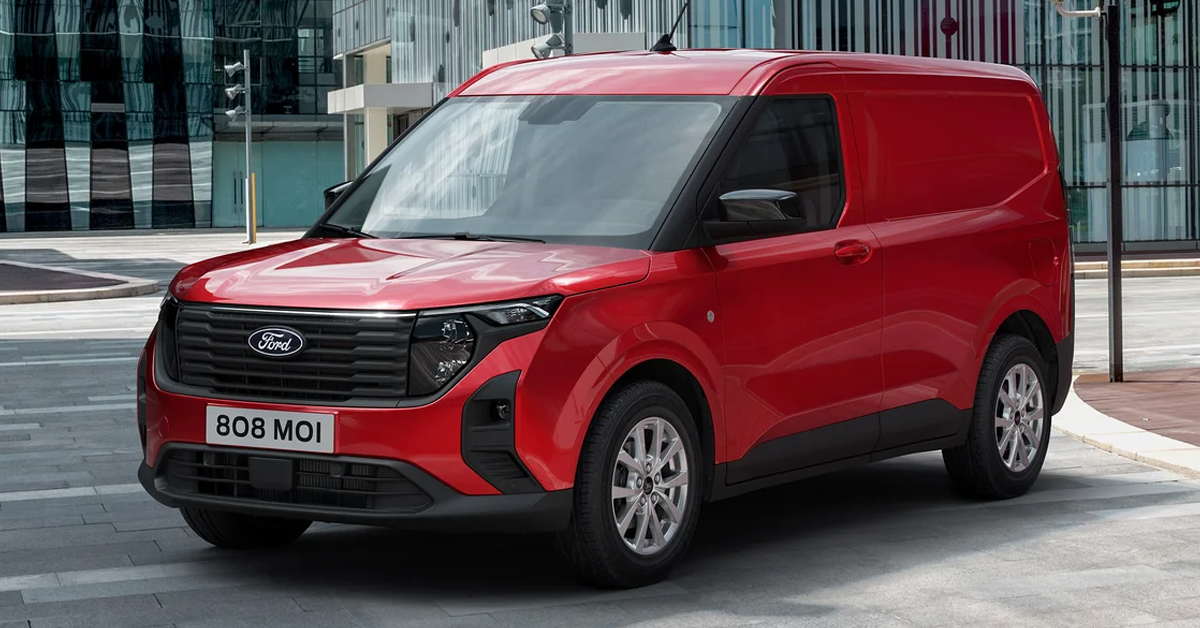
Official press image of the Ford Courier. | © Ford Motor Company
The Ford Courier name from the 1952 sedan delivery and the Mazda-based pickup to the Transit Courier, E-Transit Courier and E-Tourneo Courier, covering engines, payload, battery range and charging, showing what Ford says and what is only reported.
Courier is a Ford name that has been used on very different vehicles. Reports say it began in 1952 on a North American sedan delivery, returned in 1972 on a small pickup built by Mazda, appeared in Europe on a Fiesta-based van and in Brazil on a coupe utility, and then came back in 2014 as the Transit Courier (reported). Ford’s own pages we read cover only the current Transit Courier, E-Transit Courier and E-Tourneo Courier, so the earlier history is reported. Our Ford history article covers the company around these years.
| Sedan delivery name | Courier, 1952 (reported) |
| Mazda-based pickup | Courier, 1972 (reported) |
| Europe van | Fiesta-based Courier, 1990s (reported) |
| Brazil coupe utility | Courier, 1998 (reported) |
| Name returned | Transit Courier, 2014 (reported) |
| Current van | Transit Courier, 2023 launch (Ford) |
| Electric van | E-Transit Courier (Ford) |
| Electric MPV | E-Tourneo Courier (Ford) |
| Current plant | Craiova, Romania (Ford) |
| Ford page for early Couriers | None found |
The current Courier family is Ford’s smallest range in Europe. Ford’s January 2024 release describes the all-new Transit Courier as a compact van with 25 per cent more load volume, and Ford’s April 2023 release describes the E-Transit Courier as a ground-up new all-electric commercial vehicle (Ford). Ford’s March 2025 article says E-Transit Courier production was underway at Ford Otosan’s facility in Craiova, Romania (Ford).
The people-carrying version is the Tourneo Courier. Ford’s 2024 release calls the E-Tourneo Courier a stylish, spacious electric vehicle with a 43 kWh useable battery and up to 288 km of range, and Ford’s Courier page says the five-seat Tourneo Courier completes Ford’s next-generation Tourneo family (Ford). Our Tourneo Connect and Tourneo Custom articles cover the two larger Tourneo models, and this article keeps the Courier on its own.
The pages disagree on a number of figures, and we show both values with their sources. The E-Transit Courier is given up to 300 km of range in 2025 and up to 334 km in 2026 after a battery change from 43 kWh to 46 kWh, while the E-Tourneo Courier is given up to 288 km on the 43 kWh battery (Ford). Reports of the pickup give different start and end years, and Ford’s own Transit Courier payload of up to 854 kg differs from a report’s 845 kg (Ford, reported).
Choosing one Courier is the first problem for a reader. A search for Ford Courier can return a 1950s sedan delivery, a 1970s Mazda-based pickup, an Australian utility or a 2020s electric van, and these are not related by engineering. We therefore split the article by vehicle, give each section its own dates, and mark every figure as Ford’s own or reported, so the reader can see which Courier a number belongs to.
We kept the scope tight. We found no Ford-owned page for the sedan delivery or the Mazda-based pickup, so every figure for them is reported. We found no Ford price list, no Ford sales total and no Ford recall information for any Courier in the text we read. We give no claim about reliability, resale values or running costs, and where a source gives a single value we show it with its date. Ford writes power in PS and kW and range in kilometres for Europe, and we keep Ford’s units and do not convert them unless we say so.
The first Courier was a sedan delivery. Reports say Ford applied the Courier name to a two-door sedan delivery based on its full-size station wagon line from 1952, with a front-engine, rear-wheel-drive layout and the internal designation 78A (reported). A description of one surviving car says it had a unique rear door that hinged on the side, introduced in 1952 and continued until 1956 (reported). We found no Ford-owned page for this vehicle, so these facts are reported.
| Years, one report | 1952 to 1960 (reported) |
| End year, other report | Through 1957 (reported) |
| Layout | Front engine, rear-wheel drive (reported) |
| Internal designation | 78A (reported) |
| Side-hinged rear door | 1952 to 1956 (reported) |
| Replacement | Econoline cargo van, 1961 (reported) |
| Falcon sedan delivery | Through 1964 (reported) |
| One car's engine | 239 cu in V8, 1954 (reported) |
| Australian version | Utility, 1952 (reported) |
| Ford production total | No figure found |
The end date differs by source. Reports say Ford sold the Courier sedan delivery through 1960 and replaced it and the F-Series panel delivery with the Econoline cargo van for the 1961 model year (reported). A video history says the sedan deliveries remained in production up through 1957, which conflicts with the 1960 date, and we found no Ford statement settling it (reported). We show both dates and do not choose between them.
A reader should know what a sedan delivery was. It looked like a station wagon but had no rear side windows, so a business could carry goods under cover while the vehicle still drove like a family car, and a report calls it a precursor of the modern cargo van (reported). A blog says that from 1959 the Courier name was used on the lowest-trim two-door wagon and not on a windowless delivery, which adds another version to the story (reported).
The sedan delivery body style moved to a smaller car. A report says the two-door sedan delivery was made part of the compact Ford Falcon range and was offered through the 1964 model year, and that a Falcon sedan delivery was sold with or without rear side windows (reported). Our Ford history article gives context on Ford’s car lines of that period, and we give no claim about how many sedan deliveries Ford sold.
Engine details come from individual cars. One auction-style description lists a 1954 sedan delivery with a 239 cubic-inch V8 and a three-speed manual transmission with overdrive, finished in Dove Gray with a brown interior (reported). That is one car and not a specification for the range, and we give no claim about the engines offered across the 1952 to 1960 years. A 1952 model was also reported to be produced in Australia as a utility, which is a different body style (reported).
We keep the limits plain. We found no Ford production total, price, payload or fuel figure for the sedan delivery, and we found no Ford archive page about it in the text we read. A reader who needs the original specification should use Ford’s heritage archive or a period brochure, and should treat the dates and details in this section as reported and subject to correction by Ford’s own records. Reports on a vehicle this old often copy one another, so two reports that agree are not always two independent confirmations. We also avoid quoting auction asking prices, because they describe one car on one day and say little about the model.
Ford revived the Courier name in 1972 on a small pickup. Reports say it was a rebranded Mazda B-Series, built by Toyo Kogyo and imported to North America in response to the unforeseen popularity of small Toyota and Datsun pickups among young buyers, and that Ford took the name from its old sedan deliveries after a 12-year gap (reported). Another report dates the nameplate to 1971 as the first compact pickup built for Ford, so the start differs by one year (reported).
| Pickup start, one report | 1972 (reported) |
| Pickup start, other report | 1971 (reported) |
| Built by | Toyo Kogyo (Mazda) (reported) |
| Name gap before revival | 12 years (reported) |
| Reported end of U.S. sales | 1982 (reported) |
| Domestic replacement | Ranger, 1982 or 1983 (reported) |
| Third generation | 1985, larger cab (reported) |
| Options in 1985 | V6, four-wheel drive (reported) |
| Reached Australia | November 1978 (reported) |
| Ford Australia end year | 2006 (reported) |
The Courier began a long partnership. A report says it was the first product marketed jointly between Ford and Mazda, and that the link lasted for decades before Ford sold its remaining Mazda shares in 2015 (reported). Reports say Ford gave it a grille that resembled the full-size F-Series and fitted two headlights instead of Mazda’s four, and that the tailgate read COURIER in large raised letters in 1972 and 1973 (reported). We found no Ford page for those details.
The end of U.S. sales is reported as 1982. A history says production ended after 1982 and that Ford replaced it in 1983 with the domestically built Ranger, while another says the Courier was sold in the U.S. until 1982 when Ford introduced its own Ranger, so the Ranger year is given as 1982 or 1983 depending on whether model or calendar year is used (reported). Our Ford models article lists the current range and we give no claim about the Ranger’s first year.
Outside the U.S. the Courier lasted longer. A report says the third generation was introduced in 1985 alongside the redesign of the Mazda Proceed and B-Series, with a larger cab, five-speed manual transmissions, four-wheel drive and a V6 engine as options (reported). Another report says the Courier reached Australia in November 1978 and that Ford Australia kept the name until 2006 in Australia and New Zealand, and a third says the generation continued to 1985 in markets such as Australia (reported).
Those Australian dates conflict, and we show both. One account has the Mazda-based Courier ending in Australia in 1985 with the older generation, and another has the name continuing through 2006 with later generations (reported). The two can both be true if the name continued on newer Mazda trucks, but we found no Ford statement that explains it, so we give no claim about which generation ended when. A fifth-generation Courier from 1998 was sold mainly in New Zealand and Australia (reported).
The Courier was then replaced by a Ford-branded truck. A report says the Mazda B-Series was replaced by the Mazda BT-50 in 2006 and that the Ford Ranger later became the donor for the trucks sold under both brands (reported). We found no Ford engine, payload or price table for any Courier pickup in the text we read, and we give no claim about them. Collectors should check the vehicle identification number and the market of sale, because specifications differed by country. We found no Ford statement of how many Courier pickups were sold in North America, Australia or elsewhere, and we give no claim about production totals or about which model year is most common today.
A different Courier was sold in Europe. Reports say the Courier was a compact panel van based on the Fiesta, sold in Europe from 1991 to 2002 (reported). One report says that until 1999 it used the Endura 1.3-litre engine and the Zetec-SE 1.4-litre 16-valve engine, and that the 1.4 had a top speed of 170 km/h and a 0 to 100 km/h time of 12 seconds (reported).
| Europe van years | 1991 to 2002 (reported) |
| Base | Fiesta (reported) |
| Body | Compact panel van (reported) |
| Engines to 1999 | 1.3 Endura, 1.4 Zetec-SE (reported) |
| 1.4 top speed | 170 km/h (reported) |
| 1.4 0 to 100 km/h | 12 seconds (reported) |
| Brazil utility start | 1998 (reported) |
| Brazil utility end | 2013 (reported) |
| Name withdrawn | 2014, then Transit Courier (reported) |
| Ford page for these | None found |
The European Courier was a small van, not a pickup. A report calls it a compact panel van (reported), and we found no Ford statement of where it sat in Ford’s range. Our Transit Connect article covers the van that followed in Europe and the U.S., and we give no claim about how the older Courier compared with it on load volume or payload.
The Brazilian Courier was a coupe utility. A report says the most recent model in the Courier series was developed by Ford Brazil and introduced in 1998, and one source gives the series span as 1971 to 2013 across all Courier bodies (reported). The model years listed in one source are 1998 to 2013 for the coupe utility, and the same source gives 1991 to 2002 for the compact panel van (reported).
A coupe utility combines a passenger cabin with a pickup-style rear, and a report lists the 1998 Brazilian Courier in that body style (reported). We found no Ford engine, payload or price table for the Brazilian Courier in the text we read, and we give no claim about it. A reader looking for specifications should use a Brazilian market source for the exact version.
The name then stopped. A report says that for 2014 the stand-alone Courier name was withdrawn, but that it returned as the Transit Courier, the smallest vehicle of the Ford Transit van series (reported). That claim connects the older vans to the current family, but it is a naming link and not an engineering one, because the current Transit Courier is a different design built in Romania, as Ford’s own pages say (Ford).
We found no Ford-owned page for either the Fiesta-based van or the Brazilian utility, so all of this section is reported. The date ranges differ between sources, with 1991 to 2002 and 1998 to 2013 given for different bodies, and we show them as given. We give no claim about sales, reliability or the engines of the Brazilian version, and we recommend checking Ford’s heritage archive for any figure a reader plans to rely on. The Courier vans of that era were small and simple, but we found no Ford figure for their payload, load volume, fuel use or price, so we do not describe them in numbers. A reader who owns one should use the workshop manual for that market, because the 1.3-litre and 1.4-litre engines were fitted to different versions and years, and a report that lists both does not say which car had which engine. We also found no statement of whether the 1998 Brazilian utility shared parts with the European van, so we give no claim about parts sharing between the two.
The current Transit Courier is a new design. Ford’s January 2024 release says production of the all-new van with petrol and diesel powertrains was underway, with 25 per cent more load volume than the previous generation, additional payload and an SUV-inspired exterior (Ford). Ford’s product page says the van features driver assistance systems that won a Euro NCAP platinum award, and that the first examples were arriving with businesses across Europe (Ford). Our Transit article covers the larger van family.
| Launch | 2023 reveal; 2024 first deliveries (Ford) |
| Load volume gain | 25 per cent (Ford) |
| Petrol outputs | 100 PS and 125 PS, 1.0 EcoBoost (Ford) |
| Diesel | 1.5 EcoBlue, 100 PS (Ford) |
| Gearboxes | Six-speed manual; seven-speed dual-clutch (Ford) |
| High-payload maximum | Up to 854 kg (Ford) |
| Payload, French report | 845 kg option (reported) |
| Towing, petrol | 1,000 kg (reported) |
| Towing, diesel | 1,100 kg (reported) |
| Safety claim | Euro NCAP platinum driver assistance (Ford) |
The engines are small. Ford says the new van introduces a 125 PS variant of its 1.0-litre EcoBoost petrol engine, offered alongside the 100 PS version, and that a 100 PS 1.5-litre EcoBlue diesel is available for higher-mileage use with a six-speed manual gearbox (Ford). The petrol is paired with a six-speed manual or a new seven-speed dual-clutch transmission (Ford). Reports give the engines in kW as 74 kW and 92 kW for the petrol and 74 kW for the diesel (reported).
Payload is stated with a conflict. Ford’s January 2024 release says customers can choose a standard payload model or a high-payload version with dual-rate springs for a maximum gross payload of up to 854 kg (Ford). A French trade report says payload rose from 582 kg to 678 kg for the petrol and diesel versions, or 845 kg as an option (reported). The 854 kg and 845 kg figures differ by nine kilograms, and we show both.
Towing is reported. A trade report says the maximum trailer weight is 1,000 kg for the petrol models and up to 1,100 kg for the diesel, with the 125 PS petrol the only model with an automatic (reported). Ford’s April 2023 release says the all-electric model tows up to 750 kg, which is lower than the combustion figures (Ford). Ford says towing varies with cargo, configuration, accessories and passengers, so a buyer should check the vehicle’s documents.
The launch timeline is given by Ford. Its April 2023 release says the Transit Courier would be available first with petrol and diesel engines, which could be ordered from summer 2023 for delivery before year-end, and that the vehicle would make its public debut at the Commercial Vehicle Show in Birmingham from April 18 to 20 (Ford). A French trade report says production at Craiova would begin in the third quarter of 2023 for the combustion versions and in the third quarter of 2024 for the electric version (reported).
We found no Ford price in the pages we read, no Ford fuel or CO2 figure in the text we read for the petrol and diesel versions, and no Ford sales total. A German report says the new generation moves to the platform of the new Puma and is built in Romania in Transit and Tourneo versions, and that service intervals are two years or 30,000 km (reported). We give no claim about the platform beyond that report, because Ford’s pages we read do not describe it. Ford’s own pages call the van compact and give load volume, payload and towing, so a buyer can compare it with rivals on those figures without relying on the platform story.
The E-Transit Courier is Ford Pro’s smallest electric van. Ford’s April 2023 release says it uses a 100 kW motor and that Ford targeted DC fast charging up to 100 kW, adding 87 km of range in 10 minutes and charging 10 to 80 per cent in less than 35 minutes, with an 11 kW AC overnight home charge in 5.7 hours (Ford). That release did not state the battery size or the range, and said full details would be confirmed closer to launch (Ford).
| Motor | 100 kW (Ford) |
| Battery, 2025 | 43 kWh usable (Ford) |
| Battery, 2026 | 46 kWh usable (Ford) |
| Range, 2025 | Up to 300 km (Ford) |
| Range, 2026 | Up to 334 km WLTP (Ford) |
| Maximum payload | 700 kg (Ford) |
| Towing | 750 kg (Ford) |
| DC charging, 2026 | 10-80% in about 26 minutes (Ford) |
| AC charging, 2026 | 10-80% in about 3 h 5 min at 11 kW (Ford) |
| Load-through item length | Over 2,600 mm (Ford) |
The numbers were confirmed in 2025. Ford’s March 2025 article says the compact van delivers up to 300 km of zero-tailpipe-emission driving using a 43 kWh battery and a 100 kW motor, and that production was underway in Craiova (Ford). Ford’s European electric line-up article says the van offers up to 300 km of range, up to 700 kg of payload and 25 per cent more load space than the previous generation Transit Courier, enough for two Euro pallets (Ford).
A larger battery arrived for 2026. Ford’s February 2026 article says usable battery capacity rose from 43 kWh to 46 kWh, with up to 334 km of WLTP range, which Ford’s brand manager describes as over 10 per cent more than before (Ford). By our arithmetic, 334 km is about 11 per cent above 300 km and 46 kWh is about 7 per cent above 43 kWh (our calculation). The higher-productivity 2026 model was set to reach customers from summer 2026 (Ford).
The 2026 charging figures are better than the 2023 targets. Ford’s 2026 article says a 10-minute DC top-up on a 100 kW charger adds roughly 114 km and a 10 to 80 per cent charge takes about 26 minutes, and that AC charging from 10 to 80 per cent takes about 3 hours 5 minutes at 11 kW and about 4 hours 35 minutes at 7.4 kW single phase (Ford). The 2023 target was 87 km in 10 minutes and under 35 minutes for 10 to 80 per cent (Ford).
Other 2026 changes are connectivity. Ford says a 5G modem is now standard on every E-Transit Courier, that a partnership with Octopus Electroverse gives access to over one million public chargers, and that Ford Pro Mobile Service covers around 500 vans across 13 markets (Ford). Ford says the connected features depend on network availability and a compatible plan (Ford). Our Transit Custom article covers the one-tonne electric van in the same Ford Pro range, and the figures are not interchangeable.
We found limits to report. Ford’s 2026 page does not list payload, load volume or motor power, so we use the 2023 and 2025 figures for those and give no claim that they changed. A French trade report says the pack has a nominal capacity of 54 kWh for 43 kWh usable, and a German report gives 100 kW, 136 PS and 290 Nm with a top speed of 145 km/h (reported). We found no Ford price for the electric van and no Ford figure for its sales.
The E-Tourneo Courier is the electric passenger version. Ford’s October 2024 release says it has a 43 kWh useable battery for up to 288 km of range on a full charge (Ford). Ford’s Courier page calls the five-seat Tourneo Courier the model that completes Ford’s next-generation Tourneo family and says it is now on sale across Europe (Ford). Ford’s European line-up article says the E-Tourneo Courier joins the Puma Gen-E, Explorer, Capri and Mustang Mach-E in showrooms (Ford).
| Battery, 2024 | 43 kWh useable (Ford) |
| Range, 2024 | Up to 288 km (Ford) |
| Seats | Five (Ford) |
| On sale | Across Europe (Ford) |
| Battery boost | 2026 release (Ford) |
| Real-world range, database | 200 km (reported) |
| Efficiency, database | 218 Wh/km (reported) |
| UK price, database | 29,940 pounds (reported) |
| German price, database | 35,999 euros (reported) |
| Boot gain, German report | 44 per cent (reported) |
The Tourneo’s range figure is lower than the van’s. Ford gives 288 km for the E-Tourneo Courier on the 43 kWh battery in 2024 and up to 300 km for the E-Transit Courier on the same battery in 2025, which is a 12 km difference between the two vehicles and may reflect body shape or the test version (Ford). Ford does not explain the difference, so we give no reason. A reader should compare the two using the same year and source.
The 2026 update applies to both models. Ford’s February 2026 release is titled as the E-Transit Courier and E-Tourneo Courier getting a range-enhancing battery boost, and Ford’s brand manager explains what is new on both vehicles (Ford). The release gives the E-Transit Courier figure of up to 334 km, and we found no separate Ford figure for the E-Tourneo Courier in the text we read, so we give none.
Independent range data uses another basis. A battery database lists the E-Tourneo Courier with a 43.6 kWh useable battery, a real-world range estimate of 200 km, an efficiency of 218 Wh/km and prices of 29,940 pounds in the UK and 35,999 euros in Germany, with order dates from April 2025 in the UK (reported). Its real-world range runs from 140 km on a cold highway to 300 km in mild city driving (reported). A different database lists 136 hp, 290 Nm and a single-speed transmission (reported).
The Tourneo Courier family connects to its larger siblings. Our Tourneo Connect article covers the mid-size model that Ford describes as sharing the family, and our Tourneo Custom article covers the nine-seat model. A German report says the fourth-generation Courier moved to the platform of the new Puma and that the Tourneo Courier has a boot 44 per cent larger than the previous Tourneo generation (reported). Ford’s pages we read do not state that boot gain, so it is a reported figure.
We found limits. Ford’s pages we read give no E-Tourneo Courier price, no boot volume in litres for the electric model and no Ford statement of sales. We give no claim about the combustion Tourneo Courier, because we found no Ford page for it in the text we read. A buyer should check the range, battery size and boot figure on the vehicle’s documents, because Ford changed the battery for 2026 and the earlier figures may no longer apply. A reader comparing the two vehicles should also use the same test basis, WLTP in Ford’s case, and not mix it with database real-world estimates.
The Courier names fit together in a simple way. Transit Courier is the compact van and E-Transit Courier its electric version, while Tourneo Courier and E-Tourneo Courier are the passenger versions, as Ford’s pages use them (Ford). The older Couriers were a sedan delivery, a Mazda-based pickup, a Fiesta-based van and a Brazilian utility, and none of them is related to the current family by engineering (reported). Our Ford models article lists Ford’s current range.
| Compact van | Transit Courier (Ford) |
| Compact electric van | E-Transit Courier (Ford) |
| Passenger version | Tourneo Courier (Ford) |
| Passenger electric | E-Tourneo Courier (Ford) |
| Plant | Craiova, Romania (Ford) |
| Plant operator | Ford Otosan (Ford) |
| Electric production start | Underway by March 2025 (Ford) |
| Ford sales total | No figure found |
| Ford price list | No figure found |
| Historic Courier pages | None found at Ford |
Production is in Romania. Ford’s April 2023 release says all models would be built in Craiova by Ford Otosan, the manufacturer of the best-selling Transit Custom and the segment-leading E-Transit (Ford). Ford’s March 2025 article says E-Transit Courier production was underway there (Ford). The 2023 release gave production later in 2024 for the electric van, and the 2025 article shows it began in 2025, so the start moved by months (Ford).
Ford’s electrification plan frames the family. Ford’s March 2025 article says Ford Pro now offers electrified variants of every van in the Transit family, with the E-Transit, E-Transit Custom and E-Transit Courier fully electric and the Transit Custom and Transit Connect plug-in hybrids easing the transition (Ford). Ford’s April 2023 release described the Courier as part of Ford’s global plan to rapidly scale electric vehicles, and said it was part of a $50 billion or more global push (Ford).
The sources behind the article vary in quality. For the current family we used Ford media pages, Ford newsroom articles and a Ford PDF release, which are Ford-owned. For the pickup, the sedan delivery and the Fiesta-based van we used reference articles, a collector listing and trade reports, all tagged as reported. For prices and independent range figures we used a battery database, and we tag it as reported and never mix its figures with Ford’s.
We found no Ford-owned information about the historic Couriers. We also found no Ford price list for any current Courier in the text we read, no Ford sales total, no Ford recall data and no Ford towing figure for the Tourneo Courier. We give no claim about any of those. Where Ford says range or payload varies with conditions or accessories, we repeat the caution, and we mark any gap in a table as not found. Ford publishes European media pages in several languages and for several markets, and the same figure can appear with different wording, so we always quote the English page we read and name its date in the text. Where two Ford pages gave different values for one item, we kept both rather than choose the newer without proof.
A reader should treat the article as a map of Ford’s published numbers and of the history that reports give. The most important open questions are the E-Tourneo Courier’s 2026 range, the exact Transit Courier payload, the towing limit on a given vehicle and the current price in the buyer’s market. We recommend confirming those with a Ford dealer, and confirming any historic detail with Ford’s own archive before relying on it.