 Brands
Ford E-Transit — Battery, Range, Charging and Payload
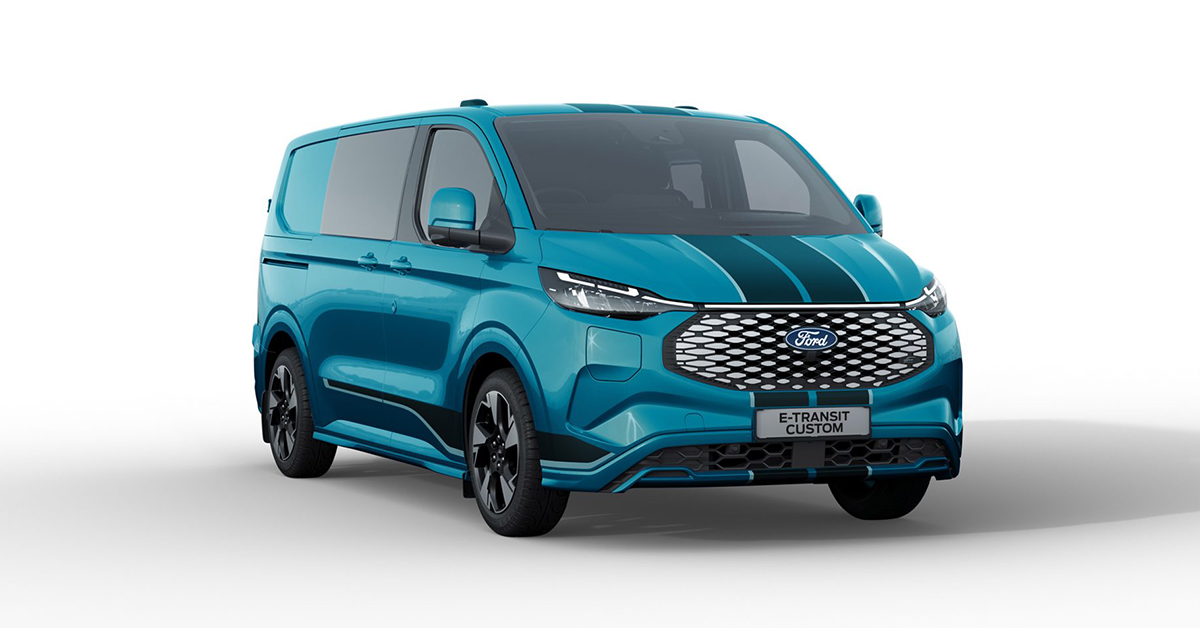
Official press image of the Ford E-Transit. | © Ford Motor Company
The Ford E-Transit from its 2020 reveal and 2022 U.S. launch to the 89 kWh van, covering range, charging, payload, prices, sales and the European vans, showing what Ford says and what is only reported.
E-Transit is Ford’s all-electric full-size van. Ford says it was introduced in the U.S. in 2022 as the company’s first all-electric full-size van, with production at the Kansas City Assembly Plant alongside the gas models (Ford). Ford’s 2027 page sells it as a Cargo Van, and Ford’s 2026 article adds a Chassis Cab and a Cutaway (Ford). Our Transit article covers the gas van and the family around it, and this article stays on the electric version.
| U.S. introduction | 2022, Kansas City (Ford) |
| Body styles | Cargo Van, Chassis Cab, Cutaway (Ford) |
| Battery, 2027 page | 89 kWh (Ford) |
| Motor | Single rear motor, 198 kW (Ford) |
| Peak output | 266 hp (Ford); 189 hp (Ford) |
| Peak torque | 317 lb-ft (Ford) |
| Top speed | Governed to 75 mph (Ford) |
| Range, 2027 Low Roof | 166 miles (Ford) |
| Peak charging power | 176 kW (Ford) |
| U.S. sales, 2024 | 12,610, record (Ford) |
The powertrain is simple. Ford’s 2027 page lists an 89 kWh battery, a single-speed transmission, a standard single onboard charger with an optional dual onboard charger, and a top speed governed to 75 mph (Ford). Ford’s 2025 spec sheet lists a single rear motor with a peak output of 198 kW, which it gives as 266 horsepower, and 317 lb-ft of peak torque (Ford). Ford’s 2026 article writes the same 198 kW as 189 horsepower, and the two horsepower figures conflict (Ford).
Range has grown from the first model. Ford’s 2022 media page gave a targeted 126 miles for the low-roof cargo van on a 68 kWh battery (Ford). Ford’s 2024 article gave an estimated 159 miles for the low-roof van on an 89 kWh battery (Ford). Ford’s 2027 page lists 166 miles for the Low Roof, 155 for the Medium Roof, 149 for the High Roof long length and 148 for the High Roof extended length, and the page does not explain the move from 159 to 166 miles (Ford).
Ford’s 2027 page gives a maximum available payload of 3,322 pounds and an optional 2.4 kW Pro Power Onboard outlet (Ford). It gives peak charging power of 176 kW and lists cargo volume of up to 487.2 cubic feet behind the first row in the extended High Roof van (Ford). Those are the headline numbers, and the sections below show where Ford’s own pages give different values for the same item in different years.
The sales picture changed sharply. Ford’s fact sheet says E-Transit was America’s best-selling electric van in 2024 with record annual sales of 12,610, and that sales rose 30% to 3,756 in the first quarter of 2025 (Ford). Reports of Ford’s 2025 sales table give 5,186 E-Transits for the full year, down 58.9%, with only 582 in the fourth quarter (reported). Ford’s own pages we read do not give the full-year 2025 total in text.
We kept the scope tight. We found no Ford figure for E-Transit efficiency in kWh per mile, no Ford figure for winter range loss, and no Ford statement of the total number of E-Transits built. Where Ford’s pages disagree across model years, we show both values with their years. We give no claim about reliability, resale values or total cost of ownership beyond Ford’s own statements, which we quote and label. Readers should treat every figure here as tied to the model year named beside it, because Ford changed several numbers between years.
Ford’s 2024 Transit Day article says Ford revealed the E-Transit in 2020 (Ford). Reports date the reveal to November 12, 2020 and say Ford targeted a start price below $45,000, an estimated range of 126 miles for the low-roof cargo van, and availability in late 2021 (reported). The same reports say Ford announced a $100 million investment and about 150 new jobs at the Kansas City Assembly Plant for the van (reported). Our Ford history article covers the company around these events.
| Reveal | 2020 (Ford) |
| Reveal date | November 12, 2020 (reported) |
| Targeted start price at reveal | Below $45,000 (reported) |
| Launch battery | 68 kWh usable (Ford) |
| Launch range target | 126 miles, low-roof cargo van (Ford) |
| Launch Cutaway MSRP | $43,295 (Ford) |
| EV component warranty | 8 years or 100,000 miles (Ford) |
| First shipments | February 2022 (reported) |
| Early orders | More than 10,000 from 300+ customers (reported) |
| Maintenance claim | 40% lower than 2020 gas Transit (Ford) |
Ford’s 2022 media page describes the launch version. It gives a usable battery capacity of 68 kWh and an available targeted range of 126 miles in the low-roof cargo van configuration, and it says the average daily range for U.S. commercial vans is 74 miles (Ford). It says the E-Transit Cutaway had a starting MSRP of $43,295, backed by an eight-year or 100,000-mile electric vehicle component warranty (Ford). An early report gave the battery as 67 kWh, so the figure differs by source (reported).
Ford’s page also describes how the van is made and supported. It says the E-Transit is assembled at Kansas City alongside Transit, that about 300 qualified upfitters work nationwide with 13 within 30 miles of the plant, and that Ford’s network includes more than 650 Commercial Vehicle Centers and over 2,300 EV-certified dealers (Ford). Ford says the interior cargo dimensions and most mounting points match the Transit, and that it offers eight configurations (Ford).
Delivery dates need care. Ford’s 2021 heritage article said production would begin in late 2021, and Ford says the van reached the U.S. market in 2022 (Ford). Reports say Ford began shipping 2022 E-Transit vans from Kansas City in February 2022, with more than 10,000 orders from more than 300 customers, and give Walmart and the City of Orlando as early customers (reported). So the late-2021 plan and the early-2022 shipping date differ, and we show both. We found no Ford page that explains the gap, so we do not guess at it.
Ford’s 2022 page makes cost claims. It says estimated scheduled maintenance cost is 40% lower than a 2020 gas-powered Transit over eight years or 100,000 miles, based on recommended service schedules and Ford’s standard method using 2019 and 2020 data (Ford). It describes Ford Pro Charging as a single source for home, public and depot charging, with access to the BlueOval Charge Network (Ford). Those are Ford’s own claims, and we did not check them against an independent source.
Telematics terms changed over time. Ford’s 2022 page says Ford Pro E-Telematics included a complimentary three-year trial that starts at the warranty start date, with an annual service required afterward (Ford). Ford’s 2027 page says the Connectivity Package and Telematics Essentials come with one year complimentary (Ford). We found no Ford statement of the trial length for other model years, and we give no claim about it. Fleet buyers should confirm the current trial terms with a Ford Pro dealer before ordering.
The battery grew by about a third. Ford’s 2024 article says the 2024 extended-range E-Transit has 89 kWh of usable energy, compared with 68 kWh on the original van, and an estimated 159 miles of range for the low-roof cargo van based on EPA multi-cycle test methodology (Ford). Ford says the medium-roof and high-roof figures are projected, not tested (Ford). By our arithmetic, 89 kWh is about 31% more than 68 kWh, and 159 miles is about 26% more than 126 miles (our calculation).
| 2022 battery and range target | 68 kWh, 126 miles low roof (Ford) |
| 2024 battery and range | 89 kWh, 159 miles low roof (Ford) |
| 2024 range gain, low roof | 26% (Ford) |
| 2024 range gain, high roof | 32% (Ford) |
| 2025 article battery | 89.9 kWh (Ford) |
| 2025 spec sheet battery | 89 kWh usable (Ford) |
| 2027 range, Medium Roof | 155 miles (Ford) |
| 2027 range, High Roof long | 149 miles (Ford) |
| 2027 range, High Roof extended | 148 miles (Ford) |
| Onboard charger input | 19.2 kW (Ford) |
Ford’s range-gain wording varies. The 2024 article says range rose 26% on low-roof models and 32% on high-roof models, and Ford’s September 2024 shipping article headlines up to 32% more range (Ford). The 26% figure matches our arithmetic for the low roof. The 32% figure is for the high roof, and a reader who sees only the headline could assume it applies to every van, which Ford’s own text does not say (Ford).
Battery capacity is written two ways. Ford’s 2025 what’s-new article says an 89.9 kWh battery is standard on the 148-inch wheelbase Cargo Van and on the 178-inch Chassis Cab and Cutaway (Ford). Ford’s 2025 spec sheet and its 2026 and 2027 pages say 89 kWh (Ford). A report lists 89.9 kWh for the 2027 van (reported). The two figures likely describe the same pack, but we found no Ford statement saying so, so we show both. Buyers who need the exact pack size for a bid or a lease should ask Ford Pro in writing.
Ford’s 2025 spec sheet gives performance and layout details. It lists a floor-mounted battery, rear-wheel drive and a rear motor, with a peak output of 198 kW or 266 horsepower and 317 lb-ft of torque on the enhanced-range battery (Ford). It lists a single li-ion pack with a 19.2 kW onboard charger input (Ford). Ford’s 2022 page says the rear suspension is a heavy-duty semi-trailing arm design and that smart acceleration truncation limits acceleration based on calculated payload (Ford).
Range figures for 2024 and 2025 conflict in reports. Ford’s 2024 article gives 159 miles for the 2024 low-roof van (Ford). A listing says the 2025 low-roof van has a 159-mile rating compared with 143 miles for 2024, which does not match Ford’s own 2024 figure (reported). A review gives 159 miles as the EPA-estimated range for the 2027 van, while Ford’s 2027 page gives 166 miles for the Low Roof (reported). We show Ford’s figure for each year.
Earlier configuration ranges were lower. Reports of the 2022 price release give 126 miles for the low roof long wheelbase, 116 miles for the medium roof and 108 miles for the high roof (reported). Ford’s 2022 page gave range only for the low-roof cargo van (Ford). We found no Ford statement of a range figure for the Chassis Cab or Cutaway, and we give no claim about range with an upfit, because Ford says range varies with conditions, vehicle use, upfits and battery age (Ford). Ford’s figures are estimates from a test method, so real routes with heavy loads, cold weather or high speed may differ from them.
Ford’s 2027 page gives the current charging numbers. Peak charging power is 176 kW, and a 10 to 80 per cent DC fast charge takes 28 minutes on a 180 kW or greater charger and 80 minutes on a 50 kW charger (Ford). Ten minutes on a 180 kW or greater DC charger adds 50 miles and 15 minutes adds 71 miles on the Low Roof (Ford). Ford’s 2025 spec sheet gives 47 miles in 10 minutes and writes the peak power as 176 kWh, which is a unit typo for 176 kW (Ford).
| Peak charging power | 176 kW (Ford) |
| 10-80% on 180+ kW DC | 28 minutes (Ford) |
| 10-80% on 50 kW DC | 80 minutes (Ford) |
| Range added, 10 min DC | 50 miles per 2027 page; 47 per 2025 sheet (Ford) |
| Range added, 15 min DC | 71 miles per 2027 page; 67 per 2024 article (Ford) |
| 0-100% on 80A, single charger | 9 h 33 min (Ford) |
| 0-100% on 80A, dual charger | 6 h 11 min (Ford) |
| 0-100% on 32A | 14 h 20 min (Ford) |
| Pro Power Onboard | 2.4 kW, optional (Ford) |
| NACS adapter, 2027 | Bundled or separate, sources differ (Ford) |
Level 2 charging depends on the charger and the onboard charger. Ford’s 2027 page gives zero to 100 per cent in 9 hours 33 minutes on an 80-amp Ford Charge Station Pro with a single onboard charger and 6 hours 11 minutes with the dual onboard charger (Ford). On a 32-amp station it gives 14 hours 20 minutes for either (Ford). Range added per hour on the Low Roof is 17 miles with 80 amps and a single charger, 26 miles with the dual charger, and 11 miles at 32 amps (Ford).
Ford’s 2024 article gives older and different numbers. It says the dual onboard chargers support a peak charging power of 176 kW and that zero to 100 per cent takes 6 hours 11 minutes on the Series 2 80-amp charger, which Ford says is 22 per cent faster than the prior battery (Ford). It says a 15-minute fast charge adds an estimated 67 miles on a low-roof cargo van, a 49 per cent increase over the prior battery, while the 2027 page gives 71 miles for the same 15 minutes (Ford). The 49 per cent figure is about charging speed, not total range (Ford).
Pro Power Onboard turns the van into a power source. Ford’s 2022 page says it provides up to 2.4 kW and can power tools and equipment on job sites, and Ford’s 2024 article says it works while the vehicle is moving and while charging (Ford). Ford’s 2027 page lists it as optional at 2.4 kW (Ford). Ford’s 2026 article says the option is a 2.4 kW Pro Power Onboard for exportable power (Ford). We found no Ford statement of how long it can run on a full battery.
The 2027 charging hardware is a conflict in the sources. Ford’s 2027 page lists a Mobile Power Cord and Fast Charging Adapter (NACS) bundle for 120-volt and 240-volt use among its charging items, and Ford Canada’s page lists the mobile charge cord and the NACS fast-charging adapter separately (Ford). Reports say the 2027 NACS adapter is now a standalone option and no longer bundled with the cord (reported). We could not tell from Ford’s text whether the bundle is standard or optional, so we give both.
Ford’s page also lists a front-facing charging port (Ford). Ford says that scheduled preconditioning warms or cools the cabin while plugged in to preserve range (Ford). Ford’s 2024 article says the enhanced-range model could qualify for the Commercial Clean Vehicle Tax Credit of up to $7,500 per vehicle, depending on the buyer’s tax situation (Ford). That statement was for the 2024 model year, and we give no claim about whether any federal credit applies to a 2027 van.
Payload figures change by year and body style. Ford’s 2022 media page gave a maximum payload of 3,880 pounds for cargo vans and 4,428 pounds for cutaways (Ford). We found no Ford-owned 2025 payload table in the text we read, so we give no 2025 payload figure for any body style. Ford’s 2026 article gave 3,320 pounds and 4,201 pounds depending on configuration, and Ford’s 2027 page gives 3,322 pounds (Ford).
| Cargo payload, 2022 | 3,880 lb (Ford) |
| Cutaway payload, 2022 | 4,428 lb (Ford) |
| Cutaway payload, 2025 | Not found in Ford text |
| Chassis Cab payload, 2025 | Not found in Ford text |
| Cargo payload, 2026 | 3,320 lb and 4,201 lb (Ford) |
| Cargo payload, 2027 | 3,322 lb (Ford) |
| Cargo behind first row, Low Roof | 277.7 cu ft (Ford) |
| Cargo behind first row, High Roof extended | 487.2 cu ft (Ford) |
| Maximum cargo, High Roof extended | 536.4 cu ft (Ford) |
| Seats | 2 (Ford) |
The cargo van payload therefore fell from 3,880 pounds in 2022 to about 3,320 pounds in 2026 and 2027 on Ford’s own pages, while the larger battery was added in between (Ford). We found no Ford statement linking the two changes, so we do not say the battery caused the drop. A review that drove the 2027 van says it can haul up to 3,320 pounds, which matches Ford’s 2026 article (reported). Ford says payload depends on configuration and points buyers to the door-jamb label (Ford).
Cargo volume is listed by roof height. Ford’s 2027 page gives cargo room behind the first row of up to 277.7 cubic feet for the Low Roof, 357.1 for the Medium Roof, 404.3 for the High Roof long and 487.2 for the High Roof extended (Ford). It gives maximum cargo volumes of 311.9, 400.5, 453.4 and 536.4 cubic feet for the same four (Ford). Ford’s fact sheet and 2022 page say up to 487 cubic feet, so the 536.4 figure is a different measure, and we show both (Ford).
Dimensions come from the same page. Overall height is 83 inches on the Low Roof, 100.2 inches on the Medium Roof and 109.4 inches on the High Roof, and the High Roof overall length is 235.5 inches for the long body and 263.9 inches for the extended body (Ford). The van seats two, and the rear doors open 180 degrees as standard on Low and Medium Roof vans and 253 degrees as standard on the High Roof (Ford). Ford’s page says the marketing copy names three lengths while the FAQ lists only two, which is an inconsistency on Ford’s own page (Ford).
Configurations differ by source. Ford’s 2022 page said eight configurations, made of three roof heights, three body lengths, a cutaway and a chassis cab (Ford). Ford’s 2024 article says two lengths, three roof heights, three body styles and up to 487 cubic feet of cargo volume (Ford). Ford’s 2026 article says the Chassis Cab and Cutaway gained a 156-inch wheelbase option (Ford). A listing says the 2027 roof names were simplified to Low Roof, Medium Roof and High Roof (reported).
Standard equipment on the 2027 Cargo Van includes Ford Co-Pilot360 with Pre-Collision Assist, a Lane-Keeping System and a rear view camera, SYNC 4 with a 12-inch center display, a 5G modem, an 8-inch cluster, push-button start and 16-inch steel wheels with 235/65R16C tires (Ford). Options include Vehicle Integration System 2.0, Parcel Delivery Package, adaptive cruise control, a 360-degree camera and shelving or wall liner kits (Ford). We found no Ford towing figure for the E-Transit on the pages we read, so we give none.
Ford’s price history for the E-Transit comes from several of its own pages. The 2022 media page gave the Cutaway a starting MSRP of $43,295, excluding destination (Ford). Ford’s 2024 article gave the 2024 enhanced-range model an MSRP beginning at $51,095, excluding destination, fees, taxes and options (Ford). Ford’s fact sheet gave the 2026 E-Transit Cargo Van at $53,260, the Chassis Cab at $48,050 and the Cutaway at $48,150, before a $2,095 destination and delivery charge (Ford).
| Cutaway, 2022 launch | $43,295 (Ford) |
| Enhanced-range model, 2024 | $51,095 (Ford) |
| Cargo Van, 2025 | $51,000 (reported) |
| Cutaway, 2025 | $45,700 (reported) |
| Cargo Van, 2026 | $53,260 (Ford) |
| Chassis Cab, 2026 | $48,050 (Ford) |
| Cutaway, 2026 | $48,150 (Ford) |
| Destination and delivery, 2026 | $2,095 (Ford) |
| 350 Cargo Van, 2026 | $55,655 (reported) |
| 350 Cargo Van, 2027 | $56,655 (reported) |
Reports add other years. They say the 2022 price release listed the low roof long wheelbase at $48,395, the medium roof regular wheelbase at $48,280, the medium roof long wheelbase at $49,490 and the high roof long wheelbase at $51,530 (reported). They say the 2025 Cutaway began at $45,700 and the 2025 Cargo Van at $51,000 (reported). By our arithmetic, Ford’s 2026 Cargo Van price is $2,260 above that $51,000 figure, and the report gives the same $2,260 increase (our calculation).
Reports for 2026 and 2027 include destination or differ in other ways. One report gives the 2026 van at $55,355 and the Chassis Cab at $50,145, which are Ford’s $53,260 and $48,050 plus the $2,095 destination charge by our arithmetic (reported). A used-car guide gives the 2026 E-Transit 350 Cargo Van at $55,655 and the Extended Length High Roof at $59,070, and the 2027 van at $56,655 and $60,070 (reported). The $55,655 figure is $300 above Ford’s price plus destination, and we cannot explain the gap.
Ford’s own 2027 page shows an “as shown” price field with no figure in the text we could read, and its lease section shows no amounts (Ford). We therefore have no Ford-owned 2027 price, and every 2027 number here is reported. The 2027 model keeps the 89 kWh battery, the 266 horsepower motor and rear-wheel drive, according to a listing, and the main reported change is the NACS adapter becoming a separate option (reported).
The price story is not one-directional on Ford’s own pages. The Cutaway went from $43,295 at launch to $48,150 for 2026, and the Cargo Van went from reported 2022 prices near $48,000 to $53,260 (Ford). The enhanced battery arrived in between, and Ford’s 2024 price of $51,095 sits between the launch and 2026 figures (Ford). We found no Ford statement explaining the price changes, so we describe them and give no reason.
We give no claim about discounts, lease terms, state incentives or the federal credit that Ford mentioned in 2024. We found no Ford price for Canada on the pages we read, so we give none. We also found no Ford statement of the price difference between the 2027 E-Transit and the gas Transit for the same body style, and we do not compute one, because the 2027 Ford prices are not in the text we read. Buyers should price their own configuration on Ford’s build page, because options such as the dual onboard charger, shelving and the Parcel Delivery Package change the final figure.
Ford’s fact sheet says E-Transit was America’s best-selling electric van in 2024, with record annual sales of 12,610 units (Ford). It says sales rose 30% to 3,756 in the first quarter of 2025 (Ford). Ford’s 2024 article had also called it America’s best-selling electric van on 2023 industry-reported sales (Ford). Those are all Ford’s own statements, and the segment definition matters for the ranking.
| U.S. sales, 2024 | 12,610, record (Ford) |
| Q1 2025 sales | 3,756, up 30% (Ford) |
| U.S. sales, 2025 | 5,186, down 58.9% (reported) |
| Q4 2025 sales | 582, down 82.6% (reported) |
| Q4 2024 sales | 3,354 (reported) |
| Ranking claim | Best-selling electric van, 2024 (Ford) |
| Government claim | Best-selling electric CV for governments, 2023 (Ford) |
| Gas saved since 2022 | More than 3 million gallons (Ford) |
| CO2 saved since 2022 | Over 25 million kg (Ford) |
| Average commercial van daily range | 74 miles (Ford) |
Reports of Ford’s January 2026 sales table show a sharp fall. They give E-Transit sales of 5,186 for 2025 against 12,610 for 2024, down 58.9%, and 582 for the fourth quarter against 3,354, down 82.6% (reported). By our arithmetic, 5,186 less the first-quarter 3,756 leaves 1,430 units across the other three quarters (our calculation). Ford’s January 2026 release highlights Transit at 161,797 and does not highlight the E-Transit result in the text we read (Ford).
Context from Ford’s other electric vehicles is available. A report of the same table gives Mustang Mach-E sales of 51,620 in 2025, down 0.2%, and F-150 Lightning sales of 27,307, down 18.5% (reported). Another report says Ford ended production of the F-150 Lightning and scaled back its electric plans, and says Ford offered three electric models in the U.S. (reported). Our F-150 Lightning article covers that truck, and we give no claim about Ford’s plans for the E-Transit.
Ford’s fact sheet gives wider claims. It says Ford is number one in electric vehicle registrations to state, local and federal governments, and that E-Transit is the best-selling electric commercial van for those governments, using calendar-year 2023 registration data (Ford). It says E-Transit drivers have saved more than 3 million gallons of gas and over 25 million kilograms of CO2 versus gas Transit vans since 2022, using enrolled E-Telematics vehicle data from July 2022 to February 2024 (Ford). Both are Ford’s own figures.
Ford’s 2024 article gives the use-case argument. It says Ford analyzed 2.5 million trips, or 30 million miles, of telematics data and found an average commercial van daily range of 74 miles (Ford). It says the added range supports longer routes and uses such as refrigerated delivery (Ford). It says E-Transit serves more industries and vocations than any other electric van, based on registration data (Ford). We found no Ford statement of which industries bought the most E-Transits.
We keep the limits plain. We found no Ford-owned page with the 2025 full-year E-Transit total in text, so the 5,186 figure is reported, and a reader should check Ford’s sales table. We found no 2026 year-to-date E-Transit sales figure from Ford. We give no claim about why sales fell, because Ford’s pages we read do not say, and we give no claim about the effect of any incentive, price change or production change on the totals. A reader who needs a market-share figure for electric vans should use the registration data Ford cites rather than our table. We also give no claim about how the segment ranking was calculated beyond Ford’s own footnotes.
Ford sells the E-Transit in Europe too. Ford’s facts article says European E-Transit production began in 2023 (Ford). Reports from the 2021 registration announcement say Ford planned to launch it in Europe in spring 2022, so the start date differs between Ford’s later statement and the earlier plan (reported). Ford’s 2025 article calls the E-Transit Europe’s best-selling two-tonne electric van (Ford).
| Europe production start | 2023 (Ford) |
| Europe standard battery | 68 kWh (Ford) |
| Europe enhanced battery | 89 kWh, up to 402 km WLTP (Ford) |
| Europe upgraded battery | 96 kWh, up to 431 km (Ford) |
| 89 kWh charge, 0 to 80% | 28 minutes (Ford) |
| Highest-powered European E-Transit | 269 PS (Ford) |
| European payload, some versions | Over 1,600 kg (Ford) |
| E-Transit Custom range | Up to 337 km, 64 kWh (Ford) |
| E-Transit Courier range | Up to 300 km, 43 kWh (Ford) |
| E-Transit Courier motor | 100 kW (Ford) |
The European battery options are listed by Ford. Ford’s March 2025 release says the standard range version has a 68 kWh battery and the enhanced range version has an 89 kWh battery for up to 402 km of electric driving on the WLTP cycle (Ford). Ford’s later what’s-new article says an upgraded 96 kWh usable battery adds up to 29 km and delivers up to 431 km, an increase of up to 117 km over the longest-range E-Transit with the standard 68 kWh battery (Ford).
Charging in Europe is also given. Ford’s Swiss release says the 89 kWh battery charges from 0 to 80 per cent in 28 minutes, which is nine minutes faster than the 68 kWh variant (Ford). It says the 89 kWh version has about 27 per cent more range than the standard model (Ford). The U.S. 2027 page gives a 28-minute 10 to 80 per cent charge on a 180 kW or greater charger, so the two figures are similar but use different start points (Ford).
The same release family includes two smaller electric vans. Ford’s March 2025 release says the E-Transit Custom delivers up to 337 km of pure-electric range from a 64 kWh battery with a 100 kW or 160 kW motor, and that the E-Transit Courier delivers up to 300 km from a 43 kWh battery and a 100 kW motor (Ford). Our Transit Custom article covers the one-tonne electric van in detail, including its later 71 kWh battery and all-wheel-drive option.
Ford’s March 2025 release says Ford Pro now offers electrified variants of every van in the Transit family as E-Transit Courier production begins (Ford). Ford’s European facts article says some E-Transit versions carry over 1,600 kg and that the highest-powered version makes 269 PS (Ford). The U.S. van’s 266 horsepower is a different unit from 269 PS, and we do not compare them.
Readers comparing the E-Transit with Ford’s other models can use our Ford models page. This article keeps the U.S. van and the European vans in separate sections, because battery sizes, ranges and test cycles differ between the EPA method and the WLTP method. We found no Ford figure for European E-Transit prices on the pages we read, so we give none, and we give no claim about how many European E-Transits Ford has sold in total. Ford’s European pages also give range as a WLTP figure, which is a different method from the EPA estimate used in the U.S. We therefore never add or compare the two ranges directly, and we give no claim about how a European van would score on the EPA test.