 Brands
Volkswagen ID. Buzz — History, Range, GTX and Specs

Official press image of the Volkswagen ID. Buzz electric van. | © Volkswagen AG
The Volkswagen ID. Buzz is the electric Bulli: a van that Volkswagen first showed as the I.D. BUZZ concept in 2017 and has built in Hannover since 2022. Here is the full ID. Buzz story, from the Detroit concept and the March 2022 premiere to the 77, 79 and 86 kWh batteries, the long-wheelbase seven-seater, the GTX, the US launch and the 2026 Pro 4MOTION update.

Official press image of the Volkswagen ID. Buzz electric van. | © Volkswagen AG
The Volkswagen ID. Buzz is the all-electric van that brings the Bulli, as Volkswagen calls its classic Type 2 bus, into the electric age. It was shown as the I.D. BUZZ concept at the Detroit show in January 2017, previewed in near-production form in March 2022 and built in Hannover, Germany, by Volkswagen Commercial Vehicles. It comes as a five-seat or seven-seat passenger van, as the ID. Buzz Cargo, and since 2024 as a sporty GTX. This guide follows the story from the concept to the 2026 update.
| Concept premiere | January 2017, Detroit (Volkswagen) |
| Production announced | 18 August 2017, Pebble Beach (Volkswagen) |
| Production premiere | 9 March 2022, Hamburg (Volkswagen) |
| Series production start | 2 June 2022, Hannover (reported) |
| Maker | Volkswagen Commercial Vehicles (Volkswagen) |
| Platform | MEB (Volkswagen) |
| Body styles | ID. Buzz and ID. Buzz Cargo (Volkswagen) |
| Long wheelbase shown | 2 June 2023 (Volkswagen) |
| GTX premiere | 21 March 2024, Hannover (Volkswagen) |
| Plant | Hannover, Germany (Volkswagen) |
Volkswagen presents the van as the heir to a long tradition. Its March 2022 release says that in the 1950s the Volkswagen Bulli stood for a new feeling of automotive freedom, and it describes the ID. Buzz as transferring seven decades of Bulli know-how into the era of software and digitalisation. Earlier revivals had stayed on the show stand. A motoring magazine recalled a 2001 Microbus concept and a later Bulli concept that preceded the I.D. BUZZ of 2017 (reported). The 2017 car was the one that led to a production model.
The dates are easy to follow. The I.D. BUZZ had its world premiere at the North American International Auto Show in Detroit in January 2017, according to Volkswagen’s newsroom. On 18 August 2017, at a press conference at the Concours d’Elegance in Pebble Beach, California, Volkswagen announced that the ID. BUZZ would go into series production, based on the concept car. The production version had its world premiere on 9 March 2022 in Hamburg, five years after the concept, and the first customer cars were due that autumn.
The ID. Buzz was also the first ID. model to be built by Volkswagen Commercial Vehicles, which makes the Transporter and Multivan. That matters for how the car is sold. The newsroom describes it as Europe’s first all-electric MPV and van range, with a passenger version and a Cargo version. The passenger car was launched in Europe with a five-seat layout. A longer seven-seat version and the GTX followed, and a 2026 update added all-wheel drive to the Pro model.
The ID. Buzz also had a long road to North America. Volkswagen’s 2022 release already said that a long-wheelbase version would debut in the American market in 2023, with sales from 2024. The long-wheelbase van was shown in June 2023, and deliveries in the United States began with the 2025 model year. Our ID.4 guide covers the SUV from the same family, while the ID. Buzz is built in Hannover, Germany, as the later sections explain.
A note on sources. Dates, dimensions and ranges come from Volkswagen press releases and newsroom pages wherever possible. Where only a trade outlet gives a figure, it is labelled “reported”. The ID. Buzz has been sold in several markets with different batteries, wheelbases and test cycles, so ranges and prices differ by country and by year. Treat every figure as a snapshot with a date, and check the current local configurator before you buy.
The framing has stayed consistent. Volkswagen’s Detroit release in 2017 called the I.D. BUZZ a Microbus of a new era, and its 2022 release calls the production ID. Buzz the new face of an intelligent, future-oriented and sustainable form of mobility. In other words, the company has used the same idea for the concept and for the car: the Bulli as a symbol, rebuilt around electric drive and software.

Official press image of the Volkswagen I.D. BUZZ concept car. | © Volkswagen AG
The I.D. BUZZ concept was a bold idea. Volkswagen’s Detroit press kit calls it the first fully autonomously driving van with an electric drive, and it quotes a range of up to 600 kilometres (270 miles) in the concept. Two electric motors, one on each axle, gave all-wheel drive. Volkswagen’s release described it as a Microbus of a new era that links the legendary origins of the brand with its electric future, and it was the second car in the I.D. family after the compact I.D. shown at Paris in 2016.
| Concept premiere | January 2017, Detroit (Volkswagen) |
| Concept range | Up to 600 km (Volkswagen) |
| Concept battery | 83 to 111 kWh (reported) |
| Concept output | 369 hp, two motors (reported) |
| Concept 0 to 100 km/h | 5.3 s, all-wheel drive (reported) |
| Concept charging | 150 kW, 80 per cent in about 30 min (reported) |
| Concept seats | Up to eight (Volkswagen) |
| Autonomous mode | I.D. Pilot (Volkswagen) |
| Series production announced | 18 August 2017 (Volkswagen) |
| Platform | MEB (Volkswagen) |
The numbers were large. The concept had a 111 kilowatt-hour battery in the floor and a combined output of 369 horsepower, according to trade reports of the Detroit launch (reported). A table published with the Detroit material lists battery capacities of 83 to 111 kilowatt-hours, a 0 to 100 km/h time of 5.3 seconds for the all-wheel-drive version and a limited top speed of 160 km/h. Charging power was 150 kilowatts, with about 30 minutes needed to reach 80 per cent. Volkswagen said the concept had up to eight seats.
Self-driving was central to the 2017 story. The press kit describes an “I.D. Pilot” mode in which the van drives itself. That promise did not reach the production car. The ID. Buzz that Volkswagen sells today has driver-assistance systems and, in 2026, Connected Travel Assist, but it is driven by a person. A separate autonomous version, the ID. Buzz AD, is being developed with partners and is covered in the last section of this guide.
The step to production was taken fast. At Pebble Beach in August 2017, Volkswagen announced the ID. BUZZ would be built in series. Herbert Diess, then chairman of the Volkswagen brand, led that press conference, according to newsroom images. The production version arrived in 2022, five years after the concept.
MEB, the Modular Electric Drive Kit, is the technical base. Volkswagen’s 2022 release describes it as the first scalable mass-production platform for all-electric cars, giving the group a basis for many models and segments. The ID.3 was the first MEB car and the ID.4 the second, and Volkswagen Group Components describes the ID. Buzz as one of the newest and largest vehicles on the platform. It also made the axles for the first time on this model, in a hall set up at Hannover-Barsinghausen.
What changed between concept and production? The squarer, more practical shape is the main difference, and a trade report said Volkswagen officials explained it as a way to maximise interior space (reported). The concept’s big battery gave way to a 77 kilowatt-hour net battery in the first European cars. The autonomous mode was dropped, and the eight-seat idea became a five-seat layout, with six and seven seats planned later. These are the usual trade-offs between a show car and a car that has to be built and sold.
The concept also had a smaller sibling. The Detroit release points out that Volkswagen had shown the compact I.D. at the Paris show only months before. It says that car would launch in 2020 with ranges of up to 600 kilometres, and that it would be the first car based on the MEB to go into production. The I.D. BUZZ therefore showed how far the same platform could be stretched, from a compact hatchback to a van.
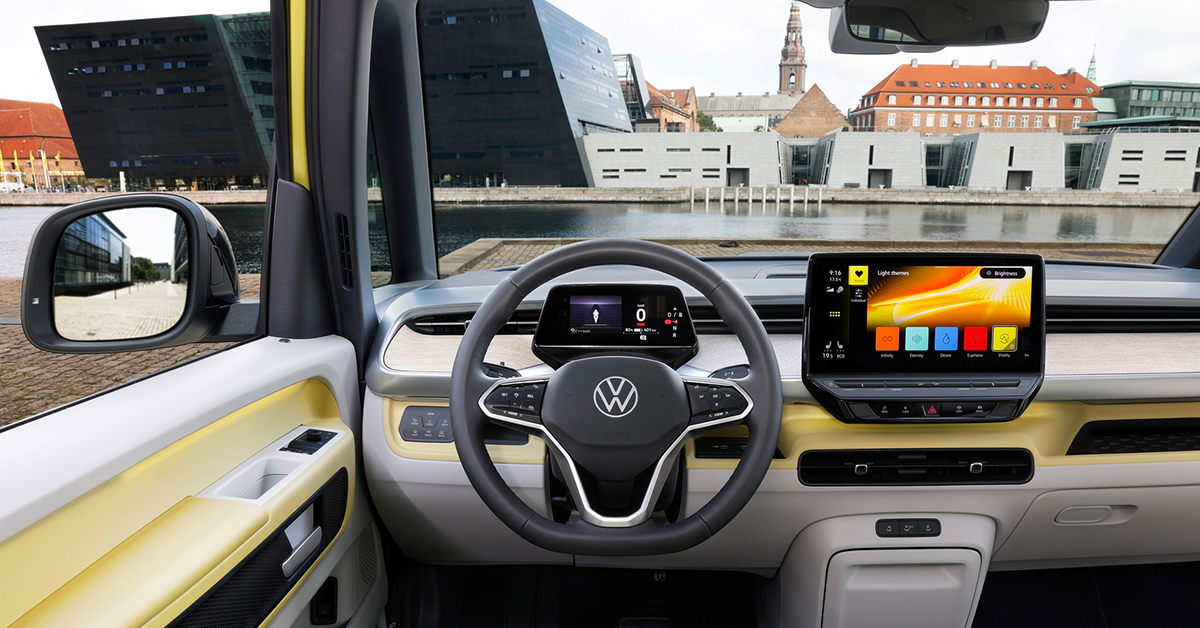
Official press image of the Volkswagen ID. Buzz electric van. | © Volkswagen AG
The ID. Buzz is built around a long wheelbase and short overhangs. The Volkswagen newsroom gives the standard-wheelbase car a length of 4,712 millimetres and a wheelbase of 2,988 millimetres, which it says is about the same as the T6.1 Transporter. Including the roof aerial, the car is 1,937 or 1,938 millimetres high depending on specification and 1,985 millimetres wide without mirrors. Volkswagen says that makes it 192 millimetres shorter and 81 millimetres wider than a T6.1 with the same wheelbase.
| Length | 4,712 mm (Volkswagen) |
| Wheelbase | 2,988 mm (Volkswagen) |
| Width | 1,985 mm without mirrors (Volkswagen) |
| Height | 1,937 or 1,938 mm (Volkswagen) |
| Drag coefficient | 0.285 ID. Buzz, 0.29 Cargo (Volkswagen) |
| Luggage, passenger | 1,121 l, up to 2,205 l (Volkswagen) |
| Cargo space | 3.9 m³, two euro pallets (Volkswagen) |
| Seats at launch | Five (Volkswagen) |
| Launch motor | 150 kW, rear axle (Volkswagen) |
| Upholstery | No real leather (Volkswagen) |
Drag is low for a van. The newsroom gives a drag coefficient of 0.285 for the ID. Buzz and 0.29 for the ID. Buzz Cargo. Volkswagen says the low figure reduces energy consumption and increases range. The long wheelbase, the compact body and the flat floor of the MEB platform also free up space inside, and the release says the layout makes the best use of the footprint of the vehicle. The design chief at the time, Jozef Kabaň, said the car brings a lot of endearing charm back onto the road.
Luggage space is generous. The passenger van takes up to 1,121 litres in the standard-wheelbase version, or up to 2,205 litres with the second row folded. The ID. Buzz Cargo offers 3.9 cubic metres behind a fixed partition, enough for two euro pallets loaded transversely. The Cargo has two or three seats up front. The passenger van launched as a five-seater, and Volkswagen said at the premiere that six- and seven-seat layouts would follow, which they did with the long-wheelbase version.
The interior follows the ID. family’s digital approach. Volkswagen’s release says the ID. Buzz comes with the latest ID. Software and sets new standards in its segment with systems for safety, comfort and charging. Its Plug & Charge function makes charging at public stations easier, according to the press kit. Volkswagen also stresses sustainability: the interior has no real leather, and the release says a high percentage of recycled materials is used. The 2026 update added physical buttons on the steering wheel, as the last sections note.
Performance in the first car was modest. Volkswagen’s first European versions had a 150 kilowatt (201 hp) motor on the rear axle, and a North American release quoted 229 lb-ft of torque, about 310 newton-metres (reported). A trade table gave the standard-wheelbase car a top speed of 145 km/h. The later 210 kilowatt long-wheelbase car reaches 100 km/h in 7.9 seconds, according to Volkswagen’s June 2023 release. Weights are not given in the sources used for this guide.
A short word on trims. The 2022 European line-up had Pure, Pro and equipment packs, and the 1st Edition at launch, according to the press kit and UK price reports. The UK launch prices were 57,115 pounds for the Life, 61,915 pounds for the Style and 62,995 pounds for the 1st Edition (reported). In Germany, a trade report quoted 64,581 euros with VAT for the launch car (reported). Prices have moved a lot since, so the table gives specifications and not a price list.
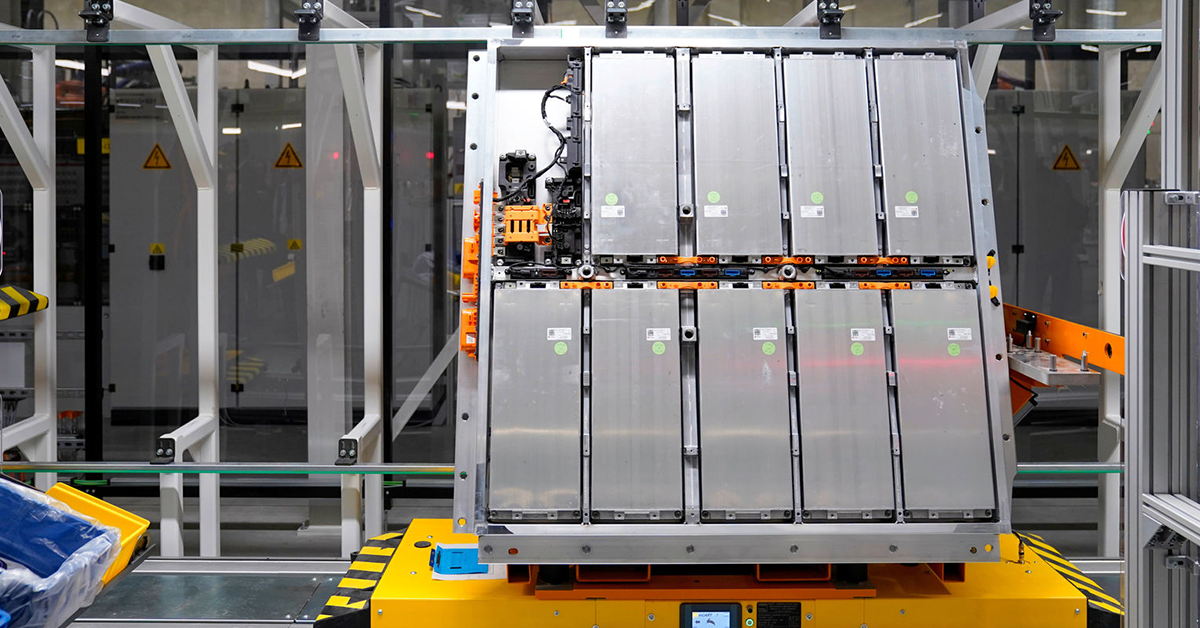
Official press image of the MEB battery system in production at the Volkswagen Group Components plant in Brunswick. | © Volkswagen AG
The first European ID. Buzz had a 77 kilowatt-hour net battery, with 82 kilowatt-hours gross, according to Volkswagen’s 2022 release. The 150 kilowatt motor drove the rear axle. AC charging was up to 11 kilowatts and DC charging up to 170 kilowatts through the CCS socket, with a charge from 5 to 80 per cent in about 30 minutes. The newsroom’s Copenhagen media-drive release of August 2022 quoted a WLTP range of 402 to 423 kilometres for the ID. Buzz Pro, with consumption of 21.7 to 20.5 kWh per 100 km.
| Launch battery | 77 kWh net, 82 kWh gross (Volkswagen) |
| Launch motor | 150 kW, rear axle (Volkswagen) |
| Launch DC charging | Up to 170 kW (Volkswagen) |
| Launch range | 402 to 423 km WLTP, Pro (Volkswagen) |
| Long wheelbase battery | 85 kWh net, 91 kWh gross (Volkswagen, reported) |
| Long wheelbase motor | 210 kW, APP550 (Volkswagen) |
| GTX output | 250 kW (340 PS), 4MOTION (Volkswagen) |
| GTX batteries | 79 kWh and 86 kWh net (Volkswagen) |
| GTX DC charging | 185 kW and 200 kW (Volkswagen) |
| GTX range | Up to 461 km and 487 km WLTP (reported) |
The long-wheelbase van brought a bigger battery and more power. In June 2023, Volkswagen announced a 210 kilowatt rear motor, the APP550 that is also used in the ID.7, and a larger battery. The release called it an 85 kilowatt-hour net battery, and a trade report gave the gross figure as 91 kilowatt-hours (reported). Later material for the ID. Buzz GTX gives 86 kilowatt-hours net, so the net figure is 85 or 86 depending on the source. A trade site also reported that the battery has 13 modules (reported).
The GTX uses two batteries. Volkswagen’s release of 21 March 2024, Media Information No. 35/2024, gives a new 79 kilowatt-hour net battery for the standard wheelbase and an 86 kilowatt-hour net battery for the long wheelbase. The 79 kilowatt-hour battery charges at up to 185 kilowatts DC, and the 86 kilowatt-hour battery at up to 200 kilowatts, according to the release. A trade table from August 2024 gives a WLTP range of up to 461 kilometres for the 79 kilowatt-hour car and up to 487 kilometres for the long-wheelbase 86 kilowatt-hour car (reported).
Power depends on the version. The GTX has two electric motors and a system output of 250 kilowatts (340 PS), which Volkswagen calls 100 kilowatts more than before and its most powerful series-production Bulli ever. It has 4MOTION electric all-wheel drive. Volkswagen’s 2023 announcement of the GTX gave 6.4 seconds from 0 to 100 km/h, according to a trade report (reported). The rear-wheel-drive long-wheelbase car, by contrast, takes 7.9 seconds. Towing is up to 1,800 kilograms for the standard-wheelbase GTX and 1,600 kilograms for the long wheelbase.
Entry-level versions followed. A trade report of August 2024 said Volkswagen Commercial Vehicles added two new base versions with a 59 kilowatt-hour battery, and listed a range of 330 kilometres WLTP with a footnote (reported). I did not find a Volkswagen release for those versions in the sources used here, so treat them as reported. The same report lists the 185 and 200 kilowatt charging figures for the larger batteries. These base versions are mainly of interest to fleet and van buyers in Europe.
What does all this mean in practice? For most buyers the choice is between the 79 and 86 kilowatt-hour batteries. The larger battery gives about 26 kilometres more WLTP range in the GTX figures above and a higher charging limit. Real-world range depends on speed, load, temperature and wheels, and a boxy van is more affected by motorway speed than a saloon. In the United States the same van is rated by the EPA at lower figures, as the last section explains. Always compare ranges on the same test cycle.

Official press image of the Volkswagen ID. Buzz electric van. | © Volkswagen AG
Volkswagen built the ID. Buzz at its Hannover plant, the home of Volkswagen Commercial Vehicles. The 2022 release says the models are produced at the main plant in Hannover, and that since 2022 the plant has been one of the group’s high-tech locations for all-electric vehicles. Volkswagen says the Hannover site also builds the plug-in hybrid Multivan, and that automation reaches up to 90 per cent in parts of production. Hannover joined Zwickau and Emden as the third German site for ID. vehicles.
| Plant | Hannover, Germany (Volkswagen) |
| Plant role | Third German ID. site, after Zwickau and Emden (Volkswagen) |
| Digital premiere | 9 March 2022, 7 pm CET (Volkswagen) |
| Advance orders | From May 2022 in some countries (Volkswagen) |
| Series production start | 2 June 2022 (reported) |
| 2022 target | Up to 15,000 vehicles (reported) |
| Full capacity | Up to 130,000 a year (reported) |
| Axle hall | Hannover-Barsinghausen, 200 people (Volkswagen) |
| Component share | About 40 per cent of value creation (Volkswagen) |
| Pre-sold | More than 10,000 (reported) |
The launch ran in steps. Volkswagen held a digital world premiere on 9 March 2022 at 7 pm CET, announced in Media Information No. 18/2022, and the release of the same day spoke of a world premiere in Hamburg. Before that, a pre-production fleet had been touring Europe, and newsroom images record a covered drive in Hamburg dated February 2022. Advance orders opened in some countries in May 2022, and the first vehicles were due in the autumn, according to Volkswagen’s release.
Production began in June. A trade report said Volkswagen Commercial Vehicles started series production of the ID. Buzz on 2 June 2022, after the ID. Buzz Cargo had already begun (reported). Josef Baumert and the works council chairman Stavros Christidis celebrated the start with employees, according to the same report. The plant planned up to 15,000 ID. Buzz and ID. Buzz Cargo vehicles in 2022, and up to 130,000 a year once production was fully ramped up. About 4,000 employees were trained for the new line.
Suppliers are part of the story. The 2022 press kit says Volkswagen Group Components makes the electric motor, the battery system and the axles in Kassel, Braunschweig, Salzgitter and Hannover. An axle assembly hall at Hannover-Barsinghausen employs 200 people. The battery system was at first made in Braunschweig, with Hannover planned as the long-term source, and Volkswagen says components contribute about 40 per cent of the ID. Buzz’s value creation. This was the first ID. model for which the group assembled the axles.
Early demand was good. A trade headline reported more than 10,000 units pre-sold in Europe (reported). The passenger version was sold in Germany from around 64,500 euros according to a June 2023 report (reported). A discount campaign in 2026 offered reductions of up to 6,000 euros to clear remaining model-year 2025 vehicles, according to a trade report (reported). That shows how prices have changed since the launch.
All ID. Buzz vans for the world are built in Hannover. Volkswagen’s 2023 release says the long-wheelbase version is made in Germany for Europe, Canada and the United States, and the North American model ships across the Atlantic. A separate pre-series production of the autonomous ID. Buzz AD has also started at Hannover, according to a trade report (reported). The plant is therefore tied closely to the van’s success.
Volkswagen also stresses where the van is made. The German version of the 2022 press kit has a section headed “Made in Germany” that talks about high quality and the safeguarding of jobs. At the production start, the works council chairman Stavros Christidis said the Bulli of the future was safeguarding jobs at the brand’s headquarters in Hannover (reported). That local angle is part of why the plant matters.

Official press image of the Volkswagen ID. Buzz electric van. | © Volkswagen AG
The long-wheelbase ID. Buzz was shown on 2 June 2023, according to the date on the newsroom’s image of the near-production car. Volkswagen described it as the latest addition to the family and said it is made in Germany for Europe as well as for Canada and the United States. It adds 250 millimetres of wheelbase, which makes room for a third row of seats and up to 2,469 litres of storage space, according to Volkswagen’s release.
| Long wheelbase shown | 2 June 2023 (Volkswagen) |
| Wheelbase gain | 250 mm (Volkswagen) |
| Third row | Yes, up to seven seats (Volkswagen) |
| Storage space | Up to 2,469 l (Volkswagen) |
| Motor | 210 kW, APP550 (Volkswagen) |
| 0 to 100 km/h | 7.9 s (Volkswagen) |
| Battery | About 85 kWh net, 91 kWh gross (Volkswagen, reported) |
| DC charging | Up to 200 kW (Volkswagen) |
| Gross weight | 3,125 kg, up from 3,000 kg (reported) |
| Built in | Hannover, for Europe, Canada and the US (Volkswagen) |
A bigger battery and a stronger motor came with it. The long-wheelbase van uses the 210 kilowatt APP550 rear motor from the ID.7 and a larger battery of about 85 kilowatt-hours net. DC charging is up to 200 kilowatts, and Volkswagen quoted a 0 to 100 km/h time of 7.9 seconds. A trade report said the long-wheelbase van also gets the ID.7’s infotainment system with a touchscreen of up to 15 inches (reported), and a panoramic sunroof with a switchable glass area of about 1.5 square metres (reported).
The seating is flexible. The long-wheelbase van can be had with seven seats, and a trade report said that two individual second-row seats with armrests can be chosen instead of a bench (reported). The extra length also lifts the permissible gross weight. A trade table of August 2024 says the long-wheelbase gross weight rose from 3,000 to 3,125 kilograms (reported). Volkswagen has not given a boot figure for the third row in the sources used here, so only the 2,469 litre total is quoted.
The long-wheelbase van was the model for North America. The 2022 premiere release had said a long-wheelbase version would debut in America in 2023, with sales from 2024. Volkswagen of America then announced details of the powertrains and batteries in May 2024, according to trade reports. Volkswagen said the battery in the United States would be the larger 91 kilowatt-hour (85 kilowatt-hour usable) pack as standard and optional in Europe, according to a trade report on the June 2023 premiere (reported).
Prices and rivals are less clear. Volkswagen did not give prices at the June 2023 premiere, and a trade report put the European short-wheelbase van at about 64,500 euros at that time (reported). I did not find a Volkswagen comparison with rival minivans, so this guide does not rank it against competitors. What can be said is that the long-wheelbase van changed the ID. Buzz from a five-seat lifestyle van to a proper family vehicle, which is why it is now the version most buyers consider.
A caution on names. Volkswagen calls the short version the normal wheelbase, or NWB, and the long version the LWB. In Europe you can buy both. In the United States only the long-wheelbase van is sold. Some sources mix the two when they quote range, charging power or weight, which explains many of the differences between figures. When you compare cars, always check which wheelbase and which battery the number belongs to, and which test cycle was used.
North America was the reason for the stretch. Volkswagen’s 2022 release said that Volkswagen of America would start the comeback of the so-called microbus in the United States and Canada, and the 2023 release repeated that the company was starting the comeback of the VW bus in North America with the long-wheelbase model. The longer van was therefore designed with American family buyers in mind from the start.
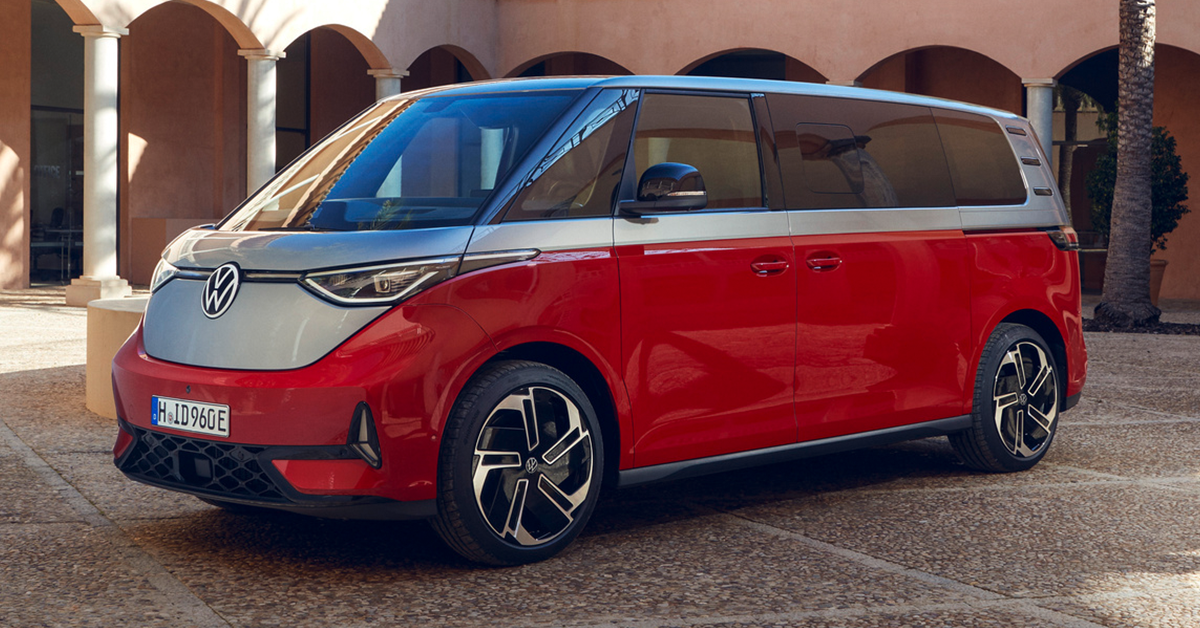
Official press image of the Volkswagen ID. Buzz GTX. | © Volkswagen AG
The ID. Buzz GTX had its world premiere on 21 March 2024 in Hannover, in Media Information No. 35/2024, at the annual media conference. Volkswagen called it the most powerful Bulli of all time, with 250 kilowatts (340 PS) from two motors and standard 4MOTION all-wheel drive. The release lists two wheelbases and two new batteries, a trailer limit of up to 1,800 kilograms, and pre-sales starting in the summer. Newsroom images from the premiere are dated 21 March 2024.
| GTX premiere | 21 March 2024, Hannover (Volkswagen) |
| GTX output | 250 kW (340 PS) (Volkswagen) |
| GTX drive | 4MOTION all-wheel drive (Volkswagen) |
| GTX batteries | 79 kWh and 86 kWh net (Volkswagen) |
| GTX towing | Up to 1,800 kg standard wheelbase (Volkswagen) |
| Update announced | April 2026 (reported) |
| New model | ID. Buzz Pro 4MOTION (reported) |
| Pro 4MOTION towing | 1,800 kg standard, 1,600 kg long (reported) |
| Pro 4MOTION price, Germany | 60,820.90 euros, long 62,647.55 euros (reported) |
| North America | 2026 model year skipped (reported) |
The GTX is also about style. Volkswagen’s release says both GTX models share an individualised design, as part of its wider 2024 GTX campaign alongside the ID.3, ID.4, ID.5 and ID.7 Tourer. The release highlights its use as a towing vehicle for bike, boat or horse trailers, because the extra power and all-wheel drive help on slippery ground. The standard-wheelbase GTX can pull up to 1,800 kilograms braked on an 8 per cent gradient, while the long wheelbase is rated lower.
In April 2026, Volkswagen Commercial Vehicles announced a comprehensive technology update for the new model year. The headline was the ID. Buzz Pro 4MOTION, which takes the GTX powertrain without modification into the standard Pro model. Compared with the rear-wheel-drive version, the towing capacity rises by 600 kilograms, to 1,800 kilograms for the standard wheelbase and 1,600 kilograms for the long wheelbase, according to the reports. The standard wheelbase uses the 79 kilowatt-hour battery and the long wheelbase the 86 kilowatt-hour battery.
The update also changed the cabin and software. A trade report said the steering wheel gets physical buttons again, and the infotainment system, called Innovision, gets an app store (reported). One-pedal driving is added, along with Connected Travel Assist that brakes at red lights using traffic data (reported). Vehicle-to-load charging supplies up to 2 kilowatts through an adapter on the charging socket and not through a standard plug inside the car (reported). The two-tone Candy White and Cherry Red colour was extended to the Pro versions.
Prices for the update were reported in Germany. A German magazine quoted 60,820.90 euros for the Pro 4MOTION with the standard wheelbase and 62,647.55 euros for the long wheelbase (reported). The updates were due to reach Europe and the United Kingdom in the summer of 2026. Trade reports said North America would skip the 2026 model year entirely, and that the updates might reach the US-spec car for 2027 (reported). That is the only information on North American plans that I found.
What does the update mean for buyers? The Pro 4MOTION closes a gap that previously forced customers who needed towing power or all-wheel drive to buy the more expensive GTX. The new V2L function turns the van into a mobile power source for e-bikes or camping equipment, though at a low output. As always, check the exact specification in the configurator for your country, because Volkswagen’s equipment packages differ between markets.
The GTX also shows how far the range has moved since 2022. Volkswagen presented it at its 2024 annual media conference as the most powerful series-production Bulli of all time, with 100 kilowatts more power than the 150 kilowatt first version. Between the 2022 launch car and the 2026 Pro 4MOTION, the van has gone from a single rear motor to an all-wheel-drive family with two wheelbases and several battery sizes.

Official press image of the Volkswagen ID. Buzz electric van. | © Volkswagen AG
The United States finally got its Bus back for the 2025 model year. Volkswagen of America priced the ID. Buzz Pro S at 59,995 dollars, the Pro S Plus at 63,495 dollars and the launch-only 1st Edition at 65,495 dollars, before a destination fee, according to trade reports (reported). One report added a mandatory 1,550 dollar shipping fee (reported). The US cars are long-wheelbase vans with seven seats built in Hannover. Volkswagen’s first US delivery went to the comedian Gabriel Iglesias, a noted VW collector, according to trade reports.
| US model year | 2025 (reported) |
| US trims | Pro S, Pro S Plus, 1st Edition (reported) |
| Pro S price | 59,995 dollars before destination (reported) |
| Pro S Plus price | 63,495 dollars (reported) |
| 1st Edition price | 65,495 dollars (reported) |
| EPA range, RWD | 234 miles (reported) |
| EPA range, 4MOTION | 231 miles (reported) |
| US 2026 model year | Skipped (reported) |
| Group list, H1 2026 | 27,200 units with Cargo (reported) |
| Group list, Jan to Sep 2026 | 42,000 units with Cargo (reported) |
The US range was a disappointment to some. Reports said the rear-wheel-drive van has an EPA-estimated range of 234 miles and the 4MOTION version 231 miles (reported). One trade site said that was well below the 260 miles many had hoped for (reported). The US-spec van uses the large battery as standard. A report also said that some dealers were offering large discounts soon after launch, which it took as a sign of weaker demand than Volkswagen and its dealers expected (reported).
After the 2025 model year the picture changed. Trade reports said the United States would skip the 2026 model year, with Volkswagen selling its inventory of 2025 vans, and that the new European features might reach the US for 2027 (reported). I did not find an official Volkswagen statement on the US plan for 2027 in the sources used here. For readers in the United States, the practical point is to check the exact model year and equipment, and to compare dealer inventory, because discounts have been reported.
Sales in Europe have been steadier. A trade list of Volkswagen Group’s best-selling electric models put the ID. Buzz, including the Cargo, at 27,200 units in the first half of 2026 (reported) and at 42,000 for the first nine months (reported). That makes it one of the group’s top ten electric models in those lists, although I did not find an official Volkswagen table for the same period.
There is also a driverless future. The 2022 press release said the ID. Buzz would also be used for future autonomous mobility, and a trade report said Volkswagen Commercial Vehicles has started pre-series production of the ID. Buzz AD at Hannover, developed with Moia and Mobileye for the European and US markets (reported). I could not confirm the date or the schedule of that programme from a Volkswagen release, so treat it as a trade report. It echoes the 2017 concept’s I.D. Pilot idea, nearly a decade later.
So, where does the ID. Buzz stand today? It is on sale in Europe in standard and long wheelbase, with GTX and Pro 4MOTION all-wheel-drive versions and a 2026 technology update. It has no named successor in the sources used here. It has been priced and re-specified several times, and its US sales have been hurt by price and range. For enthusiasts, it remains the clearest answer to a simple question: what would a Microbus be if it were designed today, and the 2017 concept is still the best place to start.