 Brands
Discontinued Ford Models — Every End Date and Replacement
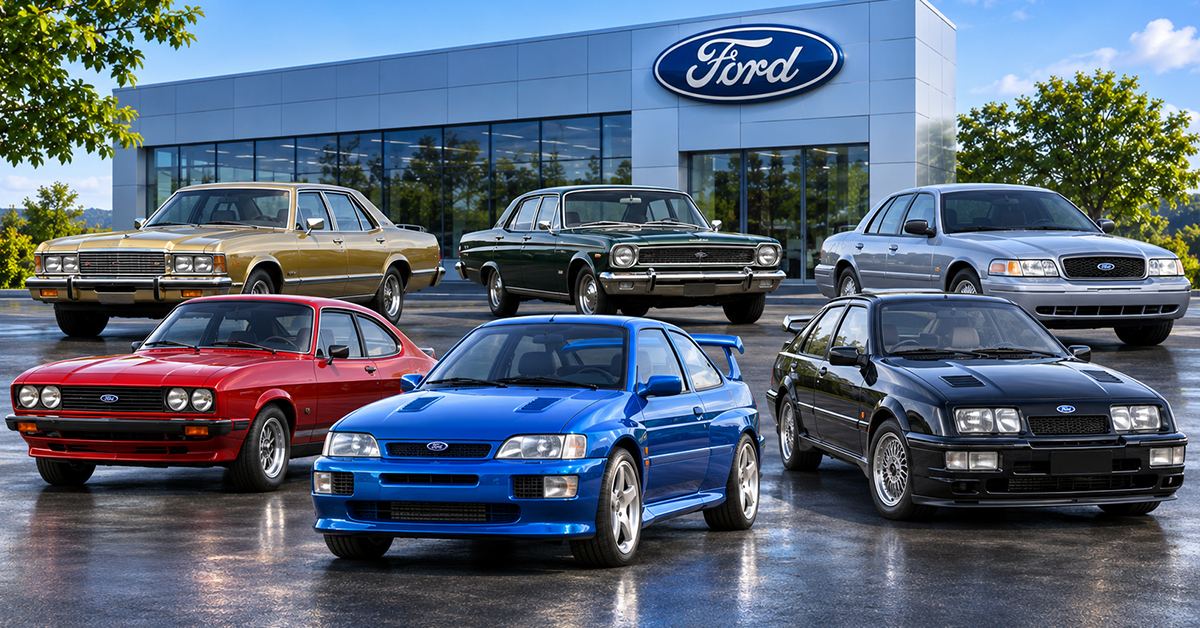
AI-generated concept illustration — Discontinued Ford models. | Rev N Rise
Discontinued Ford models from the Model T and Falcon to the Taurus, Fiesta, Focus, Mondeo, Galaxy, S-Max, Edge and Escape, with end dates, replacements and the reasons Ford gave, showing what Ford says and what is only reported.
Ford has ended many models over more than a century, and this article lists the main ones with their end dates and what followed. It is a hub for the individual model articles on this site, so each entry is short. Our Ford models article covers the range on sale now, and this article covers the models that are gone. We use Ford’s own pages where we found them and tag everything else as reported.
| Model T ended | May 26, 1927 (Ford) |
| Capri, first run ended | 1986 (Ford) |
| Crown Victoria ended | 2011 (Ford) |
| Taurus, last built | March 1, 2019, Chicago (Ford) |
| Mondeo ended | Phased out early 2022 (Ford) |
| C-Max Europe | End of June 2019 (Ford) |
| Fusion, two dates | July 31, 2020 or August 2020 (reported) |
| Fiesta, final car | July 7, 2023 (reported) |
| Edge, two dates | April 26, 2024 or early May 2024 (reported) |
| Escape, final car | December 17, 2025 (reported) |
The ends fall into a few waves. The first is the classic era, from the Model T in 1927 to the Falcon in 2016. The second is the North American car exit announced in 2018, which led to the end of the Focus, Taurus, Fiesta and Fusion there. The third is Europe’s clear-out from 2019 to 2023, covering the C-Max, Mondeo, Fiesta, S-Max and Galaxy. The fourth is the 2024 to 2025 end of the Edge, the Escape and the first-generation F-150 Lightning.
The sources differ in quality, so we label them. Ford’s own pages cover the Model T, Capri, Crown Victoria, Taurus, Mondeo, C-Max, Edge and Lightning, which we tag (Ford). A Ford retrospective on the Flex is hosted on a financial data site, so we flag it. The dates for the Falcon, Fiesta, Fusion, EcoSport, Escape and Ka come from reports and reference histories, and we tag those as reported and name no outlet.
We count a model as discontinued when production of that nameplate ended in a region. Some names continue elsewhere. The Focus ended in North America in 2018 but was built in Europe until 2025, and the Capri name returned on an electric crossover. We note those cases in each entry. We found no Ford page that lists every discontinued model, so this list is our own selection from the Ford model articles on this site and some extra checks, and we make no claim that it is complete.
Dates are shown with their conflicts. Where two sources give different end dates, we show both, as with the Fusion in July or August 2020, the Edge in April or May 2024 and the EcoSport in 2022 or 2023. We do not choose between them unless Ford’s own page does. We also give no claim about collector values, remaining stock or how many of each model were built in total, because the pages we read do not give those numbers. Readers who need a figure for a purchase or a repair should use the linked model article and Ford’s own website, because the pages we read do not cover every market or model year.
The article is a snapshot as of November 2026. Ford has changed its plans several times since 2018, and models that are still on sale today may appear on a later list. Readers who need the current lineup should use Ford’s national website. Our Ford history article explains how the company reached each of these decisions, and the model articles linked below carry the full detail for each car. We give no claim about any figure we did not find on a page we could read, and the tables show a plain note where Ford gave us nothing to quote.
The Ford Model T is the oldest model on this list. Ford’s own pages say it was introduced in October 1908 and that production ended on May 26, 1927, after 19 years (Ford). Another Ford page calls the end a ceremony in May 1927 and the end of an era (Ford). An engineering-society record says the 15 millionth Model T marked the end, a touring car priced at 380 dollars (reported). Our Model T article covers the car, its price and the assembly line.
| Model T introduced | October 1908 (Ford) |
| Model T ended | May 26, 1927 (Ford) |
| Model T run | 19 years (Ford) |
| Thunderbird, line ended | 1997 (reported) |
| Thunderbird revival | 2002 to 2005 (reported) |
| Falcon, final car | October 7, 2016, Broadmeadows (reported) |
| Falcon ute, final | July 29, 2016 (reported) |
| Falcon run | 56 years, seven generations (reported) |
| Capri, first run | 1969 to 1986 (Ford) |
| Capri, total built | More than 1.8 million (Ford) |
The Thunderbird ended twice. A reference history says the line was redesigned and enlarged several times, downsized in 1977, 1980 and 1983 and ended in 1997, before a two-seat revival from 2002 to 2005 (reported). A fan site says Ford pulled the plug in September 1997 after more than four decades of continuous production, and a trade site quotes the Ford Division president saying the revival would stop after the 2005 or 2006 model year (reported). Our Thunderbird article covers the generations.
The Falcon ended in Australia. A reference history says production ran for 56 years and seven generations, ending at Broadmeadows on October 7, 2016, with a blue XR6 as the final car (reported). A motoring site says the Falcon ute ended earlier, on July 29, 2016, with a white XR6 after more than 55 years and almost half a million sales (reported). Our Falcon article covers the Australian car in full.
The Capri ended in 1986 and returned later. Ford says the first Capri was a front-engined, rear-wheel-drive sports coupe built by Ford of Europe from 1969 to 1986, which it calls the Mustang’s European cousin, and that production ended in 1986 with more than 1.8 million built (Ford). A reported production history gives 1,886,647 across all generations and says the last car left the Cologne line on December 19, 1986 (reported). Our Capri article also covers the electric return. Where two sources differ, we show both values and name the kind of source behind each, and we do not average them or pick the one that looks more likely.
These entries share a pattern. Each ended when the car no longer fitted the company’s plan, and each left a memory of a long run. The Model T ended after 19 years, the Falcon after 56 years and the Capri after 17 years in its first form, by our count from the 1969 and 1986 dates (our calculation). We found no Ford page for the Thunderbird and Falcon end dates, so those are tagged as reported. Readers who need a figure for a purchase or a repair should use the linked model article and Ford’s own website, because the pages we read do not cover every market or model year.
We found limits. Ford’s pages we read name no replacement for the Model T, and we give no claim about one. We found no Ford page on the Thunderbird or Falcon end dates, and we give no production totals for either. We also give no claim about the values of used classics. We give no claim about any figure we did not find on a page we could read, and the tables show a plain note where Ford gave us nothing to quote.
The Crown Victoria ended in 2011. Ford’s fleet release says Ford would offer a new Police Interceptor sedan when production of the Crown Victoria ended in 2011, maintaining its 15-year leadership in the police fleet market (Ford). Ford’s heritage post says that by 2011, with Ford still leading the market, it was time to replace the Crown Victoria, and the new Police Interceptor and Interceptor Utility went on sale in 2012 (Ford). Our Crown Victoria article covers the history and specifications.
| Crown Victoria, production ended | 2011 (Ford) |
| Police Interceptor on sale | 2012 (Ford) |
| Police fleet leadership | 15 years (Ford) |
| Thomas Assembly ended | Late 2011 (Ford) |
| Taurus, last built | March 1, 2019, Chicago (Ford) |
| Taurus, earlier ending | 2006, revived 2008 (reported) |
| Fusion, last built, two dates | July 31, 2020 or August 2020 (reported) |
| Fusion plant | Hermosillo, Mexico (reported) |
| 2018 plan, cars kept | Mustang and Focus Active (reported) |
| 2020 target, trucks and utilities | Almost 90 per cent (reported) |
The Taurus ended in 2019. Ford’s release says the last Taurus sedan rolled off the line at the Chicago Assembly Plant on March 1, 2019, marking the end of US production of the historic nameplate (Ford). A trade magazine says the Taurus briefly ended in 2006 and was revived as an all-new car in 2008, so the 2019 end is the second ending (reported). A police trade magazine said in April 2018 that 2019 would be the final model year for the Taurus and the Interceptor Sedan (reported). Our Taurus article covers all the generations.
The Fusion ended in 2020. A news report says the last Fusion rolled off the line at Hermosillo, Mexico on July 31, 2020, capping a run that began in 2006, and a Ford spokesperson is quoted saying Ford ended Fusion sedan production on July 31 (reported). A British magazine feature says production ended in August 2020, which conflicts with July 31, so we carry both (reported). Our Fusion article covers the hybrid and the final year.
All three belong to the 2018 plan. Reports quote Ford saying that given declining consumer demand and product profitability, it would not invest in the next generations of traditional Ford sedans for North America, and that the car portfolio would move to the Mustang and an all-new Focus Active crossover (reported). Reports say Ford expected almost 90 per cent of its North American portfolio to be trucks, utilities and commercial vehicles by 2020 (reported). We found no Ford page in the text we read that gives the original statement.
The Crown Victoria was different. It ended because of the Panther platform, which a reference history says it was the last car made on, sharing it with the Mercury Grand Marquis and the Lincoln Town Car (reported). A news feature says the platform ended with the Crown Victoria after the longest run of any American platform, with more than 9.6 million units sold (reported). Ford’s own pages we read say the Thomas Assembly plant in Ontario ended in late 2011 (Ford).
We found limits. We found no Ford page with the total number of Taurus or Fusion cars built, and we give no claim about it. We also give no claim about the reliability or resale value of these cars. Buyers of used examples should check the service history and the engine, since the hybrid Fusion and the police versions of the Crown Victoria and Taurus differ from the standard cars in wear and in equipment, and a dealer can confirm the specification. We give no claim about any figure we did not find on a page we could read, and the tables show a plain note where Ford gave us nothing to quote.
The Mondeo ended first in Europe. Ford’s March 2021 release says Mondeo production would be phased out in early 2022, and that since its 1993 launch Mondeo sales had reached about five million (Ford). A report says the final Mondeo for Europe rolled off the Valencia line on April 4, 2022, 29 years after the launch (reported). Ford’s 2021 release is the only Ford page we read that states the end directly (Ford). Our Mondeo article covers the car in full.
| Mondeo, phased out | Early 2022 (Ford) |
| Mondeo sales since 1993 | About five million (Ford) |
| Mondeo, final European car | April 4, 2022, Valencia (reported) |
| Fiesta, Europe end announced | Autumn 2022 (reported) |
| Fiesta, final car | July 7, 2023 (reported) |
| Fiesta, North America end | May 2019 (reported) |
| Focus, North America | Ended 2018 (Ford) |
| Focus, Europe | Production ends 2025 (reported) |
| Sierra run | 1982 to 1993 (reported) |
| Escort, Europe final | July 2000 (reported) |
The Fiesta ended in 2023. Reports say Ford announced in autumn 2022 that production would cease in the summer of 2023, with the last Fiesta built at Cologne by the end of June 2023 (reported). A trade site says the final car rolled off the line on Friday, July 7, 2023, so the actual last build came about a week after the announced date (reported). In North America, reports say Fiesta production ended in May 2019 at Cuautitlan, Mexico (reported). Our Fiesta article covers the 1976 original to the last one.
The Focus ended in two steps. Ford’s US page says the Focus ended in 2018 in North America (Ford). A report says Ford would end production of the then-current Focus in May 2018 and bring in a Chinese-built Focus Active (reported). Ford’s UK site says it has discontinued the Focus as a new model, and a report says European production would end in 2025 (Ford, reported). Our Focus article covers the generations and the final build.
Two older European cars also belong here. A reference history says the Sierra was a mid-size family car built by Ford of Europe from 1982 to 1993, replacing the Cortina and the Taunus and replaced by the Mondeo (reported). A trade site says all European Escort production moved to Halewood in 1998 and finally stopped in July 2000, and a German listing says the Focus took over in 1998 (reported). Our Sierra and Escort articles cover both.
The Ka had a split ending. A reference list says the original Ka went on sale in 1996 and stayed on the market for 12 years, followed by a second car built with the Fiat 500 (reported). A trade report says Ford began importing the Ka+ from India in 2016 and later ended European sales of it, in 2019, as part of its profit plan (reported). One source says the Ka ended in 2016 and another says 2019, which reflects the two different cars (reported).
We found limits. Ford’s pages we read give no final production totals for the Fiesta, Focus or Mondeo, and we give none. The Fiesta’s replacement in Europe is described in a reference list as the Puma, but we found no Ford page that says so, and we tag it as reported (reported). We give no claim about how the end of these cars affected Ford’s European market share, because the pages we read do not give it. We give no claim about any figure we did not find on a page we could read, and the tables show a plain note where Ford gave us nothing to quote.
The C-Max ended in Europe in 2019. Ford’s March 2019 release confirms the end of C-MAX and Grand C-MAX production at Saarlouis, Germany by the end of June 2019 (Ford). It says the Ford-Werke supervisory board approved ceasing production, as the models would be phased out at the end of their normal life cycle, and links the decision to the end of the night shift (Ford). The release is part of the Ford of Europe transformation strategy (Ford). Our C-Max article covers the Grand C-Max and the Energi.
| C-Max and Grand C-Max, Europe | End of June 2019, Saarlouis (Ford) |
| C-Max end reason | End of normal life cycle (Ford) |
| Galaxy and S-Max end | April 2023, Valencia (reported) |
| Galaxy first production | June 1995 (reported) |
| S-Max Car of the Year | 2007, 58 journalists (Ford) |
| Galaxy sold since launch | About 820,000 (reported) |
| S-Max sold since launch | About 570,000 (reported) |
| Galaxy sales, 2021 | 4,700 (reported) |
| S-Max sales, 2021 | 7,400 (reported) |
| Valencia jobs cut, report | 1,100 (reported) |
The Galaxy and S-Max ended together. A report quotes Ford saying it would discontinue S-MAX and Galaxy production in Valencia, Spain in April 2023 as it prepared for an electric future (reported). Reports say about 820,000 Galaxy and 570,000 S-Max cars had been sold across Europe since their launches, and that 4,700 Galaxy and 7,400 S-Max cars were sold in 2021 (reported). Ford’s March 2021 release said both models remained in production with full hybrid versions recently launched (Ford).
The Galaxy was the older of the two. A reference history dates its first production to June 1995 after a joint venture with the Volkswagen Group, while the S-Max went on sale in 2006 and won European Car of the Year 2007 (reported, Ford). Ford’s own release says the S-MAX was awarded Car of the Year 2007 by a panel of 58 journalists from 22 countries (Ford). Our Galaxy article covers the 1995 joint venture, and our S-Max article covers the hybrid.
The reasons are reported. They say sales of people carriers were dwindling as makers sought higher profit margins with SUVs and crossovers, and that Ford was moving to an electric future (reported). A Spanish report says the Galaxy would have no direct successor, and a March 2023 report says Ford planned to cut 1,100 jobs at Valencia as it ended the two models (reported). Ford’s own pages we read do not give the job figure.
A seven-seat Ford did continue in electric form. Ford’s European pages list the E-Tourneo Custom and the E-Tourneo Courier among its electric vehicles (Ford), and our Ford electric cars article covers them. We found no Ford page that names a successor to the Galaxy or S-Max, so we give no claim that the Tourneo models replace them, and we tag only the Ford lineup facts as Ford. The people-carrier market in Europe moved mostly to SUVs, according to reports (reported).
We found limits. Ford’s pages we read give no final production totals for the C-Max, Galaxy or S-Max, and we give none. We also found no Ford page that dates the last S-Max built, and we give no claim about it. Buyers of used examples should check the engine, because the diesel and hybrid versions differ in running costs and in the tax treatment of each market, and a Ford dealer can confirm the specification of a particular car. We give no claim about any figure we did not find on a page we could read, and the tables show a plain note where Ford gave us nothing to quote.
The Edge ended in 2024. Ford’s own Edge pages say it is the end of the road for Edge SUV production and add that Ford is still supporting the Edge and its other vehicles (Ford). A reported history says North American production ended on April 26, 2024 with no direct successor, while another report says the last one rolled off the line in early May 2024, so the date is disputed (reported). Our Edge article covers the 2007 debut to the final build.
| Edge, Ford pages | End of the road for Edge production (Ford) |
| Edge, last built, two dates | April 26, 2024 or early May 2024 (reported) |
| EcoSport, end, two dates | 2022 or 2023 (reported) |
| EcoSport, Ford final assembly listed | Chennai, India (Ford) |
| Escape, final car | December 17, 2025, Louisville (reported) |
| Escape, years in production | About 25 (reported) |
| Escape peak sales, 2017 | Over 308,000 (reported) |
| Louisville electric truck investment | Nearly 2 billion dollars (Ford) |
| Flex, end | Late November 2019 (reported) |
| Flex sales, 11 years | More than 296,000 (reported) |
The EcoSport ended in two steps. A reported history says production ended in 2022, although one reference gives 2023 (reported). It says the second generation was assembled in India, Thailand, Russia and Romania and that Ford ended production in Vietnam in early 2022 (reported). Ford’s 2019 US specification sheet lists final assembly at the Chennai plant in India (Ford). Our EcoSport article covers the Brazil start in 2003 and the last build.
The Escape ended in December 2025. Reports say the final Ford Escape rolled off the line at the Louisville Assembly Plant on December 17, 2025, after about 25 years, alongside the Lincoln Corsair (reported). A Ford spokesperson is quoted saying production would stop for the Escape and Corsair later in 2025 when the plant started retooling (reported). Reports say the Escape peaked at over 308,000 sales in 2017 and sold 132,471 through the first 11 months of 2025 (reported).
The Escape’s end links to the electric plan. Ford’s August 2025 release says Ford will invest nearly 2 billion dollars at the Louisville Assembly Plant to build a midsize electric truck, which Ford said would reach customers in 2027 (Ford). Reports say Ford is steering Escape shoppers to the Bronco Sport and the Maverick (reported). Our Ford electric cars article covers the Universal EV Platform and the Fathom pickup, which Ford’s Ford Pro page says is coming in 2027 (Ford).
The Flex ended in 2019. A Ford retrospective, hosted on a financial data site, says the Flex broke the mold and that Ford is aiming to replace 75 per cent of its portfolio by the end of 2020 (Ford). A Ford manager is quoted saying Ford would stop building the Flex at the end of November and that Lincoln MKT production ended earlier in the month (reported). A report says Ford sold more than 296,000 Flex vehicles in its 11-year run (reported). Readers who need a figure for a purchase or a repair should use the linked model article and Ford’s own website, because the pages we read do not cover every market or model year.
We found limits. The Escape and the Flex have no article on this site, so this section is the only place we cover them, and we found no Ford-owned page for either end date. The Flex retrospective is hosted off Ford’s own sites, so we flag it. We give no claim about the value of used examples or about the number of Escapes still in dealer stock, and we found no Ford page that says what replaces the Edge. We give no claim about any figure we did not find on a page we could read, and the tables show a plain note where Ford gave us nothing to quote.
Ford’s reasons changed by decade. In 2018 the reason given was declining demand for sedans and the profit of trucks and SUVs, according to reports of a Ford statement (reported). In Europe in 2019 Ford’s release linked the C-Max decision to a transformation strategy aimed at a sustainably profitable business (Ford). In 2022 the stated reason was the transition to an electric future (reported). In 2025 Ford’s plan stressed trucks, hybrids and affordable electric vehicles (Ford).
| 2018 plan scope | North American sedans (reported) |
| 2019 Europe step | C-Max and Grand C-Max (Ford) |
| 2022 Europe step | Mondeo phased out (Ford) |
| 2023 Europe step | Fiesta, S-Max, Galaxy (reported) |
| 2024 step | Edge ends in North America (reported) |
| 2025 step | Escape and F-150 Lightning (Ford, reported) |
| Crown Victoria replacement | Police Interceptor, 2012 (Ford) |
| Focus replacement, North America | Focus Active, China-built (reported) |
| Escape shoppers steered to | Bronco Sport and Maverick (reported) |
| Lightning successor | Extended-range electric truck (Ford) |
Ford’s December 15, 2025 plan is the latest turn. It says production of the current F-150 Lightning has ended and the next generation will be an extended-range electric truck built at the Rouge Electric Vehicle Center, and that Ford expects about 19.5 billion dollars in special items (Ford). It says that by 2030 about 50 per cent of Ford’s global volume is expected to be hybrids, extended-range electric vehicles and electric vehicles, up from 17 per cent in 2025 (Ford). Our Lightning article covers the original truck.
Some replacements are named by Ford. Ford says the Police Interceptor and Interceptor Utility replaced the Crown Victoria, and its 2019 release marks the end of US Taurus production at Chicago Assembly (Ford). Reports say the Chicago plant was retooled for the Explorer and the Michigan Assembly plant, which built the Focus, was retooled for the Ranger and Bronco (reported). We found no Ford page in the text we read that lists these moves in one place.
Other replacements are reported or only implied. A reference list names the Puma as the Fiesta’s successor in Europe, and a report says the Focus Active was imported from China for North America (reported). The Sierra gave way to the Mondeo, and the Escort to the Focus, according to reference histories (reported). The Galaxy, S-Max, Edge and Escape have no named direct successor in the pages we read, and a Spanish report says so for the Galaxy (reported).
The timeline shows a steady shrinking of the car range. The 2018 plan targeted North America, the 2019 and 2022 decisions targeted Europe, and the 2024 and 2025 decisions removed two crossovers and one truck generation. In the same period Ford added the Bronco, Bronco Sport, Maverick, Puma Gen-E, Explorer Electric and Capri Electric to its range, according to its own pages and our model articles. We give no total count of models added or removed, because the pages we read do not give one.
We found limits. Ford’s pages we read do not give a single list of discontinued models, and we found no Ford statement of how many nameplates it ended in any year. We give no claim about the profit effect of any of these decisions, because the figures in the pages we read are for whole programmes and not for single models. A reader who needs a certain model’s end date should use the linked model article and check the Ford page cited there. We give no claim about any figure we did not find on a page we could read, and the tables show a plain note where Ford gave us nothing to quote.
This list is a selection and not a full catalogue. We covered the models that have articles on this site and a few more, such as the Flex, the Ka and the Escape. We left out many Ford models that ended, including regional ones, trucks, vans and special editions, because we did not research them for this article. We found no Ford page that lists every discontinued model, so we make no claim that the list is complete.
| Ford pages found for | Model T, Capri, Crown Victoria, Taurus, Mondeo (Ford) |
| More Ford pages found for | C-Max, Edge, F-150 Lightning (Ford) |
| Reported dates only | Falcon, Fiesta, Fusion, EcoSport (reported) |
| More reported dates only | Escape, Flex, Ka, Sierra, Escort (reported) |
| Ford list of all ended models | No Ford page found |
| Total nameplates ended | No Ford figure found |
| Last S-Max built | No Ford date found |
| Fiesta production total | No Ford figure found |
| Profit effect per model | No Ford figure found |
| Next models to end | No Ford statement found |
Ford’s own pages cover only some of the end dates. We found Ford pages for the Model T, Capri, Crown Victoria, Taurus, Mondeo, C-Max, Edge and Lightning. The Falcon, Fiesta, Fusion, EcoSport, Escape, Flex, Ka, Sierra, Escort and Thunderbird dates come from reports and reference histories. A reader who needs an exact date should open the model article linked in the relevant section and check the source named there.
Source quality varies. We used Ford releases from Ford’s newsroom and media centre, a Ford retrospective hosted on a financial data site and Ford pages on its model websites, and we tagged those (Ford). We used trade, reference, classic-car and news reports only as cross-checks and tagged them as reported. Reports of Ford statements, such as the 2018 sedan plan, are tagged as reported because we did not find the original Ford page in text we could read.
Conflicts are shown, not resolved. The Fusion date, the Edge date, the EcoSport year, the Fiesta announcement and last-build dates, the Ka ending and the Galaxy launch month all appear with both values and their sources. Where the difference looks like a model-year or announcement versus last-build gap, we say so, but we do not pick one value unless Ford’s own page does. We never convert any date or figure unless a source does.
The article is a snapshot, and the list will change. Ford has changed its plans several times, and a model we treat as ended in one region may return in another, as the Capri did. Models announced for the future, such as the Fathom pickup, are covered in our Ford electric cars article and not here. We give no prediction of which models Ford will end next, because the pages we read give no basis for one. Readers who need a figure for a purchase or a repair should use the linked model article and Ford’s own website, because the pages we read do not cover every market or model year.
A reader should confirm key facts directly. The most important open questions are the exact last-build date of a given model, whether it continues in another region and which model Ford names as its replacement. We recommend the linked model article and the Ford page cited in it for those, and we give no claim about values of used cars, because those depend on condition, mileage and market and change often. We give no claim about any figure we did not find on a page we could read, and the tables show a plain note where Ford gave us nothing to quote.